Modern urban life cuts us off from direct connection with the animal world, yet daily the lives of millions of animals are affected by what we consume and wear and what we trade in. The use of animals for food, labour and pleasure pursuits has long been justified with the assumption that unlike humans, animals aren't fully sentient beings. In recent years, however, science has revealed an astonishing array of complex animal behaviour, and scientists and policy makers now accept that the animals we make use of are indeed conscious, with preferences and intentions. The implications for our culture of factory farming, fast food and rainforest liquidation are staggering. In this powerful book, internationally renowned experts on animal behaviour and agriculture such as Jane Goodall, Tim Lang and Vandana Shiva are brought together with ethicists, religious scholars, international industry and regulators for the first time to debate these critical issues and tackle the profound implications of animal sentience.
The first sections discuss scientific and ethical perspectives on the consciousness, emotions and mental abilities of animals. Later sections address how human activities such as science, law, religion, farming, food production, trade, development and education respect or ignore animals' sentience and welfare, and review the options for changes in our policies, our practices and our thinking. The result is nothing less than a stark and necessary look into the heart of humanity and the ethics that govern our animal powered society.
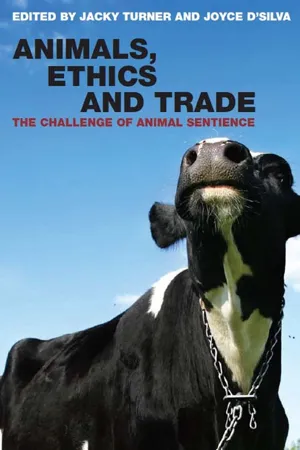
- 312 pages
- English
- ePUB (mobile friendly)
- Available on iOS & Android
eBook - ePub
About this book
Information
PART 1
Animal Sentience:
Evidence and
Interpretations
1
The Sentience of Chimpanzees
and Other Animals
Jane Goodall
Founder – The Jane Goodall Institute (JGI)
Chimpanzees’ lives
Chimpanzees, in many ways, serve as ambassadors from the animal kingdom to the world of humans – as a bridge between ‘man’ and ‘beast’. I began my study of the Gombe chimpanzees, living on the eastern shore of Lake Tanganyika, in Tanzania, in 1960. During the 46 years of continuous study since then, we have learned much of enormous significance, both for the understanding of chimpanzees and their complex society, and for the understanding of many aspects of our own behaviour and our relationship with the rest of the animal kingdom. Perhaps the most significant findings are those that show just how like us chimpanzees actually are.
First of all, there are the numerous physiological similarities between chimpanzees and us. The composition of chimpanzee and human blood is so similar that we could receive a blood transfusion from a chimpanzee. Their immune system is so like ours that they can catch or be infected with just about all known human contagious diseases. The structure of the DNA of chimpanzees and humans differs by only about 1 per cent and, now that the genome of the chimpanzee has been unravelled, it seems that the genetic similarity between us and them is even closer than was thought before. Most fascinating for me is the similarity in the structure, the anatomy, of the chimpanzee and human brain and nervous system. Thus it should not be surprising to find that these apes are capable of intellectual performances once thought unique to the human animal. It has been demonstrated in a variety of captive studies that they are capable of generalizing, abstraction and cross-modal transfer of information. They can understand and use abstract symbols in communicating. They can learn more than 300 of the signs used in American Sign Language (ASL) and can communicate with each other in this way as well as with their trainer. They are capable of self-recognition and can often understand the moods and needs of other individuals – in other words, they have a ‘theory of mind’.
As the Gombe research continued, I gradually got to know more and more of the approximately 50 individuals who made up the community I was studying. I named them, and learned that each had a unique personality. I soon realized that they had extremely complex social lives.
Chimpanzees have a large repertoire of calls, postures and gestures with which they communicate information about what is going on within and around them. They kiss, embrace, hold hands, swagger and tickle – just like we do, and often in the same context. They not only use but also make tools – an ability once thought to differentiate humans from the rest of the animal kingdom. And they use rocks and sticks as missiles, often demonstrating very accurate aim. Chimpanzees are capable of compassion and altruism on the one hand, and of violence and a kind of primitive warfare on the other.
Particularly striking are the long-term affectionate and supportive relationships between family members that can last throughout life (chimpanzees can live more than 60 years). There is a long childhood dependency of five or six years, during which the infant suckles, rides on the mother's back and sleeps in her nest at night. And then, when a new baby is born, the older child remains emotionally dependent on the mother for at least another three years and possibly longer. Even after that, he or she repeatedly returns to spend time with the mother and the younger siblings. Learning plays an important role in the acquisition of social and environmental skills. We now know that in different parts of Africa, wherever chimpanzees have been studied, they use different objects as tools, in different contexts. Chimpanzees, like humans, can learn to make and use tools not only by trial and error, but also through observation, imitation and practice – one of the anthropologists’ definitions of cultural behaviour.
Cooperation and altruism
The chimpanzees in the wild show sophisticated cooperation. This is particularly obvious during hunting and the sharing of the carcass after a kill. And our longitudinal study has yielded many striking examples of their capacity for caring and altruism. Let me share some of these stories. The first of these occurred when I was following a nine-year-old adolescent named Pom and her little three-year-old brother, Prof, along a forest trail. Suddenly Pom stopped and stared at a place along the trail ahead. Her hair bristled and she gave a tiny ‘huu’ of fear and ran up a tree. Prof continued along the trail. Perhaps he didn't hear the sound she made; perhaps he didn't know what it meant. As he got closer and closer to the place along the trail, his sister became more and more agitated. A huge grin of fear appeared on her face, every hair bristled and finally she rushed down the tree, gathered up her little brother and climbed back up the tree with him. There, coiled up at the side of the trail, was a big poisonous snake.
The second example concerns Madam Bee, an old female who became a victim of what was probably poliomyelitis. She lost the use of one arm and found it tiring to travel long distances between one food source and another. On several occasions when she arrived at a large fruit tree with her elder daughter, Little Bee, she lay on the ground while Little Bee climbed up to feed. Then, after feeding for ten minutes or so, Little Bee stuffed as much food as she could in her mouth, took some more in her hand, climbed down and laid the food in her hand beside her old mother. The two sat together feeding.
One example of true altruism at Gombe occurred when three-and-a-half-year-old Mel lost his mother. As mentioned, chimpanzee youngsters in the wild suckle until they are five or six years old – but they can survive on solids from about three years old. If Mel had had an older brother or sister, he would have been adopted, carried around and protected by that elder sibling. But Mel had no elder sibling and it seemed unlikely that he could survive. Then, to our amazement, a 12-year-old adolescent male, Spindle, adopted him. Spindle carried Mel on his back and let him cling to his belly if Mel was frightened or cold. He shared his food with Mel when the infant begged, and gathered him into his nest at night. When the adult males challenge one another for social dominance, performing wild displays, hurling rocks and branches, mothers quickly take their infants out of the way. Males have been known to throw or drag infants who get in the way. If Mel got too close to the adult males on such occasions, Spindle would run to rescue Mel, though he risked being buffeted himself, and sometimes was. Yet usually adolescent males are extremely cautious when in the vicinity of the big males when they are socially aroused, and keep well out of the way. It is without question that Spindle saved Mel's life.
In some zoos chimpanzees are kept on islands or exhibits surrounded by water-filled moats, since they do not swim. There are examples of chimpanzees risking their lives to try to save companions from drowning when they accidentally fall into the water. One adult male died when trying to rescue a drowning infant.
The implications for ethology
It was because of the striking physiological similarities between humans and chimpanzees that science seized upon chimpanzees as the ideal model for the study of certain human diseases – especially those that do not affect most laboratory animals. Yet at the same time, science was reluctant to admit to the equally striking ways in which chimpanzees resemble us intellectually, behaviourally and emotionally. Thus hundreds of chimpanzees were doomed to imprisonment in sterile lab cages just 5 feet square and 7 feet high. It was only after I had been a year in the field, when Louis Leakey got me into a PhD programme at Cambridge University (though I had no degree of any kind), that I first began to understand the bitter struggle between those who believe that animals can be exploited, used and abused in ways that might be of some benefit to the human species, and those who believe passionately that animals should be given certain rights that would protect them from such exploitation. At that time, in the early 1960s, many ethologists maintained that the behaviour of all animals – except the human animal – was little more than a series of genetically coded responses to sensory stimuli. To attribute human-like behaviour to non-human animals was to be guilty of anthropomorphism.
So, when I got to Cambridge I quickly found that I had done everything wrong. It would have been more scientific to identify the chimpanzees by numbers rather than names. And I could not talk about personality, mind or emotions in animals, since these things were unique to us – to the human animal. And even if they were present in animals, this could not be proved and so was best not talked about. Fortunately, throughout my childhood, I had had a wonderful teacher who had taught me that animals truly did have personalities, minds and feelings – and that was my dog, Rusty. So I was wary of accepting simplistic, reductionist explanations of complex behaviour. Luckily, at Cambridge I had a wise thesis supervisor, Robert Hinde, who taught me how to express my revolutionary ideas in a way that would save me from much hostile scientific criticism. (For example, I could not say ‘Fifi was jealous’ since I could not prove this, but I could say ‘Fifi behaved in such a way that, had she been human, we would say she was jealous’!)
Since the Gombe study began in 1960, more and more biologists have gone into the field and started long-term studies on all manner of animal species: apes, monkeys, elephants, whales, dolphins, wolves, rodents, birds and so on. And these studies taken together have shown that animal behaviour is far more complex than originally admitted by science. We find that we are not alone in the universe; we are not the only beings capable of love and hate, joy and sorrow, fear and despair. We are not the only creatures with minds capable of solving problems. And certainly we are not the only animals to experience pain and suffering. In other words, there is no sharp line between the human animal and the rest of the animal kingdom. It is a blurred line, and becoming more so all the time. This has been clear to many eastern philosophies and religions, to the indigenous people around the world, and to thousands of ordinary people who have shared their lives, in meaningful ways, with dogs, cats, rabbits, horses and other animals brought into the home, living with the family.
Humans are indeed unique – for one thing we have an extraordinarily well developed intellect. I believe that the key factor in the development of this intellect was the emergence, at some point in human prehistory, of sophisticated spoken language. For this enables us to teach our children about objects and events not present, to learn from the distant past, to make plans for the distant future and to discuss an idea so that it can grow from the accumulated knowledge of a group of people. Our intellect has enabled us to develop truly astonishing technologies. We have been to the moon, we have invented modern electronic communications and computers that can play chess – the list is never ending. But being clever does not equate with being wise. Scientists feel the need to prove everything before they can admit to its truth. But sometimes this is not the best route. Common sense suggests that if, when an animal is wounded, it screams, tries to escape and shows other signs of distress, it is probably experiencing pain in much the same way as we would in a similar circumstance. When dog owners sense that their dogs are contented or sad, depressed or joyous, they are probably right. And even if there is only a possibility that animals are feeling as some of us believe that they feel, then they should surely be given the benefit of the doubt. We should not let the objectivity of the scientific method override human intuition, human compassion.
Farm animals
The blurring of the line between animals and humans raises for many people a range of ethical issues related to the ways in which we use and abuse animals for so many purposes all around the world. One such issue relates to the raising of animals for food in factory or intensive farms.
I was introduced to many farm animals when I was a child. In fact it would be true to say that I started my scientific career in a hen house! When I was four and a half years old I spent a holiday on a farm in the country. My family lived in London where the only animals around, other than our dog, were pigeons and sparrows. So seeing cows and pigs and horses out in the fields, and meeting them close up, was very exciting. One of my jobs was to collect the hens’ eggs. There were no battery farms in those days and the hens were laying their eggs mostly in little wooden hen houses. Each day I put these eggs into my basket and after a while I began to wonder where, on the hen, was there a hole big enough for the egg to come out from? I examined the hens very closely but was unable to see such a hole. Apparently I then began asking everyone ‘Where does the egg come out?’, but without getting an answer that satisfied me. So when one afternoon I saw a hen going into one of the henhouses, and thinking, I suppose, that she was going to lay an egg, I crawled after her. Of course, this was a mistake. The hen, scared, flew off with squawks of fear.
Realizing that other hens would probably avoid that particular hen house, I climbed into an empty one, hid in the straw at the back and waited – and waited, and waited – until finally a hen came in. I can still remember seeing the slightly soft white egg plop onto the straw. Meanwhile my family had no idea where I was and, after searching all over, finally called the police. My mother, still searching, suddenly saw an excited little girl, covered in straw, rushing towards the house. Instead of getting mad at me for frightening everyone, she sat down to hear the story of how a hen lays an egg. When I look back on that incident, I realize that I showed all the hallmarks of a budding scientist. I was curious, I asked questions. The answers did not satisfy me so I decided I had to find out for myself. My first attempt failed, so I tried another method. And I learned that the most valuable attribute was patience.
Habituating an animal to human presence is tremendously important when you go out in the field. My first experience was when I was about eight years old, and on another wonderful holiday in the country. Close to where we were staying was a field of saddleback pigs. I remember climbing over the gate and moving slowly towards them – but they ran off. We were there for two weeks, and every day I went back to the field after lunch with an apple core. At first I put the offering on the ground as near to the pigs as I could get, and moved away a bit to watch. After a few days one pig approached and took the apple core, and eventually, to my great deligh...
Table of contents
- Cover Page
- Half Title page
- Title Page
- Copyright Page
- Contents
- List of Contributors
- About This Book
- List of Acronyms and Abbreviations
- Introduction
- Part 1 Animal Sentience: Evidence and Interpretations
- Part 2 Ethics, Law and Science
- Part 3 Implications for Farming and Food Production
- Part 4 Animal Sentience in International Policy
- Annex: Further contributions to the conference ‘Darwin to Dawkins: The Science and Implications of Animal Sentience’
- Index
Trusted by 375,005 students
Access to over 1.5 million titles for a fair monthly price.
Study more efficiently using our study tools.
Frequently asked questions
Yes, you can cancel anytime from the Subscription tab in your account settings on the Perlego website. Your subscription will stay active until the end of your current billing period. Learn how to cancel your subscription
No, books cannot be downloaded as external files, such as PDFs, for use outside of Perlego. However, you can download books within the Perlego app for offline reading on mobile or tablet. Learn how to download books offline
Perlego offers two plans: Essential and Complete
- Essential is ideal for learners and professionals who enjoy exploring a wide range of subjects. Access the Essential Library with 800,000+ trusted titles and best-sellers across business, personal growth, and the humanities. Includes unlimited reading time and Standard Read Aloud voice.
- Complete: Perfect for advanced learners and researchers needing full, unrestricted access. Unlock 1.5M+ books across hundreds of subjects, including academic and specialized titles. The Complete Plan also includes advanced features like Premium Read Aloud and Research Assistant.
We are an online textbook subscription service, where you can get access to an entire online library for less than the price of a single book per month. With over 1.5 million books across 990+ topics, we’ve got you covered! Learn about our mission
Look out for the read-aloud symbol on your next book to see if you can listen to it. The read-aloud tool reads text aloud for you, highlighting the text as it is being read. You can pause it, speed it up and slow it down. Learn more about Read Aloud
Yes! You can use the Perlego app on both iOS and Android devices to read anytime, anywhere — even offline. Perfect for commutes or when you’re on the go.
Please note we cannot support devices running on iOS 13 and Android 7 or earlier. Learn more about using the app
Please note we cannot support devices running on iOS 13 and Android 7 or earlier. Learn more about using the app
Yes, you can access Animals, Ethics and Trade by Jacky Turner,Joyce D'Silva in PDF and/or ePUB format, as well as other popular books in Biological Sciences & Ecology. We have over 1.5 million books available in our catalogue for you to explore.