- 208 pages
- English
- ePUB (mobile friendly)
- Available on iOS & Android
eBook - ePub
About this book
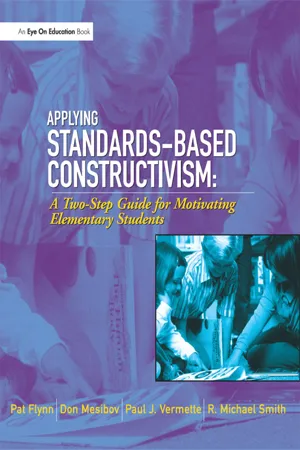
This book provides teachers with practical ways of constructing lessons that will engage students and help them develop personal responsibility for their own learning.
Information
1
Relationship
Between Standards
and Constructivism
Between Standards
and Constructivism
Examples of Constructivist–Based Standards
♦ The students will demonstrate map skills by constructing simple maps using title, map, legend, and compass. (Virginia Standards of Learning—Social Studies, grade 2)
♦ The student is expected to demonstrate that electricity can flow in a circuit and can produce heat, light, sound, and magnetic effects. (Texas Essential Knowledge and Skills—Science Concepts, grade 5)
♦ Student demonstrates application of appropriate science process/inquiry skills (i.e., question, observe, use simple equipment and skills, use evidence to develop reasonable explanations, design and conduct simple scientific investigations and explanations) to solve problems and/or address issues. (Kentucky Student Performance Standards—Science, grade 4)
♦ Students will understand mathematics and become mathematically confident by communicating and reasoning mathematically, by applying mathematics in real-world settings, and by solving problems (New York State Learning Standards and Performance Indicators, elementary level.)
♦ Students speaking demonstrates a command of standard American English and organizational delivery strategies. (State of California English Language Arts Content Standards, grade 2.)
These standards (above) are representative of what states are requiring across the nation. The key word (either expressed or implied) is demonstrate. How can students demonstrate what they know and can apply competently while sitting passively in a classroom and taking an occasional short answer/essay test? State standards call for teaching practices based on constructivist theory about how people learn.
Constructivism and Standards
There is growing recognition that effective teachers are people who are becoming guides on the side rather than sages on the stage. This is much easier to say, than to do. To become a guide on the side requires expertise with group work, performance tasks, reflective activities, and a variety of teaching strategies that most of us did not observe when we were students, and most of us have not been taught to teach. For the past twenty years, we (the authors) have worked with teachers and future teachers, on a daily basis, striving to assist them on their journey toward shifting from a teacher centered to a learner centered approach. What have we learned?
When we find teachers who are comfortable with even one of the strategies required to conduct a learner centered classroom (cooperative learning, performance tasks, authentic assessment, journaling, etc.), they always have the same story to tell. They have worked at least three years to achieve a comfort level with the strategy, they had someone as a collaborator (a friend, spouse, or teacher down the hall), they gradually changed their approach to teaching, it did not happen overnight, and there was a great deal of trial and error.
It is with reverence for the many caring educators who will read this book, and a deep appreciation of the difficult journey to improve teaching by aligning classroom practices with constructivist theory of how people learn that we now share a “Two Step” model that we hope will make this journey easier. Our model is based on three simple concepts that will be explained throughout this book:
1. Student engagement with information must precede teacher explanations.
2. Instruction (guidance) should come in the form of interventions as students engage with information, ideas, and concepts.
3. Authentic tasks create an environment for student engagement and teacher interventions.
The approach, throughout this book is to model what we are asking teachers to do in the classroom. Since we believe that every lesson should be focused on specific learning objectives (derived from local, state, or national standards), we begin chapter 1, section 1 with a statement of our learning objectives for you as you read this section. At the end of each section you will find an assessment question that is designed to challenge you to see whether you have grasped the learning objective.
Learning Objective
The reader will understand that the author views constructivism as a theory that can be applied to help learners address specific standards. Constructivism IS NOT a vehicle for allowing students to decide what is to be taught; rather it enables students to learn more effectively whatever is being taught.
Main Points
♦ State and provincial standards are effectively addressed by applying constructivist theory.
♦ While the Two-Step is consistent with other models, it has advantages: it increases understanding, motivates students to learn, and it is teacher-friendly for classroom application.
Many state and provincial standards, across the United States and Canada, cannot be addressed without using constructivist teaching strategies. This book is about authentic task constructivism in a standards-based environment. In this chapter we will: 1) begin to discuss the impact of constructivist teaching strategies on student motivation, 2) address the correlation between standards and constructivism, and 3) introduce the concept of the Two-Step as a teacher-friendly framework for constructivism in the classroom. In later chapters we will challenge the commonly held belief that there is no role for lectures in a constructivist environment and, similarly, we will argue that simply because an activity is interactive doesn’t mean it is constructivist.
Student Motivation
In 1960, a teacher might have resorted to one of the following threats to assure attentiveness from a student: “Your grade will suffer,” “I may have to call your parents.” “One more word and I’ll send you to the office.” “Listen up, the test is tomorrow.” While it is questionable whether this approach was ever the best way to teach for understanding, it did succeed in achieving a reasonable degree of classroom decorum and an acceptable number of passing students. Not anymore.
In 2003, teachers are concerned about students “who just don’t listen.” The number of children who come to school unprepared, with little or no homework attempted, increases each year, discipline is harder to maintain, and parental support may be lacking, particularly for those students having the most difficulties.
To the rescue comes constructivism, a theory of how people learn, it traces its resurgence to Piaget (1970s) after lingering in the background since the early 1900s when Thorndyke’s behaviorist ideas won out over Dewey’s more constructivist approaches. Constructivism is far from a cure all, but a growing number of professional educators are recognizing that teaching strategies, grounded in constructivist theories of how people learn, may hold the potential to: reduce discipline problems; enable teachers to challenge students who have a wide range of abilities, interests, and intelligences; be a vehicle for multiple assessments of student performance; challenge students to utilize higher level thinking skills well beyond simple recall of information; promote intrinsic motivation; and become the primary vehicle for standards-based teaching practices
Constructivist Theory and State Standards
Constructivism is a theory about how people learn, not what they should learn. Constructivist theory indicates we need to engage with information in order to understand it, and we need to understand in order to apply it competently. At the outset, we need to be as clear as we can that what we are espousing is constructivism in a standards-based environment as identified in states’, districts’, and provinces’ learning standards and core curricula. The curriculum content—what is to be taught—is a given, as are the standards of performance that are to be used to judge competence.
A Virginia standard for grade 2 social studies requires, “The students will demonstrate map skills by constructing simple maps using title, map legend, and compass.” In Ontario, by the end of Grade 1, students will demonstrate awareness that structures have distinctive characteristics; by the end of Grade 4, students will demonstrate an understanding of the characteristics of pulleys and gears; by the end of Grade 5, students will demonstrate an understanding of the effect of forces acting on different structures and mechanisms.
How can students demonstrate, if they are sitting passively listening to a teacher? How can anyone demonstrate without engagement? In New York and California, where the word demonstrate is not used, it is often implied: A California science standard for grades 3 through 5 requires students to “...develop their own questions and perform investigations.” A New York State math, science, and technology standard requires that, “Students will (demonstrate how they can use) mathematical analysis, scientific inquiry, and engineering to pose questions, seek answers, and develop solutions.”
Standards are about what students know, are able to do, and are able to create. This book is about pedagogy—teaching strategies for enabling students to demonstrate what they know and can do and can create.
All the contours, nooks, and crannies of our brand of constructivism will be explored in detail in the various chapters of the book. For now, let’s just say that constructivism is based on a body of research that supports the position that understanding can’t be poured from one person’s head to another’s like water—that each of us creates our own picture of the world and how it works through our personal engagement with it. As a teacher or parent, what we can do is provide structure and guidance for our children’s journey to construct meaning from their environment and experiences.
Primarily, I will be dealing with a Two-Step model for developing lesson plans which enable teachers to employ constructivist teaching techniques and practices. The Two-Step is consistent with models that may be familiar to you such as those developed by Madeline Hunter, Robert Marzano, Jay McTighe, and Grant Wiggins, and others. However, the Two-Step may address aspects of understanding beyond what other models have to offer while also lending itself to easier and more practical classroom application. A comparison of the Two-Step with five models is in Appendix B.
The Two-Step
The authors offer this book with the expectation that effective teachers will find nuggets for integration in their practices whether they utilize the Two-Step as a framework for lesson or unit design, or whether they adapt aspects of the Two-Step—such as beginning each lesson with student engagement, ending each lesson with a closure activity that elicits comments from most if not all students, forcing student thinking through active engagement with information, or integrating reflection as an essential classroom strategy.
State and district learning standards were created from a vision of a desirable future. This book is devoted to inventing ways of helping professional educators and parents bring that future into being.
Thoughts for Reflection
“That grinding sound you hear is a paradigm shift without the clutch.” (Dilbert/Scott Adams)
End of Section Assessment
Can the reader offer a brief articulation of the distinction between constructivism and standards for student learning?
Understanding Requires Engagement
Learning Objective
The reader will come to appreciate that engagement is essential and that it creates the environment that nurtures learning; engagement affords us the opportunity to demonstrate what we have learned. Two-Step lessons generate engagement.
Main Points
♦ You remember things (including facts for a test) best when you are actively engaged in learning them.
♦ You can draw conclusions from what you have learned and can take effective actions based on what you have learned only if you are actively engaged in your learning.
♦ The Two-Step teaching model gives the teacher a practical way to ensure that students are engaged in what is being taught.
“Demi,” at the age of three, “learned his letters with his grandfather, who invented a new mode of teaching the alphabet by forming the letters with his arms and legs, thus uniting gymnastics for head and heels” (Alcott, 1868).
What Louisa May Alcott knew in 1868, and researchers, according to Roger Johnson, have told us for more than 200 years, professional educators are only now coming to accept: Understanding comes from active en...
Table of contents
- Cover
- Title Page
- Copyright Page
- Table of Contents
- Preface
- Concept Map
- Acknowledgements
- 1 Relationship Between Standards and Constructivism
- 2 The Components of the Two-Step
- 3 How We Learn Guides How We Teach
- 4 How Constructivism Differs from Traditional Models: A Practical Application for Teachers, Administrators, and Students
- Appendix A
- Appendix B
- References
Trusted by 375,005 students
Access to over 1.5 million titles for a fair monthly price.
Study more efficiently using our study tools.
Frequently asked questions
Yes, you can cancel anytime from the Subscription tab in your account settings on the Perlego website. Your subscription will stay active until the end of your current billing period. Learn how to cancel your subscription
No, books cannot be downloaded as external files, such as PDFs, for use outside of Perlego. However, you can download books within the Perlego app for offline reading on mobile or tablet. Learn how to download books offline
Perlego offers two plans: Essential and Complete
- Essential is ideal for learners and professionals who enjoy exploring a wide range of subjects. Access the Essential Library with 800,000+ trusted titles and best-sellers across business, personal growth, and the humanities. Includes unlimited reading time and Standard Read Aloud voice.
- Complete: Perfect for advanced learners and researchers needing full, unrestricted access. Unlock 1.5M+ books across hundreds of subjects, including academic and specialized titles. The Complete Plan also includes advanced features like Premium Read Aloud and Research Assistant.
We are an online textbook subscription service, where you can get access to an entire online library for less than the price of a single book per month. With over 1.5 million books across 990+ topics, we’ve got you covered! Learn about our mission
Look out for the read-aloud symbol on your next book to see if you can listen to it. The read-aloud tool reads text aloud for you, highlighting the text as it is being read. You can pause it, speed it up and slow it down. Learn more about Read Aloud
Yes! You can use the Perlego app on both iOS and Android devices to read anytime, anywhere — even offline. Perfect for commutes or when you’re on the go.
Please note we cannot support devices running on iOS 13 and Android 7 or earlier. Learn more about using the app
Please note we cannot support devices running on iOS 13 and Android 7 or earlier. Learn more about using the app
Yes, you can access Applying Standards-Based Constructivism by Pat Flynn,Don Mesibov,Paul Vermette in PDF and/or ePUB format, as well as other popular books in Education & Education General. We have over 1.5 million books available in our catalogue for you to explore.