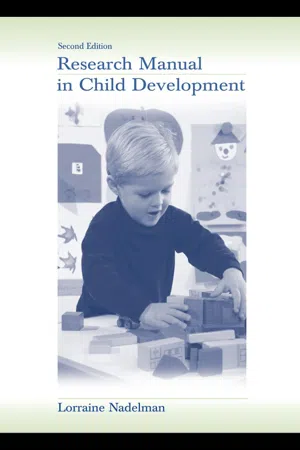
This unique hands-on lab manual in child development provides great ideas and resources for teaching research courses involving child subjects. It includes projects in psychomotor/perceptual, cognitive, and social development. Projects are preceded by background essays on the history of that topic, related research, theoretical issues, and controversies. Each project has hypotheses to test, detailed procedures to follow, all stimuli, individual and group data sheets, empty tables, suggested statistics, discussion questions, and an updated bibliography.
Special features of this second edition:
*The introductory text portion details research considerations, including an introduction to psychological research, sections on developmental research, children as subjects, and general experimental research procedures.
*The popular Infant Observation project has the student visit homes with babies for a semester and provides practice in observational data collection, reliability assessment, and report writing.
*The cognitive development section includes two new subfields: Theory of Mind and Language--Children's Interpretation of the Word Big, in addition to classic studies of Piaget's spatial perspective-taking and attention and memory. The final chapter describes a suggested neuropsychological project.
*The socialized child section includes a new study on sibling relationships as seen by the older or younger sibling, in addition to the earlier projects on self-esteem, sex identity, and cooperation-competition. The final section describes a suggested cross-cultural interview project.
- 480 pages
- English
- ePUB (mobile friendly)
- Available on iOS & Android
eBook - ePub
Research Manual in Child Development
About this book
Information
Publisher
Psychology PressYear
2003Print ISBN
9780805840414
9781138410404
Edition
2eBook ISBN
9781135640866
PART ONE
INTRODUCTION—RESEARCH
CONSIDERATIONS
A
A Primer of Scientific Research
SECTION 1
AN INTRODUCTION TO PSYCHOLOGICAL RESEARCH
Robert Wozniak
When Sara, a 3-month-old infant, accidentally brushes a rattle with her hands, the sound that follows surprises her. For a small baby, events such as this are unpredictable and unknown. A few months later, when Sara sees the rattle, picks it up, and shakes it to hear the noise, she has brought a bit of order into her world. She has learned to relate a visual experience, an action, and feelings of grasping and shaking to the occurrence of a sound.
To “know” is to construct such relationships between events; and to “understand” is to fit such relationships into more comprehensive organized systems. Thus, although 7-month-olds may be aware of rattles and rattling sounds, they will not really understand much about them for some years. They will not, for example, connect the relationship between the rattle and the sound it makes to knowledge of a general class of sounds made by hollow containers that enclose loose objects. Yet, eventually, despite the fact that they may never see a rattle that has been broken open, they will come to think of a rattle as a hollow container enclosing a number of very small objects that produce their characteristic sound by bouncing off the walls of the container. The simple relationship between the visual image, the motion of a baby’s arm, the feeling of the rattle in her hand, the feeling of movement, and the resulting sound, will become embedded in a complex system of relationships (much broader, of course, than that just described). Then the child may be said to “understand” something about the occurrence of the rattling sound. Often the level of this understanding continues to increase well into adulthood. It may quite possibly increase for the rest of the person’s life (if, for example, the individual becomes an expert in acoustics) as the simple relationship is continually incorporated into wider and wider systems of knowledge.
What each of us as individuals does on a personal level, science attempts to achieve on a transpersonal level. The goals of science will be to “know” the event: to relate its occurrence to the occurrence of other events that accompany it, a process generally termed description; and to “understand” the event: to incorporate these descriptive relationships into the systematically organized body of knowledge about such occurrences that the science already possesses. Only this will allow the scientist to explain why certain accompanying conditions and not others are those under which the phenomena of interest appear. The building of a systematic body of knowledge requires both description and explanation.
Method—The Means to Achieving Understanding
Although, in practice, there is variation among the sciences in the way in which knowledge and understanding are achieved, there are, nonetheless, general characteristics of the scientific approach that show up in one way
or another in the work of all scientists. These are outlined briefly here, and then each of the key elements of the process is discussed individually in more detail.
In general, scientists begin with a question concerning the conditions surrounding the occurrence of some phenomenon that they do not yet understand. In research in child development, as a rule, such questions arise from one of three sources: (a) the observation of children’s activity; (b) implications drawn from theoretical statements; or (c) logical or methodological criticism of previous research.
After a question has been identified, the researcher generally proceeds to review the information already available concerning the phenomena with which the question is involved. When the available information is the product of observation, it is referred to as data. From a review of the available data, the researcher formulates a descriptive statement or hypothesis concerning the conditions under which the phenomena of interest might be regularly observed.
Hypotheses usually lead to investigation, that is, to further observation designed to determine whether the phenomena of interest will appear under the conditions specified by the hypothesis. Investigation generates new data; from data the scientist draws conclusions about the suitability of the hypothesis. This may lead to the acceptance, rejection, or, most often, reformulation of the hypothesis.
The process of reformulation typically continues until the hypothesis has been so stated that further data repeatedly suggest that the hypothesis is a fair statement of the conditions under which the phenomena can be observed. When this occurs, the hypothesis attains the status of law; furthermore, when in the course of the development of a science a number of laws have been articulated concerning interrelated phenomena, then a theory concerning the relationship among these laws may be constructed. The theory, if it is well formulated, in turn suggests new combinations of conditions under which particular phenomena ought to be observable (i.e., new hypotheses may be formulated), and the process begins anew with the important additional characteristic that now the evaluation of hypotheses also implies the acceptance, rejection, or modification of a theory.
Questions and Their Sources
The starting point of any program of research is the articulation of a question. A psychological question is a statement concerning the occurrence of some mental or behavioral event that ought to be incorporated into the systematic body of psychological theory but for which the psychologist is unable to give a satisfactory psychological explanation.
- Direct observation. Perhaps the best source of questions for the researcher interested in children is the direct observation of children’s activity, although interesting scientific questions about children may also originate from other sources (see below). Sometimes, formulating these questions requires naturalistic observation of children in the everyday environment. Often, however, the activity of children in the controlled setting of the experimental laboratory itself yields important and interesting questions for investigation.
- Implications from theory. A second source of psychological questions is theory. The nature and role of theory in psychology will be discussed later. For now, it is sufficient to note that theories are systems of interrelated statements concerning classes of phenomena and their relationships. Theories are attempts to understand.
The nature of theory is such that it must have implications that are testable. It must yield statements of the form—if A, then B. Theory must suggest that one or another phenomena, previously unobserved in a particular context, will occur given some set of conditions. It must, in other words, generate questions for research. Indeed, this is one of the characteristics of good theory. All things being equal, the more a theory is productive of research questions, the better the theory.
One important point that must not be overlooked in research on children is that theory, which is neither good nor bad in and of itself, is but a tool for the understanding the child. Consequently, theory-generated research questions should be tied closely to the original phenomena that the theory set out to explain.
When the results of investigations suggested by a theory are interpreted, they should be interpreted with an eye to implications for understanding the original phenomena that prompted the theory to begin with.
Keeping this in mind helps the researcher resist the temptation to let theory replace the child as the subject of research. - Revision and extension of prior research. Research questions may also be generated by logical or methodological criticism of previous research. An important variable may have been inadequately controlled or overlooked. An interpretation that does not follow from the data may have been offered or alternative interpretations slighted. An overly specific set of experimental conditions may have been employed and the results generalized to too wide a context. Such occurrences typically suggest questions that need to be answered before the conclusions of the original research can be accepted.
Review of the Available Data and Formulation of Hypotheses
When a particular question has been selected, the researcher proceeds to gather whatever information is known about the phenomena in question. This information may come from any of several sources: (a) published journals and books; (b) unpublished sources such as master’s theses, doctoral dissertations, convention papers, and unpublished manuscripts; (c) personal communication with coworkers in the area; and (d) experience with one’s own previous research.
Published Sources. Journals that publish the results of child development research on a wide variety of topics and ages include Child Development, Developmental Psychology, Monographs of the Society for Research in Child Development, British Journal of Developmental Psychology, International Journal of Behavioral Development, Journal of Experimental Child Psychology, Journal of Genetic Psychology, Genetic Psychology Monographs, Human Development, and Merrill-Palmer Quarterly. More specialized journals focus on narrower ranges of topics or particular periods of development. These include Infancy, Infant Behavior and Development, Journal of Child Language, Journal of Family Psychology, Early Education and Development, Developmental Neuropsychology, Journal of Applied Developmental Psychology, Cognitive Development, Journal of Cognition and Development, Journal of Clinical Child Psychology, Development and Psychopathology, Journal of Research on Adolescence, and Social Cognition. In addition, the Society for Research in Child Development publishes a valuable reference work entitled Child Development Abstracts and Bibliography, which provides subtopical indexes of newly published books and articles in child psychology. See THREE D for a description of information retrieval systems.
Unpublished Material. Information relevant to the researcher’s question may also reside in unpublished sources such as dissertations, convention papers, and unpublished manuscripts. Dissertations are usually abstracted and indexed in a reference manual entitled the Dissertation Index and are often available on microfilm or through interlibrary loan. Convention papers are, of course, listed in convention programs (sometimes with abstracts), and, along with unpublished manuscripts, they are often indexed in the reference lists of published articles. Unpublished work can usually be obtained by writing directly to the author.
Personal Communication. As a rule, the researcher working in a given area is not the only worker in that area. Often the researcher has a number of colleagues whose interests center around the same general class of problems. They may maintain contact with one another through correspondence, mutual attendance at symposia, or through acting as occasional consultants to one another’s research. This leads to an informal exchange of ideas, which is one of the most important factors in the progress of the field. Such personal communications with often provide the researcher with information useful in articulating a question.
Prior Experience. Except in instances where the researcher turns attention to a new area of investigation, an important source of information relevant to the research question will typically be one’s own past research. Data from previous investigators may bear directly on some aspect of the problem at hand. Or, at least, the researcher will have a fund of experience in observing and thinking about children in situations somewhat similar to that with which the present question is involved. This experience often plays a major role in helping the researcher to formulate the specific new hypotheses and design the particular new investigations.
Hypotheses
When all of the already accumulated data that bear on the research question have been gathered and examined, they are employed in formulating hypotheses about the conditions under which the phenomena of interest will appear. For example, a researcher might notice that whenever a 5-mon...
Table of contents
- Cover Page
- Title Page
- Copyright Page
- Preface
- Part One: Introduction—Research Considerations
- Part Two: Observational Studies
- Part Three: Experimental Studies
- Part Four: Appendices
Trusted by 375,005 students
Access to over 1.5 million titles for a fair monthly price.
Study more efficiently using our study tools.
Frequently asked questions
Yes, you can cancel anytime from the Subscription tab in your account settings on the Perlego website. Your subscription will stay active until the end of your current billing period. Learn how to cancel your subscription
No, books cannot be downloaded as external files, such as PDFs, for use outside of Perlego. However, you can download books within the Perlego app for offline reading on mobile or tablet. Learn how to download books offline
Perlego offers two plans: Essential and Complete
- Essential is ideal for learners and professionals who enjoy exploring a wide range of subjects. Access the Essential Library with 800,000+ trusted titles and best-sellers across business, personal growth, and the humanities. Includes unlimited reading time and Standard Read Aloud voice.
- Complete: Perfect for advanced learners and researchers needing full, unrestricted access. Unlock 1.5M+ books across hundreds of subjects, including academic and specialized titles. The Complete Plan also includes advanced features like Premium Read Aloud and Research Assistant.
We are an online textbook subscription service, where you can get access to an entire online library for less than the price of a single book per month. With over 1.5 million books across 990+ topics, we’ve got you covered! Learn about our mission
Look out for the read-aloud symbol on your next book to see if you can listen to it. The read-aloud tool reads text aloud for you, highlighting the text as it is being read. You can pause it, speed it up and slow it down. Learn more about Read Aloud
Yes! You can use the Perlego app on both iOS and Android devices to read anytime, anywhere — even offline. Perfect for commutes or when you’re on the go.
Please note we cannot support devices running on iOS 13 and Android 7 or earlier. Learn more about using the app
Please note we cannot support devices running on iOS 13 and Android 7 or earlier. Learn more about using the app
Yes, you can access Research Manual in Child Development by Lorraine Nadelman in PDF and/or ePUB format, as well as other popular books in Psychology & Developmental Psychology. We have over 1.5 million books available in our catalogue for you to explore.