- 216 pages
- English
- ePUB (mobile friendly)
- Available on iOS & Android
eBook - ePub
About this book
Probably the most famous of the Romantic poets, William Wordsworth worked with and influenced many of the leading poets of the age. This excellent introduction to his life and works sets his writing firmly in the context of his times. John Purkis provides an outline of Wordsworth's life and cultural background and their effect on his work, and examines his verse, from the earliest school poems to the final years.
Information
Part One
Historical Background
[Wordsworth’s poetry] is one of the innovations of the time. It partakes of and is carried along with the revolutionary movement of our age…. Had Wordsworth lived in any other period of the world he would never have been heard of.WILLLIAM HAZLITT, The Spirit of the Age
Family trees
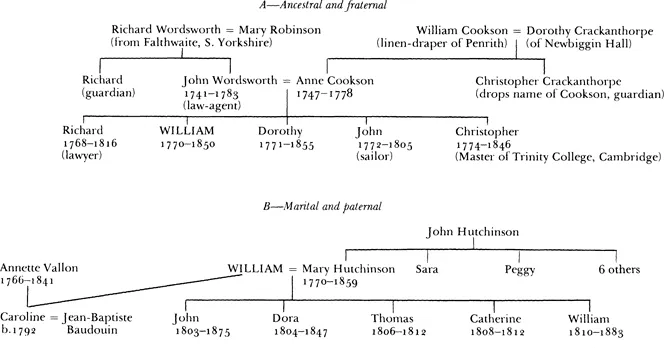
1 Biography summaries
John Morley: I once said to Matthew Arnold that I’d rather have been Wordsworth than anybody (not exactly a modest ambition); and Arnold, who knew him well in the Grasmere country, said, ‘Oh no, you would not; you would wish you were dining with me at the Athenaeum. He was too much of a peasant for you.’Mr Gladstone: No; I never felt that: I always thought him a polite and amiable man.JOHN MORLEY, Life of Gladstone
Chronological table
| WORDSWORTH’S LIFE | EVENTS INBRITISH AND EUROPEAN HISTORY. | |
| 1766 | Marriage of Wordsworth’s parents. | |
| 1769 | Birth of Napoleon Bonaparte. James Watt patents his steam engine. | |
| 1770 | 7 April William Wordsworth born at Cockermouth, Cumberland. | Birth of Beethoven. Birth of Robert Owen. |
| 1772 | Birth of S. T. Coleridge. | |
| 1775 | Birth of Turner. | |
| 1776 | War of American Independence (ends 1782). | |
| 1778 | His mother dies. | |
| 1779 | Wordsworth sent away to Hawkshead Grammar School, where he stays, apart from holidays, until 1787. | |
| 1783 | His father dies. | |
| 1787 | At St John’s College, Cambridge until 1791. | |
| 1789 | French Revolution begins. Fall of Bastille. | |
| 1790 | Long vacation Fourteen weeks’ tour in France and Switzerland with Robert Jones. | |
| 1791 | Leaves Cambridge with a pass degree. | |
| 1791 | November Goes to Orléans to perfect his French. | |
| 1792 | In love with Annette Vallon, 25-year-old daughter of a surgeon of Blois. | 20 April France declares war on Austria and Prussia. August Louis XVI imprisoned; later dethroned. September September Massacres in Paris. 20 September Revolutionary army defeats Prussians at Valmy. |
| Wordsworth in Paris on 29 October and soon leaves France. 15 December Caroline, child of William and Annette, born at Orleans. | 29 October Louvet the Girondin accuses Robespierre of despotism. | |
| 1793 | Wordsworth in London. January Publishes An Evening Walk, and Descriptive Sketches. July After staying in the Isle of Wight Wordsworth crosses Salisbury Plain | 21 January Louis XVI executed. February England declares war on France. |
| (Stonehenge), then proceeds via Tintern Abbey to North Wales. October Secret visit to Paris. (Wordsworth told Carlyle he saw the execution of Gorsas.) | Jacobins in power in France. September Reign of Terror begins in France. 7 October Gorsas the Girondin guillotined. October–November Girondin leaders executed. | |
| 1794 | In Lake District. At end of year he nurses Raisley Calvert who dies in January 1795 leaving Wordsworth £900. | 28 July Execution of Robespierre. Later the French begin wars of conquest. |
| 1795 | Meets William Godwin in London and is influenced by his ideas. | 22 August Establishment of the Directory. Aggressive policy of foreign conquest to fill French treasury. |
| August At Bristol. First meeting with Coleridge. | ||
| 26 September William and Dorothy at Racedown Lodge, Dorset, until July 1797. | ||
| 1796 | Napleon’s Italian campaign. | |
| 1797 | June Coleridge visits the Wordsworths, who then (July) rent Alfoxden House for a year to be near Coleridge. | |
| 1798 | July Walking tour in Wye Valley; visits Tintern Abbey. | August Battle of the Nile. French subjugation of Switzerland. |
| September Publication of Lyrical Ballads. 16 September Wordsworths and Coleridge land at Hamburg; then separate, Wordsworths staying at Goslar from October to April 1799. | ||
| 1799 | May On their return to England, Wordsworth and Dorothy stay at Sockburn-on-Tees. | |
| December They settle at Dove Cottage, Grasmere, their home until 1808. | November Napoleon First Consul. | |
| 1800 | Coleridge comes to Greta Hall, Keswick. | |
| 1801 | January Second edition of Lyrical Ballads in 2 vols. | |
| 1802 | 27 March Treaty of Amiens; temporary peace between England and France. | |
| August William and Dorothy visit Calais for four weeks to see Annette and Caroline. | 15 August Napoleon Consul for life. | |
| 4 October Wordsworth marries Mary Hutchinson; Dorothy continues to live with them at Dove Cottage. | ||
| Third edition of Lyrical Ballads. | War between England and France resumed. | |
| 1803 | Tours Scotland with Dorothy and Coleridge. | |
| 1804 | 9 April Coleridge leaves for Malta. | May Napoleon becomes Emperor. 2 December His coronation. |
| 1805 | 5 February Wordsworth’s brother John drowned in the Earl of Abergavenny, wrecked in Weymouth Bay. | |
| Fourth edition of Lyrical Ballads. | 21 October Trafalgar. | |
| 1806 | August Coleridge returns to England. | |
| 1807 | Poems in Two Volumes published. | |
| 1808 | Leaves Dove Cottage for Allan Bank, Grasmere, where he lives until 1811 (Coleridge also resident). | Convention of Cintra. |
| 1809 | May Publishes tract On the Convention of Cintra. June Coleridge begins to issue a magazine, The Friend, to which Wordsworth also contributes. | |
| 1810 | Quarrel with Coleridge. | |
| 1811 | Moves to the Rectory, Grasmere, until 1813. | |
| 1812 | Reconciliation with Coleridge. Death of his children Catherine and Thomas. | Napoleon invades Russia. |
| 1813 | Settles permanently at Rydal Mount, having been appointed Distributor of Stamps for Westmorland. | |
| 1814 | The Excursion published. | |
| 1815 | Publishes his collected Poems and The White Doe of Rylstone. | 18 June Waterloo. End of Napoleonic Wars. Corn Laws passed. |
| 1817 | Meets John Keats at Haydon’s house in London. | |
| 1818 | Publishes pamphlets on Tory side at elections. | |
| 1819 | Appointed J.P. | Peterloo. |
| 1820 | Visits Continent. New edition of Poems in 4 vols. and Duddon Sonnets published. | |
| 1822 | Ecclesiastical Sketches and separate edition of A Description of the Scenery of the Lakes (guidebook) published. | |
| 1827 | Poetical Works (5 vols.) published. Many later editions. | Death of Beethoven. |
| 1829 | Dorothy Wordsworth seriously ill. | |
| 1831 | Last meeting with Coleridge. | |
| 1832 | Wordsworth opposes Reform. | Reform Bill. |
| 1834 | Coleridge dies. | Poor Law Amendment Act. |
| 1835 | Yarrow Revisited and Other Poems. Mental deterioration of Dorothy. | |
| 1838 | D.C.L. (Durham). | |
| 1839 | Campaigns for authors’ copyright. D.C.L. (Oxford). | Copyright Bill. |
| 1842 | Poems, chiefly of Early and Late years published. Resigns office of Distributor of Stamps. Receives pension from Civil List of £300 a year. | Chartist agitation. |
| 1843 | Appointed Poet Laureate. | |
| 1844 | Campaigns against extension of railway to Lake District. | |
| 1847 | Death of Dora, his daughter. | |
| 1849 | Final edition of Poetical Works. Hartley Coleridge dies. | |
| 1850 | 23 April William Wordsworth dies at Rydal Mount. July The Prelude published. | |
| 1851 | Death of Turner. | |
| 1855 | Dorothy Wordsworth dies. | |
| 1859 | Mary, his wife, dies. |
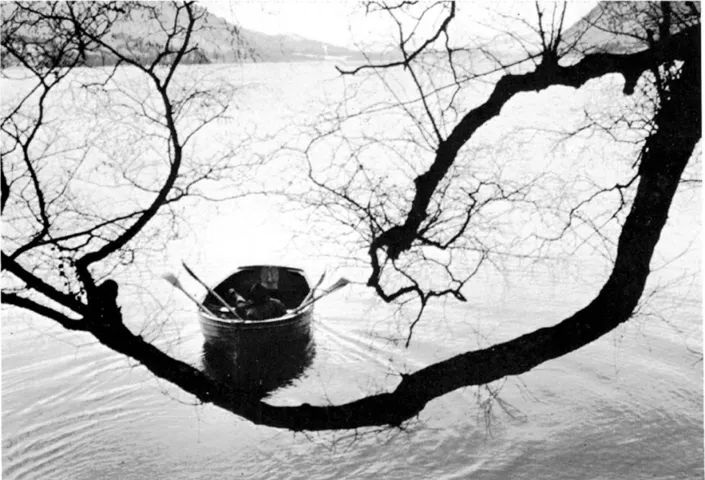
Boat on Ulhwater, by Tom Sharpe
The Prelude as autobiography
My life is in my writings.WORDSWORTH
A chronological table can only give us the bare outlines of a life: one asks three questions. How much do the facts listed really tell us? And, even if they are an adequate summary of the externals of time and chance to which all are subject, what about the inner life? Finally, what, in retrospect, did the person who lived that life consider had happened during its course?
In the case of William Wordsworth we are fortunate in possessing his own very full account of the first part of his life, roughly down to the mid-1790s, in the ‘Poem’ addressed to Coleridge which we now know as The Prelude. We shall be considering The Prelude as a poem at the appropriate point in the Critical Survey; for the moment I propose to refer to it simply as evidence of Wordsworth’s internal struggles and preoccupations, as if it were a diary or a letter to a friend which just happens to be in verse.
Wordsworth tells us that he wrote The Prelude in order to give an account of the growth of his mind, which may help to account for the inclusion of some of the stranger incidents. The poem may be read through quickly by a newcomer to the study of Wordsworth, but it would be foolish to pretend that there are no difficulties. It is not always easy to follow what the poet is trying to tell us, even when we understand the words on the page: he was conscious of the problem himself, as in the famous (and, dare I say, quite charming lines) —
My drift I fear
Is scarcely obvious.…
Prelude 1850, v, 293–4
There are two parts of his life to which he devotes a great deal of space, and to which he returns again and again. The first is his education: we find in the first two books of The Prelude those experiences which Wordsworth regarded as formative. The second was his residence in France during the French Revolution: this direct encounter with the main movement of the age led Wordsworth into constant political agony and debate, and it is significant that one of the main characters in The Excursion, his other long poem, is the Solitary, a despondent figure disillusioned by the failure of the Revolution.
In this chapter we shall begin by examining these concerns in some detail. Wordsworth concludes The Prelude with tributes to his sister Dorothy, and to S. T. Coleridge, both of whom, in their different ways, helped him to resolve the personal crisis into which the events of the 1790s had led him, and I have given a short biography of each. There follow some accounts of Wordsworth by people who knew him, mainly in later life, as a way of pointing up, and perhaps correcting, the poet’s own version of himself.
Education
I had a full twelve months’ start of the freshmen of my year.WORDSWORTH, of his first year at Cambridge
Let Nature be your Teacher.WORDSWORTH, The Tables Turned
Wordsworth was an intelligent and highly educated man: he was a learned, clever, even a witty poet. This catalogue of adjectives needs to be frequently declaimed and asserted, even in the teeth of what most people will call ‘the evide...
Table of contents
- Cover Page
- Half Title Page
- Frontispiece
- Title Page
- Copyright Page
- Contents
- List of Illustrations
- List of Abbreviations
- Foreword
- Acknowledgements
- Introduction
- Part One: Historical Background
- Part Two: Critical Survey
- Part Three: Reference Section
- General Index
- Index to Wordsworth's Poetry and Prose
Trusted by 375,005 students
Access to over 1.5 million titles for a fair monthly price.
Study more efficiently using our study tools.
Frequently asked questions
Yes, you can cancel anytime from the Subscription tab in your account settings on the Perlego website. Your subscription will stay active until the end of your current billing period. Learn how to cancel your subscription
No, books cannot be downloaded as external files, such as PDFs, for use outside of Perlego. However, you can download books within the Perlego app for offline reading on mobile or tablet. Learn how to download books offline
Perlego offers two plans: Essential and Complete
- Essential is ideal for learners and professionals who enjoy exploring a wide range of subjects. Access the Essential Library with 800,000+ trusted titles and best-sellers across business, personal growth, and the humanities. Includes unlimited reading time and Standard Read Aloud voice.
- Complete: Perfect for advanced learners and researchers needing full, unrestricted access. Unlock 1.5M+ books across hundreds of subjects, including academic and specialized titles. The Complete Plan also includes advanced features like Premium Read Aloud and Research Assistant.
We are an online textbook subscription service, where you can get access to an entire online library for less than the price of a single book per month. With over 1.5 million books across 990+ topics, we’ve got you covered! Learn about our mission
Look out for the read-aloud symbol on your next book to see if you can listen to it. The read-aloud tool reads text aloud for you, highlighting the text as it is being read. You can pause it, speed it up and slow it down. Learn more about Read Aloud
Yes! You can use the Perlego app on both iOS and Android devices to read anytime, anywhere — even offline. Perfect for commutes or when you’re on the go.
Please note we cannot support devices running on iOS 13 and Android 7 or earlier. Learn more about using the app
Please note we cannot support devices running on iOS 13 and Android 7 or earlier. Learn more about using the app
Yes, you can access A Preface to Wordsworth by John Purkis in PDF and/or ePUB format, as well as other popular books in Literature & Literary Biographies. We have over 1.5 million books available in our catalogue for you to explore.