eBook - ePub
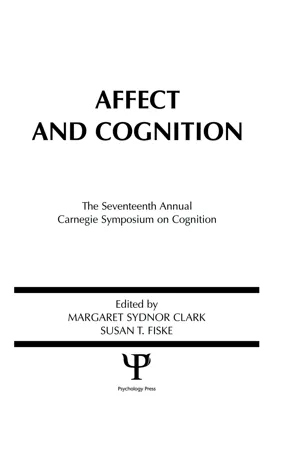
Affect and Cognition
17th Annual Carnegie Mellon Symposium on Cognition
- 368 pages
- English
- ePUB (mobile friendly)
- Available on iOS & Android
eBook - ePub
Affect and Cognition
17th Annual Carnegie Mellon Symposium on Cognition
About this book
First published in 1982. In late May, 1981, the 17th annual Carnegie Symposium on Cognition brought 16 cognitive and social psychologists to Camegie-Mellon University. Their topic was affect and cognition. For only the second time, the Carnegie Symposium had been organized by social psychologists. John Carroll and John Payne chaired the first social cognitive symposium in 1975. Their conference came precisely at the time when social cognition was beginning to take root within social psychology. Since then, the area has blossomed. These are the papers from the conference.
Information
Subtopic
Cognitive Psychology & CognitionIndex
Psychology1 The Structure of Value: Accounting for Taste
George Mandler
University of California, San Diego
University of California, San Diego
"I know what I like."
—Zuleika Dobson
Thesis
It is assumed that evaluative cognitions are central to a psychological understanding of emotional experience. Three sources of value judgments are innate approach/avoidance tendencies, cultural predication, and the internal structure of the target event/object. Only the last of these is addressed in this chapter.
The basis of a structural analysis is found in schema theory and in the notions of schematic assimilation and accommodation. Schemas are representations of experience that guide action, perception, and thought. Schemas (and the resulting expectations) are developed as a function of the frequency of encounters with relevant instantiations. New encounters are evaluated against existing schemas, and the interaction between an event (evidence in the world) and a schema determines the perception, understanding, and organization of our environment. The congruity between an event and the relevant schema's relational structure is suggested to be the basis of some judgments of value. A prototype of evaluative cognitions is found in the congruity between the structure of an event and the most frequent instantiations of a schema; such congruity gives rise to valuations of familiarity, acceptability, and a basic sense of liking. This positive valuation of the familiar is based on congruity and assimilability, while incongruity and accommodative pressures lead to arousal and to evaluative states that may be either positive or negative.
Value is generally considered to be a conscious judgment. It is therefore necessary to consider the conditions under which conscious representations of values are constructed. Such constructions of phenomenal value need not incorporate any conscious representation of other features of the target event/object. Evidence that is presented to the individual activates a large number of analytic processes, but only a subset of the results of these activations is available in consciousness.
Evaluative cognitions, although depending on different schematic features and structures, have the same functional status as descriptive cognitions. In combination with states of physiological (autonomic) arousal, they contribute to the subjective experience of affects and emotions.
The Place of Value in a World of Cognitions
Value and Emotion
What is it about taste that is indisputable? What is in the "eye" of the beholder that confers beauty? How is a judgment about goodness or beauty derived from the representation of an event? How can such a representation, which is traditionally considered to be a bundle of attributes or features, give rise to an evaluation that seems to have no identifiable source?
My reason for trying to account for taste, for describing the structure of value, arises from a desire to complete an account that I began some years ago in Mind and Emotion (1975). I presented an analysis of emotional experience based on the interaction between physiological arousal and evaluative cognitions. The former contributes the gut aspect of emotions—their intensity and "bodily" feel; the latter deal with the "mental" feel of emotions—their quality and subjective content. I also wish to expand the domain of cognitive psychology into an area that has been both neglected and misunderstood. It has been neglected by cognitive theorists and misunderstood by those who wish to make distinctions between cognitions and some other aspects of human functioning. My intent is also motivated by a commitment to go "beyond phenomenology," to understand the psychological processes that underlie the common language and the common understanding.
The analysis of most emotional states seems to devolve on some evaluative cognition about the world and the self; these cognitions typically are represented in descriptions of the world or the self as hostile, pleasant, threatening, beautiful, sexy, or evil. Such evaluations combine with autonomic arousal to produce the emotional states described in the common language as anger, joy, fear, ecstasy, lust, or dread. Evaluations are complex events that arise out of the ongoing meaning analyses that are a continuous feature of human mental life. In the psychological literature, as in belles-lettres, these complex evaluations tend to be described in the common language of value. Threat, beauty, attraction, and uncertainty often become primitives in psychological theory; they are taken at face value. Although there have been attempts to describe the cognitive states that may underlie the use of certain "emotional" words, the effort has typically been either in terms of an invocation of fundamental, neural states (as seen, for example, in Darwin) or by reference to wants, desires, expectations, and evaluations (an early example being Leibniz).
The latter enterprise comes close to my own hopes for a psychology of evaluative cognitions. The analysis of emotional terms taken from the common language tends to become a linguistic undertaking, trying to find the semantic structure that is discernible upon careful analysis of the terms (e.g., Wierzbicka's (1972) analysis of the semantic primitives that construct emotion words). Analyses such as these are an important first step toward an understanding of the structure of the cognitions that are incorporated in subjective emotional states. I want to go a step further and provide a psychological analysis of the evaluations that are needed even for the semantic enterprise. I shall concentrate on the basic evaluative dimensions of good/bad, approach/withdrawal, like/dislike, etc. I deliberately include several referents here because it is not my purpose to explicate any one term of the common language. I do not believe that the concern of theoretical psychologists should be such explication. Rather, I see our role to be that of constructing reasonable statements about structures and processes that, if all is well, will generate some of the phenomena spoken about (vaguely and diffusely) in the common language (Mandler, 1975). One result of such an enterprise is the rejection of some psychological implications of our common language. Thus, it will become apparent that the representation of "good" does not have a symmetrical counterpart in the representation of "bad", but rather that these evaluations arise out of somewhat different cognitive events. Similarly, it will become obvious that "liking" and "disliking" are not poles on a single psychological dimension.
It is the function of the psychologist to make reasonable guesses (on the basis of observation and experiment) about the underlying structures of the human mind and to explore how basic processes produce observable consequences, including the common language and understanding. Thus, it is not my function or intention to explicate value terms, to determine exhaustively, for example, the psychological bases of the good or the beautiful. In short, one can either try to analyze the terms and usages of natural or common languages, or one can concentrate on the underlying psychological processes that, inter alia, generate such terms and usages. I have consistently taken the latter approach. However, such an analysis is not likely to explain completely the common experience, because the latter's complexity suggests that it is determined by a number of different interacting processes.
There exists a large, possibly innumerable, set of cognitive states that are evaluative and that contribute to emotional experience. Evaluative states include judgments of threat, danger, gain, achievement, self-esteem, and so forth. I confine my presentation to one class of these evaluative cognitions, a class that I believe to be basic to the phenomenal experience of liking, preference, acceptability. It is exemplified by the pervasive human characteristic to prefer the known to the unknown, the usual to the unusual, the familiar to the strange. These cognitions arise out of a structural analysis that is primarily concerned with the congruity between events and schemas. Such an analysis deals with the representation of knowledge (cognition) in the broadest sense. And it is in this broad sense that modern cognitive psychology addresses the notion of cognitions—it includes anything that is said to be mentally represented. For this reason I have occasion to question a recent proposition of Zajonc's (1980), that cognition and affect (value) are subserved by different mechanisms.1
Value and Consciousness
I want to make sure that my use of the concept of cognition is clearly understood. In the literature of the past several decades, cognition and cognitive processes are often used to refer to conscious, thought-like processes. For example, when Zajonc (1980) quotes Wundt (1905) on the primacy of affect, it is clear that cognition is identified with conscious ideation. The Wundt quotation concerns the observation that affective elements move into consciousness (become conscious) before anything of the ideational elements is (consciously) perceived. In making a distinction between affect and cognition, Zajonc endorses Wundt's distinction between affective and ideational elements. However, what seems to be actually at issue is the attainment of consciousness of likes and dislikes (i.e., values) and of descriptive (ideational) elements.
If one accepts the notion, expressed earlier by Lashley and G. A. Miller, that conscious contents are—to a large extent—the products of cognitive processes, then it is reasonable to ask what gives rise both to the affects and to the ideas. I assume that cognitive processes are at work whenever information is processed and knowledge used or invoked. Among that knowledge is information about preference, about liking and disliking, about good things and bad things. The same underlying thought is surely implied by theories of decision (Kahneman & Tversky, 1979; Luce, 1959), which consider the final (conscious) choice or preference to be the result of (cognitive) processes that are not conscious at the time of the choice and may, in fact, never become conscious.
All this is more than a semantic quibble. Zajonc's colorful statement that "preferences need no inferences" can now be rephrased to read that "conscious preferences need no conscious inferences." Since I assume that inferences can be the result of nonconscious, theoretically postulated, processes, we can refine the problem further and ask what inferred structures and processes could be responsible for judgments of value?
To recapitulate: Conscious as well as unconscious, deliberative as well as automatic, processes can be "cognitive." To say that one "likes" something requires access to stored knowledge, unless one accepts a radical position that goodness is in the object. If it is the case that affective/cognitive judgments appear to be made without any conscious access to other "cognitive" processes, then we must examine what it is about valuation and consciousness that produces such phenomenal characteristics. Is the apparent "direct" access to feelings and judgments of value unique to valuation, or is it—as I shall argue—an instance of a more general characteristic of human thought?
Evaluative Actions: Types and Sources
I need to distinguish three different sources of evaluative actions and to delimit the range of events to which I wish to apply the notion of the structural source of value. I chose to speak of evaluative action in order to be able to include such things as evaluative terms in language, evaluative nonverbal behavior such as approach/withdrawal and facial expressions, and other acts that are apparently based on evaluation or preference.
I exclude two classes of evaluation from this analysis. The first comprises innate preferences. These are evaluative actions that are based on apparently innate approach/avoidance tendencies. These, often species specific, dispositions are exemplified by the preference for an optimal temperature range (and the rejection of extreme cold and heat), the preference for sweet and the rejection of bitter substances, and the retreat from looming objects.2
The second set of evaluative actions and judgments that I exclude are those that are based on cultural predication. Culture is a powerful teacher of valuative judgments, primarily through the vehicle of the common language. It is through the process of acculturation that we "learn" that corn is (in the U.S.) or is not (in France) fit for humans, that spinach is "good" for you, that shaking hands with people is or is not "proper." Such valuations are not based on an examination of the object of interest, but rather the value is a predicate of the object—produced and maintained by cultural processes. Thus corn is said to be inedible because it is corn, not because of the way it tastes and looks.
There exist relatively few instances of innate valuation in comparison with the vast array of predicated values. However, the large number of the latter should not mislead us into believing that all or even most of valuative actions that are socially acquired are based on cultural predication. The kind of value I wish to address also depends to a large extent on social and cultural contexts. If the familiar, the normal, and the usual are indeed preferred, then it is clearly our culture, our social context, and our normal environment that define what will become usual and familiar. Familiarity comes about through extensive experience in the culture and not by social fiat like cultural predication.
I am concerned with those cases of valuation that require an examination of the target event but that are not instances of innate dispositions or cultural predication. I shall argue that the third kind of valuation, structural valuation, is based on a relationship between the structure of the target event and some stored mental representation—a schema.
What is an Evaluative Judgment?
By asserting that evaluations are cognitive events, we must try to distinguish between those cognitive events that are evaluative and those that are not. Clearly it is only a subset of knowledge/information/cognition that plays a part in emotion and affects3—the judgment that something is good or beautiful seems to be quite different from the judgment that it is hot or orange.
We start therefore with the apparent distinction between descriptive and evaluative terms, sometimes also incorporated in the distinction betwee...
Table of contents
- Cover
- Title
- Copyright
- Dedication
- Contents
- Preface
- PART 1: COGNITIVE UNDERPINNINGS OF AFFECT
- PART 2: COGNITION AND AFFECT: APPLICATIONS AND BEHAVIOR
- PART 3: AFFECTIVE UNDERPINNINGS OF COGNITION
- Author Index
- Subject Index
Trusted by 375,005 students
Access to over 1.5 million titles for a fair monthly price.
Study more efficiently using our study tools.
Frequently asked questions
Yes, you can cancel anytime from the Subscription tab in your account settings on the Perlego website. Your subscription will stay active until the end of your current billing period. Learn how to cancel your subscription
No, books cannot be downloaded as external files, such as PDFs, for use outside of Perlego. However, you can download books within the Perlego app for offline reading on mobile or tablet. Learn how to download books offline
Perlego offers two plans: Essential and Complete
- Essential is ideal for learners and professionals who enjoy exploring a wide range of subjects. Access the Essential Library with 800,000+ trusted titles and best-sellers across business, personal growth, and the humanities. Includes unlimited reading time and Standard Read Aloud voice.
- Complete: Perfect for advanced learners and researchers needing full, unrestricted access. Unlock 1.5M+ books across hundreds of subjects, including academic and specialized titles. The Complete Plan also includes advanced features like Premium Read Aloud and Research Assistant.
We are an online textbook subscription service, where you can get access to an entire online library for less than the price of a single book per month. With over 1.5 million books across 990+ topics, we’ve got you covered! Learn about our mission
Look out for the read-aloud symbol on your next book to see if you can listen to it. The read-aloud tool reads text aloud for you, highlighting the text as it is being read. You can pause it, speed it up and slow it down. Learn more about Read Aloud
Yes! You can use the Perlego app on both iOS and Android devices to read anytime, anywhere — even offline. Perfect for commutes or when you’re on the go.
Please note we cannot support devices running on iOS 13 and Android 7 or earlier. Learn more about using the app
Please note we cannot support devices running on iOS 13 and Android 7 or earlier. Learn more about using the app
Yes, you can access Affect and Cognition by Margaret S. Clark,Susan T. Fiske in PDF and/or ePUB format, as well as other popular books in Psychology & Cognitive Psychology & Cognition. We have over 1.5 million books available in our catalogue for you to explore.