- 224 pages
- English
- ePUB (mobile friendly)
- Available on iOS & Android
eBook - ePub
About this book
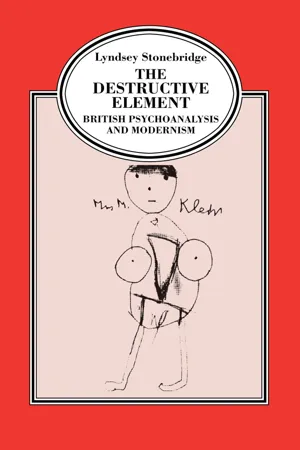
Freud's account of the sublimated drives at work beneath the surfaces of advanced societies, alongside the modernist fictions of Joyce, Proust, Kafka, Woolf and others, both reflected and inaugurated a strain of modernism preoccupied with the darkest elements of the human psyche. In The Destructive Element Lyndsey Stonebridge examines the career and legacy of British psychoanalyst Melanie Klein as a lens through which to examine the 20th century's fascination with death drives, the sublimation of civilization's discontents and the socialization of children--fascinations that would surface throughout the cultural production of the West. At once cultural history and psychoanalytic theory, and a bold reformulation of the legacies of modernism, The Destructive Element is an essential contribution to our understanding of the Western tradition.
Information
1
Sticks for Dahlias: The Destructive Element in Literary Criticism and Melanie Klein
The waste remains, the waste remains and kills.
William Empson, ‘Missing Dates’
‘In the destructive element immerse…that was the way’. When Richards found the right phrase to describe Eliot’s The Waste Land in Conrad’s Lord Jim it was, in part, with reference to psychoanalysis. In ‘A Background for Contemporary Poetry’ Richards identifies psychoanalysis as one of the causes of the epistemological violence that has been waged upon the ‘Magical View of Nature’. Nature, for Richards, is already something like an English suburban garden, as his somewhat breathless indictment of horticultural malaise suggests in the passage which inspires the footnote on Eliot:
Over whole tracts of natural emotional response we are to-day like a bed of dahlias whose sticks have been removed. And this effect of the neutralisation of nature is only in its beginnings. Consider the probable effects in the near future of the kind of enquiry into basic human constitution exemplified by psychoanalysis.
A sense of desolation, of uncertainty, of futility, of the baselessness of aspirations, of the vanity of endeavour, and a thirst for life-giving water which seems suddenly to have failed, are the signs in consciousness of this necessary reorganisation of our lives. Our attitudes and impulses are being compelled to become self-supporting; they are being driven back upon their biological justification, made once again sufficient to themselves. And the only impulses which seem strong enough to continue unflagging are commonly so crude that to more finely developed individuals, they seem hardly worth having.1
Small wonder, perhaps, that it was the footnote and not the main body of Richards’ text which acquired such notoriety. (The answer to that’, Stephen Spender ripostes impatiently ten years later, ‘is “Don’t be a dahlia, and you won’t need a stick!”’).2 The vandal in the garden is psychoanalysis which has removed the stick of belief by uncovering unconscious drive-invested impulses so crude, Richards notes, that ‘they seem hardly worth having’.
Where Trilling will later make a virtue out of the fact that psychoanalysis drives us back to our ‘biological justification’, Richards, who once said that he began his study of physiology with the intention of becoming a psychoanalyst, is more troubled by the cultural implications of desire.3 Even when psychoanalytic ‘stories are duly discounted’, he argues in ‘A Psychological Theory of Value’, ‘enough which is verifiable remains for infans polypervers to present a truly impressive figure dominating all future inquiry into value.’4 One way to read Richards’ footnote, then, is as a possible solution to this threat to value posed, in part, by psychoanalysis. Eliot, says Richards, ‘by effecting a complete severance between his poetry and all beliefs […] has shown the way to the only solution of these difficulties. “In the destructive element…that was the way.”’5 The Waste Land offers a ‘perfect emotive description’ of a crisis of value that psychoanalysis, among other sciences, has laid bare: a ‘pseudo-statement’ which because it relinquishes any claim to belief, can order and, thereby, transcend the damage that it at the same time diagnoses. To suggest that Richards developed his own theory of value in response to psychoanalysis’ threat to value would be to misconstrue his project; yet there remains a noteworthy tension here between psychoanalysis and the construction of Richards’ own literary principles which can shed light on how the question of value in each discourse became inextricable from shifting definitions of the destructive element.
Far from overtly inflating the value of art, Practical Criticism prided itself in its attacks on traditional notions of aesthetic value. In Principles of Literary Criticism Richards puts paid to the ‘phantom of the aesthetic state’ by proposing what looks like a thoroughly democratic theory of pleasure and value. Richards wants a psychology of value which will dispense with idealism and offer an alternative to Fry’s and Bell’s aestheticism. Value, hence, is not to be defined via the category of the aesthetic; rather, as with Freud, and similarly following G.T. Fechner, Richards proposes an economic theory that equates value with the reduction of tension: ‘anything is valuable which satisfies an appetency.’6 The key to satisfying an appetency lies in the development of an organized system that can keep conflicting impulses in balance. Against the implied totalitarianism of an ‘aesthetic state’ a well-ordered individual psychology acts as a microcosm of the balanced liberal state. Like Freud, Richards recognizes that such an organization of impulses on a cultural level requires a sacrifice on the part of the individual. But where Freud is pessimistic about the exorbitant price to be paid for this entrance into culture (as in Civilization and Its Discontents), Richards, owing more to Bentham (like his collaborator C.K. Ogden), is more sanguine: ‘By the extent of the loss, the range of impulses thwarted or starved, and their degree of importance, the merit of a systematization is judged. That organization which is least wasteful of human possibilities is, in short, the best’.7 No use crying over the milk spilt by the infans polypervers in its journey, in Richards’ terms, to the acquisition of value: waste not, want not.
But phantoms of the aesthetic state are not only illusory; like other ghosts they also have a habit of returning to haunt the site of their supposed exorcism. As Steven Connor has argued, Richards’ apparent continuum between disorganized appetencies and aversions, and their development towards equipoise and organization, quickly hardens into an opposition between good and bad art.8 While he maintains that aesthetic experiences are ‘only a further development, a finer organization of ordinary experiences, and not in the least a new or different kind of thing’,9 this finer organization of art also offers an economy that is not available in common experience: ‘the experiences which the arts offer are not obtainable, or but rarely, elsewhere. Would that they were! They are not incomplete; they might be better described as ordinary experiences completed’.10 Art completes, because of its superior organization of impulses, what ordinary experience leaves unfinished. The value of The Waste Land, therefore, lies in nothing so snobbish as its intellectual allusions, but ‘in the unified response which this interaction creates in the right reader’.11 This is the poetically correct reader of Practical Criticism (the bête noire of anyone who has struggled to demonstrate Richards’ point in the course of their literary education). To be immersed in the destructive element in this sense is to subscribe to a view that redeems waste through a critical economy that transmutes conflict into balanced equipoise. Or, as Richards puts it in his revised version of the footnote in his later Science and Poetry, Eliot finds a ‘new order through the contemplation and exhibition of disorder’.12
Dahlias, then, have nothing to lose but their sticks, as Practical Criticism begins to put right the damage done by psychoanalysis in the garden of value. But removing the sticks of belief, like banishing the ghost of aesthetic idealism, is easier said than done. Richards bases his claims on a thoroughly modern theory of value: ‘The view that what we need in this tempestuous turmoil of change is a Rock to shelter under or to cling to, rather than an efficient aeroplane to ride it, is comprehensible, but mistaken.’13 But the rhetoric of redemption is never far away. In his appendix to Principles of Literary Criticism, ‘The Poetry of T.S Eliot’, Richards revises his earlier reading of the poem. Not only does the poem immerse us in the destructive element, here Richards also introduces Eliot’s ‘persistent concern with sex, the problem of our generation, as religion was the problem of the last’.14 Perhaps in the light of this new association with sex, Richards, no doubt also responding to Eliot’s own corrective complaints, ends with an implicit qualification of his earlier reading:
There are those who think that [Eliot] merely takes his readers into the Waste Land and leaves them there, that in this last poem he confesses his impotence to release the healing waters. The reply is that some readers find in his poetry not only a clearer, fuller realization of their plight, the plight of a whole generation, than they find elsewhere, but also through the very energies set free in that realization a return of the saving passion.15
The rhetoric of redemption here might quite reasonably be said to belong not to Richards but to his – carefully placed – ‘some readers’. Notwithstanding, Richards’ language correlates eloquently with a thesis that sees art as completing experience and as thereby restoring value in a world gripped by a crisis in belief. It is as if, finally, the ‘impressive figure’ of the polymorphously perverse infant has been promoted to the status of the aesthetically and culturally valuable: the baselessness of contemporary life that this figure signifies is refracted back to us through poetry, not only as a monument to our desolation, but as an icon of possible salvation through suffering. Something, it might be said, has just crawled under a rock; or as Eliot later says of Richards’ criticism, drawing the obvious parallel with Arnold, this is ultimately ‘salvation by poetry’.16
While it is true to say that Richards, in contrast to Eliot and American New Criticism, is reconciled to producing a form of scientific criticism for a secular culture, something perhaps of that unconscious Christianity that Eliot wanted criticism to preserve remains here.17 This is precisely the point that William Empson, steadfastly opposed to religious criticism throughout his career (particularly in his later work), makes in his astute appendix on value in The Structure of Complex Words (dedicated to Richards ‘[w]ho is the source of all ideas in this book, even the minor ones arrived at by disagreeing with him’). Richards, says Empson, ‘need not be as secure against the religions as he intended to be’.18 It is the lack of qualification in Richards’ theory of value, Empson argues, that issues a back-door invitation to the kinds of dangerous idealism that Richards wants to get rid of. Once again this debate about value is caught up in a conversation with psychoanalysis. Empson points out that by defining value as the achievement of equilibrium through the reduction of tension, Richards runs tantalizingly close to reproducing a version of Freud’s death drive. As Empson puts it in an apparently un-posted letter to Richards from Peking in 1933: ‘Freud’s dim but rich concept of death wishes come in here: one sense of it is certainly that all impulses are reactions to a stimulus aiming at the removal of the stimulus’.19 As long as value is defined solely in terms of the achievement of equilibrium, the democratic balance Richards aims for risks carrying with it a more deathly proposition. And if this is the case, there is nothing to stop the infans polypervers from re-emerging as a problem for value. Richards’ claims about the sublimatory values of ‘balanced’ impulses, says Empson, ‘still [don’t] face the issue that this may be done badly: it is just this process that sends energy into perverse desires that give pain when unsatisfied and no pleasure when satisfied’.20 As Empson reintroduces psychoanalysis into the debate he also exposes the internal limits of Richards’ version of the destructive element: immersing oneself in a world of no belief armed only with a stoically utilitarian theory of value is finally no protection from those other, less civilized, destructive elements identified by psychoanalysis. The waste, that surplus of thwarted and starved impulses that Richards wanted to channel into his version of a useful life, remains.
Far from offering a solution to the crisis of value, Richards leaves us with a question that elsewhere Empson identifies as pertaining to psychoanalysis: ‘what version of a perversion is to be admired’?21 This is the question that Empson addresses to himself in ‘Death and Its Desires’ which he drafted in the same year as his letter to Richards. It is not (it could hardly be) perversion per se that worries Empson here, but the extent to which death wishes in art degenerate into forms of weak mysticism and unwarranted pessimism – corrupted versions of the destructive element which Richards’ theory of value, by implication, cannot guard against. Empson finds the purest version of the destructive element, or the death wish, like Eliot before him, in the Fire Sermon of the Buddha, and describes Nirvana in terms which directly recall Richards’ praise of Eliot: ‘The main effect of the doctrine … is to remove all doctrinal props about immortality and still claim that death is somehow of the highest value’.22 Empson particularly relishes the way the Fire Sermon achieves this without Christianity’s morbid fascination with spectacles of sacrificial death – his is a dip in the destructive element without a voyeuristic pay-off. Elsewhere Empson thinks of this distinction in terms of the difference between the ‘return to a narcissistic state of being’ (Nirvana) and ‘corpse lust’ (voyeuristic sadism) and notes how irritating it is not to be sure which version of the death wish a work of art is offering you – which version of perversion (The Waste Land might be a case in point).23 It is difficult (although probably wrong-headed) not to suspect that Empson is engaged in some irreverent shadow-boxing with Richards here. Where Richards chooses the scene out of Lord Jim in which the Bavarian butterfly collector and trader, Stein, lectures Marlow on the ways of non-being (‘with the exertions of your hands and feet in the water make the deep, deep sea keep you up’)24 in order to register the profundity of Eliot’s disassociation of belief, Empson offers us English pastoral in the form of T.F. Powys (‘death like the clown is a sort of perverse figure of pastoral’). In ‘John Pardy and the Waves’, Powys’ Molloy-like tramp character concludes his search for happiness by immersing himself in the waves. Empson paraphrases:
Passing on to count the waves of the sea he was told by the waves that if he joined them he could not only destroy himself but become one of the great elements of destruction and perhaps take part in a typhoon to destroy a city.25
‘In the destructive element…’. Because it is pastoral, what’s important to Empson is the extent to which the genre mystifies or normalizes existing social and economic relations. Such is the case with Powys’ treatment of death; ‘this indefatigable game of talking about death must be a mere blind; the use of death wishes in such literature is only to protect something else’.26 Powys domesticates the destructive element, and on these grounds Empson charges him with something like bad faith. In the same paper Empson makes a similar charge against R.E. Money-Kyrle, the psychoanalyst who was to become one of Melanie Klein’s most trustworthy and steadfast supporters. It is Money-Kyrle, perhaps, who by driving the death instinct to its logical and extreme conclusion, also produces the most grotesque parody of Richards’ theory of value: ‘the quickest and most final method by which an individual can remove his needs’ he advises ‘is to put his head in a gas-oven’.27
Empson and Richards remind us that while Valentine Cunningham is right to argue that the destructive element is caught up within a general apocalyptic rhetoric of the 1920s and 1930s, the phrase also has a specific theoretical and moral history. For Richards the struggle was to find a model of criticism that could redeem a world out of step with its own values; ‘redeem’ both in the sense of atone, and in the economic sense of to reclaim what’s yours, or to make good the waste. In his 1935 revision of Science and Poetry, he increases the political stakes of his theory of value: the Treaty of Versailles, Richards notes, is no longer sustainable, what we need is ‘a League of Nations for the moral ordering of the impulses; a new order based on conciliation, not on attempted suppression’.28 World War Two blasted that illusion apart (notoriously, literary studies t...
Table of contents
- Cover
- Half Title
- Title
- Copyright
- Dedication
- Contents
- Preface
- Acknowledgements
- Introduction From Bokhara to Samarra: Psychoanalysis and Modernism
- Chapter 1 Sticks for Dahlias: The Destructive Element in Literary Criticism and Melanie Klein
- Chapter 2 Is the Room A Tomb? Virginia Woolf, Roger Fry and the Kleinians
- Chapter 3 Rhythm: Breaking the Illusion
- Chapter 4 Stone Love: Adrian Stokes and the Inside Out
- Chapter 5 Frames, Frontiers and Fantasies: ‘Nasty Ladies Within’ – Marion Milner and Stevie Smith
- Notes
- Selected Bibliography
- Index
Trusted by 375,005 students
Access to over 1.5 million titles for a fair monthly price.
Study more efficiently using our study tools.
Frequently asked questions
Yes, you can cancel anytime from the Subscription tab in your account settings on the Perlego website. Your subscription will stay active until the end of your current billing period. Learn how to cancel your subscription
No, books cannot be downloaded as external files, such as PDFs, for use outside of Perlego. However, you can download books within the Perlego app for offline reading on mobile or tablet. Learn how to download books offline
Perlego offers two plans: Essential and Complete
- Essential is ideal for learners and professionals who enjoy exploring a wide range of subjects. Access the Essential Library with 800,000+ trusted titles and best-sellers across business, personal growth, and the humanities. Includes unlimited reading time and Standard Read Aloud voice.
- Complete: Perfect for advanced learners and researchers needing full, unrestricted access. Unlock 1.5M+ books across hundreds of subjects, including academic and specialized titles. The Complete Plan also includes advanced features like Premium Read Aloud and Research Assistant.
We are an online textbook subscription service, where you can get access to an entire online library for less than the price of a single book per month. With over 1.5 million books across 990+ topics, we’ve got you covered! Learn about our mission
Look out for the read-aloud symbol on your next book to see if you can listen to it. The read-aloud tool reads text aloud for you, highlighting the text as it is being read. You can pause it, speed it up and slow it down. Learn more about Read Aloud
Yes! You can use the Perlego app on both iOS and Android devices to read anytime, anywhere — even offline. Perfect for commutes or when you’re on the go.
Please note we cannot support devices running on iOS 13 and Android 7 or earlier. Learn more about using the app
Please note we cannot support devices running on iOS 13 and Android 7 or earlier. Learn more about using the app
Yes, you can access The Destructive Element by Lyndsey Stonebridge in PDF and/or ePUB format, as well as other popular books in Psychology & Mental Health in Psychology. We have over 1.5 million books available in our catalogue for you to explore.