- 208 pages
- English
- ePUB (mobile friendly)
- Available on iOS & Android
eBook - ePub
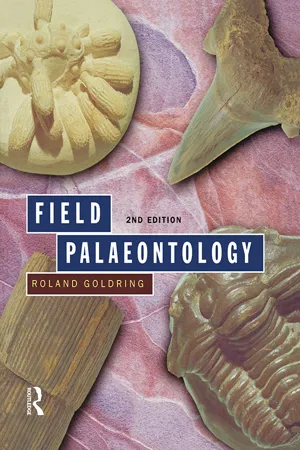
Field Palaeontology
About this book
"This is the major text on the integration of field palaeontology and sedimentology, particularly valuable for both practical lab exercises and students working independently and unsupervised on field projects"
Reviewer's comment
Field Palaeontology provides a comprehensive, rigorous and unique approach to the analysis of fossils and sediments and offers a practical field guide which no palaeontology student can afford to be without.
The past decade has seen immense changes in palaeontology and in the study of sedimentary rocks in general. This edition has been thoroughly revised to take into account these advancements in the subject to produce a book that is unique in its coverage of palaeontology and sedimentology. It aims to provide a basis for evaluating the information potential of fossiliferous sediments, and then to give an outline of the strategy and tactics whicn can be adopted in the field.
Field Palaeontology is written for advanced undergraduate courses in palaeontology, palaeoecology, palaeobiology, sedimentology and biostratigraphy within geoscience and geology degrees. It is also useful reading for Masters earth science students and first year postgraduates looking for a grounding in the basics of the subject.
Chapter 1
Principles and classification
The best geologist is the one who has seen the most rocks.
H. H. Read and J. V. Watson
Beginning Geology
All geologists need to have an appreciation of fossils. The main object of this text is therefore to draw attention to the usefulness of fossils, as seen in the field, to individuals who will be looking at fossils with different objectives, and with different backgrounds and experience. This chapter discusses first the various categories of information that can be obtained from fossils, and then outlines a classification of fossiliferous sediments that reflects these information categories. The object is, at an early stage of any investigation, to assess the value of a site, and how the information potential may respond to vertical and lateral change.
A group of palaeontologists at a fossiliferous site pursue a number of different goals. Some are concerned with determining the biostratigraphy, some with the palaeoecology, others are searching for especially well-preserved material. Many follow carefully prepared sampling programmes, in order to collect fresh material for micropalaeontological or geochemical analysis. Similarly, the sedimentologist, having logged a section and determined the lithologies and current directions, has to consider the available biological data to make a convincing palaeoenvironmental analysis. It is to the palaeontologist, palaeoecologist and sedimentologist that this text is principally directed: how to recognize the potential of fossiliferous sediments and analyse the sediments to best advantage. The task of palaeoecologists and sedimentologists concerned with palaeoenvironmental interpretation is particularly demanding because they have to be at the same time palaeontologists, palaeoecologists, hydraulic sedimentologists, sedimentary geochemists and sedimentary mineralogists. The best way to deal with a particular site is to take each of these roles in turn, keeping in mind the way in which they integrate with the other.
The biggest hurdles to be faced in the organic world are the colossal diversity of life, today and in the past, and the unpredictability of evolution. Added to this is the problem of determining to which group of animal or plant a fossil or fossil fragment belongs, especially when only an impression is available, or it has been deformed tectonically.
If the immediate urge on locating a fossil is to extract it, then pause and consider what information might be forthcoming from a careful examination of its position and attitude in the sediment. A detective investigation is under way and there is seldom a simple answer and rarely can every line of information potential be completely followed through.
1.1 Categories of information
Systematic and morphological Information about the morphology and organization of hard and soft parts that can be used in identification and classification.
Physiological and ethological Information that can lead to an understanding of the function (physiology) and behaviour (ethology) of the organism preserved as a fossil. Good information is likely to be provided by material fossilized more or less in the position in which it lived (autochthonous), where soft tissue has been preserved, and by trace fossils.
Evolutionary Information that can lead to an appreciation of the evolutionary position and evolutionary pattern of the fossilized organism within a particular unit. The pertinent question is whether, in a sequence, it will be rewarding to sample sequentially to gain an appreciation of evolutionary changes. Stratigraphic breaks and facies changes need to be minimal.
Energetic Information that can be used in assessing ancient productivity and ecological energetics. Preservation of growth laminae is important for any work in this field. (The word energetics means energy transformations within communities.)
Ecological Information that can be used to determine ancient ecological relationships and palaeoenvironments. Autochthonous material will be particularly useful, together with indications of trophic niche (such as predation), interspecific relationships, relationships to substrate surface, etc.
Hydraulic, stratinomic and younging Information that can be used for determination of the hydraulic regimes, stratinomic aspects and as way-up, younging (geopetal) criteria. This information differs from preceding categories in that autochthony is not necessarily involved, and it is generally the hydraulic and stratinomic attributes of the fossils that are of interest. (The word stratinomy means the processes between death and final burial.)
Stratigraphic Information that can be used for stratigraphic correlation and the identification of bounding surfaces. Here the degree of autochthony or allochthony, fragmentation and dissociation is less important providing there has not been significant reworking, and providing that identification is still possible. A fragment of a biostratigraphically important taxon that still retains its hallmark will be sufficient.
Diagenetic Information that can be used to appreciate diagenesis and diagenetic history. Shape, structure and composition of fossils are the intrinsic variables that relate to the chemical and compactional changes in sediments, which largely follow completion of stratinomic processes and precede later diagenetic change associated with tectonic history. (The word diagenesis means the changes – chemical, physical and biological – that occur after initial deposition.)
Besides these categories there will be information on geotechnique (distribution of porosity and permeability attributable to skeletal morphology and to bioturbation) and implications for reservoir characterization and management.
1.2 Principles
Two principles, in particular, are involved when investigating fossiliferous sediments:
- Different groups of fossils have different information potential, either because of their inherent attributes, or because of taphonomic considerations.
- Different types of fossiliferous sediment yield different categories of geological information.
The first principle is one that is generally appreciated. Systematic and stratigraphic classifications of fossils are used at an early stage of geological experience. Compare the relatively small amount of information that can be obtained from the morphology of a fossil gastropod in contrast to the much greater amount that is generally available from an echinoid test. Poor preservation may further reduce the information from a strongly recrystallized gastropod shell. Or compare the high stratigraphic value of many graptolites with the low value of contemporary bivalve molluscs. Similarly, it is shells with moderate convexity and bilateral symmetry that are the most useful types in the determination of flow characteristics. Also, benthonic calcareous algae are more useful in environmental interpretation than are many other groups.
The second principle may be understood by scanning Fig. 1.1 or, more closely, a section in Upper Jurassic (Oxfordian) sands and limestones (Figs 1.2 and 1.3 to 1.5; see also Box 1.1). In the basal sands, the narrow shafts and local galleries (Ophiomorpha nodosa) made by burrowing arthropods are useful as indicators of an estuarine environment; whereas more precise stratigraphical information may be obtained from thin muddy partings, yielding spores, pollen and occasional microplankton. The palynofacies supports interpretation of the sands and muds as representing an estuarine depositional environment. The only moderately good stratigraphic information from the upper, calcareous part of the section is from relatively uncommon and poorly preserved ammonites from the oolites. No ammonites have yet been discovered from the coralliferous part of the section and its age is somewhat uncertain. Bivalves at the coarse-grained, shelly base to the transgressive carbonates often show preferred orientation and provide information on the nature of local erosional environments. The coralliferous unit, in which the branching coral Thecosmilia dominates, has an abundant and well-preserved associated biota, including regular echinoids and bivalves. Examination of the wackestone matrix reveals small gastropods, brittlestar ‘vertebrae’ and small thecideidine brachiopods (Fig. 5.3). The branching and massive corals have provided opportunity for growth and productivity studies. The muddy oolite also displays an autochthonous/parautochthonous biota of infaunal bivalves and the irregular ech...
Table of contents
- Cover
- Half Title
- Title Page
- Copyright Page
- Table of Contents
- Preface
- Acknowledgements
- Safety in the field
- References cited on inside back cover
- Chapter 1: Principles and classification
- Chapter 2: Field strategies
- Chapter 3: Taphonomy of body fossils
- Chapter 4: Fossil identification
- Chapter 5: Body fossils for the palaeontologist and palaeoecologist
- Chapter 6: Shell concentrations and skeletal elements as hydraulic and environmental indicators
- Chapter 7: Fossils for the stratigrapher and structural geologist
- Chapter 8: Trace fossils and bioturhation
- Appendices
- Index
Trusted by 375,005 students
Access to over 1.5 million titles for a fair monthly price.
Study more efficiently using our study tools.
Frequently asked questions
Yes, you can cancel anytime from the Subscription tab in your account settings on the Perlego website. Your subscription will stay active until the end of your current billing period. Learn how to cancel your subscription
No, books cannot be downloaded as external files, such as PDFs, for use outside of Perlego. However, you can download books within the Perlego app for offline reading on mobile or tablet. Learn how to download books offline
Perlego offers two plans: Essential and Complete
- Essential is ideal for learners and professionals who enjoy exploring a wide range of subjects. Access the Essential Library with 800,000+ trusted titles and best-sellers across business, personal growth, and the humanities. Includes unlimited reading time and Standard Read Aloud voice.
- Complete: Perfect for advanced learners and researchers needing full, unrestricted access. Unlock 1.5M+ books across hundreds of subjects, including academic and specialized titles. The Complete Plan also includes advanced features like Premium Read Aloud and Research Assistant.
We are an online textbook subscription service, where you can get access to an entire online library for less than the price of a single book per month. With over 1.5 million books across 990+ topics, we’ve got you covered! Learn about our mission
Look out for the read-aloud symbol on your next book to see if you can listen to it. The read-aloud tool reads text aloud for you, highlighting the text as it is being read. You can pause it, speed it up and slow it down. Learn more about Read Aloud
Yes! You can use the Perlego app on both iOS and Android devices to read anytime, anywhere — even offline. Perfect for commutes or when you’re on the go.
Please note we cannot support devices running on iOS 13 and Android 7 or earlier. Learn more about using the app
Please note we cannot support devices running on iOS 13 and Android 7 or earlier. Learn more about using the app
Yes, you can access Field Palaeontology by Roland Goldring in PDF and/or ePUB format, as well as other popular books in Physical Sciences & Geography. We have over 1.5 million books available in our catalogue for you to explore.