Despite the overwhelming evidence against them, many people still believe they can overcome the economic and racial constraints placed upon them at birth. In the first edition, Heather Beth Johnson explored this belief in the American Dream with over 200 in-depth interviews with black and white families, highlighting the ever-increasing racial wealth gap and the actual inequality in opportunities. This second edition has been updated to make it fully relevant to today's reader, with new data and illustrative examples, including twenty new interviews. Johnson asks not just what parents are thinking about inequality and the American Dream, but to what extent children believe in the American Dream and how they explain, justify, and understand the stratification of American society. This book is an ideal addition to courses on race and inequality.
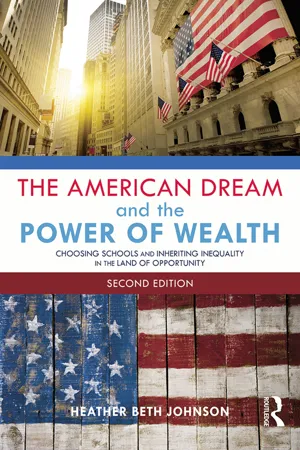
eBook - ePub
The American Dream and the Power of Wealth
Choosing Schools and Inheriting Inequality in the Land of Opportunity
- 252 pages
- English
- ePUB (mobile friendly)
- Available on iOS & Android
eBook - ePub
The American Dream and the Power of Wealth
Choosing Schools and Inheriting Inequality in the Land of Opportunity
About this book
Information
1
THE WEALTH GAP AND THE AMERICAN DREAM
The wealth gap between white and black families in the United States is increasing, not decreasing. When I state this in a lecture, I watch students’ faces look up from notebooks with expressions of skepticism or full-blown disbelief. They come to talk to me after class, then walk with me, slowly moving out of the classroom building along the winding paths of the university to my office, asking me, “How—how can this be? The racial wealth gap is increasing?”
I know it is hard to believe. My students have been told their whole lives that everything is getting better, not worse, where race and class inequality is concerned. They have learned that the civil rights battle was won years before they were born. They know the story of Martin Luther King, Jr., and many can recite sentences of his famous “I Have a Dream” speech. They have witnessed the election and re-election of Barack Obama, the first black president of the United States of America. They have grown up believing that the general principles of equal opportunity, egalitarianism, and inclusiveness are the basis for how our system operates. The concept of an increasing black-white wealth gap in the present-day United States is a hard pill for college students to swallow, not because it reveals that inequality exists—they know that it does—but because it implies a fracture in the American Dream, a recognition of real advantage and disadvantage being passed along categorically to each new generation. To know that certain individuals own less or have achieved more than others is one thing, but to know that whole groups of people are increasingly privileged or constrained by their families’ wealth histories suggests that inequalities are somehow happening systematically. This is contrary to what my students have been taught—that inequity among us is simply the result of differences in individuals’ achievements, that it is not patterned, organized, or structural.
I understand their confusion because I, too, grew up thinking that America was moving closer and closer to resembling a level playing field—especially in regard to race, class, and gender. The message was straightforward and compelling: in the Post–Civil Rights Era we were competing in a fair game with equal chances for success so that, regardless of our backgrounds, whoever worked the hardest would go the furthest. Growing up, my perception was that if it were not entirely true, this message was at least mostly true, and surely truer then than at any time in the past. My parents, my teachers, and everyone else in their generation who conveyed to me this message were justifiably proud of the strides that had been made toward racial justice, equal opportunity, women’s rights, and civil rights. Optimism was high and—notably—not unfounded. Much progress had been (and continues to be) made to dis-mantle the many forms of injustice.
Not unlike the generations of Americans before us, my students and I have been immersed in the culture of a deeply held American Dream. We were told that in this country an individual rises and falls based on personal achievement or lack thereof; that one’s background or family of origin is neither a significant help nor hindrance in the quest for success; and that each of us earns and deserves our relative social positioning. Many a child has been told these things, and the American Dream has surely evolved in various ways over time, but those of us born since the 1950s have grown up in the wake of social movements, groundbreaking court decisions, and unprecedented cultural shifts that have led to a particularly literal interpretation of the American Dream’s theme. Equal opportunity has been presented to us not so much as an ideal but as an achieved reality. A level playing field has been held out to us not so much as a goal but as an actual, legitimate explanation for how our system operates. So, it is not hard to imagine our surprise when we realize that regardless of all we have been taught, despite all our beliefs, things are not exactly what they seem.
To learn that race and class inequality is still happening systematically, and that in fact an historic cleavage such as the racial wealth gap is getting deeper, is to realize that significant sociostructural problems have yet to be solved, and to suspect that there is something wrong with the system. This may force us to examine how much of our own stories are entwined with the privileges or disadvantages that we were born into. To do this is to face the legacies—good and bad—that we have inherited from past generations. This is hard to do in a society so focused on the principle of rising or falling based on individual merit.
This book is about two seemingly paradoxical elements of American life: first, it is about the race and class inequalities related to family wealth that continue to be structured in ways that systematically and categorically advantage some groups while disadvantaging others. Second, it is about the American Dream’s ideology of meritocracy that tells us that everyone—regardless of background—ends up where they do based on their own individual achievement. Both of these are major dimensions of social life in the contemporary United States. Despite how much or little we notice them in our daily lives, each is entrenched in our culture and foundational to life as we know it. In this book I take on what is an often unproblematized contradiction: I ask how Americans make sense of the power of wealth (specifically inherited wealth) given its incompatibility with the principles of the American Dream. While perspectives from across the socioeconomic spectrum are included here, I focus especially on wealthy families, seeking to discern how they reconcile the substantial advantages they confer upon their children with their bedrock belief in meritocracy. In this new edition, I also include the perspectives of children themselves growing up in wealthy, white families. Drawing on research conducted with sociologist Margaret Ann Hagerman, I explore to what extent children believe in the promise of the American Dream and how they explain, justify, and understand the stratification of American society.
Previous literature has documented the patterns of wealth ownership and the statistical contours of the wealth gap. I am not interested in replicating these studies; rather, I am interested in how people make sense of the structure of wealth inequality—especially the intergenerational transfer of wealth in families—given that it flies in the face of the American Dream. How can we claim a commitment to meritocracy even when our own lived experiences often contradict it? How do we acknowledge structured inequality as we teach our children that individual achievement determines life chances? And what do our children think when we offer these lessons? For me, what is most sociologically fascinating is not the ideology of meritocracy itself nor the structure or power of wealth. What is so intriguing is how foundational both are to our society, yet how irreconcilable each is with the other—and, perhaps most important, how rarely we question this paradox. An analysis of how Americans reconcile the American Dream with the power of wealth addresses an important lacuna in the emerging sociological literature on wealth and stratification: the role of ideology. Ideology is a critical component in understanding how race and class inequalities are perpetuated in the contemporary United States because ideology—in how it helps to mask and justify systems of inequality—contributes to the collective denial, and thus maintenance, of structural inequities.
At its heart, this book is about the same basic issues of inequality, power, and consciousness that preoccupied Émile Durkheim, Karl Marx, and Max Weber in what is now known as the canon of “classical social theory” they pioneered in the 1800s. It is also about the same fundamental questions of structural inequality that lie at the heart of much sociology today. It is about my students’ question: How can this be?
How are race and class inequality perpetuated through generations in contemporary American society, despite deep belief in equal opportunity and great efforts to dismantle injustice? In a country that takes pride in being the land of opportunity, how do we continue to justify legacies of wealth inequality that grant opportunities to some groups over others? These questions are important because our beliefs and our actions—what we think and what we do—will impact the extent to which we perpetuate historic dilemmas into the future. Given what we have inherited, what will we pass along to the generations after us?
Race, Class, and Hard Work
In the United States today, approximately 25 percent of children under the age of six are living below the official poverty line, while 49 percent of children in America live in low-income families.1 Many of these children’s parents are desperately impoverished and unemployed, and the plight of these families—often single mothers and their children—is harrowing.2 Perhaps even more troubling, because of the irony, is how many poor children live in homes with at least one working parent; in 2011, 50 percent of poor families were working families.3 Many of these families have worked hard, they have played by the rules, and they are still coming up short. This is especially true during a widespread economic crisis, such as the Great Recession, which data show disproportionately impacted lower-income families in terms of relative losses in wealth holdings.4 The working poor challenge our thinking about inequality in America: if people wind up where they do based on how hard they work, and if 50 percent of the poor are working hard, then why is it that those families are struggling so to even stay afloat? Such questions have been asked often and social scientists have revealed some of the structural arrangements contributing to the predicaments of the working poor;5 only recently, however, have we begun to seriously consider ways that the structure of wealth ties into the dynamics of intergenerational inequality in the contemporary United States.
The sociology of wealth is both an old and a new way to study inequality. For the theorists who pioneered the discipline of sociology, unequal distribution of valued resources and unbalanced relations of property were at the theoretical core of their studies. Marx’s Capital is probably the most famous example.6 Private property ownership was critical to such traditional analyses of inequality because of the command over resources and the power to propel life chances that it granted an individual, family, or group. But over time, especially in the United States, the study of social stratification became almost completely dominated by analyses of labor market dynamics and income inequalities. As a result, in both the academic literature and the mind-set of the American public, the concept of socioeconomic class has been tied almost exclusively to achievement in education, success in the labor market, and earned income. This is so much the case that today we often think of class as equated with household income; and indeed, socioeconomic class is often measured this way. Certainly income greatly impacts most American families’ basic living standards; but, within the framework of traditionally defined socioeconomic status, many questions about the perpetuation of class inequality have remained elusive. To obtain a more comprehensive understanding of class status and class inequalities, researchers have recently begun to look outside the dominant paradigm of income inequality with a renewed interest in examining private family wealth and its impact on framing life chances and basic capacities for an individual or family.7
Class is a fundamental category in social theory. Social class inequality is generally understood as hierarchical cleavages that exist between individuals or groups relative to their economic well-being, status, and life chances in society. But in most recent empirical research, theory, and policy work, class has been measured almost exclusively by education, occupation, and income. A more comprehensive understanding of social class takes multiple dynamics into consideration.8 In addition to level of education, occupation, and income, social class is about the sharing of identities and practices, the ways in which resources are mobilized across generations, and the norms and values that shape behavior.9 Wealth is an important part of such an understanding because wealth involves, for example, inheritance, which is not earned but which has serious implications for resource mobilization, worldviews, life chances, and the intergenerational transmission of inequality.
In the early 1990s, with the publication of Assets and the Poor, Michael Sherraden reintroduced the concept of wealth as a fundamental variable in understanding social class inequality—specifically, the perpetuation of poverty.10 Since then, the study of wealth as a contemporary scholarly subject has fully emerged across disciplines. This work has begun to reveal that, while we typically equate money with earned income, many American families acquire a substantial portion of their financial portfolios through nonmerit sources, mainly in the form of intergenerational transfers of financial assets. While most American households use job earnings to pay for day-to-day necessities (for instance, food, housing, and clothing), wealth, in contrast, often originates from family financial assistance, gifts, or inheritance and becomes a way to create opportunities, shape life experiences, and ensure the future. Family wealth can propel a family’s mobility, access important resources for the next generation, and cultivate a sense of security. A focus on wealth creates a new paradigm for understanding social inequality in fundamentally important ways. It sheds light on some of the dynamics and patterns of contemporary inequality that are masked if we study income alone. It reveals certain advantages that are not earned by individuals per se, but received through families. It allows us to see an historic and persisting wealth gap as a significant sociostructural problem.11
The structure of wealth inequality in the United States is, and always has been, extremely unbalanced, more unbalanced than income inequality. Wealth inequality is more extreme in this country than in any European country or industrial society.12 In her analysis of wealth patterns in the United States, sociologist Lisa Keister found that “while disparities in income and educational attainment are extreme, disparities in the ownership of wealth are likely worse and apparently more enduring across generations.”13 In 2010, the top 1 percent of wealth holders in the United States owned approximately 35 to 37 percent of wealth, and the top 10 percent of wealth holders in the United States owned approximately 80 percent of all wealth.14 Due to the intergenerational dimension of family wealth, these holdings are continually expanding and amassing.15 In this, the wealthiest country on earth, some children grow up with lux...
Table of contents
- Cover
- Title
- Copyright
- Dedication
- Contents
- Preface and Acknowledgments to the Second Edition
- 1 The Wealth Gap and the American Dream
- 2 Meritocracy and “Good” Schools
- 3 Buying In and Opting Out
- 4 Making Do and Feeling Stuck
- 5 Wealth Privilege
- 6 Inequality and Ideology
- 7 An Unresolved Conflict
- Appendix: Methodology
- Bibliography
- Index
Trusted by 375,005 students
Access to over 1.5 million titles for a fair monthly price.
Study more efficiently using our study tools.
Frequently asked questions
Yes, you can cancel anytime from the Subscription tab in your account settings on the Perlego website. Your subscription will stay active until the end of your current billing period. Learn how to cancel your subscription
No, books cannot be downloaded as external files, such as PDFs, for use outside of Perlego. However, you can download books within the Perlego app for offline reading on mobile or tablet. Learn how to download books offline
Perlego offers two plans: Essential and Complete
- Essential is ideal for learners and professionals who enjoy exploring a wide range of subjects. Access the Essential Library with 800,000+ trusted titles and best-sellers across business, personal growth, and the humanities. Includes unlimited reading time and Standard Read Aloud voice.
- Complete: Perfect for advanced learners and researchers needing full, unrestricted access. Unlock 1.5M+ books across hundreds of subjects, including academic and specialized titles. The Complete Plan also includes advanced features like Premium Read Aloud and Research Assistant.
We are an online textbook subscription service, where you can get access to an entire online library for less than the price of a single book per month. With over 1.5 million books across 990+ topics, we’ve got you covered! Learn about our mission
Look out for the read-aloud symbol on your next book to see if you can listen to it. The read-aloud tool reads text aloud for you, highlighting the text as it is being read. You can pause it, speed it up and slow it down. Learn more about Read Aloud
Yes! You can use the Perlego app on both iOS and Android devices to read anytime, anywhere — even offline. Perfect for commutes or when you’re on the go.
Please note we cannot support devices running on iOS 13 and Android 7 or earlier. Learn more about using the app
Please note we cannot support devices running on iOS 13 and Android 7 or earlier. Learn more about using the app
Yes, you can access The American Dream and the Power of Wealth by Heather Johnson,Heather Beth Johnson in PDF and/or ePUB format, as well as other popular books in Social Sciences & Social Classes & Economic Disparity. We have over 1.5 million books available in our catalogue for you to explore.