Many practitioners consider setting up in private practice at some point in their career, whether full-time or alongside other employment. The Essential Skills for Setting Up a Counselling and Psychotherapy Practice provides comprehensive yet accessible coverage of all the major skills needed to succeed. Based on the authors' extensive experience, this book provides a valuable insight into how to minimise the risks associated with working privately, offering practical advice on how to keep a balance between self-development, personal health and meeting the needs of clients, whilst maintaining high standards and making a reasonable living. Acknowledging the fact that being a good therapist may not, in itself, be sufficient to be successful in self-employment, the authors discuss the need for sound business skills, professional development, self-knowledge and motivation. Divided into three sections, the book covers all the essential business, professional and personal skills and includes discussion of subjects such as insurance, finance, legal issues, marketing, stress management, security and retirement planning.
The focus on skills and how to acquire and develop them makes this book an invaluable reference for all mental health professionals who are considering setting up their own private practice. This book will prove to be an invaluable reference for all mental health professionals who are considering setting up their own private practice.
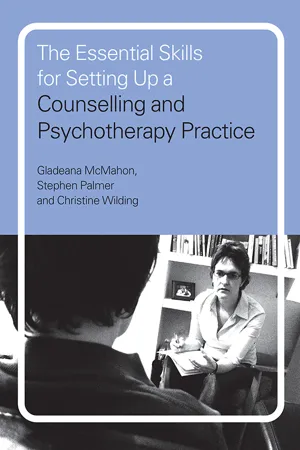
eBook - ePub
The Essential Skills for Setting Up a Counselling and Psychotherapy Practice
- 160 pages
- English
- ePUB (mobile friendly)
- Available on iOS & Android
eBook - ePub
The Essential Skills for Setting Up a Counselling and Psychotherapy Practice
About this book
Information
Part One
The business skills
What Makes some Businesses Successful and Others Fail?
This is a fundamental question on which many books have been written and will continue to be written. Most people will be aware of the closure of coalmines, steelworks or shipyards and have noticed shops boarded up in depressed areas. What is not so visible is the failure of many small businesses run from private homes or small premises. It is not that such businesses necessarily go bankrupt, rather that the owners give up as they see the inevitability of bankruptcy, in an attempt to cut their losses.
Yet in many cases such disappointments are avoidable. The first useful business skill to be acquired lies in your ability to appreciate what makes the difference between success and failure, and in applying this knowledge to your own private practice.
First, it is worth looking at some of the reasons why a private practice may fail.
Why practices fail
The original idea was not thought through
When his partner left him, Alan remained in a nicely furnished two-bedroom flat on the eighth floor of a tower block. An accredited therapist, he decided to convert the second bedroom into a consulting room and office and start his own private practice. Three months later he gave up paid employment and started advertising for clients.
The initial response was good and his appointment book started filling up. However, he was surprised at the number of potential clients who never turned up for the first meeting and also at how very few clients, particularly women, persisted beyond the first one or two sessions.
He discussed his cases and his concerns with his supervisor. He shared his thoughts with a colleague and it was his colleague who pointed out the possibility that the unattractive environment where Alan lived could be part of the problem. The lift was often out of order, there was graffiti and although there was never any real trouble there were some dubious characters hanging around. Alan had failed to see his environment through the eyes of his potential clients and realised he could not run a successful practice from his present home.
When Alan rented a room at a local complementary health centre he found his clients turned up and stayed the course.
Insufficient income
Lucy was a lone parent who ran a busy private practice while her daughter was at school. Typically, she was able to see five clients a day, five days a week, for forty weeks in the year. Most of her clients could afford no more than between £10 and £15 per session. After subtracting the costs of running her business, Lucy realised that she would be just as well off drawing unemployment and other related benefits. She gave up private practice and joined a voluntary organisation as a paid therapist.
Insufficient working capital
Hearing of the experiences of Alan and Lucy, Katherine was determined to learn from their experiences to make a success of private practice. She found premises in a very pleasant location at a rent of £400 per month and signed a twelve-month tenancy agreement. She saw her bank manager and managed to get an unsecured loan of £4,000 repayable over two years; £3,000 of the loan went on the deposit on the premises, a computer, furniture and furnishings and general office items, leaving £1,000 ‘to be on the safe side’. She decided she would charge clients £25 per session.
Katherine had moved back home to live with her parents when her relationship broke down and she reckoned she could manage on living expenses of £500 a month. Her parents were happy to support her in her business venture as they could see the long-term advantages for their daughter. What could go wrong?
Clients started arriving, paid their fees and remained for repeat sessions. Katherine felt encouraged. However, although client numbers were steadily increasing they were not doing so as quickly as Katherine had imagined they would. She was surprised at how quickly the spare £1,000 from her bank loan disappeared, even though she had been very strict with her own personal expenditure.
After three months Katherine had run out of cash and was concerned with regard to her tenancy agreement. She reviewed her income and expenditure. Her records showed:

Faced with a drop in income over the Christmas period, the cancellation of a skiing holiday in January, the exhaustion of her own remaining personal savings and the probable sale of her car, Katherine approached her landlord, who agreed to cancel her lease in return for retaining the initial deposit. The bank loan repayments were rescheduled over a longer time period and Katherine arranged for colleagues to take over her clients.
Insufficient financial control
Nicole was a very popular therapist and she had no problem keeping her clients even though her fees were high, but she was not very good at bookkeeping and at year-end there was a mad panic to sort out her accounts. Although she had worked on a range of personal issues in her own therapy, her impoverished childhood still showed itself in her wallet full of credit cards being used to the limit.
Needless to say, matters took a turn for the worse when demands for payment were not met. Fortunately, she acquired a business partner who took control of the financial side of the business.
Insufficient skills
Arthur was in his early fifties and, although he had no formal training in counselling, he helped out in his spare time at his local church and for various charities. People found him an empathic and helpful person and he was seen as an asset to the organisations he worked for. His clerical job in local government gave him no satisfaction and when he was made redundant he decided to convert his deceased mother’s bedroom into a consulting room and advertise his services as a therapist.
Arthur had no idea of what he should be charging or how to deal with the majority of clients who came his way. The realities of working with a range of clients challenged his abilities and this saddened him because he had thought he would be able to offer a good service to his clients. He soon came to realise that he was out of his depth and, feeling shaken and demoralised, he gave up his private work.
Lack of motivation and energy
Patrick was a laid-back therapist always putting off ‘till tomorrow what he should do today’. Early-morning clients would sometimes surprise him before he had dressed or washed. His consulting room was a mess for which he was always apologising. Client files were left lying around and one client took great exception to this and complained to Patrick’s professional association about his behaviour. The resulting investigation was more than he could handle; he gave up counselling and drifted into a series of part-time jobs.
Hard-working and conscientious to the point of breakdown
Petra took on every client who came her way, most with deep-seated problems. She found it hard not to feel personally responsible and was conscientious in the extreme. Her clients could ring her at any time and did, frequently late at night. Although she was working with her supervisor on the issue of therapeutic boundaries, she was finding this a difficult issue to manage. Over a five-year period, due to circumstances outside her control, she received supervision from four different supervisors and the issue of therapeutic boundaries never got resolved.
In the end, Petra suffered from burnout and her income dried up as she felt unable to cope with client work. She took a routine nine-to-five job where she could switch off when her work was over and devote more time to her own needs.
Family pressures
Jane decided to run her own practice when both her children were at primary school. She was well organised and the extra money helped to pay for holidays, home improvements and treats for the children. Although reluctant at first, her husband was happy that she was finding fulfilment in her counselling work, and it took the pressure off him to be the sole provider. Jane’s mother lived nearby and helped out with the children during the holidays.
This arrangement worked well until Jane’s mother suffered a stroke and wasn’t able to help out. The children wanted their friends to visit and it was difficult to contain the noise in a small house. The hours Jane was able to devote to clients in a peaceful atmosphere reduced to the point where it was hardly worth the effort. It became very difficult to manage family and client needs at the same time. In the end Jane gave up her private practice but resolved to return to it when the children had effectively left home.
The wrong location
Jack was a keen sailor with his own boat. He devoted weekends, holidays and most of his spare money to sailing. When the opportunity came to move to a seaside resort with a marina, Jack jumped at the chance.
Up to that time Jack had worked as a self-employed therapist in a large city, where the problem was how to fit in the large numbers of clients who presented themselves. Starting again in the more relaxed environment of a seaside town with a large population of older retired people, Jack was surprised at the small number of clients he was able to attract.
In a bid to drum up more business, he cut his fees substantially, but with little effect. There just didn’t seem to be the same demand for fee-paying counselling services. Fortunately, his sea-going and boat-repair skills were in great demand and sufficient to provide a modest living.
Bad luck
Elspeth was set for a promising career in private practice counselling. Talented and hard-working, she had everything going for her.
One summer’s evening, driving home, she collided with a stolen car driven through red lights by two teenagers. Apart from the severe physical injuries that stopped her working for six months, she also suffered from post-traumatic stress disorder, which completely undermined her self-confidence, and she experienced frequent panic attacks together with a range of other symptoms that prevented her from doing counselling work for a long time afterwards.
Conclusion
The above vignettes illustrate some of the reasons why a private practice may fail. Although, clearly, they are not comprehensive, it can be seen that a number of factors are involved in the provision of a successful practice. These include personal factors, such as the motivation and skills of the therapist, financial factors, such as the generation of sufficient income and the control of expenses, and environmental factors such as location and ambience.
All these factors and more will be covered in this section. First, let’s look at the personal characteristics of a successful business person and see what relevance these might have for a therapist running a private practice.
The personal characteristics of a successfu...
Table of contents
- Cover
- Half Title
- Title Page
- Copyright Page
- Table of Contents
- Dedication
- Preface
- Introducton
- 1. The business skills
- 2. The professional skills
- 3. Personal self-management skills
- Postscript
- References
- Recommended reading
- Useful addresses
- Index
Trusted by 375,005 students
Access to over 1.5 million titles for a fair monthly price.
Study more efficiently using our study tools.
Frequently asked questions
Yes, you can cancel anytime from the Subscription tab in your account settings on the Perlego website. Your subscription will stay active until the end of your current billing period. Learn how to cancel your subscription
No, books cannot be downloaded as external files, such as PDFs, for use outside of Perlego. However, you can download books within the Perlego app for offline reading on mobile or tablet. Learn how to download books offline
Perlego offers two plans: Essential and Complete
- Essential is ideal for learners and professionals who enjoy exploring a wide range of subjects. Access the Essential Library with 800,000+ trusted titles and best-sellers across business, personal growth, and the humanities. Includes unlimited reading time and Standard Read Aloud voice.
- Complete: Perfect for advanced learners and researchers needing full, unrestricted access. Unlock 1.5M+ books across hundreds of subjects, including academic and specialized titles. The Complete Plan also includes advanced features like Premium Read Aloud and Research Assistant.
We are an online textbook subscription service, where you can get access to an entire online library for less than the price of a single book per month. With over 1.5 million books across 990+ topics, we’ve got you covered! Learn about our mission
Look out for the read-aloud symbol on your next book to see if you can listen to it. The read-aloud tool reads text aloud for you, highlighting the text as it is being read. You can pause it, speed it up and slow it down. Learn more about Read Aloud
Yes! You can use the Perlego app on both iOS and Android devices to read anytime, anywhere — even offline. Perfect for commutes or when you’re on the go.
Please note we cannot support devices running on iOS 13 and Android 7 or earlier. Learn more about using the app
Please note we cannot support devices running on iOS 13 and Android 7 or earlier. Learn more about using the app
Yes, you can access The Essential Skills for Setting Up a Counselling and Psychotherapy Practice by Gladeana McMahon,Stephen Palmer,Christine Wilding in PDF and/or ePUB format, as well as other popular books in Psychology & Small Business. We have over 1.5 million books available in our catalogue for you to explore.