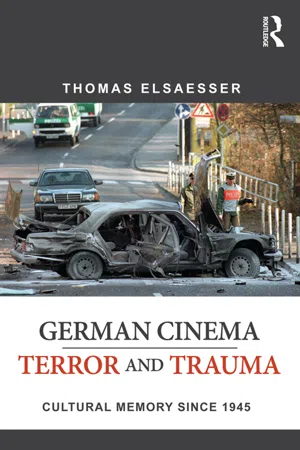
In German Cinema – Terror and Trauma Since 1945, Thomas Elsaesser reevaluates the meaning of the Holocaust for postwar German films and culture, while offering a reconsideration of trauma theory today. Elsaesser argues that Germany's attempts at "mastering the past" can be seen as both a failure and an achievement, making it appropriate to speak of an ongoing 'guilt management' that includes not only Germany, but Europe as a whole. In a series of case studies, which consider the work of Konrad Wolf, Alexander Kluge, Rainer Werner Fassbinder, Herbert Achterbusch and Harun Farocki, as well as films made in the new century, Elsaesser tracks the different ways the Holocaust is present in German cinema from the 1950s onwards, even when it is absent, or referenced in oblique and hyperbolic ways. Its most emphatically "absent presence" might turn out to be the compulsive afterlife of the Red Army Faction, whose acts of terror in the 1970s were a response to—as well as a reminder of—Nazism's hold on the national imaginary. Since the end of the Cold War and 9/11, the terms of the debate around terror and trauma have shifted also in Germany, where generational memory now distributes the roles of historical agency and accountability differently. Against the background of universalized victimhood, a cinema of commemoration has, if anything, confirmed the violence that the past continues to exert on the present, in the form of missed encounters, retroactive incidents, unintended slippages and uncanny parallels, which Elsaesser—reviving the full meaning of Freud's Fehlleistung—calls the parapractic performativity of cultural memory.
- 352 pages
- English
- ePUB (mobile friendly)
- Available on iOS & Android
eBook - ePub
About this book
Information
PART I
Terror, Trauma, Parapraxis
1
TERROR AND TRAUMA
The Changing Meanings of Terror and Trauma
Terror and trauma—two words already used up from overexposure before one knew what they came to mean. Since 9/11 they have become part of the political discourse without having necessarily been coined for political use; too often they serve to emotionalize violent incidents, and they bank on the rhetorical effects triggered by their opposition. Sometimes they are the words that make one speechless before horrific suffering, whether in the face of almost inconceivably cruelty, or by the sheer number of victims of hate and revenge, or of chance and arbitrariness. The Holocaust and 9/11, the Bali suicide bombings or the Breivik shootings in Norway are embedded in collective memory not least because of the scale of the lives senselessly sacrificed. On other occasions, the words stir up passion and generate heat, without the heat shedding much light. They can cut off debate or silence dissent, when distinctions should be made, when causes have to be addressed, and the reasons for violence or the cycles of retribution also need to be identified. However, these realities come to most of us in and through images, so that speaking in one breath of terror and trauma carries the risk of leaving physical violence indistinguishable from symbolic, somatic and semantic violence.1
Their everyday inseparability makes of terror and trauma the Siamese twins of a contemporary political and media discourse. They are in this chapter thought and brought together, precisely because of their by no means self-evident intimacy, as well as the duty to separate between them. For instance, are the two concepts transitive, implying causal agency, or do they behave intransitively, merely giving a name to an intangible nexus of situations and affects, without object, aim or origin? Together they evoke both the state of emergency so keenly felt in the Western world over the past decades, and the sense of paralysis—political, but also intellectual—that this state of emergency seems to have provoked. Often, it is not even clear who is inducing the panic and to what end the paralysis: is it the conspiratorial determination of the right, to use the politics of fear in order to retain or regain power, or the exhaustion and indecision of the liberal (United States) and social-democratic (Europe) left, secretly aware of being short of answers?
Second, terror and trauma are here brought together because they apply to Germany in a very specific context, where several generations of historical agents, and several frames of reference cross and intersect, having to do with the special kinds of remembering and forgetting, persistent returns, absence and presence I will in the following call the afterlife. The afterlife, or rather, the many different afterlives, I am referencing are the state terror of the Hitler regime, the traumatic destructiveness of WW II, the murder of the Jews, and the acts of terror committed by the Red Army Faction (RAF), one of whose declared aims it was to provoke into visibility what they saw as the hidden state terror of the West German government. These events, their sequence, and also their apparently cyclical return have implanted themselves in the collective mind, to the point of now being part of Germany’s national identity. “Afterlife,” “memory” and “identity” can in fact serve as key components of a preliminary definition of “trauma,” as it is being used in this context.
Finally, the words terror and trauma suggest particular strategies of representation and communication, in which agency is highly symbolic and mediated, as well as utterly physical and direct. This applies to trauma’s relation to memory, of which it is an exacerbated and peculiarly embodied manifestation, and it applies to terror, as above all the means for communicating a message in the language of extreme violence. “Terror,” it will be recalled, comes from a Latin root, meaning “to cause to tremble,” which is to say, it names not just an agent or cause (the “terrorist”) but also the effect on the recipient: trembling being the physical sign of the state of mind we usually call fear, though it can also be the opposite, trembling with rage. Terrorism, as usually understood, is above all a method of per- and dis-suasion—“propaganda by the deed”2 or “propaganda by violent means” as Ian Buruma described it3 and even as a method of direct action, it has the structure of a complex communication: unlike another violent method of persuasion, torture, which involves a one-on-one situation, an act of terror does one thing (it kills people), in order to achieve something else (to strike fear into an adversary or a civilian population), but the fear is itself only a means to an end: to deliver a message of power, resolve, ubiquity, invincibility. Involving means and ends, methods and ideologies, messages and intermediaries, it is a form of communication between two antagonists, via a third; this third is not the victim (instrumentalized and degraded to the status of collateral damage), but the fear inculcated in the survivor or spectator. Meant to produce images, whose scale, traumatizing violence and shock is addressed to an audience, terrorism is a form of agency, but it is also parasitic on an entity already in place: a community, a public sphere, a ready mediascape and technologies able to record and disseminate the image-messages generated by acts of terror whose long-term effects (of repetition, iteration, replay) are also intended to be traumatic. Put in a nutshell: terrorism consists of material speech-acts, whose mode of performativity is trauma.
Terror and trauma inscribe themselves in cycles, but also in perversely self-renewing “dialogues” of blow and counterblow, where the means often stand in tragic discrepancy to the effects achieved, and a literally shocking asymmetry connects intentions and consequences. Their common support, platform or stage have been, since the 1970s, the mass media, at first television and then the Internet, but also the discourses, narratives and regimes, through which these messages are interpreted and given meaning.
Terror and trauma, however, should not be thought of together too automatically, as in several ways they do not belong together. Each term has a range of meanings, and each has gained topical currency under quite different historical and political constellations.4 Terrorism means something different when referring to the Federal Republic of Germany in the 1970s, than it does in the Israel-Palestinian conflict, as it flared up in the late 1980s in the occupied territories, and then since 2000, when, after the dashed hopes of the Oslo Agreements, the second Intifada made resistance to occupation descend into the squalor and horror of the suicide bombings against civilian targets.
Terror once more changed scope and reference after September 2001, in the post-9/11 world, when the United States decreed a global “war on terror,” introducing terms such as axis of evil and a language of confrontation and Manichean dualism that, for most Europeans, inadmissibly covered over these differences, by polarizing an already dangerously polarized world into those “with us” and those “with the terrorists,” when, for instance, it would make just as much—if not more—sense to polarize between the “haves” and the “have-nots,” or “the included” and “the excluded.” If terror was the new prism through which we were asked to understand the contemporary world, and by which the priorities of the political scenario-agendas were set, then we needed to know what was the field of force into which it inscribed itself (the “clash of civilizations,” “the fight for oil,” “democracy”?) and which other modes of action (and response) it thereby stifled, blocked and obliterated. In all the interminable debates, was there still a discursive space to even begin to try and understand not only what terror’s “causes” were, but also “historicize” the meaning of the term, without being accused of condoning the acts? What, for instance, happened to the term resistance—the key word of several generations of political actors in the twentieth century, and one with overwhelmingly positive connotations? To call all uses of violence not sanctioned by the state “terror” is already to assume the terrain as defined, when it is precisely this definition that is at issue: the use of the term has created an “outside,” from which it is unassailable, and an “inside” that feels for most of us (not only in Europe) unacceptably self-defensive, emotionally claustrophobic and politically reactionary.5
Trauma, too, has come back into discussion under different signs and conditions: it referred first to the anguish of the victims of the Holocaust, haunted by what they had witnessed and were not allowed to forget; what they tried to work through or find relief from: initially, the indifference of the world at large about the reality of the camps; then the lack of justice and retribution handed out to the perpetrators; last and not least, it referred to the guilt feelings of those having survived. In a quite different context, trauma became a political issue in the United States, when in 1980 the American Psychiatric Association recognized post-traumatic stress disorder (PTSD) as a clinical symptom among Vietnam War veterans, creating a medical-legal basis for seeking redress: several other constituencies of victims (rape victims, child abuse victims, victims of other forms of domestic violence and social discrimination) began seeking attention for their suffering from the consequences of actual or imagined “traumas.” Since the 1990s, trauma and its associated or emerging theories have become part of a cultural discourse, as opposed to a medical, legal or psychoanalytical one, hinting at larger shifts in the relation between consciousness, self-perception, the senses and the body, but also temporality, identity and subjectivity. Trauma with respect to history, memory, witnessing and evidence, has found an increasingly wide echo in the arts, theater, the cinema, in literature and philosophy.6
If separate and simultaneous, terror and trauma also belong together, however, because there exist a number of reciprocal relationships that have to be worked out if one is to make sense of some of the broader parameters just sketched. These reciprocities have at least two distinct dimensions: to begin with, there is the uncertain relation of cause and effect. At first sight, it seems that one (terror) is the cause, and the other (trauma) the effect: those subjected to terror are also the ones suffering from trauma. As indicated above, the purpose of terror is not so much to destroy lives or property, but to create—by an act of (self-) destruction—those survivors and witnesses whom the act traumatizes. But does trauma always follow terror, or is it conceivable that terror may be the consequence of trauma? Here, opinion is sharply divided, and the respective political options soon narrow and diverge. Can there be the “trauma of occupation” or the “trauma of daily humiliation” or the trauma of “absolute alienation” to which acts of terror become the desperate but, some would claim, also desperately effective responses? Is this line of reasoning permissible at all, or does it excuse the unpardonable—the sacrifice of innocent lives—by trying to rationalize it and dignify it with an explanation? Is there such a thing as state terrorism, which actually provokes terrorist acts? Who, conversely, benefits from the counter-terrorism legitimized by retaliatory cycles? Or is state terrorism by definition counter-terrorism, naming merely an obligation that invariably accrues to the state, whose prime task it is to protect its citizen? But what if there is no state, either because a people has to live in a “failed state,” a state that harms its citizen, or, as in some cases, a people that has no state of their own, let alone one that could protect them?
Asymmetry, Auto-Immunity, Risk and Reflexivity
A second kind of reciprocal relation between terror and trauma can be established. It is not causal but names asymmetrical, intertwined power relations, when the mutual implication and possible reversibility of victim and perpetrator are at stake: intuitively repugnant to contemplate and yet difficult to repudiate in certain circumstances.7 An example of such antagonistic reciprocity would be the assumption—paranoid from one perspective, the natural effect of networks from another—that the respective positions of victim and perpetrator are both masterminded, with those pulling the strings resolutely remaining off-stage.8 In R.W. Fassbinder’s DIE DRITTE GENERATION/THE THIRD GENERATION (1979), an industrialist, played by Eddie Constantine, and a police inspector, in charge of providing him with protection (Hark Bohm), share a joke: namely that it was capitalism itself that had invented terrorism, in order to force the state to better safeguard capital’s interests. Alternatively, the controlling instance may be inherent in the situation, rather than operating from outside. After 9/11 Jacques Derrida and Jürgen Habermas had a famous dialogue, resulting in a book called Philosophy in a Time of Terror. There, Derrida voiced the opinion that terrorism has now become an “autoimmunity disorder,” with the seeds of 9/11 having been
produced by the United States during the Cold War and after, a kind of “suicide of those who welcomed, armed and trained [the terrorists].” [The terrorists’ act is] a product of that which it rejects, mirror image of its target. […] The prognosis is sombre: product of the violence that seeks to suppress it, terrorism created a trauma that cannot be relieved by mourning because the heart of the trauma is not the past event but the fear for the future event whose catastrophic nature can only be guessed. Imagination is here fed by the media, without which there would have been no “world-historical event” in the first place. The circle is almost unbreakable: terrorism and that which it is against are locked in a reciprocal game of destruction where causes may no longer be distinguished from consequences.9
Derrida describes here, in so many words, the logic that made the Reverend Jeremiah Wright infamous in 2008, when he quoted Ambassador Peck quoting Malcolm X on Fox News in 2001: “America’s chickens are coming home to roost.” Fassbinder, Baudrillard, Derrida, the Reverend Wright: subversive jokers in dubious taste, or tellers of unpalatable, tabooed truths? The moves and counter-moves that for Derrida come together in the event of 9/11 and its aftermath—retrospectively rewriting for us the forty-five years of post-war history preceding it—have all contributed to joining terror and trauma in a hitherto unprecedented way. First, in order to combat the Soviet Union via proxy, the United States itself armed and trained the Islamist militants, helping to create the religious fundamentalists and post-ethnic local and tribal identities that then turned against the West.10 What has made the situation worse than it was during the Cold War, more volatile and unpredictable was the Fall of the Wall in 1989, since “deterrence” and the single enemy no longer maintained a (symmetrical) balance of terror between two superpowers. Once power-relations became asymmetrical, and adversaries acted not out of self-preservation but staked their own lives (along with the lives of others), conflicts took on...
Table of contents
- Cover
- Half Title
- Title Page
- Copyright Page
- Table of Contents
- Introduction: Terror and Trauma
- PART I Terror, Trauma, Parapraxis
- PART II Parapractic Poetics in German Films and Cinema
- PART III Trauma Theory Reconsidered
- Selected Bibliography
- Acknowledgments
- Index
Trusted by 375,005 students
Access to over 1.5 million titles for a fair monthly price.
Study more efficiently using our study tools.
Frequently asked questions
Yes, you can cancel anytime from the Subscription tab in your account settings on the Perlego website. Your subscription will stay active until the end of your current billing period. Learn how to cancel your subscription
No, books cannot be downloaded as external files, such as PDFs, for use outside of Perlego. However, you can download books within the Perlego app for offline reading on mobile or tablet. Learn how to download books offline
Perlego offers two plans: Essential and Complete
- Essential is ideal for learners and professionals who enjoy exploring a wide range of subjects. Access the Essential Library with 800,000+ trusted titles and best-sellers across business, personal growth, and the humanities. Includes unlimited reading time and Standard Read Aloud voice.
- Complete: Perfect for advanced learners and researchers needing full, unrestricted access. Unlock 1.5M+ books across hundreds of subjects, including academic and specialized titles. The Complete Plan also includes advanced features like Premium Read Aloud and Research Assistant.
We are an online textbook subscription service, where you can get access to an entire online library for less than the price of a single book per month. With over 1.5 million books across 990+ topics, we’ve got you covered! Learn about our mission
Look out for the read-aloud symbol on your next book to see if you can listen to it. The read-aloud tool reads text aloud for you, highlighting the text as it is being read. You can pause it, speed it up and slow it down. Learn more about Read Aloud
Yes! You can use the Perlego app on both iOS and Android devices to read anytime, anywhere — even offline. Perfect for commutes or when you’re on the go.
Please note we cannot support devices running on iOS 13 and Android 7 or earlier. Learn more about using the app
Please note we cannot support devices running on iOS 13 and Android 7 or earlier. Learn more about using the app
Yes, you can access German Cinema - Terror and Trauma by Thomas Elsaesser in PDF and/or ePUB format, as well as other popular books in Media & Performing Arts & Film History & Criticism. We have over 1.5 million books available in our catalogue for you to explore.