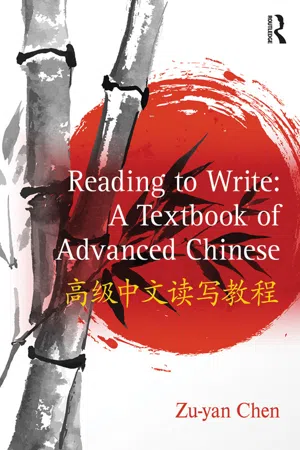
Reading to Write: A Textbook of Advanced Chinese
eBook - ePub

Reading to Write: A Textbook of Advanced Chinese

  1. 146 pages
  2. English
  3. ePUB (mobile friendly)
  4. Available on iOS & Android
eBook - ePub

Reading to Write: A Textbook of Advanced Chinese

About this book

Traditionally, reading and writing are believed to be separate but related language processes and teachers follow the conventional wisdom of teaching in-depth reading, with writing as a tag-on issue.

Therefore, there exists an increasingly urgent call for a well-rounded reading-writing curriculum and a theoretically-informed, empirically-based, student-centered advanced textbook that aims to develop the synergy between reading and writing. Reading to Write: A Textbook of Advanced Chinese is intended to fill this significant gap. It treats reading and writing as integrative parts and interactive skills in Chinese language teaching, putting them hand-in-hand, supplementing each other.

Frequently asked questions

Yes, you can cancel anytime from the Subscription tab in your account settings on the Perlego website. Your subscription will stay active until the end of your current billing period. Learn how to cancel your subscription.
No, books cannot be downloaded as external files, such as PDFs, for use outside of Perlego. However, you can download books within the Perlego app for offline reading on mobile or tablet. Learn more here.
Perlego offers two plans: Essential and Complete
  • Essential is ideal for learners and professionals who enjoy exploring a wide range of subjects. Access the Essential Library with 800,000+ trusted titles and best-sellers across business, personal growth, and the humanities. Includes unlimited reading time and Standard Read Aloud voice.
  • Complete: Perfect for advanced learners and researchers needing full, unrestricted access. Unlock 1.4M+ books across hundreds of subjects, including academic and specialized titles. The Complete Plan also includes advanced features like Premium Read Aloud and Research Assistant.
Both plans are available with monthly, semester, or annual billing cycles.
We are an online textbook subscription service, where you can get access to an entire online library for less than the price of a single book per month. With over 1 million books across 1000+ topics, we’ve got you covered! Learn more here.
Look out for the read-aloud symbol on your next book to see if you can listen to it. The read-aloud tool reads text aloud for you, highlighting the text as it is being read. You can pause it, speed it up and slow it down. Learn more here.
Yes! You can use the Perlego app on both iOS or Android devices to read anytime, anywhere — even offline. Perfect for commutes or when you’re on the go.
Please note we cannot support devices running on iOS 13 and Android 7 or earlier. Learn more about using the app.
Yes, you can access Reading to Write: A Textbook of Advanced Chinese by Zu-yan Chen in PDF and/or ePUB format, as well as other popular books in Languages & Linguistics & Languages. We have over one million books available in our catalogue for you to explore.

1 第一课 Writing about events, part one

记事篇上

1.1 Writing guide 写作指导

Key elements of event writing 记事要素

记叙文有六个要素:时间、地点、人物、事件的起因、经过和结果。
一个事件总是在一定的时段中发生、发展和变化。比如,上午、下午、晚上是一天的时段;上课前、上课时、下课后是一节课的时段;童年、少年、青年是人生的时段。以时间为序,组织材料,叫顺叙。用顺叙的法子,可以把事件的起因、经过和结果交代得很清楚。有时也可用倒叙,使文章结构富于变化,造成悬念,引人入胜。
不管用哪种法子,文笔一定要生动。此外,要通过对事件的叙述和描写,直接或间接地表达作者的思想。
Narratives have six key elements: time, place, character, as well as an event’s cause, progression, and result.
An event always occurs, develops, and changes within a certain time frame. For example, morning, afternoon, and night are time periods within a day; before class begins, during class, and after class ends are class time periods; childhood, adolescence, and young adulthood are stages of life. Organizing material in order of the time of occurrence is called narrating in chronological order. By implementing this method of recounting events in chronological order, it’s possible to account for cause, progression, and result very clearly. Sometimes one may also use flashback, which makes a composition even richer in structural change in addition to causing suspense and leading the reader to find the piece more interesting.
Regardless of which type of method is used, the style of writing must be lively. Furthermore, through the narration and description of an event, one must express the author’s thoughts directly or indirectly.

词汇一

1
指导
指導
zhǐdǎo
instruction, guide
2
记叙文
記敘文
jìxùwén
narrative
3
要素
yàosù
key element
4
事件
shìjiàn
event, incident
5
起因
...

Table of contents

  1. Cover
  2. Half Title
  3. Title
  4. Copyright
  5. Contents
  6. Acknowledgements 鸣谢
  7. Preface 前言
  8. User’s guide 使用说明
  9. 1 Writing about events, part one: 记事篇上
  10. 2 Writing about events, part two: 记事篇下
  11. 3 Writing about people: 写人篇
  12. 4 Writing about scenery, part one: 绘景篇上
  13. 5 Writing about scenery, part two: 绘景篇下
  14. 6 Writing about feelings: 抒情篇
  15. 7 Persuasive writing: 议论篇
  16. Appendices 附录
  17. Vocabulary index 词汇索引