- 256 pages
- English
- ePUB (mobile friendly)
- Available on iOS & Android
eBook - ePub
About this book
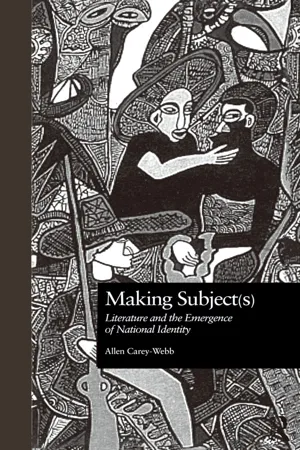
Considering a wide range of cultural materials and engaging in a close reading of literary texts, this book draws a compelling comparison between national identity in Europe and the Third World. The author explores historical periods of nation building in Europe (Early Modernism) and the postcolonial world (post-1945 decolonization) to demonstrate that intriguingly similar circumstances of imperial rule, linguistic diversity, and educational systemization facilitated the emergence of national consciousness in both European and non-European countries. By bringing the insights of postcolonial studies to classic canonical dramas of Shakespeare and Lope de Vega, the author describes the impact of New World colonial encounters on Spanish and English national formation and self-conception. This book is the first to investigate the rich intertextuality of El Nuevo Mundo (Spain, 1601) and The Tempest (England, 1611). Turning to Ousmane Sembene and Salman Rushdie-perhaps the two most important postcolonial writers-this study shows how their finest novels write back to the European tradition of Lope and Shakespeare and simultaneously represent the trend of postcolonial literature from assertive anticolonial nationalism to postmodern national critique. Tracing developments in the study of nationalism and literature from Louis Althusser and Benedict Anderson through Frederic Jameson, Homi Bhabha, and Partha Chatterjee, the book's introduction serves as a lucid guide to a central problem in contemporary cultural studies for the general reader or the specialized scholar. Juxtaposing Renaissance etchings, traditional African and Indian sculpture, 19th-century political cartoons, and intriguing works of contemporary art, Making Subject(s) is of unusual interest and visual appeal.
Information
CHAPTER 1
Introduction
Subjects of Empire and Nation
We have made Italy, now we have to make Italians.
Massimo d’Azeglio
I pledge allegiance to the flag of the United States of America and to the republic for which it stands, one nation under God, indivisible, with liberty and justice for all.
Francis Bellamy
Today the nation-state system is the triumphal form of political and cultural organization across the globe. Everyone on earth is a national citizen. As scholars have recently pointed out, the phenomenon of national states and cultures is, given its remarkable ascendancy, a relatively new development. Many countries are less than fifty years old, and, even in Europe, the Age of Nationalism is thought to be as close to us as the nineteenth century. Yet national peoples and national territories emerged both prior to and significantly after the 1800s. Indeed, the stage was set for the creation of modern nations in western Europe during the late sixteenth and early seventeenth centuries. With their increasing centralization of authority, ordering of regional administration, and fostering of uniform infrastructures, language, and education, European absolute monarchies were the clear forerunners of contemporary nation-states. We now recognize this transformative period as “Early Modernism,” a transitional stage between medieval kingdoms and modern representative nations, and it was at this time that the first nations—Spain, France, and England—began to take form. In ensuing centuries, as colonialism and imperialism spread European language, culture, and political forms across the globe, European rule produced significant political, social and cultural resistance. This resistance — usually coextensive with the districts of administration — eventually found expression in the rise of nationalist movements first in North and South America, and later, culminating in the mid-twentieth century, in the Middle East, Asia, and Africa.
The truly remarkable thing about the nation-state system is not its dissemination as a political form but its infusion as a deeply held consciousness, a way of feeling, thinking, and acting, accepted, even cherished, by a tremendous heterogeneity of human beings. While there remain today, at the opening of the twenty-first century, isolated pockets of peoples who may not think of themselves as “nationalized,” as having — or wanting to have — an identification with a nation-state system and national territory, such peoples are increasingly rare. How the rest of us have taken on national identities, how individuals in different historical periods and vastly disparate locations across the globe have come to think of themselves as national citizens, with all the differences and commonalties this entails, is an important and interesting question in the study of culture and history.
Answering this question requires not only that we examine the formal political history of nation-states but that we look also into the complex ways in which “national peoples” are themselves “made.” The problem of making Italians put forward by d’Azeglio at the first meeting of parliament of the newly united Italian kingdom has faced the leaders of all national states at one time or another, though not always in such self-conscious terms. This making is a complex activity of collective naming, of the inclusion of national selves and the exclusion of cultural and political others. In this sense the making of national subjects is a kind of “discourse,” one that involves not only military conquests, political negotiations, and formal juridical institutions but also an enormous diversity of cultural and linguistic processes, from the explicit school room recitation of the Pledge of Allegiance to the establishment and institutionalization of national literary canons.
As an experiment in comparative literature, this book will explore the making of national subjects by examining literary works from different traditions and from two distinct historical moments. Although it will come up, we will be less concerned with the expression of nationalism as an explicit ideology and more interested in the ways that literature allows us to analyze national identities in their moment of emergence. We will want to see how national peoples are named, particularly in their relationship to colonial and colonizing others. More than this we will also see how literature can be read not only to name and linguistically identify national groups but, equally important, to reveal social, political and historical practices that bring national subjects and national subjectivity into being. As both literary and historical documents then, the works under discussion will help us to consider the simultaneous and mutually implicated development of state authority and national identity.
It is the contention of Making Subject(s) that there are significant commonalties and important mirroring oppositions in the emergence of national identity between Early Modern European states and many “third-world” nations hundreds of years later. However, as we begin, we must be aware that juxtaposing literary works from different historical periods runs the risk of sweeping generalizations that tell us more about contemporary methods of reading than about the texts, periods, or even the “discourses” that are our presumed objects of study. Care must be taken and historical sensitivity must be acute. At the same time, however, the exploration of literary texts as part of nationalist discourse ought to be both as cross-cultural and as historically ranging as is the nation-state form itself and its concomitant conception of national identity. While no two periods, nations, or national citizens are alike, attempting to connect such commonalties is the essence of informed theoretical inquiry.
Juxtaposing European and “third-world” nations and literatures also has particular pitfalls. In comparing the development of literature and nationalism in Early Modern Europe with the contemporary “third world,” there is a danger in either failing to recognize or radically asserting cultural difference. There is the risk of participating in what Edward Said has identified as an orientalist narrative where the “third world” is seen as an early, arrested, or underdeveloped “stage” of European history. The issue of orientalism has also been raised in terms of the use of the term “third world,” whose problematics are only partially addressed by the use of the expression in quotation marks. As is repeatedly pointed out in current discussions, the term “third world” homogenizes situations more remarkable for their diversity than their commonalty while denying internal difference.1 Dividing the globe into distinct “worlds,” the three-worlds model distances the “Other” and unifies the “Self,” thus obscuring connected and mutually constitutive histories. The term “European,” of course, works in similar ways, even if its swath is somewhat less encompassing. (Consequently, when the word ‘European“ suggests radical difference from “third world,” it will also appear in quotation marks.) The phrase ‘Third world” is part of an already coded discourse, one that is established in institutional discussions, programs of “third-world” cultural study, and in “thirdworld literature” teaching and research positions. As Prasad Madhava explains, the term has descriptive meaning only within the context of European colonialism and its aftermath in national development. Indeed, the “third world” literature discussed in the present study is all originally written in European languages. To borrow Gayatri Spivak’s phrasing, though all the texts are “(re)presentations” none are “representational,” none “speak for” the “subaltern.”2
Moreover, the association throughout Making Subject(s) of nations and texts is not meant to suggest that any one text can be representative of “its” nation of “origin.” Terms such as “representative” or “origin” are not only ambiguous for “third-world” novels in European languages but also for the “European” Renaissance plays of the seventeenth century, which are more likely to still be read within unexamined constructions of “national tradition.”
These reservations must be kept in mind as we place “European” and “third-world” histories and texts alongside one another. Yet, by according equal recognition of “third world” cultural products and monuments of the Western tradition it should become possible to engage in a genuinely meaningful comparative literature. By examining European and “third-world” texts together, it will become evident that the emergence of national identity is not only an issue for “third-world” writing; the very development of “the canon” and the role of canonical literature in European nation formation may also be illuminated by an investigation of “emergent literatures.” Examining “first- ” and “thirdworld” situations together reveals the profound importance of the colonial relationship and systems of national authority to the rise of the nation in both colonizing and colonized contexts. Indeed, the very problem we are addressing, the problem of the nation, requires an international perspective. Michael Sprinker points out that:
The national question, in literature and in politics, cannot be resolved except by situating it within the context of international determinations that exceed the limits imposed by the nation and national culture. (28)
The relationship of “third-world” and “European” literature is one of continuity as well as difference. The “third-world” writers discussed here were educated in systems installed by European colonizers. They write in European languages, utilize European literary forms, and are published by European presses. “First-world” readers are a part of their audience.3 The international and historical comparisons attempted here challenge widely held notions that European nation-states are in some way more “natural” than “third-world” nation-states, or the view that “third world” revolutionary nationalism is automatically less (or more) “democratic.”
As is now widely accepted, identity is coded by gender, ethnicity, class, and race. There is a growing awareness that nationality is also a form of subjectivity that requires analysis. As in the case of all identities, that of the nation is pieced together within a complex, intertwined fabric of discourse. Yet, the narration of national identity is also, in some ways, special. The nation-state comes into being in more closely defined historical moments than, say, gender, class, or race. Whether operating as an hegemonic or a counter-hegemonic undertaking, the construction of national identifies can be associated with particular historical struggles and political interests. In this process we will see that literature and its institutions play a prominent role. Literary texts participate in the making of national subjects and thus are implicated in the politics of the nation. As Prasad puts it:
Literature, or a national culture in general, is one of the representational machineries that serve to consolidate the nation-state. Its historical emergence in Europe is tied to the rise of primary capitalist nation-states; in this sense literature is “national” … a Marxist theory of literature cannot begin anywhere else. (72)
In recent years the enthusiastic embrace of nationality and nationhood by those countries breaking away from Soviet domination as well as by a wide cross-section of patriotic movements across the globe is often considered an anachronism, an atavistic counterpoint to a sustained global trend toward ever-greater cosmopolitanism. Such an analysis, however, entails an overly simplistic understanding of the history and culture of nations. Nation-states have always arisen in tension with international forms of social and political organization. In Making Subject(s) we will investigate the complex relationship of empire and nation as it is manifest in the cultural forms that have allowed the identification and development of national peoples.
SUBJECTIVITY AND SUBJECTION
This turn to the cultural aspect of the making of nations recognizes that political and historical changes cannot be understood independently of the ideological or discursive practices that define for individuals who they are and to whom and to what they owe loyalties and obligations. In bringing together an exploration of language functions with political practices, the present work is characteristic of “postmarxist” thought that recognizes the limitations of models of economic determinism in predicting and describing cultural behavior. A postmarxist perspective would seem to be especially appropriate in examining nationalism because the very resiliency of the national idea and the nation-state form itself are the problem of traditional historical materialist analysis. The development of internationalist socialist blocks turns out to be superseded not by worldwide class-based revolution but instead by resurgent national affiliations and increasing numbers of nation-states. Rather than greeting these developments with a simplistic return to idealist thinking, we need to complicate our conception of material practices and to recognize the way that ideology operates in the actions of everyday life. We need to see how subjection and subjectivity, subject and subjects, are made simultaneously.
In his essay “Ideology and Ideological State Apparatuses,” Louis Althusser explores the surprising efficacy and persuasiveness of state power. He argues that the authority of the national state is manifest not only in the use of direct military or juridical force but also, and most importantly, in the reproduction of forms of action, ways of thinking, and habits of life that permeate all social forms including churches, schools, families, popular media, cultural institutions, and so on. Drawing partly on the thought of Antonio Gramsci, Althusser argues that ideology must be thought of not as a set of disembodied ideas but instead as concrete practices which comprise the everyday activities individuals carry out as they perform the functions laid down for them in the various institutions in which they operate. In this sense individuality itself (to the extent to which that term retains its traditional bourgeois meaning) is understood as a function of participation within accepted (always already laid-out) ideological practices. The Althusserian notion that ideology “interpellates individuals as subjects” offers an explanation of the resilience of the nation-state—despite the best efforts of marxists, and others, to surpass it. Althusser’s analysis inaugurates a variety of important intellectual work aimed at understanding the relationship between ideology, individual agency, and the effects of social institutions. The intellectual positions influenced by Althusserian thought generally go under the heading poststructuralist and are as diverse as the genealogies of institution and subjectivity carried out by his former student Michel Foucault, the cultural/political analysis of Edward Said’s Orientalism or Culture and Imperialism, and the antifoundationalist marxism of Ernesto Laclau and Chantal Mouffe, who, instead of class struggle, speak the language of hegemony and counter hegemony, of discourse, articulation, and subjectivity.
These postmarxist conceptions of the mutuality of material and ideological practices underlie the investigation of the interpellation of subjects I undertake in both Early Modern Europe and the postcolonial “third world.” As I seek to understand the emergence of national identities in the context of empire building and dismantling, I also draw on recent historical and theoretical work on national subjectivity. Benedict Anderson has been highly influential in this field. Anderson rejects the traditional marxist notion that national affiliations are merely “inventions” or “fabrications” (elsewhere called “false consciousness”) and claims instead that “communities are to be distinguished, not by their falsity/genuineness, but by the style in which they are imagined” (15). Anderson argues that the development of a capitalist marketplace for printed books in European vernacular languages was essential to the emergence of national consciousness; this line of argument depends upon a profound thinking-together of ideology and material practice. According to Anderson, when the market for texts in Latin (accessible only to a relatively small number of bilingual readers) became saturated in the mid-eighteenth century, the burgeoning print industry increasingly turned to other more marketable languages. In this way European vernacular languages were “assembled,” codified, and disseminated within a market area determined by the limits of their intelligibility. Diverse dialects were combined, and, via print, fixed in time.
Though Anderson does not refer to it, a suggestive example of such an undertaking is the creation of dictionaries and encyclopedias. Indeed, in the preface to his famous (1755) dictionary Samuel Johnson observes, “The vari...
Table of contents
- Cover
- Half Title
- Comparative Literature and Cultural Studies
- Title Page
- Copyright Page
- Table of Contents
- Illustrations
- Acknowledgments
- Series Editor's Foreword
- 1. Introduction: Subjects of Empire and Nation
- Part I: Colonizing Nations and the Public Theater in Early Modern Spain and England
- Part II: Anticolonial Nationalism and the Postcolonial Novel
- Notes
- Bibliography
- Index
Trusted by 375,005 students
Access to over 1.5 million titles for a fair monthly price.
Study more efficiently using our study tools.
Frequently asked questions
Yes, you can cancel anytime from the Subscription tab in your account settings on the Perlego website. Your subscription will stay active until the end of your current billing period. Learn how to cancel your subscription
No, books cannot be downloaded as external files, such as PDFs, for use outside of Perlego. However, you can download books within the Perlego app for offline reading on mobile or tablet. Learn how to download books offline
Perlego offers two plans: Essential and Complete
- Essential is ideal for learners and professionals who enjoy exploring a wide range of subjects. Access the Essential Library with 800,000+ trusted titles and best-sellers across business, personal growth, and the humanities. Includes unlimited reading time and Standard Read Aloud voice.
- Complete: Perfect for advanced learners and researchers needing full, unrestricted access. Unlock 1.5M+ books across hundreds of subjects, including academic and specialized titles. The Complete Plan also includes advanced features like Premium Read Aloud and Research Assistant.
We are an online textbook subscription service, where you can get access to an entire online library for less than the price of a single book per month. With over 1.5 million books across 990+ topics, we’ve got you covered! Learn about our mission
Look out for the read-aloud symbol on your next book to see if you can listen to it. The read-aloud tool reads text aloud for you, highlighting the text as it is being read. You can pause it, speed it up and slow it down. Learn more about Read Aloud
Yes! You can use the Perlego app on both iOS and Android devices to read anytime, anywhere — even offline. Perfect for commutes or when you’re on the go.
Please note we cannot support devices running on iOS 13 and Android 7 or earlier. Learn more about using the app
Please note we cannot support devices running on iOS 13 and Android 7 or earlier. Learn more about using the app
Yes, you can access Making Subject(s) by Allen Carey-Webb in PDF and/or ePUB format, as well as other popular books in Literature & Literary Criticism. We have over 1.5 million books available in our catalogue for you to explore.