- 232 pages
- English
- ePUB (mobile friendly)
- Available on iOS & Android
eBook - ePub
Dependency Culture
About this book
First published in 1992. In this volume the authors discuss that although the idea that the main object of social security is to regulate the lives of poor people rather than to relieve their poverty which fell into disfavour in the post-war heyday of the welfare state; that this idea has more recently returned, as mass unemployment increases the pressure on welfare budgets and the weakness of the British economy calls into question our ability to maintain social spending.
Information
Chapter 1
Introduction: The Birth of a Myth
Social security must be designed to reinforce personal independence rather than extend the power of the state.
(DHSS 1985a)
I’d like a little bit of extra money so that if the kids do need a pair of trainers or a pair of shoes, I can go and get them without having to hint at me mother to go halves with me. I would like to be more independent.
(Carol, quoted in Oppenheim 1990: 50)
Social welfare is about the regulation of need, about the classification of individual needs into categories and the allocation of different levels of resources to different kinds of need. This book is concerned with social security claimants of working age. Since the inception of state policies dealing with poor people at the end of the feudal era, government has been concerned to ensure that welfare does not deter those who might enter paid employment from doing so. This principle underlay the punitive treatment of ‘sturdy beggars’ in sixteenth-century Britain, the eighteenth-century Speenhamland wage-subsidy system, the nineteenth-century Poor Law with its principles of less eligibility and denial of citizenship rights to those in receipt of state aid, and the work test associated with twentieth-century social security benefits. It formed a cornerstone of Beveridge’s regime of national insurance unemployment benefit with means-tested back-up for those without insurance entitlement. ‘The correlative of the State’s undertaking to ensure adequate benefit for unavoidable interruption of earnings . . . is enforcement of the citizen’s obligation to seek and accept all reasonable opportunities of work’ (Beveridge 1942: 58). The principle remained an important part of policy, but received little attention during the three decades of welfare state expansion after the Second World War. More recently, radical changes in policy have intensified the surveillance of claimants and brought the issue of work incentives to the top of the welfare agenda.
An analogous set of principles governs the use of welfare as an alternative to family dependency. Most benefits include provision to enable claimants to maintain spouses as dependants. Means tested welfare is not available to married or cohabiting partners if their spouses have an income adequate to maintain them as dependants. Insurance provision covers some categories of widowhood, but the lack of any substantial benefit system directed at single parents testifies to the reluctance of government to encroach in meeting needs which are seen as properly the duty of the family.
In any society but the most primitive survival requires cooperation, Human civilisation is built upon complex chains of interdependence: those who disagree must carve their own pencils. However, legitimate and habitual forms of dependence take on the status of rights and are understood as independence. The market is the standard source of income for those of working age, either through direct employment or indirectly through family dependency on someone who is employed. The resulting social construction of dependency defines wage-labour or family relationship as independence, so that it becomes difficult to recognise the possibility of exploitation or subjugation in these contexts. The use of state welfare is understood as dependency. The operation of this process in the recent development of social security policy is the theme of this book.
Social security and dependency culture
The experience of constraint in welfare spending following the oil crisis of the mid-1970s, coupled with the election in 1979 of a radical reforming government committed to a programme of reducing state intervention, directed attention at arguments about dependency. Cuts in benefits for those whose state dependency was seen as unjustified and tighter regulation of access to benefits in the first place curbed spending and transferred a number of people from state to market and family dependency, helping the government in achieving its policy aims. The impact of the recessions of the early 1980s (which took unemployment in the United Kingdom to the highest level since 1938) and of the 1990s in increasing the numbers in a position to claim benefits reinforced the urgency of an attack on welfare dependency. In a keynote speech on social welfare, the Secretary of State for Health and Social Security declared that ‘dependence in the long run decreases human happiness and reduces human freedom . . . the well-being of individuals is best protected and promoted when they are helped to be independent’ and later that ‘the indiscriminate handing out of benefits . . . can . . . undermine the will to self-help’ (Moore 1987: 4, 9).
The official critique of dependency was reinforced by the notion of dependency culture which developed in analysis of the impact of social security in the late 1980s. In a recent review of policy, McGlone defines the ‘dependency culture’ thesis as follows: ‘the government believes that the payment of certain types of social security encourages people to become dependent on benefit and lowers their desire to find work or behave in a responsible manner’ (1990: 171). This argument links three ideas. First is the claim that people respond to financial incentives in a simple economistic calculus of cash benefit against effort, so that the evasion of work is in direct proportion to the size and accessibility of the reward for not working – social security benefits for unemployed people. The second idea rests on a more sociological approach to motivation. The values of significant others and of the neighbourhood, status-aspirations, social esteem and milieu are important influences on the choices people make. If this is so for clothes, holidays, children’s forenames, architecture, academic traditions, drama and motor cars, why not in relation to work and family ethics?
The third aspect of the dependency culture argument is the moralistic edge to the condemnation of inappropriate dependency. Not only is claiming by people of working age seen as economically inefficient, as the reluctant collectivist tradition in social welfare has argued since the depression of the 1930s, its analysis immeasurably strengthened by the work of Keynes (George and Wilding 1985: 52–3), it is also presented as an affront to the cherished values of rightthinking people. Such ideas have a respectable pedigree, stretching back to the description of the Old Poor Law as ‘a bounty on indolence and vice’ and ‘a universal system of pauperization’ in the 1834 report of the Poor Law Commissioners (quoted in Blaug 1963: 152). As structural approaches to poverty gained ground, strengthened by the evidence of studies such as that of Rowntree, who demonstrated that some 10 per cent of the population of York at the turn of the century could not avoid poverty however wisely they spent their income, mainstream approaches to the problem became less concerned with the improvidence of those in need. Beveridge analysed poverty in terms of the contingencies of a common life-cycle and paid little attention to measures designed to enhance incentives, although he certainly saw work as a social obligation. He assumed that ‘men who have once gained the habit of work would rather work . . . than be idle’ (1942: 57). The policy recommendations were for insurance-based welfare designed to meet the needs defined in his report.
The notion that social environment generated poverty was a central element in Sir Keith Joseph’s research programme on transmitted deprivation in the 1970s. Only in the 1980s has the idea that government policy itself colludes in creating a milieu which reinforces a counterproductive calculus of the attractiveness of benefits compared to earned incomes entered official statements. The centrepiece of policy making in the 1980s, the report on the reform of social security, heralded by the Secretary of State as a ‘New Beveridge’, states:
it is self-def eating if [social security] creates barriers to the creation of jobs, to job mobility or to people rejoining the labour force. Clearly such obstacles exist if people believe themselves better off out of work than in work . . . if we wish to encourage people to provide for themselves, then the social security system . . . must not stand in their way.
(DHSS 1985a: 3)
The idea that ill-regulated benefits set in train social processes that foster irresponsible and economically damaging behaviour is particularly attractive to a government committed to spending restraint and faced by growing demands on social security from unemployed people.
The dependency culture thesis was developed most powerfully in the recent work of US policy analysts. Charles Murray, the foremost US advocate of the approach, visited London in 1987 to meet DHSS and Treasury officials and members of the Prime Minister’s Policy Unit. In 1989, he addressed the Prime Minister and contributed a series of influential articles to the press. Most commentators see Murray’s work as of central importance in the propagation of the idea of dependency culture in the United Kingdom (Levy 1988: 52; Field 1989; Plant 1991: 78; George and Howards 1991: Ch. 4). It is discussed in detail in Chapter 2.
The outline of the book
The resurgence of interest in the dangers of welfare dependency occurred at a time when the current of social change was set in a direction that increased the vulnerability of some groups to reliance on benefits. In this chapter we review these changes and relate them to evidence on the risk of poverty. Two kinds of change are of most importance in patterns of employment and in family structures. We go on to consider the interaction of these changes with a shift in the direction of government policy to poor people based on the time-honoured approach of ‘blaming the victim’. At a time of recession and high unemployment these changes produce a sharpening of the discipline implicit in the system of social security for the poor of working age.
Chapter 2 develops the analysis of dependency understood as a marginalising category through a detailed account of the debate about the ‘underclass’ in Britain and America. The attempt to define the disreputable poor as a ‘residuum’, superfluous to the structuring of economic and social life around the core themes of paid work and family leads to a simultaneous denial of the reality of mutual dependence under a modern division of labour and within the family, and of the possibilities of exploitation that arise when that dependence is coupled with an inequality of power. Chapter 3 examines the policy shifts of the past decade in more detail and relates these shifts to popular ideas about work, family and dependency as derived from national attitude surveys. This sets the scene for the presentation of the analysis of the experience of welfare claimants, based on our own discursive study in the next chapter.
The study shows that individual claimants by and large adhere to the mainstream values of work and family ethics. State social welfare systems are experienced as intrusive and oppressive. There is little evidence of the kind of interaction between claimants that writers like Murray assume forms the basis of a culture of dependency, resting on shared values. Chapter 5 extends this analysis. There is no evidence that the new disciplinary techniques of social security strengthen work or family incentives, and every indication that they weaken the self-confidence of claimants. This sense of captivity rather than illicit dependence increasingly distinguishes the experience of claiming last-resort welfare. It indicates that reforms designed to strengthen the incentives to encourage individuals to leave benefits may have the paradoxical effect of reinforcing the pressures that keep people in that situation. The final chapter returns to the central theme of how recent approaches to social welfare have intensified the processes that depict the use of state benefits as dependency, and characterise the use of market or family as a means of livelihood as independence. The exclusive focus on dependence on the state as pathological makes it impossible to analyse the mutual interdependence of everyone living at a level above that of Robinson Crusoe (in the days before Friday) and to discuss this in the study of welfare policy.
In the rest of this chapter we discuss changes in relation to employment and the family and consider how they increase the vulnerability of particular groups to the stigmatised status of welfare state dependants.
Social change and 'new poverty'
By the mid-1970s the long-term post-war shift in the direction of greater equality in many European countries had come to an end. The change was most marked in the United Kingdom. According to an EC study, which defined as poor those whose spending was less than half the national average (taking household composition into account), the proportion of people in the United Kingdom below the poverty line increased from 7 to 12 per cent in the relatively short period between 1975 and 1985 (O’Higgins and Jenkins 1989: 3).
Changes in the pattern of poverty over the past two decades have given rise to concern that social welfare systems are facing the rise of a ‘new poverty’ and that the structure of benefits is ill-equipped to meet shifting needs (see, for example, Donnison 1991; Room 1991). The social welfare systems of the post-war period were based mainly on social insurance designed to meet the normal contingencies of the life-cycle of the working class. In the United Kingdom, the system of benefits that followed the Beveridge Report catered for loss of income due to retirement, sickness, disability, widowhood and unemployment. It was assumed that most workers would be able to gain sufficient insurance entitlement through employment to qualify for benefits when they and their dependants needed them. A means-tested safety-net was provided for those whose needs were not covered. The system also assumed that macro-economic policies would maintain a high level of employment, and national insurance unemployment benefit was time limited on the grounds that jobless workers would soon re-enter work. Child benefit was introduced to help cover the cost of children.
These systems were reasonably successful in containing poverty among the working class in the three decades of stability, economic growth and high employment that followed the end of the war (Ringen 1987). However, as the economic crises of the mid-and late 1970s called into question the ability of governments to finance mass welfare, changes in the economy and in the pattern of family life produced new needs which these systems were unable to meet. The most important changes were as follows:
- A rapid increase in long-term unemployment. The insurance-based system was unable to cope with this, since entitlement to benefit expired or had never been achieved by those entering the labour market, who suffered particularly high rates of unemployment.
- An increasing tendency to insecure or part-time employment which generated low and uncertain income and inadequate insurance records, since those below the earnings threshold were not included in the scheme.
- A continuing increase in the numbers of one-parent families, many of whom were at risk of poverty, and for whom there was no adequate system of benefits.
The new poverty was particularly prevalent among some social groups: ethnic minorities, migrants, the lower working class and some groups of young people. It is spatially distributed in particular areas of the inner city and declining regions. The previous dominant pattern of poverty, structured around a typical working class life-cycle, generated its own constituency to press for social welfare. Since the most obvious needs of the new poverty are concentrated among particular groups, there is no obvious basis for political pressure to devise new policies appropriate to changing circumstances. One authoritative commentator regards the construction of such policies as the foremost challenge to a new European ‘social state’, which will be essential to the achievement of social integration in the EC (Leibfried 1991: 3–4).
The weakness of the economy in the United Kingdom, the social changes of the 1980s (particularly the rapid increase in the number of one-parent families) and the government policies designed to cut benefit spending posed the problem of the ‘new poverty’ in a peculiarly acute form in the United Kingdom. Unfortunately, no satisfactory data on recent changes in the pattern of poverty is available, since the government suppresses information which might be useful to its critics. The official statistical series which showed the proportion of the population at or below last-resort social security levels of income was discontinued in 1985, but has since been extended in a slightly different form to 1987 by independent researchers. A new official series shows the proportion of the population living at various levels of income below the national average for 1981 to 1987 (extended to 1988 by Institute for Fiscal Studies researchers) but yoes not permit the relation between incomes and benefits to be judged. The quality of the material is subject to controversy. Both MPs and academics have repeatedly called for a new series (Townsend 1991; Social Security Select Committee 1991: para. 19). It is at present unclear whether statistics will be made available to cover the late 1980s and the 1990s. Both series show a substantial worsening in the position of the poorest groups over the 1980s, and such independent evidence as is available from studies of consumption patterns and from local area surveys indicates that this trend is continuing (Bradshaw and Holmes 1989). Discussion of the trends in poverty in this chapter is based mainly on the discontinued series showing the proportion of people in various groups at or below supplementary benefit level, since this makes it possible to relate poverty directly to social policy.
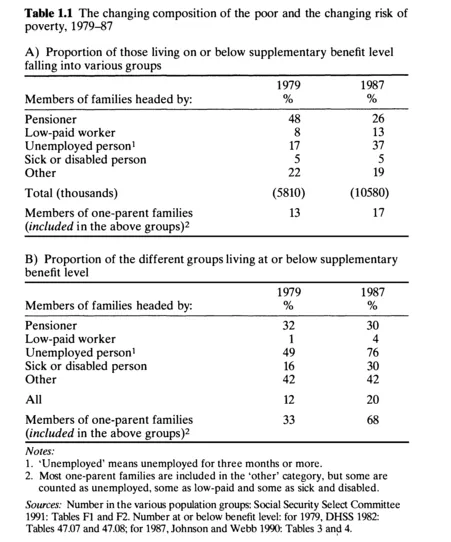
The information is displayed in two ways. Part A of Table 1.1 shows the percentage of the various groups living at or below supplementary benefit level in 1979 and 1987. Part B shows the proportion of those groups in the population at large who fell into poverty. While the figures in the table refer to individuals, classification into groups is by head of household. Low-paid workers who are not household heads are not included in the statistics. About 20 per cent of UK workers – six and a half million people–fall below the Council of Europe threshold (set at 68 per cent of mean earnings), the highest percentage for any EC country except Greece (Minford 1990: 10). Unless there is an equitable internal redistribution of income in households containing these workers, the statistics will seriously under-report poverty among this group. The information also excludes the increasing numbers of homeless people and ignores not only changes in arrangements for school meals, water charges and local taxes but also increases in VAT and excise duties, all of which have operated to cut the living standards of the poorest groups over the period covered, so that the picture of changes it presents is unduly optimistic.
The numbers at or below the benefit level in the United Kingdom have increased rapidly from nearly six to over ten and a half million or from 12 to 20 per cent of the population. The most important reason for the increase is the rapid rise in the numbers of unemployed people. Families headed by single parents and by low-waged workers have also increased sharply in number. The number of sick and disabled people has increased in line with the overall rise in poverty, whereas the number of pensioners has risen only slowly, so that they make up a shrinking proportion of the expanding numbers of poor people.
The second part of the table paints a rather different picture. It reflects the vulnerability of the different groups to poverty, taking into account their relative size. The families of unemployed people are the group most likely to depend on last-resort benefits in both years, as their access to insurance benefits is cut back and they become impoverished by long-term unemployment. One-parent families also run a very high risk of poverty. Over two-thirds were living at or below the means-test level by the end of the 1980s. About a third of pensioners, mainly elderly single people and including a high proportion of women, are poor in both years. The vulnerability of sick and disa...
Table of contents
- Cover
- Original Title
- Title
- Copyright
- Contents
- Tables and figures
- Preface
- Abbreviations
- Chapter 1 Introduction: the birth of a myth
- Chapter 2 Culture, structure and failure: the underclass debate
- Chapter 3 Values and dependency
- Chapter 4 The claiming experience
- Chapter 5 Dependency or captivity?
- Chapter 6 Dependency and power
- Appendix
- References
- Name index
- Subject index
Trusted by 375,005 students
Access to over 1.5 million titles for a fair monthly price.
Study more efficiently using our study tools.
Frequently asked questions
Yes, you can cancel anytime from the Subscription tab in your account settings on the Perlego website. Your subscription will stay active until the end of your current billing period. Learn how to cancel your subscription
No, books cannot be downloaded as external files, such as PDFs, for use outside of Perlego. However, you can download books within the Perlego app for offline reading on mobile or tablet. Learn how to download books offline
Perlego offers two plans: Essential and Complete
- Essential is ideal for learners and professionals who enjoy exploring a wide range of subjects. Access the Essential Library with 800,000+ trusted titles and best-sellers across business, personal growth, and the humanities. Includes unlimited reading time and Standard Read Aloud voice.
- Complete: Perfect for advanced learners and researchers needing full, unrestricted access. Unlock 1.5M+ books across hundreds of subjects, including academic and specialized titles. The Complete Plan also includes advanced features like Premium Read Aloud and Research Assistant.
We are an online textbook subscription service, where you can get access to an entire online library for less than the price of a single book per month. With over 1.5 million books across 990+ topics, we’ve got you covered! Learn about our mission
Look out for the read-aloud symbol on your next book to see if you can listen to it. The read-aloud tool reads text aloud for you, highlighting the text as it is being read. You can pause it, speed it up and slow it down. Learn more about Read Aloud
Yes! You can use the Perlego app on both iOS and Android devices to read anytime, anywhere — even offline. Perfect for commutes or when you’re on the go.
Please note we cannot support devices running on iOS 13 and Android 7 or earlier. Learn more about using the app
Please note we cannot support devices running on iOS 13 and Android 7 or earlier. Learn more about using the app
Yes, you can access Dependency Culture by Hartley Dean,Peter Taylor-Gooby in PDF and/or ePUB format, as well as other popular books in Politics & International Relations & Social Policy. We have over 1.5 million books available in our catalogue for you to explore.