Exploring the interactions that swirl around scientific uncertainty and its coverage by the mass media, this volume breaks new ground by looking at these issues from three different perspectives: that of communication scholars who have studied uncertainty in a number of ways; that of science journalists who have covered these issues; and that of scientists who have been actively involved in researching uncertain science and talking to reporters about it. In particular, Communicating Uncertainty examines how well the mass media convey to the public the complexities, ambiguities, and controversies that are part of scientific uncertainty.
In addition to its new approach to scientific uncertainty and mass media interactions, this book distinguishes itself in the quality of work it assembles by some of the best known science communication scholars in the world. This volume continues the exploration of interactions between scientists and journalists that the three coeditors first documented in their highly successful volume, Scientists and Journalists: Reporting Science as News, which was used for many years as a text in science journalism courses around the world.
eBook - ePub
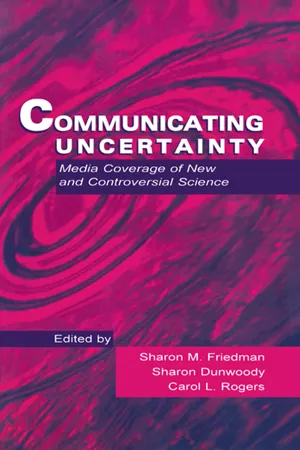
Communicating Uncertainty
Media Coverage of New and Controversial Science
- 296 pages
- English
- ePUB (mobile friendly)
- Available on iOS & Android
eBook - ePub
Communicating Uncertainty
Media Coverage of New and Controversial Science
About this book
Information
Part I
Interpreting Uncertainty
Chapter 1
Scientists’ Representations of Uncertainty
Stephen C.Zehr is an associate professor of sociology at the University of Southern Indiana. His research focuses on how science is represented in public discussions of environmental problems; currently, he is examining the ways that policymakers use economic expertise in developing strategies to manage global climate change. His previous writings include research on acid rain and ozone depletion as well as on other aspects of global climate change controversies.
Because science involves producing knowledge about what was previously unknown, uncertainty is a normal and necessary characteristic of scientific work. Scientists regularly engage parts of the world unfamiliar to them. This is not unique to science; many other workers, such as physicians or mechanics, regularly inhabit an uncertain world as well. Thus, the fact that uncertainty among scientists is prevalent is less interesting and significant than the attempt to reveal how uncertainty is actively managed by scientists. This chapter focuses on different features of the management process. It demonstrates that scientific uncertainty is not simply something that scientists try to eliminate through their research. Scientists also actively construct and effectively use it in scientific articles and in public science contexts.1
This chapter is divided into three sections. The first reviews the ways that scientists handle uncertainty in the laboratory and in scientific discourse in professional journal articles. The second focuses on the construction and management of scientific uncertainty in public science settings, such as political hearings and the mass media, where, although uncertainty could potentially undermine the authority of science in these settings, it is often used instead to enhance the image of science. The third section reviews several cases of scientific uncertainty in public science that illustrate the processes identified in the second section of this chapter. These cases include the Mackenzie Valley Pipeline Inquiry in the Canadian western Arctic, a television show about the Shroud of Turin, and U.S. Congressional hearings on acid rain.
UNCERTAINTY IN LABORATORY WORK AND SCIENTIFIC DISCOURSE
Laboratory Work
Like many other workers, scientists are beset daily with unsolved problems that demand resolution. These problems, the uncertainties they create, and the subsequent decisions that scientists must make involve diverse levels of activity (Star, 1985). For example, experimental materials may have acted in unexpected ways, a particular technique may have been incorrectly applied or interpreted, observations may have been made by less-than-trustworthy assistants or other scientists, organizational politics may be unclear, or future funding may be insecure.
Scientific work often involves moving among these activities to resolve uncertainties as they arise. If an experiment produces unexpected results, a scientist must decide whether it was caused by an improper technique, observational error, or flawed expectations. At the same time, repeating the experiment may demand more resources than are available, creating yet another level of uncertainty. Scientists then rearrange different elements of their world to make it more orderly and, they hope, to reduce uncertainty (Latour, 1987). Occasionally, the resolution of uncertainty at one level also removes uncertainty at another. For example, if more funding is obtained, part of it may be used to purchase more reliable equipment, which in turn reduces the uncertainty of a particular technique.
Scientific work does not just reduce uncertainty; it actively constructs it (Smithson 1989, 1993). This feature of science makes it unique among other work activities. Most nonscientific work involves removing uncertainties constructed elsewhere. Plumbers, for example, try to fix problems in other people’s homes that typically were not of their own creation. Scientists, on the other hand, find problems in their own work by asking questions and probing for gaps in their own realm, thus identifying uncertainties that require their special skills and knowledge to address. Science is as much an uncertainty generator as it is a certainty producer.
When uncertainties are generated in their laboratories, scientists often transform them either into universal certainties or uncertainties. In the first sense, scientists are making scientific claims to universal truth. In the second sense, they are making claims about a universal gap in knowledge (Stocking & Holstein, 1993). This transformation from local, or laboratory-generated, claims to universal claims occurs in scientific discourse directed to other scientists, such as professional meetings or journal articles, or to a broader public. This chapter considers discourse directed to other scientists first.
Scientific Discourse
To construct certain claims to truth, scientists often remove contingencies from their statements (Gilbert & Mulkay, 1984; Latour & Woolgar, 1979). Such contingencies call attention to specific technical, social, or political conditions of the local context of a claim to truth. For example, the following hypothetical scientific statement is filled with contingencies: “When we ran that test last Friday, we obtained results that we think suggest a correlation between internal exposure to mannitol and heart irregularities in rats.” The correlation between mannitol and heart irregularities appears to be contingent on which test was used, when that test was performed, how the results were evaluated, what kind of exposure was selected, and what type of animal was involved. These contingencies create uncertainty in the claim. What if a different test had been used? Were test conditions last Friday unique in some way? Were we wrong in our interpretations of the test results? Are the effects only present with internal exposure and with rats?
This type of statement, according to Gilbert and Mulkay (1984), is more typical of informal, local scientific contexts, such as discussions in the laboratory among colleagues. However, as this statement moves into more formal and more universal settings, it often loses some of these contingencies. Eventually, the statement may read: “Exposure to mannitol causes heart irregularities.” This type of statement is more likely to appear at the end of peer-reviewed articles or scientific textbooks. The elimination of contingencies in the statement also leads to the perception of much more certainty about the connection between mannitol and heart irregularities. The connection no longer appears contingent on the conditions of the local context.
Gilbert and Mulkay (1984) suggested that these two versions reflect two repertoires used by scientists, called contingent and empiricist. A contingent repertoire leads the reader or listener to infer that the state of nature could be otherwise if certain contextual conditions (e.g., psychological makeup of researcher or funding) are varied. The first version of the scientific statement incorporates a contingent repertoire. An empiricist repertoire, in contrast, leads the reader to believe that scientists’ actions and beliefs follow unproblematically and inescapably from the empirical characteristics of the natural world (pp. 55–58). The second version of the results of the rat experiment just discussed uses an empiricist repertoire; that is, it appears as a matter-of-fact statement about mannitol and heart irregularities. These two repertoires are important in scientific work because they help scientists transform local uncertainties into more certain knowledge in articles and textbooks.2
In their discourse, however, scientists do more than merely present certainties; they also carefully construct uncertainties in the state of knowledge (Smithson, 1993; Stocking & Holstein, 1993). These uncertainties play an important role in the communication of knowledge. For example, a typical peer-reviewed scientific article begins with a literature review that carefully maps out what is known about the subject. This part of the article depicts much certainty in the state of scientific knowledge.
Soon, however, the author begins to point out gaps in the body of knowledge. Questions are raised, limitations of previous research are identified, and conjectures are put forth. Areas of uncertainty and ignorance begin to emerge as the author, in effect, asks readers to agree that these areas require further investigation.
This knowledge gap—and its associated uncertainty—is important because it helps demonstrate the novelty and significance of the author’s claims to truth. After constructing the knowledge gap, the author presents a method, data, and specific claims that appear to partially fill it in. Without the gap, the significance of these claims would not be readily apparent. In the final section of an article, the author typically constructs further knowledge gaps, often carefully tailored to allude to broad ramifications of the results (e.g., implications for policymaking) or to the author’s future research contributions.
Other techniques are also used to construct uncertainty. These have been reviewed by Stocking & Holstein (1993). They noted that scientists may use caveats to acknowledge limitations in their knowledge claims. Contingencies may be added to statements, reversing the contingent-to-empiricist process previously described. Drawing on Myers (1990), they described how biologists use such rhetorical devices as echoic speech (placing knowledge claims in direct quotes), ironic turns (for example, relabeling an observation as a precon- ception), and asserting negative evidence (stating that no evidence has been gathered to support a claim). Each device is used to construct uncertainty about opponents’ claims during a scientific controversy over definitive claims to truth.
The identification of these devices is significant in that it reveals how scientists can manage their uncertainty claims. In other words, uncertainty claims do not simply represent an uncontrollable feature of scientific work or, for that matter, some underlying reality or a state of objective knowledge. Rather, uncertainty is constructed in particular situations with certain intended effects (Shackley & Wynne, 1996).
In Myers’ analysis, scientists may manage their own uncertainty by constructing uncertainty about opponents’ claims and contrasting them to try to raise their own credibility. In other settings, uncertainty claims may serve other purposes. This approach to managing uncertainty does not mean that scientist...
Table of contents
- Cover Page
- Half Title page
- Title Page
- Copyright Page
- Contents
- Preface
- Introduction
- Interpreting Uncertainty
- Science in the Public Arena
- Beyond the Basics
- Author Index*
- Subject Index*
Trusted by 375,005 students
Access to over 1.5 million titles for a fair monthly price.
Study more efficiently using our study tools.
Frequently asked questions
Yes, you can cancel anytime from the Subscription tab in your account settings on the Perlego website. Your subscription will stay active until the end of your current billing period. Learn how to cancel your subscription
No, books cannot be downloaded as external files, such as PDFs, for use outside of Perlego. However, you can download books within the Perlego app for offline reading on mobile or tablet. Learn how to download books offline
Perlego offers two plans: Essential and Complete
- Essential is ideal for learners and professionals who enjoy exploring a wide range of subjects. Access the Essential Library with 800,000+ trusted titles and best-sellers across business, personal growth, and the humanities. Includes unlimited reading time and Standard Read Aloud voice.
- Complete: Perfect for advanced learners and researchers needing full, unrestricted access. Unlock 1.5M+ books across hundreds of subjects, including academic and specialized titles. The Complete Plan also includes advanced features like Premium Read Aloud and Research Assistant.
We are an online textbook subscription service, where you can get access to an entire online library for less than the price of a single book per month. With over 1.5 million books across 990+ topics, we’ve got you covered! Learn about our mission
Look out for the read-aloud symbol on your next book to see if you can listen to it. The read-aloud tool reads text aloud for you, highlighting the text as it is being read. You can pause it, speed it up and slow it down. Learn more about Read Aloud
Yes! You can use the Perlego app on both iOS and Android devices to read anytime, anywhere — even offline. Perfect for commutes or when you’re on the go.
Please note we cannot support devices running on iOS 13 and Android 7 or earlier. Learn more about using the app
Please note we cannot support devices running on iOS 13 and Android 7 or earlier. Learn more about using the app
Yes, you can access Communicating Uncertainty by Sharon M. Friedman,Sharon Dunwoody,Carol L. Rogers in PDF and/or ePUB format, as well as other popular books in Social Sciences & Communication Studies. We have over 1.5 million books available in our catalogue for you to explore.