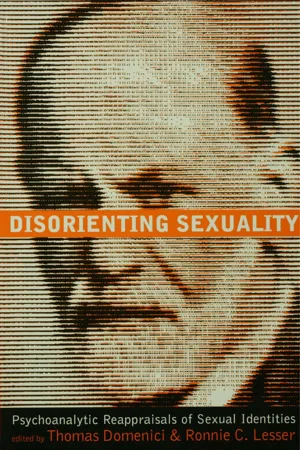
Disorienting Sexuality exposes the biases against gay men and lesbians in psychoanalytic theory and practice. In the introduction, Domenici and Lesser draw a brief history of anti-homosexual sentiment in psychoanalysis. The book then moves into essays written by lesbian and gay psychoanalysts seeking to have a voice in the reshaping of psychoanalytic theories of sexuality. The second section is devoted to presenting different theoretical perspectives for understanding both homosexuality and heterosexuality. Disorienting Sexuality concludes with the personal narratives of gay and lesbian psychoanalysts.
eBook - ePub
Disorienting Sexuality
Psychoanalytic Reappraisals of Sexual Identities
- 313 pages
- English
- ePUB (mobile friendly)
- Available on iOS & Android
eBook - ePub
Disorienting Sexuality
Psychoanalytic Reappraisals of Sexual Identities
About this book
Information
Part1
New Voices
Gay and Lesbian Psychoanalysts
1
Some Thoughts on the Role of Mourning in the Development of a Positive Lesbian Identity
Lee Crespi
UNTIL RECENTLY THE LIMITED NUMBER of psychoanalytic writings concerning lesbians focused on questions of etiology and the nature of the underlying pathology that resulted in a lesbian orientation (see Magee and Miller 1993 for a complete review of the literature). More recent contributions have attempted to challenge these earlier works and either depathologize lesbianism or deconstruct the concept of sexual orientation (Burch 1993; Lesser 1993; O’Connor and Ryan 1993). While this debate is important and challenging, it leaves out a great deal about the phenomenological experiences of lesbian patients and their analysts in doing the day-to-day work of analysis, an area in need of greater investigation. Although these issues are raised in private settings, supervision, and gay and lesbian organized conferences, they remain outside the mainstream of psychoanalytic discourse. As a result, clinicians are often left without a context in which to place the material of their lesbian patients in order to better understand them and their needs in treatment.
With this in mind, the purpose of this paper is to explore the idea that just as it is necessary for heterosexuals to mourn aspects of their homosexuality, as part of the normal developmental process, it is necessary for lesbians to mourn aspects of heterosexuality in order to allow for a more integrated self and to establish a positive lesbian identity.1 Moreover, this mourning, when it appears in analysis, should be understood to be a normal developmental process which should not be confused with sexual orientation conflict. Therefore, it is the additional aim of this paper to illustrate through clinical examples, some of the manifestations of the mourning process as they may appear in the clinical setting.
Mourning and Development
Freud (1923) recognized mourning as a pivotal developmental process when he expanded his theory of identification with the lost object first presented in “Mourning and Melancholia” (1917). He proposed that identification and mourning are integrally related, both to each other and to the formation of ego structure. He posited that in the resolution of the Oedipal Conflict mourning of the relinquished love object results in identification with that object, and ultimately results in the formation of the superego.
When it happens that a person has to give up a sexual object, there quite often ensues an alteration of his ego which can only be described as a setting up of the object inside the ego, as occurs in melancholia.… (Freud 1923, 29; emphasis added)
Mourning plays a central role in Object Relations Theory as well. Emotional and psychological development are achieved through the related processes of mourning and integration. Beginning with the loss of the mother’s breast and on through the separation and individuation process, the individual undergoes repeated experiences of relinquishing fantasies as well as actual infantile dependencies in the move toward greater autonomy and independence. In order for this to occur, conflictual ambivalent ties to early objects must be resolved, and the lost objects must be mourned so that aspects of them can be internalized and integrated as parts of the internal Self and Object world. According to Melanie Klein (1958), as a result of this mourning and integration process, perception is brought more in line with reality, resulting in a better relationship between the internal and external world.
More recently, Judith Butler (1993) also placed mourning at the core of certain developmental processes when she expanded on Freud’s discussion of melancholic identifications as the origin of gender identity. She questioned whether rigidification of gender identity might be understood to be the result of a failure to adequately mourn the same-sexed Oedipal love object which must be relinquished or “foreclosed” by the prohibition against homosexuality (Butler 1993).
This dynamic mourning, identification, and integration process continues throughout life, and at each significant developmental passage is reworked and renegotiated. At adolescence, the conflicts of the earlier separation stage are revisited, and the individual must mourn the loss of childhood dependence in order to establish the beginnings of her adult identity. Forming a committed relationship requires that the individual mourn the loss of potential fantasied partners and the narcissistic pleasures which are given up in exchange for partnership and intimacy. In a similar fashion, career choice, childbearing, midlife, and aging all require mourning of lost opportunities, choices, fantasies, dependencies, and grandiosity.
For the very young child this mourning process takes place in the context of a maternal holding environment which Winnicott (1960) defined as a “complex psychological field, determined by the awareness and the empathy of the mother” in which the infant’s “ego changes over from an unintegrated state to a structured integration.” As the individual grows, society becomes an extension of the maternal holding environment through projection and transference. Using Kohut’s model of self-objects, one may say that a “self sustaining function is performed by those objects who by their presence or activity evoke and maintain the self” (Wolf, 1988). The social structure performs this function through the family, in which expectations are defined and role models are presented. Folklore, religion, history and fashion also define social expectations by providing the images that guide certain choices. Institutional validation also provides another source of influence and direction for developmental choices and losses, the most obvious being the institution of marriage.2
Usually, intrapsychic obstacles to navigating normal developmental passages arise primarily as a result of an individual’s inability to mourn, to tolerate her ambivalent feelings toward her objects, or to relinquish omnipotent fantasies, due to internal deficits or conflicts. However, in addition to any such personal barriers which may exist, lesbians, because their life choices and passages are not mirrored or socially sanctioned (Buloff and Osterman 1993) are provided little or no external structure to aid in the mourning process or to facilitate integration. As a result, certain problems may arise and need to be addressed in analysis. I will be giving some examples of these problems throughout this paper.
The Impact of Internalized Homophobia
Lesbians develop an identity in a world that at best denies and at worst reviles homosexuality. A world in which the necessary and stage-appropriate mourning process becomes hampered by issues of internalized homophobia. Internalized homophobia is a concept introduced in the 1970s (Weinberg 1972) to identify the various forms of pernicious self attack that homosexuals experience through interaction and identification with the culture which generally promotes an anti-homosexual attitude. This creates in the individual a sense of badness that transforms mourning into depression.
Freud (1917) differentiated between mourning and melancholia primarily on the basis of the presence of lowered self-esteem, self-reproach, and self-reviling in patients exhibiting melancholia. Freud was referring to the effects of superego attacks resulting from anger at the lost object with which an identification has been made. Self-hatred resulting from internalized homophobia feeds a punitive superego and it is the rare individual whose superego is unaffected by her experience of being gay. As a result, an individual may utilize various defenses consistent with her personality to ward off self-attack. For example, we may see doubt or compartmentalization in obsessives, denial and confusion in hysterics, projection and hostility in borderlines, and so on. The greater the degree of internalized homophobia, the more rigid the defenses, thus leaving the individual less able to work through the grieving process. As a result, the interaction between internalized homophobia and the emotional pain involved in unresolved mourning can lead to increased self-hatred and depression. This may then result in greater rigidity and bravado, or alternatively in repudiation of one’s homosexuality. This raises important treatment issues.
Clinical Issues
One key issue which stands out is the need for the analyst to distinguish between conflicts about sexuality and the process of mourning. Some patients do have genuine conflicts about their sexuality and their sexual object choices, and these conflicts should be treated as such. Likewise, the patient’s mourning process needs to be facilitated through identifying it and encouraging a full range of the expression of feelings. I believe that serious problems arise when the analyst misinterprets the normal mourning process as a conflict about the patient’s sexual orientation. This inaccurate interpretation can impede the patient’s progress toward integration and thwart development of a unified self. This will lead to overcompliance and depression, or to anger and a negative therapeutic reaction.
Mistaking normal mourning for conflict often reflects the analyst’s conscious or unconscious assumptions that if the patient is expressing pain or grief or even anger about being gay, this means she has the desire to change, and it would be better to do so. This brings to mind a story told to me about a lesbian who was talking to her elderly Jewish grandmother about being gay. She was trying to explain that she had struggled long and hard with it, and that it was a difficult and painful process. Her grandmother replied, “Nu, so if it’s so hard, why do it?”
Once the distinction between conflict and mourning is made, the question of what needs to be mourned can be addressed.
Self-Regard and the Ego Ideal
According to Freud,
Mourning is regularly the reaction to the loss of a loved person, or to the loss of some abstraction which has taken the place of one, such as fatherland, liberty, an ideal and so on. (1917, 243; emphasis added)
This loss of an ideal may be thought of in terms of the role that hetero-sexuality plays in our culture. As the means of procreation and perpetuation of the species, heterosexuality is not only deemed necessary but is raised to the level of the holy, the legal, or an indication of one’s status and place in the world. It is a measure of one’s success, the basis of all social structure and stability, and in general not only the ideal outcome of all human development, but indeed, the only acceptable outcome. It follows that in recognizing or choosing homosexuality, the individual is forced to renounce any hope of ever reaching the ideal state. It is difficult therefore to describe the enormity of the loss that a man or woman faces in being gay. This loss has the potential to become the basis for self-rejection. It will be felt not only in relation to the external world but in one’s internal world in which the self becomes degraded in relation to the ego ideal (Epstein 1993).
Heterosexual Relationships
Most lesbians have had heterosexual experiences and many lesbians have had one or more serious and extended heterosexual relationships, including satisfying sexual relations, loving attachments, and at times marriage and children. For many lesbians who have had these experiences, their homosexual object choice is driven predominantly by their emotional “fit” with women, which does not preclude sexual desire but rather encompasses it. However, their experiences with men are also reflective of some degree of heterosexual emotional and/or sexual interest. Whatever the multiplicity of factors which predominate in a woman’s homosexual choice, the components of her self that continue to desire closeness with men, either physically or emotionally, need to be addressed so as to meet those needs, either directly through family relationships and friendships or indirectly through sublimation. To the degree they cannot be met they will need to be mourned. These heterosexual needs can be confusing to both patient and analyst and even can be experienced by the patient as a threat, much as heterosexual patients feel threatened when they experience awareness of their homosexual desires.
For example, recently a lesbian patient who had been active heterosexually until her late twenties presented the following situation. She had received a phone call from a man whom she used to know who wanted to get together for dinner. She found herself experiencing an old difficulty in not being able to say no to him, despite the fact that she did not like him, thinking of him as unstable and somewhat frightening. She had previously discussed how in her past relations with men she had often found herself unable to stop their sexual advances. Although she enjoyed sex with these men, she felt she allowed herself to get into situations which she later regretted, because of either the circumstances or the people involved. This incident revived concerns about whether her homosexuality was a defense against her impulsiveness with men. The patient had spent many sessions exploring various aspects of her feelings about men and women and the meaning to her of her object choices. O’Connor and Ryan (1993) attribute the propensity for self-doubt and uncertainty about sexual identity that some lesbians experience to the universal assumption of heterosexuality. The lesbian or gay man must “discover” her or his own sexuality in relation to this assumption and is therefore subject to questioning it. For the above-mentioned woman, this incident crystallized a remaining question about her sexuality. Suppose it was a defensive reaction? What then? She struggled with this for a while. What did she want to do about it? Whatever defensive functions had been served by her homosexuality had long ago been understood. She was no longer impulsive in her relations with men or women. She had no wish to change her sexual orientation. What was making her anxious was not knowing what to do with her heterosexual feelings. She did not want a relationship with a man although she sometimes desired sex with them. She was happily progressing in her current lesbian relationship and felt no need to disrupt it. We then explored the possibility that she needed to mourn the loss of physical relationships with men. This struck the patient as emotionally correct. She found she no longer had any difficulty refusing the unwanted invitation. It had the additional effect of restoring her sense that she was choosing her sexuality rather than being a lesbian by default.
Physical Security
A second element of heterosexuality that may need to be mourned by lesbians is the loss of a physically safe and socially sanctioned self-identity. Being a lesbian means giving up many powerful and important aspects of heterosexual life, including the status and respectability that marriage provides as well as the social mobility and physical safety that being with a man confers. In a recent New York Times article, a lesbian described the feelings of exposure that she felt when paying her bills in a small New England town with a check that bore her name and the name of her partner (Graff 1993). This article reflected a concern felt by many lesbians who reside or have second homes in rural areas. Unconscious fears of attack and retaliation by internal objects may often resonate with external physical risk. Many will attest to the ever-present sense of potential danger that lurks side by side with feelings of relief and gratitude in being accepted into a rural community where people own guns.
Social Losses
In regard to the social losses, there are certain events, such as attending a heterosexual wedding, that may be counted upon to trigger disguised forms of grief reactions. I have repeatedly observed in both individuals and couples an almost predictable depressive reaction manifested in the form of fighting or withdrawing and distancing from others following attendance at a wedding. This can occur in even the most progressive families where the lesbian couple may be acknowledged and accepted—in fact, sometimes even more so in these families because the individual or couple may be unprepared for the bad feelings that do surface. This reaction needs to be understood as resulting from the confrontation with the powerful confluence of social, institutional, and familial celebration of the heterosexual union and the reawakening of the sense of loss that one experiences in no longer having access to that form of sanction and approbation.
Traveling on vacation can also, at times, trigger unexpected feelings of depression. For ...
Table of contents
- Cover
- Half Title
- Title Page
- Copyright Page
- Dedication
- Table of Contents
- Acknowledgments
- Foreword
- Introduction
- Part 1 New Voices: Gay and Lesbian Psychoanalysts
- Part 2 Rethinking Sexuality: Theoretical Perspectives
- Part 3 Lesbian and Gay Psychoanalysts: Their Encounters with Anti-Homosexuality
- Part 4 Conclusion
- Contributors
- Index
Trusted by 375,005 students
Access to over 1.5 million titles for a fair monthly price.
Study more efficiently using our study tools.
Frequently asked questions
Yes, you can cancel anytime from the Subscription tab in your account settings on the Perlego website. Your subscription will stay active until the end of your current billing period. Learn how to cancel your subscription
No, books cannot be downloaded as external files, such as PDFs, for use outside of Perlego. However, you can download books within the Perlego app for offline reading on mobile or tablet. Learn how to download books offline
Perlego offers two plans: Essential and Complete
- Essential is ideal for learners and professionals who enjoy exploring a wide range of subjects. Access the Essential Library with 800,000+ trusted titles and best-sellers across business, personal growth, and the humanities. Includes unlimited reading time and Standard Read Aloud voice.
- Complete: Perfect for advanced learners and researchers needing full, unrestricted access. Unlock 1.5M+ books across hundreds of subjects, including academic and specialized titles. The Complete Plan also includes advanced features like Premium Read Aloud and Research Assistant.
We are an online textbook subscription service, where you can get access to an entire online library for less than the price of a single book per month. With over 1.5 million books across 990+ topics, we’ve got you covered! Learn about our mission
Look out for the read-aloud symbol on your next book to see if you can listen to it. The read-aloud tool reads text aloud for you, highlighting the text as it is being read. You can pause it, speed it up and slow it down. Learn more about Read Aloud
Yes! You can use the Perlego app on both iOS and Android devices to read anytime, anywhere — even offline. Perfect for commutes or when you’re on the go.
Please note we cannot support devices running on iOS 13 and Android 7 or earlier. Learn more about using the app
Please note we cannot support devices running on iOS 13 and Android 7 or earlier. Learn more about using the app
Yes, you can access Disorienting Sexuality by Thomas Domenici, Ronnie C. Lesser, Thomas Domenici,Ronnie C. Lesser in PDF and/or ePUB format, as well as other popular books in Psychology & History & Theory in Psychology. We have over 1.5 million books available in our catalogue for you to explore.