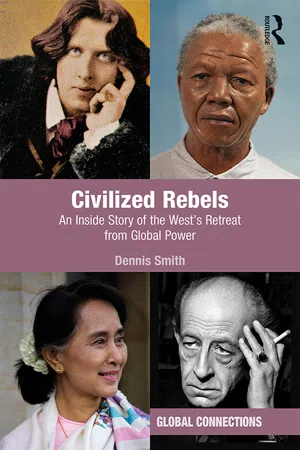
Civilized Rebels compares in depth four very well-known literary and political figures, who all opposed arrogant regimes and became prisoners. Through comparative biographies of Oscar Wilde, Jean Améry, Nelson Mandela and Aung San Suu Kyi, it explores the long-term process of the retreat of the West from global power since the late nineteenth century, relating this to the decline and fall of the British Empire and the trauma surrounding Brexit. Drawing on rich empirical materials to examine themes of forced displacement, war, poverty, imprisonment and the threat of humiliation, the book reveals how these highly civilized rebels penetrated their opponents' mind-sets, while also providing a sophisticated analysis of how their struggles fitted into the larger world picture. Methodologically and theoretically innovative, and written in a lively and accessible style, Civilized Rebels will appeal to scholars across a range of disciplines, with interests in globalization, historical international relations, postcolonial and subaltern studies, comparative biographical studies, European studies, the sociology of emotions and historical sociology.
- 204 pages
- English
- ePUB (mobile friendly)
- Available on iOS & Android
eBook - ePub
About this book
Information
1 Rebels and regimes
The road to Brexit
Expect the unexpected: that is surely our motto for the twenty-first century. For example, the great Andromedid meteor shower made a surprise appearance in December 2011.1 Did you see it? The last spectacular Andromedid display before that happened in 1885. You probably missed that one, too. The sky was full of shooting stars on the 28th November 1885. That same day General Harry North Dalrymple Prendergast VC landed at Mandalay, meaning business. He had sailed up the Irrawaddy river with his Burma Expeditionary Force. He was armed with a clutch of new-fangled Maxim guns. These weapons had been invented two years previously. They could fire six hundred rounds a minute.2 This gave them considerable persuasive capacity. They won arguments, quickly.
By the end of the day, Prendergast had loaded the Burmese royal family into bullock carts and sent them on a steamer down the river into permanent exile. From that time until the Japanese invaded in 1942 Burma was British. Soon after Prendergast’s arrival, the king’s revered white elephant, symbol of his sovereignty, fell down dead and was dragged without ceremony out of the palace gates. This gave a strong hint to the Burmese about how little they and their way of life would be respected.
Do keep a close eye on your white elephants. Other people tend not to respect them as much as you do. As we all know, elephants are enormously resourceful, take up large amounts of space, need a lot of food, deposit great piles of dung, and it is best not to get too close when they give up the ghost and keel over. So it was with the British Empire.
Those huge beasts with waving trunks and flapping ears supposedly never forget. In a similar way, being unable to accept past glories were over was the elephantine curse of the post-imperial British. They found it hard to forget. Within living memory their island had ruled over the modern world’s biggest global empire. Then suddenly, after World War II, it was gone. This wasn’t the first such humiliation. After 1776 the precious, hard-won American colonies fought themselves free from British rule with French help. But on that occasion Britain’s recovery was rapid, turbo-charged by spectacular industrial growth. A second British Empire was carved out during the nineteenth century. The Indian Raj was the jewel in its crown. But the jewel unclipped itself in 1947. The rest soon followed.
How could that have happened? After all, who won the war? What went wrong? As Oscar Wilde’s Lady Bracknell might have put it: ‘To lose one empire may be regarded as a misfortune but to lose both looks like carelessness’.3 To misquote the historian J R Seeley, losing half the world in a fit of absence of mind would be bad enough.4 But letting Britain’s empire fall from its bankrupt hands because the British could not afford to run it was intolerably worse; totally humiliating. After World War II Britain was too poor to pursue its imperialist ambitions. Losing the British Empire was a great calamity, difficult to get over. The resulting trauma sometimes led to extreme or eccentric behaviour.
A major example of this was the disastrous Suez adventure in 1956. Another instance, minor but spectacular in its own way, occurred in January 2017 when the British Foreign Secretary, Boris Johnson, made an official visit to Burma’s most sacred space, the Shwedagon Pagoda in Yangon. The occasion inspired him. He began to recite out loud Rudyard Kipling’s nostalgic imperialist poem about ‘the road to Mandalay’, published in 1892.5 The British Ambassador immediately got very jumpy. ‘Come you back, you British soldier’, intoned the Foreign Secretary, an evocative but provocative line. Was the minister really contemplating, even fancifully, a restoration of British colonial rule? At this point the ambassador reminded the man responsible for British foreign policy that he was being recorded. What the minister was doing was ‘not a good idea’; ‘not appropriate’. Luckily, the ambassador’s words staunched this flow of post-imperial nostalgia. The Foreign Secretary’s stopped reciting Kipling but sotto voce muttered ‘good stuff.’6
Civilized Rebels is about the British Empire’s decline, collapse and aftermath. This includes Britain’s troubled relationship with Ireland, and its desperate confrontations with the Third Reich and Imperial Japan. We investigate the miserable legacy the British left behind in South Africa and Burma, which disrupted and delayed those nations’ still incomplete liberation from autocratic, oppressive and neglectful rulers. Not least, we examine Britain’s restless and resentful search for a satisfactory post-imperial identity. This took that country first into the Common Market and then, over four decades later, into a prolonged trauma over Brexit, Britain’s projected withdrawal from the European Union.
We examine contrasting perspectives on the gradual disintegration of British imperial influence. These take us to late Victorian Dublin and London, Vienna in the 1930s, Antwerp, Brussels and Johannesburg in the 1940s, early twenty-first-century Yangon and Mandalay, and present-day Britain. On the way, we see dramatic confrontations between well-known insurgents and the regimes they challenged. We interrogate the lives of four formidable rebels who smarted under oppression’s lash but fought on. They all knew what they were fighting for, and studied their enemies closely.7
These rebels are Oscar Wilde (1854–1900), Jean Améry (1912–78), Nelson Mandela (1918–2013) and Aung San Suu Kyi (born 1945): two avant-garde writers and two insurgent politicians: three men and one woman; two Europeans, one African and one Asian. Between them, our rebels saw the British Empire from the inside (Wilde) and the outside (Améry), at its height (Wilde) and on its last legs (Mandela, Suu Kyi). Two of them endured its painful aftermath in Africa (Mandela) and Asia (Suu Kyi). The regimes these insurgent spirits faced were based, respectively, in late Victorian Britain, Hitler’s Germany, South Africa under apartheid, and Burma, sometimes known as Myanmar, under military dictatorship.8
By comparing these cases we can triangulate the British Empire’s decline. This takes us from its highpoint in the 1860s and 1870s to its struggle for survival against Hitler’s Germany and Imperial Japan in the 1940s. From British colonialism’s malign aftermath in postwar Africa and Asia through to the existential threats posed by Brexit9 to the empire’s residual core, the United Kingdom itself. A ghost labelled the Commonwealth still shimmered across the world’s oceans in the early twenty-first century. But imperial Britain had shrivelled to a few scattered islands and peninsulas, many of them tax havens, plus the United Kingdom itself, already shorn of Ireland and faced with possibly losing yet another nation, Scotland. Unexpectedly, in 2016 the British narrowly voted in a referendum to leave the European Union (EU), the UK’s global anchoring point for nearly half a century.
At the centre of this inquiry are the links between three major geo-historical shifts currently under way: Britain’s retreat from Europe, the West’s retreat from global power, and, entwined with both, the British Empire’s retreat from ruling the waves. Making sense of each retreat will help us understand the other two.
Our four rebels are not the only victims of abusive threats and violent oppression designed to intimidate and diminish them. Nor are they the only ones to react strongly, driven by anger, fear, sorrow or disgust. Many people are chronically vulnerable to humiliating forced displacement – being pushed down, elbowed aside, and kicked out – at several levels of social activity and political life. The poor, weak and stigmatized are habitual victims, individually and collectively. Defeat and degradation also threaten the powerful, whether good, bad or ugly. Reforming leaders promoting justice and democracy, metropolitan cliques controlling colonial empires, and fascist or neo-fascist dictatorships are all vulnerable.
In fact, people scattered across entire nations or continents may be moved to collective grief or rage as their fortunes change. Populist movements, right and left, drawing large crowds have recently sprung up across North America, Europe and in neighbouring Russia and Turkey. Brexit is part of a wider rebellion from below now rumbling in the West, both through the European Union, and in the United States. What does it all mean?
We can trace, here and there, the interplay of mood and motive back and forth between different levels, individual, group, nation and world, over historical time and geographical space. This is what this book does. In fact, the biographies of our four rebels, taken together, transport us from the north Atlantic seaboard in the 1850s to the Pacific Rim at the present day. These rebel careers are interwoven with the British Empire’s struggles as it confronts intransigent Irish, insubordinate Boers, and insurgent Burmese, fights off the Third Reich and Imperial Japan, and tries to maintain international credibility after World War II.
We begin with Wilde (born 1854) and Améry (born 1912) as the Empire wrestles rivals in Paris, Berlin and Washington. The narrative then shifts to Mandela (born 1918) and Suu Kyi (born 1945). British rulers in South Africa and Burma disarmed indigenous power structures and stripped out natural resources, but were finally forced to leave when their authority, confidence and credit failed. The effects of British imperialism’s lengthy aftermath in Africa and Asia became entangled with the end of the Cold War, the collapse of the Soviet Union, and the rise of China and India. Before imperialism died, characters such as Mahatma Gandhi (1869–1948) and Jan Christian Smuts (1870–1950), both highly inventive lawyers with very big ideas, moved across continents, competing to shape what might replace it.10 But in the 1930s they were both shoved aside by rougher types with more brutal attitudes.
Did colonial methods and fascist techniques have a degree of elective affinity?11 This would be an oversimplification, requiring refinement from recent work by the likes of Walter Mignolo.12 However, imperialist influences may be traced flowing from India, Africa and Australasia to Nazi Germany, and then returning to Africa, inspiring apartheid. A subplot brought the inhumane repression of Imperial Japan to the postwar military regime in Burma. In both Burma and South Africa the outcomes after World War II included neo-fascist regimes and prolonged internal conflict. Mandela and Suu Kyi took up the task of confronting autocracy and fighting for human rights, with real but limited success.
The global and historical perspective adopted here may help us make sense of Suu Kyi’s response to the Rohingya crisis during 2016–17 which grievously disappointed people throughout the world. Democracy Burma-style was, at least during those years, a mixture of xenophobic populism and state repression. Suu Kyi’s party, the National League for Democracy, gained a parliamentary majority in 2015 because it allowed citizens to express their resentment of the military’s neglect of the people’s material needs. But this resentment was tempered by popular fear of the military’s capacity to damage or silence its critics. This was combined with overwhelming enthusiasm for the violent campaign against Muslim ‘outsiders’ mounted by Burma’s senior generals and extremist factions within Burma’s highly influential Buddhist monasteries.
Evidence does exist that indirectly, behind the scenes and in very constricted circumstances, Suu Kyi had been trying to put life into a peace process within the troubled Rakhine state. But her political influence within Burma would probably have been greatly reduced if she had directly and openly opposed the military’s campaign against the Rohingya. Her record since becoming Burma’s State Counsellor reveals neither a saint nor a martyr but a pragmatic politician who has been working to try and realize, as far as possible, the vision inherited from her father of a democratic Burma that incorporates and respects all those that live there.
That is why we need to try to understand, as far as we can, why the Rohingya crisis left Suu Kyi looking helpless, speechless and even complicit. What happened?
This exercise in comparative biography is also an investigation of emotional dynamics and shifting political cultures played out in people’s lives and conduct over generations. We are concerned with the making and unmaking of colonial domination, military dictatorship, totalitarian despotism and racialized oppression, often in times of violent conflict. These structural shifts are closely related to the West’s gradual retreat from global power over the past century and a half. This still unfinished historical process has already been punctuated by two world wars, several civil wars, numerous massacres and countless other outrages. This perilous transition will run far into the f...
Table of contents
- Cover
- Half Title
- Title Page
- Copyright Page
- Table of Contents
- Preface
- Acknowledgements
- 1. Rebels and regimes
- 2. Oscar Wilde
- 3. Jean Améry
- 4. Nelson Mandela
- 5. Aung San Suu Kyi
- 6. Confronting humiliation
- 7. The big picture
- Index
Trusted by 375,005 students
Access to over 1.5 million titles for a fair monthly price.
Study more efficiently using our study tools.
Frequently asked questions
Yes, you can cancel anytime from the Subscription tab in your account settings on the Perlego website. Your subscription will stay active until the end of your current billing period. Learn how to cancel your subscription
No, books cannot be downloaded as external files, such as PDFs, for use outside of Perlego. However, you can download books within the Perlego app for offline reading on mobile or tablet. Learn how to download books offline
Perlego offers two plans: Essential and Complete
- Essential is ideal for learners and professionals who enjoy exploring a wide range of subjects. Access the Essential Library with 800,000+ trusted titles and best-sellers across business, personal growth, and the humanities. Includes unlimited reading time and Standard Read Aloud voice.
- Complete: Perfect for advanced learners and researchers needing full, unrestricted access. Unlock 1.5M+ books across hundreds of subjects, including academic and specialized titles. The Complete Plan also includes advanced features like Premium Read Aloud and Research Assistant.
We are an online textbook subscription service, where you can get access to an entire online library for less than the price of a single book per month. With over 1.5 million books across 990+ topics, we’ve got you covered! Learn about our mission
Look out for the read-aloud symbol on your next book to see if you can listen to it. The read-aloud tool reads text aloud for you, highlighting the text as it is being read. You can pause it, speed it up and slow it down. Learn more about Read Aloud
Yes! You can use the Perlego app on both iOS and Android devices to read anytime, anywhere — even offline. Perfect for commutes or when you’re on the go.
Please note we cannot support devices running on iOS 13 and Android 7 or earlier. Learn more about using the app
Please note we cannot support devices running on iOS 13 and Android 7 or earlier. Learn more about using the app
Yes, you can access Civilized Rebels by Dennis Smith in PDF and/or ePUB format, as well as other popular books in Politics & International Relations & Political Biographies. We have over 1.5 million books available in our catalogue for you to explore.