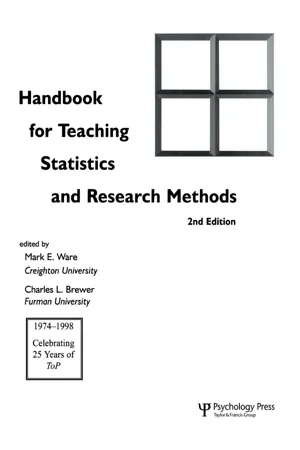
This volume presents a collection of articles selected from Teaching of Psychology, sponsored by APA Division 2. It contains the collective experience of teachers who have successfully dealt with students' statistics anxiety, resistance to conducting literature reviews, and related problems. For those who teach statistics or research methods courses to undergraduate or graduate students in psychology, education, and the social sciences, this book provides many innovative strategies for teaching a variety of methodological concepts and procedures in statistics and research methods courses.
- 296 pages
- English
- ePUB (mobile friendly)
- Available on iOS & Android
eBook - ePub
Handbook for Teaching Statistics and Research Methods
About this book
Information
Publisher
Psychology PressYear
2013Print ISBN
9780805830491
9781138163249
Edition
2eBook ISBN
9781317759348
Section II:
Research Methods
Along with statistics, research methodology undergrids scientific psychology. Courses in research methods challenge teachers and students. We selected articles for this section to help teachers meet some of the challenges by making their courses more meaningful and rewarding for them and their students. The articles contain suggestions for (a) reducing students’ fears, (b) evaluating ethical issues, (c) teaching ethics, (d) reviewing the literature, (e) using computers, (f) implementing teaching strategies, (g) demonstrating systematic observation and research design (h) teaching writing and critical thinking, (i) emphasizing accuracy in research, and (j) fostering students’ research and presentations. The articles should prompt teachers to reevaluate and improve how they conceptualize and conduct their courses in research methods.

1. Reducing Students’ Fears
In a program that incorporates research into the curriculum at all levels, Christiane Brems at the University of Alaska Anchorage developed a method for introducing students to research slowly and carefully. Her approach decreased students’ trepidation, and close collaboration of students and faculty in the research process increased enthusiasm and enjoyment for students and teachers.
Evidence suggesting that older left-handed individuals are underrepresented in the general population provided an engaging vehicle for David Johnson to introduce research methods into his courses at John Brown University. After viewing a graphical representation of this relation, students attempt to explain it. This fetching way of presenting diverse research issues can be used in various courses.
Nigel Barber at Birmingham-Southern College used a participant modeling technique in an introductory psychology class to reduce students’ fear of a laboratory rat. Students received a mild level of exposure (holding the rat’s transport box) and observed peer volunteers actually handling the animal. Students’ fear was reduced without handling the rat, which minimized ethical problems.
Taking the Fear Out of Research: A Gentle Approach to Teaching an Appreciation for Research
University of Alaska Anchorage
While teaching an undergraduate research methods course, I became painfully aware of the trepidation with which students approached this class. I decided that introducing students to research must be made more gradual and less intimidating during the first 3 years of college. Then, students may approach their senior research requirements with less apprehension.
This article describes an approach I have used in a psychology department that enrolls over 400 psychology majors and 50 clinical psychology master’s degree students. I have used this approach for six semesters, and one other faculty member has adopted it. Two other faculty members have incorporated significant pieces of it, and a fourth is in the process of so doing. Among the four of us, there are now approximately eight classes per year that integrate research. Faculty cannot be required to adopt this approach; hence, not all students in my department are exposed to it. Nevertheless, feedback from those who were exposed has been very positive. One instructor at one of our extended campuses indicated that she has also successfully incorporated research integration.
The first step in the process consists of integrating research at all levels of teaching. How research integration takes place depends on the level of the course, but it best begins in the first year. Integration is possible in all courses that are part of a traditional undergraduate psychology curriculum. For instance, it has been accomplished in Human Development (at the first-year level), Abnormal Psychology (at the sophomore level), Personality Theories (at the junior level), and Psychodynamic Theory (at the senior level). If research is integrated into core courses, psychology majors will be exposed to research early and throughout their training. The more faculty participate, the more exposure students will receive.
First-Year-Level Integration
At this level, the goal is to demystify the research process. First-year students are generally overwhelmed by the concept of research and believe it to be beyond their capabilities. They have visions of scientists working in laboratories full of rats, brewing mysterious potions, and crunching huge rows of numbers. Students need to learn that research is done by ordinary people with ordinary questions about ordinary environments and ordinary human behavior.
The demystification process is best approached in a two-pronged manner: introduce students to research and make students informed consumers of research. The former can be done easily by exposing students to research interests and activities of local faculty and graduate students. Graduate students are preferable as research models at this level because their experience resembles that of the undergraduate student more closely than that of a faculty member. In addition, students can be encouraged to visit the psychology laboratory; meet the assistants (who are rarely much older or more experienced than the students); and observe animals, equipment, or computer simulations.
Introducing students to research as consumers can take place most simply by asking them to read research articles. Although they have to read the entire article, first-year students are required to focus on the introduction section to prevent confusion that method and results sections often induce in neophytes. Reading introductions helps students recognize how authors slowly work their way through relevant literature to develop research questions.
Once students have read and digested a few articles, they can be asked to generate simple research questions. Creative role modeling is conducive to this process. I like to have fun with this approach by asking students to think of a question relevant to the course topic and then helping them reformulate the question into a format that lends itself to research. For instance, students in my Abnormal Psychology course often question the effectiveness of psychotherapy for severe mental illness. As a class, we talk about how a researcher could design a project to measure treatment outcome with such a clinical population. As a clinical psychologist, I enjoy demonstrating through this exercise that research is not limited to experimental psychology.
Sophomore-Level Integration
The demystification process continues at the sophomore level by introducing basic ideas about methodology. Sophomores are asked to read research articles, focusing on the introduction and method sections to get them thinking about how researchers go about answering questions. Students are alerted to basic questions dealing with choice of subjects, comparisons of groups, and instrument options. They read research articles with a fastidious approach so they can write a summary that reviews the question researched and critiques the chosen subjects and instruments.
Trips to the library add a nice component of knowledge to the students’ developing research repertoire. They are introduced to Psychological Abstracts, computerized search systems, journal stacks, reference guides, and research indexes. The best way to engage students in a basic literature search is to require them to find their own article to review rather than provide the same article for the entire class. Thus, students develop literature search skills and are more interested in what they read for critique.
Junior-Level Integration
More sophistication is required from students at this level, and they are introduced more thoroughly to the intricacies of methodology. Students are asked to read research articles, primarily focusing again on the method section—especially data collection. Article reviews are assigned, with a focus less on interest or clarity and more on the adequacy of data-collection procedures and conclusions drawn from the data.
Basic in-class discussion takes place about threats to internal validity (without necessarily naming the concept) by explaining maturation and history—two of the easiest threats to understand and describe in simple language. Threats to external validity are also discussed (again without necessarily naming the concept) by exaggerating generalizations from a particularly interesting article chosen by the instructor. Newspaper articles covering relevant topics work well for this purpose. In Personality Theories class, for instance, newspaper articles about gender or ethnic differences can be used because they often involve poor sampling and overstate conclusions and generalizability. Often, students have not thought about sampling biases and how they limit generalizability. Their amazement usually motivates them to seek more examples in local papers. They generally bring articles to class, and I gladly allow time to discuss them.
Senior-Level Integration
At the senior level, I require critical consumerism of research and encourage students to conduct their own research. With regard to consumerism, I ask students to review articles in a detailed manner and to comment on all article sections. With regard to the conduct of research, I allow students to substitute a research project for a term paper (usually one or two students will choose this option each semester). I encourage students to choose pertinent research topics that are of interest to them. This research can be carried out in groups or in collaboration with me or another instructor. I do ask that the projects completed with other instructors still be relevant to the course the student is taking from me, which limits collaboration with other faculty somewhat. I help students develop a meaningful research question to investigate. I do not search for perfection here but for a fairly sound study that will convey to students that they can do research. For instance, in my Psychodynamic Theories class, a student’s interest in the relation between narcissism and self-esteem led to a creative and complex project through which we developed a procedure for inducing mild narcissistic injuries in subjects (with proper follow-up and debriefing).
If my relationship with students at the senior level takes place in the context of the Research Methods course, I require them to design, conduct, and write up a research project of sufficient quality to be presentable at a regional psychological conference. Some of these projects have been of publishable quality (e.g., Skillman et al., 1992; Wilson, Vercella, Brems, Benning, & Renfro, 1992). In this course particularly, allowing students to develop projects that are of personal interest to them is critically important.
Graduate-Level Integration
At this level, I require students to review articles and conduct research. Reviews at this level are critiques that focus on a body of literature (i.e., assess whether current beliefs and practices in a given area are based on sound research). I require students to conduct research projects individually and to write them up for presentation and publication (e.g., Namyniuk & Brems, 1992; Tucker & Brems, 1993). The publication requirement instills enthusiasm for research like no other task; students are thrilled when they see their name in print.
Interacting With Students About Research
In addition to integrating research into the classroom, instructors can do other things to foster enthusiasm and reduce the fear of research. First, students’ interest in research can be piqued by telling them about one’s own research. At appropriate times, I talk about my research to help students recognize that research literature develops from many small building blocks, not a few huge studies that answer many questions or are designed to find the truth. Using examples of one’s own research brings the process down to earth for the student, makes it seem more relevant to the student, and gives it an applied context. A word of caution: One should never only present one’s own work. Otherwise students get bored and suspicious, and they may view the instructor as egotistical.
Telling students about one’s own research can also be used as a springboard to invite them to participate in one’s own research. I love to invite students to help with my projects (e.g., Brems, Baldwin, & Baxter, 1993), not to exploit them, but to teach them. Ideally, students should not be used as mere data collectors; instead, their involvement should be fairly evenly distributed across all stages of the investigation.
Research teams are another excellent means of interacting with students about research. The research teams I have conducted encouraged students to work on research projects with peers in collaborative efforts. This approach is less threatening because students can share work, exchange information, and capitalize on the individual strengths of project members (e.g., Brems, Baldwin, Davis, & Namyniuk, 1994). I lead such research teams; I do not rule them. I even let the teams make mistakes, so they can learn from their own experience. For example, during one project, the team decided after some discussion not to match subjects on educational level only to realize later that this variable was indeed an important mediator.
Brown-bag lunches and student clubs help to encourage faculty-student interaction concerning research interests, projects, and findings. Other informal information exchanges about research can involve the development of ...
Table of contents
- Cover
- Title Page
- Copyright Page
- Table of Contents
- Preface
- Section I: Statistics
- Section II: Research Methods
- Appendix
- Subject Index
Trusted by 375,005 students
Access to over 1.5 million titles for a fair monthly price.
Study more efficiently using our study tools.
Frequently asked questions
Yes, you can cancel anytime from the Subscription tab in your account settings on the Perlego website. Your subscription will stay active until the end of your current billing period. Learn how to cancel your subscription
No, books cannot be downloaded as external files, such as PDFs, for use outside of Perlego. However, you can download books within the Perlego app for offline reading on mobile or tablet. Learn how to download books offline
Perlego offers two plans: Essential and Complete
- Essential is ideal for learners and professionals who enjoy exploring a wide range of subjects. Access the Essential Library with 800,000+ trusted titles and best-sellers across business, personal growth, and the humanities. Includes unlimited reading time and Standard Read Aloud voice.
- Complete: Perfect for advanced learners and researchers needing full, unrestricted access. Unlock 1.5M+ books across hundreds of subjects, including academic and specialized titles. The Complete Plan also includes advanced features like Premium Read Aloud and Research Assistant.
We are an online textbook subscription service, where you can get access to an entire online library for less than the price of a single book per month. With over 1.5 million books across 990+ topics, we’ve got you covered! Learn about our mission
Look out for the read-aloud symbol on your next book to see if you can listen to it. The read-aloud tool reads text aloud for you, highlighting the text as it is being read. You can pause it, speed it up and slow it down. Learn more about Read Aloud
Yes! You can use the Perlego app on both iOS and Android devices to read anytime, anywhere — even offline. Perfect for commutes or when you’re on the go.
Please note we cannot support devices running on iOS 13 and Android 7 or earlier. Learn more about using the app
Please note we cannot support devices running on iOS 13 and Android 7 or earlier. Learn more about using the app
Yes, you can access Handbook for Teaching Statistics and Research Methods by Mark E. Ware,Charles L. Brewer in PDF and/or ePUB format, as well as other popular books in Psychology & History & Theory in Psychology. We have over 1.5 million books available in our catalogue for you to explore.