- 400 pages
- English
- ePUB (mobile friendly)
- Available on iOS & Android
eBook - ePub
About this book
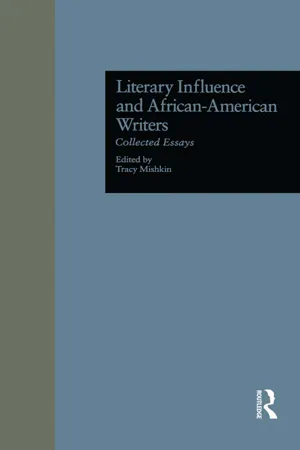
First published in 1996. This volume includes a collection of essays that where collected after the inspiration of finding positive interactions between African-American and Irish Writers during the Harlem Renaissance, a time when these two groups were hardly on good terms. The essays look at theories and realities of literary influence that especially affect African-American writers.
Information
The Nineteenth Century
Strategies of Black Characterization in Uncle Tom’s Cabin and the Early Afro-American Novel
Richard Yarborough
Poor Uncle Tom,The faithful, honest, bravePoor Uncle Tom!The patient captive slave,Poor Uncle Tom!“Poor Uncle Tom!”, a song from The Uncle Tom’s Cabin AlmanackMrs. Stowe has invented the Negro novel.George Eliot
In lectures, journals, pamphlets, newspapers, and sermons throughout the first half of the nineteenth century, pro- and antislavery forces debated not only the place of the black in the United States but also the very physical and psychological nature of the transplanted Africans. When the abolitionist journal National Era began the serial publication of a tale by Harriet Beecher Stowe called Uncle Tom’s Cabin; or, Life among the Lowly in June 1851, fiction immediately became a major weapon in the arsenals of both sides. Appearing in two-volume book form in March 1852, Stowe’s novel set off an astounding public response unique in the history of American publishing. Frederick Douglass reported that the first edition of 5,000 was gone in four days (“Literary Notices”) and that in one year Uncle Tom’s Cabin sold more than 300,000 copies (“Work”). This figure is particularly astonishing when one considers that out of a population of roughly 24 million in the United States, much of the South has to be excluded from any serious estimation of Stowe’s readership—both because of the huge slave population and because the novel was banned in many communities. Furthermore, one must forget neither the degree of illiteracy in mid-nineteenth-century America nor the widespread practice of passing books from hand to hand. Another indication of the reading public’s infatuation with Stowe was the reception accorded The Key to Uncle Tom’s Cabin (1853), a ponderous compilation of the factual material she claimed to have used in composing her bestseller: in the space of a month, roughly 90,000 copies were sold.
Uncle Tom’s Cabin was the epicenter of a massive cultural phenomenon, the tremors of which still affect the relationship between blacks and whites in the United States. Articulating most contemporaneous arguments regarding the Afro-American and endorsing a response to the race problem that has haunted black thinkers for over a century, Stowe’s novel has had a particularly powerful artistic impact as well. As the black critic William Stanley Braithwaite observes, not only was Uncle Tom’s Cabin “the first conspicuous example of the Negro as a subject for literary treatment,” but it also “dominated in mood and attitude the American literature of a whole generation” (30). In so doing, Stowe’s work played a major role in establishing the level of discourse for the majority of fictional treatments of the Afro-American that were to follow—even for those produced by blacks themselves. This is not to underestimate the crucial prototypical role the slave narratives played in shaping the Afro-American fiction tradition, especially through their impact upon white abolitionist writers (like Stowe), who, in turn, influenced black authors. A further important intergeneric connection can be discerned in the work of the ex-slaves William Wells Brown and Frederick Douglass, both of whom published narratives before turning to fiction. Finally, as Benjamin Quarles points out, “the vast audience that responded to [Stowe’s] classic tale of Uncle Tom … had already been conditioned and prepared by the life stories of runaway slaves” (67). Nonetheless, the lasting effect of Stowe’s masterwork on popular American culture dwarfs that of the slave narratives. With its extraordinary synthesizing power, Uncle Tom’s Cabin presented Afro-American characters, however derivative and distorted, who leaped with incredible speed to the status of literary paradigms and even cultural archetypes with which subsequent writers—black and white—have had to reckon. The grandeur of Leslie Fiedler’s claim that “for better or worse, it was Mrs. Stowe who invented American Blacks for the imagination of the whole world” (26) does not belie its essential truth.1
Although Stowe unquestionably sympathized with the slaves, her commitment to challenging claims of black inferiority was frequently undermined by her own endorsement of racial stereotypes. And it could hardly have been otherwise, for as Thomas Graham contends, “the Negro remained an enigma to her” (616). Of necessity, Stowe falls back upon popular conceptions of the Afro-American in depicting many of her slave characters. As one result, the blacks she uses to supply much of the humor in Uncle Tom’s Cabin owe a great deal to the darky figures who capered across minstrel stages and white imaginations in the antebellum years. The black pranksters Sam and Andy, for instance, provide a comic counterpoint to the melodramatic flight of Eliza and Harry from the slave trader Haley. And although the two slaves play a critical role in Eliza’s escape by leading the white man astray, they ultimately seem little more than bumptious, giggling, outsized adolescents. Further, Stowe never attributes their trickster-like manipulation of Haley to any real desire to help the fugitives to freedom. Rather, Sam and Andy realize that Mrs. Shelby does not want Eliza captured; eager to please their mistress, they are only too glad to oblige. Stowe’s attitude toward these slaves is also revealed in Sam’s other appearances, which are wholly comic. Primarily concerned with his own image, he is a pompous, philosophizing amateur politician, and his speeches are fraught with the tortured syntax and strained malapropisms that Stowe intends to be amusing.2
Other frequent sources of humor for Stowe are the slave children, whom she evidently viewed as part of the quaint furnishings below the Mason-Dixon line. If we take Uncle Tom’s Cabin literally, “little negroes, all rolled together in the corners,” could be found in slaves’ quarters, big-house kitchens, and barrooms throughout the South.3 Most closely resembling wild, boisterous puppies bent on driving the adults to distraction, these black children generally appear in tumbling heaps and bundles rather than as individuals. The only one whom Stowe seriously attempts to characterize is “poor, diabolic, excellent Topsy” (5), as George Sand called her; consequently, this figure embodies in particular detail the traits the author felt to be endemic to the undomesticated African.
Stowe introduces Topsy as the stereotypical pickaninny, with teeth gleaming, hair in bristling braids, eyes round and sparkling. A quick-witted, hyperactive child of eight or nine, she acts entirely from impulse and perversely flouts the accepted rules of polite white society, particularly those championed by the chilly, puritanical New Englander, Miss Ophelia. Inured to whipping and recalcitrant in the extreme, Topsy claims no natural origin—or, to be more precise, she offers a now-famous explanation of her own conception in such outrageously “natural” terms that it approaches the atheistic absurd: “I spect I grow’d. Don’t think nobody never made me.” She also justifies her destructive prankishness with a despairing resignation that exasperates Ophelia to no end: “Cause I’s wicked,—I is. I’s mighty wicked, any how. I can’t help it.” Despite her mistress’s best efforts, Topsy’s behavior remains quirkily schizoid. Assigned to clean Ophelia’s room, she either does so flawlessly or else unleashes a “carnival of confusion”; she learns to read and write “as if by magic” but refuses to master sewing (Chap. 20).
Stowe also hints at an eerie, otherworldly side to the “goblin-like” Topsy. In one of the more memorable scenes, the child responds to her owner’s whistle like a pet displaying a favorite trick:
The black, glassy eyes glittered with a kind of wicked drollery, and the thing struck up, in a clear shrill voice, an odd negro melody, to which she kept time with her hands and feet, spinning round, clapping her hands, knocking her knees together, in a wild, fantastic sort of time, and producing in her throat all those odd guttural sounds which distinguish the native music of her race; and finally, turning a summerset or two, and giving a prolonged closing note, as odd and unearthly as that of a steam-whistle, she came suddenly down on the carpet, and stood with her hands folded, and a most sanctimonious expression of meekness and solemnity over her face, only broken by the cunning glances which she shot askance from the corners of her eyes.
Although this incredible passage incidentally reveals the author’s rather odd and yet, for many whites of the time, entirely typical perception of Afro-American folk music and dance, of paramount importance is the emphasis Stowe places on the grotesque freakishness of Topsy’s performance, for she identifies this darkly magical and faintly sinister quality of the “sooty gnome” with her unredeemed African nature. With her irrepressible penchant for “turning a summerset” and the mesmerizing power “her wild diablerie” maintains over Eva St. Clare and the other youngsters, Topsy is the imp child whose undisciplined devilish spirit must be controlled (Chap. 20).
Her scenes with Eva bring Topsy’s allegedly innate African traits into sharpest relief. If Eva is the “fair, high-bred child, with her golden head, her deep eyes, her spiritual, noble brow, and princelike movements,” Topsy is her “black, keen, subtle, cringing, yet acute neighbor.” Eva, “the Saxon,” and Topsy, “the Afric,” are both “representative of their races,” and the moral struggle that ensues between them constitutes an important motif in Uncle Tom’s Cabin (Chap. 20). On one side stands the precocious, cherubic Eva, whom Stowe describes as “an impersonation in childish form of the love of Christ” (Key 51). On the other is Topsy, who embodies an innocent but still dangerous lack of self-control and restraint. And although fascinated by Topsy “as a dove is sometimes charmed by a glittering serpent” (the religious symbolism here is obvious), Eva holds the key to the black child’s conversion as she tries to touch her “wild, rude heart” with “the first word of kindness” (Chap. 20). Initially, Topsy resists, linking her hopeless spiritual condition with her race: “Couldn’t never be nothin’ but a nigger, if I was ever so good.… If I could be skinned, and come white, I’d try then.… There can’t nobody love niggers, and niggers can’t do nothin’! I don’t care.” However, Eva’s response—“Oh, Topsy, poor child, I love you!”—pierces her defenses. Prostrated by the gentle force of selfless love, Topsy breaks down, with Eva bending over her like “some bright angel stooping to reclaim a sinner” (Chap. 25). In Stowe’s world, to be born black is to be born a pagan, but paradoxically close to a state of grace; once a character’s heathen African nature is controlled, redemption becomes a possibility.
Stowe’s depiction of Legree’s henchmen, Sambo and Quimbo, reiterates this same formulation. Although easily the most immoral black characters in the novel, the two slaves have, Stowe hastens to point out, no real predisposition to cruelty. Their mocking of Uncle Tom and their participation in Legree’s satanic, drunken revels result directly from their infamous master’s example and instruction, for he “had trained them in savageness and brutality as systematically as he had his bull-dogs” (Chap. 32). In a subsequent discussion of African psychology, Stowe claims that blacks “are possessed of a nervous organisation peculiarly susceptible and impressible” (Key 45).4 Not only does this trait explain Sambo and Quimbo’s degraded condition on the Legree plantation but, from a Christian perspective, it entails what we can term an infinite capacity for conversion. Like Topsy, Sambo and Quimbo simply need more positive influence in order to be saved. Thus, witnessing Tom’s agony brings about an immediate change, and they shed tears of repentance and grief when exposed to the Holy Word. Because of the impressionability and the innate fascination with things spiritual that allegedly typify the African race, Stowe’s blacks, when apparently evil, are but misguided and always receptive to Christian rehabilitation.
Throughout Uncle Tom’s Cabin, Stowe draws importa...
Table of contents
- Cover
- Half Title
- Series Page
- Title Page
- Copyright Page
- Dedication
- Table of Contents
- Preface
- General Editor’s Introduction
- Theorizing Literary Influence and African-American Writers
- The Nineteenth Century
- African-American and Irish Literature
- Early to Mid-Twentieth Century
- Contemporary
Trusted by 375,005 students
Access to over 1.5 million titles for a fair monthly price.
Study more efficiently using our study tools.
Frequently asked questions
Yes, you can cancel anytime from the Subscription tab in your account settings on the Perlego website. Your subscription will stay active until the end of your current billing period. Learn how to cancel your subscription
No, books cannot be downloaded as external files, such as PDFs, for use outside of Perlego. However, you can download books within the Perlego app for offline reading on mobile or tablet. Learn how to download books offline
Perlego offers two plans: Essential and Complete
- Essential is ideal for learners and professionals who enjoy exploring a wide range of subjects. Access the Essential Library with 800,000+ trusted titles and best-sellers across business, personal growth, and the humanities. Includes unlimited reading time and Standard Read Aloud voice.
- Complete: Perfect for advanced learners and researchers needing full, unrestricted access. Unlock 1.5M+ books across hundreds of subjects, including academic and specialized titles. The Complete Plan also includes advanced features like Premium Read Aloud and Research Assistant.
We are an online textbook subscription service, where you can get access to an entire online library for less than the price of a single book per month. With over 1.5 million books across 990+ topics, we’ve got you covered! Learn about our mission
Look out for the read-aloud symbol on your next book to see if you can listen to it. The read-aloud tool reads text aloud for you, highlighting the text as it is being read. You can pause it, speed it up and slow it down. Learn more about Read Aloud
Yes! You can use the Perlego app on both iOS and Android devices to read anytime, anywhere — even offline. Perfect for commutes or when you’re on the go.
Please note we cannot support devices running on iOS 13 and Android 7 or earlier. Learn more about using the app
Please note we cannot support devices running on iOS 13 and Android 7 or earlier. Learn more about using the app
Yes, you can access Literary Influence and African-American Writers by Tracy Mishkin in PDF and/or ePUB format, as well as other popular books in Literature & Literary Criticism. We have over 1.5 million books available in our catalogue for you to explore.