eBook - ePub
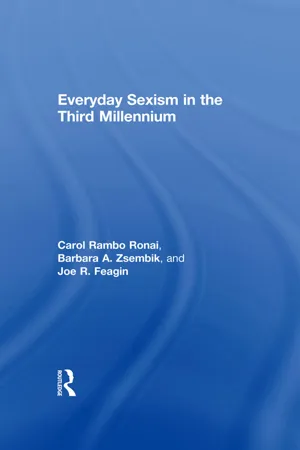
Everyday Sexism in the Third Millennium
- 264 pages
- English
- ePUB (mobile friendly)
- Available on iOS & Android
eBook - ePub
Everyday Sexism in the Third Millennium
About this book
This collection features new and original research on the range of sexism still faced every day by women in US society. It documents oppression across ethnic, racial, class, and sexual orientation groups in a wide range of gendered spaces, including the home, the workplace, unions, educational institutions, and the Internet. Exploring the way these different but related systems of oppression interact, the editors come to view sexism not as a static thing, but as part of a "dialectic of domination" in which women are simultaneously oppressed and capable of oppressing others through their discourse and practice. With its broad range of approaches, its focus on discourse and experience in gendered spaces, and its debunking of the personal and societal fictions of gender, this book goes a long way toward explaining why sexism is still so pervasive in everyday life.
Information
1
Introduction
Living with Everyday Sexism in the Third Millennium
CAROL RAMBO RONAI, BARBARA A. ZSEMBIK, AND JOE R. FEAGIN
I think the overall goal of the “feminist” movement has been to promote homosexual power—not women’s equality.
You must be willing to work for the rights that other people have earned through hard work instead of whining for them … so just shut the hell up about it.
Modern feminism should not deny or overlook the fact that a substantial segment of our society is changing for the better; in other words, don’t let a few narrow minded, ignorant few dampen the significant progress which has been achieved over the years.
—Student responses to an informal survey on feminism, conducted by
the Memphis Woman’s Action Coalition,
a campus student organization.
the Memphis Woman’s Action Coalition,
a campus student organization.
The editors of this volume have had common experiences in the classroom and workplace that were the genesis of this collection. Each of us has been issued the following challenge by our students and colleagues: “Sexism is a thing of the past, so why spend so much time on it in the classroom?” Other remarks, such as “Things are better now than they used to be, women should quit whining and get over it,” and “With everyone walking around on eggshells about sexism, it makes it seem like more of a problem than it really is, ” have revealed to us an atmosphere where students and colleagues seemed to be angry, uncomfortable, or fearful about discussing sexism.
Additionally, students and colleagues over the years have voiced doubts and fears about feminist theory, finding it alienating and irrelevant to their everyday lives. Women confessed to us that they agree with the basic tenets of feminism, but they do not want to be thought of as overbearing or unfeminine, or to be ascribed the dreaded status of “lesbian.” Men have voiced fears about not knowing how to act towards women, losing power over their lives to women and seeming unmanly (that is, homosexual) for embracing a feminist perspective.
As we stand on the threshold of the twenty-first century, we believe that now, more than ever, it is time to take stock of current experiences with and perceptions of sexism. We are living at a particularly crucial historical moment for examining the problem of sexism. Many popular observers and authors have recently argued that sexism is exaggerated if not on the decline in the United States. The current climate in the classroom and workplace reflects this conservative rhetoric about the decline of sexism, yet the content of this volume strongly suggests otherwise.
From debates like this, we determined that there is much confusion about what sexism and feminist thinking are, and have decided that it would be useful to address the following questions in an edited collection: Is there still sexism in the late twentieth century? And if so, how does it manifest in our everyday lives?
The social and political climate as it is reflected in the classroom and in the contemporary mass media suggests that sexism has been in the nation’s collective consciousness and in our collective discourse. In the last few years, the mass media have given increased emphasis, if not intelligent analysis, to sexism in everyday life. If we accept the news as a reflection of the issues we deal with in our everyday lives, then we must concede that sexism is a topic that concerns us all. One has only to read accounts of events like the 1995 O.J. Simpson trial in Los Angeles to hear discussions about domestic violence (Should the police and the judicial system have responded differently to Nicole Brown Simpson s 911 calls for help?) or about gender discrimination in the workplace (Should Marcia Clark, the prosecuting attorney, have lost her children to her ex-husband for spending too much time working on the Simpson case?). Similarly, the early 1990s congressional hearings on Clarence Thomas’s nomination to the Supreme Court served, in light of the accusations of sexual harassment from his subordinate Anita Hill, to heighten the national debate about sexual harassment.
This edited collection features new and original research from the 1990s on the range of sexism still faced by girls and women in this society. In an examination of the chapters, the reader will encounter diverse and innovative research materials that overwhelmingly contradict the commonplace sentiment that the existence of sexism is exaggerated in U.S. society. These new empirical materials document gendered oppression as it is endured by women of various age, racial, ethnic, class, and sexual orientation groups. In this book we add greater depth to our knowledge of the daily lives and experiences of women in a wide range of interactive settings, including the home, the workplace, unions, educational institutions, and the Internet.
Gender and the Matrix of Domination
Most social scientists accept the view that gender is a critical component in understanding social experiences. Increasingly, many social scientists also recognize the importance of examining the effects of gender in their own research, offering a useful corrective to a predominantly male-dominated social science. Nonetheless, in much research there is still a tendency to think of gender only as a “variable” or as an individual trait (Stacey and Thorne 1985). From our perspective, gender should be viewed as an aspect of social organization, not a variable or trait. Sexism is a far more complicated process than men oppressing women at every turn. It is part of a larger system of social organization, which includes, among other things, the actions and consciousness of women themselves, who can in their turn reinforce or resist sexism. In addition, gender is only one of several overlapping social hierarchies that organize human relationships within a society like the United States.
Feminist scholars such as Patricia Hill Collins (1990), Marilyn Frye (1983), Audre Lorde (1984), and Dorothy Smith (1979) have observed that boys and girls, men and women, are situated within several different but related systems of domination and oppression. We have sought out researchers who can enlighten us on the interrelationships among these systems. In the articles in this collection, the reader will find domination and oppression located at the intersection of gender and racial groups in eight of the articles; of gender and class in two of the articles; of gender, ethnicity, and class in one; and of gender, class, and sexual orientation in one.
Within these intersections we discover that women are simultaneously oppressed and capable of oppressing others by perpetuating the practices and discourses of sexism, racism, classism, and/or homophobia. For example, Christine Michele Robinson s chapter on African- American and interracial lesbian relationships illustrates this. To heterosexual African-Americans, black lesbians are often considered race traitors. By refusing to be in a heterosexual relationship, some black Americans argue, black lesbians fail to support black men, and thereby engage in a type of group genocide by failing to produce traditional male-female families. While African-Americans, both homosexual and heterosexual, have experienced racial discrimination, heterosexual black Americans use heterosexist practices and discourses (for example, sexist assumptions about the “proper” role of women in society) to isolate and harm black lesbians.
All the articles examine the sexist discourses—the ways in which men and women think about, talk about, and “do” gender in our everyday lives. Sexist discourses become institutionalized as public knowledge and are disseminated throughout society so effectively that they assume a “given” quality. The sexist discourses lying behind antifemale discrimination encompass many “sincere fictions” about both women and men. Sincere fictions are personal mythologies that reproduce societal mythologies at the individual level (see Feagin and Vera 1995). These myths and misconceptions are linked to how people in particular settings articulate their perceptions of gender and “do” discrimination.
As we will see in the chapters that follow, our authors have various ways of conceptualizing these fictions: controlling images, discursive constraint, stereotypes, and family idealizations. These sincere fictions trigger and rationalize behavior ranging from sexual harassment and workplace exclusion to domestic violence. Everyday discrimination triggers sexist discourse in the form of sincere fictions, which in turn feeds more gendered discrimination.
Gendered Spaces: Towards a Dialectical Theory of Domination
Initially, the editors of this volume planned to feature the idea that gender existed within a complex web of hierarchies that intersected to create a matrix of domination. After reviewing the research submitted for inclusion in this volume, we came to the conclusion that this approach was inadequate. For women and men, the matrix of social ties and relations extends out in all directions in space, both in physical spaces and in socially constructed spaces. Women’s everyday lives have many facets; the matrix approach allows us to examine the surface of only a few facets at one time. The chapters in this collection, taken as a whole, reveal multiple levels of sexism that are linked together and layered in a reflexive, interactive manner. This reality suggests the need to move away from a static matrix model and expand the conception of gendered oppression to include a major dialectical dimension.
This book’s chapters and its overall organization underscore our view of sexism as dialectical processes and interactive complexities. We fuse the concepts “gendered space” and “dialectical relationships” together to expand the matrix of domination into a “dialectic of domination.” By this latter term we mean that sexual domination is not a static “thing” found at one point in time or at one place, but rather it has a history and is webbed across many places in time and space. Gendered domination of a particular sort, or at a specific place, inevitably has external connections with other types of gendered domination, as well as with other types of domination. In our view, gendered oppression at one place is part of a process that contains both the history of gendered domination and possible futures, including futures of resistance.
A dialectical approach emphasizes that the “parts” of sexism, eloquently described in our chapters, are but segments of a larger whole that includes the present, past, and future of gendered domination not only for the “subjects” being researched but also, as several of the articles make very clear, for the researchers and the research process. “The perspectival element—recognizing that things appear very different depending on who is looking at them—plays a very important role in dialectical thought” (Oilman 1993).
Dialectics of Gendered Spaces
Persuaded by this dialectical approach, we have arranged our chapters into sections organized around three sensitizing concepts: identities as gendered spaces, bodies as gendered spaces, and economic/political arenas as gendered spaces. We do not argue that these are the only types of gendered spaces possible, but rather that these are the three interrelated dimensions that recur in the chapters of this collection.
The women presented in these chapters have often lost control of the definition of personal and social situations, because these spaces are highly gendered. “Gendered spaces” are social arenas in which a person s gender shapes the roles, statuses, and interpersonal dynamics and generates differential political and economic outcomes and interaction expectations and practices (Elshtain 1981; Oakley 1979; Siltanen and Stanworth 1982; Zsembik 1995). “Social relations are physically structured in material space, and human beings often view space expressively and symbolically. In most societies those with the greater power and resources ordinarily control the use and meaning of important spaces in a society” (Feagin, Vera, and Imani 1996, p. 49). Gendered spaces are those where the sexist biases of the most powerful generally define their character as social arenas, with the consequent feelings of control or lack of control over them. Spaces are gendered substantially because sets of sincere fictions delimit the boundaries of these spaces and the practices that occur there.
Gendered spaces mean that sexism is pervasive in women’s histories and experiences, although sexism manifests itself differently across the several, often overlapping spaces discussed in this volume. As we noted above, gendered space entails more than a physical place, for it usually involves recurring social interactions and complex, constructed meanings. For instance, sexual harassment on the Internet, as discussed by Kimberly J. Cook and Phoebe M. Stambaugh (Chapter 5), is a clear example of a place where interactions occur that do not occupy a physical space as such. In that space the sexist discourses engaged in by some male participants posting on-line messages to the sexual harassment discussion group were shaped by a number of sincere fictions about how men and women are supposed to “do gender” in U.S. culture.
Some groups or individuals deliberately engage in sexist discourse for the purpose of controlling girls and women. Many times, the face of this oppressor is a boy or a man, but sometimes it is a woman. Often sexist discourse and practice takes place in public settings, such as in the workplace or on the Internet, while at other times it is perpetrated in the most private areas of our lives, in our homes, and even our bedrooms. In most cases presented in this volume, the inequalities perpetuated by gendered spaces are sexualized. Sometimes, too, the boundaries of gendered spaces are crosscut or reinforced by the languages of class, racial grouping, ethnicity, and sexual orientation.
Dialectics of Resistance
Whether the gendered space in question is identity, the body, or political/economic arenas, it becomes for women a space where they find themselves emotionally, physically, or financially impacted in negative ways. Each gendered space or dimension is dialectically related to another, which is to say that one affects how the others will manifest themselves. A woman’s identity affects her physical well-being and her political and economic status. Moreover, physical or sexual abuse of a woman’s body impacts both her identity and her ability to function in the political and economic arenas. Likewise, blocking women from fair access to the political or economic processes because of gender discrimination makes her vulnerable to psychological or bodily harm.
This is not to say that the women discussed here do not find ways to resist discrimination and contest control over the definition of social situations. Sometimes they resist actively through strategies such as verbal protestation, physical resistance, or court action. At other times they withdraw, resisting passively so they can be around to fight another day.
Each chapter of this book can be viewed as an overt act of resistance on behalf of women. Certainly, the subjects of the chapters do resist. Many women resist gendered oppression by refusing to accept the negative identities offered them. Through autoethnography, Andreana Clay, tammy ko Robinson, and Carol Rambo Ronai engage in resistance by publicly telling about experiences that mainstream America does not want to face or discuss. The activists whom Ba...
Table of contents
- Cover
- Half Title
- Title Page
- Copyright Page
- Table of Contents
- 1. Introduction Living with Everyday Sexism in the Third Millennium
- Part I Identity as a Gendered Space Dialectical Linkages
- Part II The Body as a Gendered Space Dialectical Linkages
- Part III The Political/Economic Arena as a Gendered Space Dialectical Linkages
- Contributors
- Index
Trusted by 375,005 students
Access to over 1.5 million titles for a fair monthly price.
Study more efficiently using our study tools.
Frequently asked questions
Yes, you can cancel anytime from the Subscription tab in your account settings on the Perlego website. Your subscription will stay active until the end of your current billing period. Learn how to cancel your subscription
No, books cannot be downloaded as external files, such as PDFs, for use outside of Perlego. However, you can download books within the Perlego app for offline reading on mobile or tablet. Learn how to download books offline
Perlego offers two plans: Essential and Complete
- Essential is ideal for learners and professionals who enjoy exploring a wide range of subjects. Access the Essential Library with 800,000+ trusted titles and best-sellers across business, personal growth, and the humanities. Includes unlimited reading time and Standard Read Aloud voice.
- Complete: Perfect for advanced learners and researchers needing full, unrestricted access. Unlock 1.5M+ books across hundreds of subjects, including academic and specialized titles. The Complete Plan also includes advanced features like Premium Read Aloud and Research Assistant.
We are an online textbook subscription service, where you can get access to an entire online library for less than the price of a single book per month. With over 1.5 million books across 990+ topics, we’ve got you covered! Learn about our mission
Look out for the read-aloud symbol on your next book to see if you can listen to it. The read-aloud tool reads text aloud for you, highlighting the text as it is being read. You can pause it, speed it up and slow it down. Learn more about Read Aloud
Yes! You can use the Perlego app on both iOS and Android devices to read anytime, anywhere — even offline. Perfect for commutes or when you’re on the go.
Please note we cannot support devices running on iOS 13 and Android 7 or earlier. Learn more about using the app
Please note we cannot support devices running on iOS 13 and Android 7 or earlier. Learn more about using the app
Yes, you can access Everyday Sexism in the Third Millennium by Carol Rambo Ronai,Barbara A. Zsembik,Joe R. Feagin in PDF and/or ePUB format, as well as other popular books in Social Sciences & Feminism & Feminist Theory. We have over 1.5 million books available in our catalogue for you to explore.