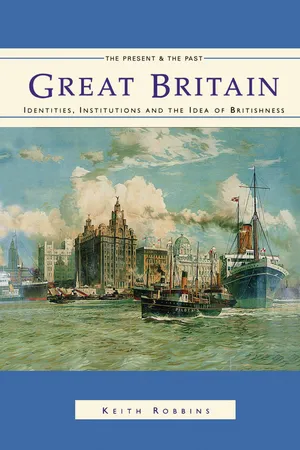
eBook - ePub
Great Britain
Identities, Institutions and the Idea of Britishness since 1500
- 392 pages
- English
- ePUB (mobile friendly)
- Available on iOS & Android
eBook - ePub
About this book
This is a timely exploration of national identity in Great Britain over nine hundred years of history. Our attitudes to the nation state are changing - national assemblies in Scotland and Wales and growing pressures for regional assemblies. In his vigorous new survey, Professor Robbins provides the background to these changing attitudes. He considers the development as well as the possible disintegration of the sense of "Britishness" among the inhabitants of Britain and investigates how - and why - they have preserved their own national and regional identities across several centuries of co-existence.
Information
Great Britain: Creation, Crisis, Consolidation c. 1500–c. 1750
Chapter 3
Designs and Accidents: Making Great Britain c. 1500–c. 1700
An observer in 1500, one recent historian has concluded, might reasonably have forecast that the ties between southern England and the rest of the British Isles would remain 'largely commercial in character'.1 There is, if this view is accepted, no reason to presuppose that union between Scotland and England (and Wales) followed inexorably from the fact that the two kingdoms shared one island. The island of Ireland, contentiously, is currently divided. There are other insular examples in the contemporary world, as there have been in the past, where two or more states co-exist. Our initial chapters, however, have made it clear that the possibility of a single 'Britain', whatever that might mean, was part of the island's tangled history. There were factors in turn-of-the-century politics which Professor Kearney's 'observer in 1500' might not altogether have taken into account.
Comparative analysis, simply put, suggests that there are two routes to political union. One state, in one scenario, is conspicuously stronger – politically, militarily, economically – than its neighbour. Its rulers, should they so desire, are therefore in a position to coerce that neighbour into a union. If necessary, they can deploy force and anticipate overcoming resistance, if it is offered. Whether a state thus conquered acquiesces in its new status depends upon a host of factors. In a second scenario, a union comes about because the rulers of neighbouring states conclude over time, perhaps for complex reasons, that it is to their mutual benefit (and the assumed benefit of their people) that a union should take place. There may, or may not, be a long antecedent history of hostility. The basis of the union and the arrangements which follow from it may, however, vary very considerably and it may or may not endure. The making of 'Great Britain', however, does not conform precisely to either pattern, though it contains elements of each. There is both design and accident, coercion and consent, in the processes which combined to bring it about over some 200 years. It is the purpose of this chapter to explain and explore them.
England, Wales and Scotland in the Sixteenth Century
In 1502 Henry VII of England concluded a full peace treaty with James IV of Scotland, the first since 1328, and 'perpetual peace' between the two kingdoms was in prospect. Under the treaty, James was to marry Henry's daughter Margaret, which he did the following year. It was an arrangement which came as near as any contemporary agreement could to inaugurating a new era in relationships between the two countries. James had in the recent past given encouragement to the English 'Richard IV', the pretender Perkin Warbeck. Henry could hope that support for English rebels would not be offered again. In his own lifetime that proved largely to be the case, but four years after his death in 1509, English and Scottish forces were again on the battlefield. At Flodden the Scottish army suffered a severe defeat. A plaintive lament for the Scots who fell has resounded down the centuries.
Quite why James should have risked such a fight remains a mystery, but the outcome was a disaster, though still one which did not place the Scottish kingdom in total jeopardy. It did mean, however, that in some Scottish quarters questions were being asked about the country's long-term future. If Scotland cultivated French support, as had been done in the past, such support might give protection against England. On the other hand, it might not be sufficient and would be considered in London to be provocative. The alternative was to return to the notion of 'perpetual peace' with England, though recognizing that an amicable relationship might equally, over a longer term, place a question mark against Scottish independence.
After Plodders, Henry VIII was more immediately interested in trying to make England a force to be reckoned with on the European mainland than in 'settling' Scotland. He did not make a direct attempt to annex Scotland. Temporarily, too, the French king had no interest in trying to use Scotland as a means of putting pressure on England. It was understandable that James V of Scotland gave no leadership when he succeeded his father, who had been killed at Flodden. He was only seventeen months old. Leading nobles were concerned and James's mother Margaret worried what her brother might do. A French garrison appeared in Scotland to deter any English attack from the south. James V, who successfully escaped from his protectors in 1528, was determined to prove that he had a will of his own, but was ever mindful of his English uncle.
Henry, however, had other things on his mind after 1529 than the condition of Scotland. It was in that year, after the failure of his attempt to obtain from Pope Clement VII the annulment of his marriage to Catherine of Aragon, that Henry summoned Parliament. There followed a series of measures over the next seven years which, culminating in the dissolution of the monasteries in 1536, had the effect of destroying papal authority in England.
Also in 1536 (with a further measure in 1543) the English Parliament passed measures to accomplish the union of England and Wales. They had no direct bearing on contemporary Anglo-Scottish relations but the fact of union nevertheless constituted a kind of precedent. Henry VII had in part exempted Welsh people from the 'penal legislation' imposed a century earlier but appears in general not to have been driven by sentiment. He gave life to a Council of Wales and the Marches based at Ludlow and installed the Prince of Wales, young Arthur, there in 1501. It was also there that Arthur died in the following year and with him the revived Arthurian myth. The problems of jurisdiction and justice on the Borders, with their lordships, were formidable and unresolved. Given that the principality remained separate, Wales as a whole was, from an administrative point of view, distinctly untidy.
It was claimed by a "Welsh historian later in the century that Henry VII gave to Prince Henry a 'special care' of his own countrymen, the Welsh, If so, Henry VIII took the view that this was best achieved by the incorporation of Wales. The legislation enacted can be viewed from two perspectives. On the one hand, Welshmen achieved full equality with Englishmen before the law. On the other hand, the law was English law not Welsh. English was to be the language of the reorganized court system in Wales. Primogeniture was to become the system of inheritance. New counties replaced the lordships and all of Wales was now shired on the English model, with the right to return Members of Parliament in London. The Council at Ludlow flourished over the next half century. Wales was made outwardly uniform as never before but, paradoxically, in the act of being absorbed into England. It was unclear whether, over time, Welsh language and culture could flourish or even survive. However little Henry VII's son and grandchildren made of the Welsh element in their ancestry, it can be argued that the Tudors could take the loyalty of the Welsh for granted. It was that same Protestant Welsh historian who Wrote in 1590 that 'No country in England so flourished in one hundred years as Wales hath done It had changed from evil to good and from bad to better.2
In Scotland there was the possibility that James V might follow Henry's example and dissolve the monasteries. Henry would have liked this to happen, since it would assist his own security in his quarrel with the papacy and have the incidental benefit of worsening Franco-Scottish relations. He attempted to create a pro-English faction in Scottish politics. However, James was not to be drawn into dissolving his monasteries. Perhaps he was too busy arranging for five of the wealthiest abbeys and priories to be granted to his under-age bastard sons – there were nine such sons to choose between. Instead, his thoughts turned to France.
In 1537 he married Madeleine, daughter of Francis I of France, in Paris, and following her death within the year he married another French bride, Mary of Guise-Lorraine. Two sons died in infancy. Lack of a legitimate heir, however, was by this time not his only difficulty. Henry VIII, who had been having his own protracted problems in producing a male heir, had grown increasingly irritated by Franco-Scottish intimacy. In what were his last years, he turned again to war with France (and captured Boulogne) and to war with Scotland. In 1541 James had declined Henry's invitation to an avuncular discussion in York and war clearly threatened. The Scottish king had great difficulty in mustering a sufficient force from his magnates to cope with such an attack. When the two armies did meet on the Border at Solway Moss in November 1542, the battle proved to be another Scottish disaster. James V himself escaped, but died in the following month, leaving as his successor his one-week-old daughter, Mary.
Henry followed up military success by diplomacy, making use of Scottish nobles who had either been in exile in England or had been captured at Solway Moss. His plan was for his five-year-old son Edward to marry baby Mary. She would move to England at the age of ten with this objective in mind. The Treaty of Greenwich (July 1543) embodied this plan, but before the year was out the Scottish Parliament repudiated the treaty, suspecting that it would be a step, perhaps an irreversible step, which would lead to political union. The political opinion that mattered in Scotland was bitterly divided on this issue, compounded as it was by clerical rivalries and the new complication of possible Protestant infection. A baby queen could not help. Henry reacted fiercely to the repudiation of the treaty, sending forces north by land and sea which harried the eastern Lowlands of Scotland viciously over the next few years. It is not for nothing that Henry's 'courtship' of Scotland at this time is known as the 'Rough Wooing'. In addition, he tried to exploit Gaelic disaffection in the Western Isles and to promote a pro-English 'fifth column' elsewhere in Scotland by bribery.
This policy was followed, after Henry's death in 1547, by a more ambitious attempt to create a fortified English 'Pale' (analogous to the Pale that existed in Ireland around Dublin). Haddington, but a short distance from Edinburgh, became the English military headquarters in the Lowlands. The Battle of Pinkie (1547) was another substantial Scottish defeat in this same area. Yet the English forces did not succeed in reaching Mary, the queen, in Stirling. In July 1548 she departed for France where it had been agreed that she should marry the Dauphin, Francis, son of the King of France. The corollary of this marital arrangement, set out in the Treaty of Haddington, was that French troops and mercenaries of other nationalities should be sent to Scotland in what would become a concerted effort to drive out the English. Over the next few years – in the context of a wider politico-military struggle between the two countries – both England and Scotland spent a very great deal in financing their armies and fortifications in Scotland. By 1550, the outcome was a clear Franco-Scottish victory. The English government withdrew its garrisons from Scotland, promised not to attack in the future, and acquiesced in the marriage of Mary to the Dauphin of France.
It seemed, therefore, that the independent survival of Scotland was guaranteed. It could also be said, however, that Scotland had merely exchanged the threat of English control for the reality of French control. The new French king, Henry II, could well use Mary's claim to the English throne for his own purposes. In addition, when Mary and the Dauphin were married in 1558, the accompanying treaty promised that her husband would take the Scottish Crown in the event of her death. In this way, Scotland might be absorbed into the French monarchy as Brittany had been absorbed fifty years earlier. In Scotland itself, Mary of Guise became Regent for her daughter from 1554. Franco-Scottish intimacy, at least at a certain level, had never been greater. Scotsmen in France were to be treated virtually as naturalized Frenchmen, and Frenchmen living in Scotland were to be treated likewise. A notable case in point was that of George Buchanan, historian, political theorist and Latin poet, pupil of John Major, who had studied and taught in Paris for a decade as a young man and returned there in the 1550s.
Even so, beneath official concord and amity lay the crisis of the Reformation which was dividing both France and Scotland internally and to which we shall subsequently return. John Knox, Scottish Protestant preacher, had been captured by French forces when they had attacked St. Andrews castle – a centre of disaffection – in 1547. On his release in 1549 he settled for safety in England and became a chaplain to the king, Edward VI. He went on his travels on the Continent when Mary Tudor, a Roman Catholic, became Queen of England in 1553 after the death of the youthful Edward. He kept his eye on events in his native land. There, in the later 1550s, the 'Lords of the Congregation', magnates who had taken up the Protestant cause, pressed for changes in a Protestant direction, but to no avail. On his return to Scotland, Knox, together with the Protestant lords, mustered sufficient support to depose Mary of Guise as Regent in 1559 – though, having done so, it was questionable whether they would themselves be able to stay in control. A few months earlier, the Regent's daughter, Mary, had become Queen of France on the death of her father-in-law. In her own mind, she was now queen of four kingdoms: Scotland, France, England and Ireland.
Elizabeth I, Queen of England and Ireland since November 1558 when she succeeded her sister Mary, naturally objected. Despite the fact that the Treaty of Câteau-Cambrésis had ended the war with France which Elizabeth

3.1 John Knox and Mary, Queen of Scots. A word in your ear, ma'am: Lawyer, tutor, church reformer, temporary galley slave, John Knox famously delivered a First Blast of the Trumpet against the Monstrous Regiment of Women (1558). He held that women should not rule. In the event Mary, Queen of Scots contrived by her behaviour to give some plausibility to the contention. Knox returned to Scotland in 1557 and Mary was deposed in 1567. Engraving after the early Victorian Edinburgh artist Sir William Allan, the first Scottish painter to research and accurately portray the dress of the period in his 'historical' canvasses.
had inherited from Mary, a French army still remained in Scotland. There was a widespread fear in London, whether justified or not, that if the Protestant rebels in Scotland were overcome, the French would then invade England and put Mary, Queen of Scots, on the throne of England. A counter-stroke was required. After having made contact with the Protestant lords in Scotland and having made sufficient military preparation^ an English land and sea campaign began in the spring of 1560, focusing on Leith, the port of Edinburgh, where a French garrison was quartered. The expedition had many shortcomings and was met with fierce resistance, but eventually it achieved its objective. The Treaty of Edinburgh, signed in July, brought the 'Auld Alliance' of France and Scotland to an end. The natural death of Mary of Guise in Edinburgh Castle came, as it were, on cue. Both French and English troops were to withdraw from Scotland. Mary, Queen of Scots, was required to remove the arms of England from her insignia and thus, in effect, to recognize that Elizabeth was indeed Queen of ...
Table of contents
- Cover Page
- Half Title Page
- Series Page
- Title Page
- Copyright Page
- Contents
- List of Maps
- List of Illustrations
- Acknowledgements
- Preface
- Prologue
- One Great Britain: Creation, Crisis, Consolidation c. 1500–c. 1750
- Two Great Britain: World Power c. 1745–c. 1945
- Chapter Epilogue
- Bibliography
- Maps
- Index
Trusted by 375,005 students
Access to over 1.5 million titles for a fair monthly price.
Study more efficiently using our study tools.
Frequently asked questions
Yes, you can cancel anytime from the Subscription tab in your account settings on the Perlego website. Your subscription will stay active until the end of your current billing period. Learn how to cancel your subscription
No, books cannot be downloaded as external files, such as PDFs, for use outside of Perlego. However, you can download books within the Perlego app for offline reading on mobile or tablet. Learn how to download books offline
Perlego offers two plans: Essential and Complete
- Essential is ideal for learners and professionals who enjoy exploring a wide range of subjects. Access the Essential Library with 800,000+ trusted titles and best-sellers across business, personal growth, and the humanities. Includes unlimited reading time and Standard Read Aloud voice.
- Complete: Perfect for advanced learners and researchers needing full, unrestricted access. Unlock 1.5M+ books across hundreds of subjects, including academic and specialized titles. The Complete Plan also includes advanced features like Premium Read Aloud and Research Assistant.
We are an online textbook subscription service, where you can get access to an entire online library for less than the price of a single book per month. With over 1.5 million books across 990+ topics, we’ve got you covered! Learn about our mission
Look out for the read-aloud symbol on your next book to see if you can listen to it. The read-aloud tool reads text aloud for you, highlighting the text as it is being read. You can pause it, speed it up and slow it down. Learn more about Read Aloud
Yes! You can use the Perlego app on both iOS and Android devices to read anytime, anywhere — even offline. Perfect for commutes or when you’re on the go.
Please note we cannot support devices running on iOS 13 and Android 7 or earlier. Learn more about using the app
Please note we cannot support devices running on iOS 13 and Android 7 or earlier. Learn more about using the app
Yes, you can access Great Britain by Keith Robbins in PDF and/or ePUB format, as well as other popular books in Geschichte & Britische Geschichte. We have over 1.5 million books available in our catalogue for you to explore.