This volume critically analyzes and explains the goals, processes, and effects of language policies in the United States and Canada from historical and contemporary perspectives. The focus of this book is to explore parallel and divergent developments in language policy and language rights in the two countries, especially in the past four decades, as a basis for reflection on what can be learned from one country's experience by the other. Effects of language policies and practices on majority and minority individuals and groups are evaluated. Differences in national and regional language situations in the U.S. and Canada are traced to historical and sociological, demographic, and legal factors which have sometimes been inappropriately generalized or ignored by ideologues. The point is to show that certain general principles of economics and sociology apply to the situations in both countries, but that differing notions of sovereignty, state and nation, ethnicity, pluralism, and multiculturalism have shaped attitudes and policies in significant ways. Understanding the bases for these varying attitudes and policies provides a clearer understanding of the idiosyncratic as well as more universal factors that contribute to tensions between groups and to outcomes, many of which are unintended. The volume makes clear that language matters always involve issues of culture, economics, politics, individual and group identities, and local and national histories.
The chapters provide detailed analyses on a wide range of issues at the national, state/provincial, and local levels in both countries. The chapter authors come from a variety of academic disciplines (education, geography, journalism, law, linguistics, political science, and sociology), and the findings, taken together, contribute to an evolving, interdisciplinary theory of language policy.
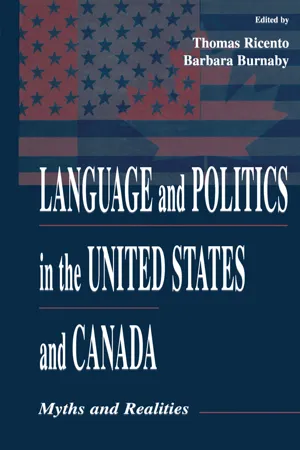
eBook - ePub
Language and Politics in the United States and Canada
Myths and Realities
- 358 pages
- English
- ePUB (mobile friendly)
- Available on iOS & Android
eBook - ePub
Language and Politics in the United States and Canada
Myths and Realities
About this book
Information
1
Introduction: Respecting the Citizens-Reflections on Language Policy in Canada and the United States
University of Wales, Cardiff
A pressing issue all over the contemporary world is the recognition of the cultural worth of its inhabitants. Managing cultural diversity as a permanent feature of the international social order is among the most taxing of political issues. Having failed to control, if not always contain, intercultural conflict through traditional means, we are now searching for new means of social integration. New methods for tackling the old problem of intergroup tensions will have to look beyond the conventional academic disciplines and ideologies drawing on economics, psychology, and political science and seek to incorporate more poignant radical ideas and insights in a more syncretic manner. In this chapter I raise several issues of substance that inform the detailed, critical debate maintained by my colleagues elsewhere in this volume. Drawing on issues raised in the following chapters, I reflect here on managing classic immigrant societies, conceptualizations of nationhood, some dynamics in multicultural societies, the linguistic hegemony of English, principles of social justice, similarities and differences between Canada and the United States, and future possibilities for languages in those two countries. The most significant issue is the question of the distribution of power in society and the encouragement of democratic participation by interest groups who hitherto have felt emasculated within the liberal state, despite the growth of what may be termed the politics of equal recognition in recent decades.
Managing Classic Immigrant Societies
The foundation of any modern democracy is the ability of its citizens to derive maximum security and satisfaction from contributing to the common wealth of society. The great common wealth of Canada and the United States is the diversity of their peoples. In their attempt to forge a sociopolitical unity from the diversity of multiculturalism, the elite of both societies have been charged with the criticism that the state totality does not reflect the sum of its constituent parts. Hence the contemporary controversies in the United States on the recognition of the worth of, for example, African Americans, Asian Americans, Hispanic Americans, and Native Americans, and in Canada on the appropriate place for Quebecois and francophones, Native Canadians, and “heritage language” Canadians.
Historically these classic immigrant societies have allowed for instrumental pluralism as a societal norm because a broad measure of freedom from state interference provided the necessary breathing space for the peaceful coexistence of citizens. Habermas (1996) averred that such space permitted citizens of widely diverging cultural identities to be simultaneously both members and strangers of their own country. The reproduction of minority cultures was, in part, a function of relatively weak economic-structural assimilation. In time, however, a middle position between assimilation and pluralism came to be appreciated. Advocates of this position claimed that it was possible to participate in mainstream culture and maintain one’s heritage language and culture (Edwards, 1985).
Those days are long gone for the majority of Canadians and Americans. Today democratic citizenship is under severe stress. Habermas (1996) argued that the safety curtain of civil religion, which has interpreted a constitutional history of 200 years, may be about to break. His contention was that “a liberal political culture can hold together multicultural societies only if democratic citizenship pays in terms not only of liberal and political rights, but of social and cultural rights as well” (p. 296). Nowhere are these rights so fiercely conjoined and attacked than in the question of ethno-linguistic identities in the modern state. How we promote the mutual respect of individuals as they identify with particular cultural groups is the key difficulty facing us as we grapple with the relationship between language, politics, and identity that is the central theme of this volume.
The challenge to liberal democracies is both real and very pressing for they are committed in principle to equal representation of all. Guttman (1992) has asked what equal representation means if public institutions do not recognize particular identities, but only allow for general or universal recognition of shared interests based upon civil and political liberties, education, health care and economic participation:
Apart from ceding each of us the same rights as all other citizens, what does respecting people as equals entail? In what sense should our identities as men or women, African-Americans, Asian-Americans, or Native Americans, Christians, Jews, or Muslims, English or French Canadians publicly matter? (p. 4)
Public recognition of the worth of constituent cultures, as permanent entities in society, is what is at stake in liberal democracies. Indeed for many engaged in the politics of their group’s survival, this is precisely what democracy should guarantee in praxis as well as in principle. This, for example, is the nub of the Quebecois argument to be treated as a distinct society, and not one among many provinces within Canada. In various ways it is the preoccupation of all struggling minorities within North America. However, we recognize with Guttman (1992) that “liberal democracy is suspicious of the demand to enlist politics in the preservation of separate group identities or the survival of subcultures that otherwise would not flourish through the free association of citizens” (p. 10). When it refuses to engage in the politics of recognition, liberal democracy appears arrogant and denies the life-enhancing spirit on which all forms of democracy are based. It accentuates fragmentation and anomie within society, ultimately leading to various forms of disengagement from public life and community responsibility. For:
Democratic citizenship develops its force of social integration, that is to say it generates solidarity between strangers, if it can be recognized and appreciated as the very mechanism by which the legal and material infra-structure of actually preferred forms of life is secured. (Habermas, 1996, p. 290)
North American societies are still in the process of forging an identity that commands the loyalty of the overwhelming majority of citizens. This may seem an odd claim from an international perspective, for both Canada and the United States have virile, recognizable state identities. However, as this volume richly testifies, fundamental issues relating to questions of “national conformity” still animate the myriad political debates on language policy, bilingual education, the limits of tolerance toward the maintenance of a plural society, the reproduction of distinctive core “American” and “Canadian” values and the like.
Of course, such considerations are universal. What makes them critical and arresting within the North American context is the danger posed to democracy by the growth of a perception that citizens are being let down by the performance of the “hollow state” and that a democratic deficit rather than a democratic fulfillment characterizes contemporary politics.
The politics of recognition is a rather belated attempt to compensate for the systematic exclusion of so many groups from the decision-making structures of modern society. Until comparatively recently it was assumed that the clarification of the nature and meaning of minority rights would not overly interfere with mainstream political business and economic development, as witnessed in the impress of the founding peoples on the transformed land.
This mission/destiny view of coast-to-coast nationhood that contributed to the making of America and Canada was predicated on the hegemonic position of the majority nation, which was derived from two variants of a common British, largely English-speaking, political culture. Patriotism is a poor substitute for the initial nationalism of the founding fathers during the process of nation building. Thus we must ask:
Under what conditions a liberal political culture shared by all citizens can at all substitute for that cultural context of a more or less homogenous nation in which democratic citizenship once, in the initial period of the nation-state, was embedded. (Habermas, 1996, p. 290)
Inclusive Versus Exclusive Nationhood
Our conceptions of human rights have been formulated in an increasingly comprehensive manner to include elements that earlier theorists would have considered to have lain outside the pale of the citizen-state relationship. This relationship is central to the analysis because democracy avers that citizens are entitled to certain minimum rights, chiefly those of participation in and protection by the state. However, the changing nature of the state, both as ideology and praxis, has encouraged a more pluralist view of its responsibilities.
How do minority interest groups influence the state structure so that it concedes certain rights which are not requested by the majority? Such concessions may be in the field of bilingual education, the legal system, differentiated media and communication systems, or the use of a previously disallowed language within public administration. They may be predicated on the basis of a personality or a territoriality principle or some expedient admixture of both (Nelde, Labrie, & Williams, 1992).
The conventional view, held by many Western states until the early post-war period, was that the state should not discriminate against or in favor of particular subgroups, however they may be defined. This view, termed the individual rights approach, is often justified by majoritarian principles of equality of all before the law, and is implemented through policies of equal opportunity for socioeconomic advancement based on merit and application. In Europe it is most closely associated with the unwritten constitutional tradition of the British legal system and in North America it was the inspiration behind the rhetoric, if not always the reality, of the melting pot approach to ethnic relations. The fact that many states persistently discriminated, by law, against Jews/Catholics/Protestants and so on in most multifaith societies should never be marginalized in this discussion, for so often the state has exercised a malignant effect on minorities, thereby blighting their historical development. The partial improvement in the treatment of minorities and the resultant constructive dialogue between representatives of the various interest groups and governmental agencies at all levels in the political hierarchy of Europe obviously bodes well for the medium-term future enactment of minority rights.
This presupposes that the state is in some way responsive to the legitimacy of minority demands. Historically, the recognition of linguistic minority demands is a very recent phenomenon. In accordance with the resolutions of the European Parliament (Arfe, 1981; Killilea, 1994; Kuijpers, 1987) the European Commission since 1983 has supported action to protect and promote regional and minority languages and cultures within the European Union. In 1996 some 4 million ecus were expended on European sociocultural schemes (budget line B3-1006 of the European Union Directorate General for Education, Training, and Youth). Equally significant is that we have a raft of recent legislation and declarations upholding the rights of minorities to use their languages in several domains (Williams, 1993). However, linguistic minorities face many structural barriers to their full participation within the E.U. system.
An alternative view, the group rights approach, has found increasing favor of late, for it recognizes that there are permanent entities within society whose potential and expectations cannot be met by reference to the recognition of individual rights alone. In the main, such recognition is offered grudgingly, and reflects a minimalist stance that seeks to extend the individual rights tradition into a multicultural context. Such extensions tend to obscure the key issue of group tension, namely the ability of the minority to preserve, and if possible, develop its own group characteristics and desires, in the face of state inspired assimilation (Williams, 1986).
Glazer (1977) has shown that attempts to institute group rights, in such spheres as government, the civil service, university admission, and business, have already been introduced in as widely varying contexts as Belgium, Canada, Finland, India, and Malaysia. Such reforms have been deliberately aimed at ensuring minority group representation in key areas of social, political, and economic life. Yet in the United Kingdom the attempt to reserve places by a variant on the quota system, or through positive discrimination and affirmative action, have been generally resisted as a subversion of individual rights. Despite the growth in legally enforced particularism and exceptionalism, which recognizes that special circumstances can obtain in minority-majority relations, the general tendency is to play down the group rights approach for it smacks of poor integration in the modern state, where the dominant conformity thesis is paramount.
Two sorts of argument are posed to counter the “special pleading” of constituent differentiated groups in the contemporary world (Williams, 1993, p. 95). The first is well entrenched and argues that the prime duty of the democratic state is to treat all of its citizens equally, regardless of racial, national, ethnic, or linguistic origin. This has been the guiding principle of the American constitutional guarantee of citizen equality. However, even from its earliest days the constitution was subject to constant reinterpretation, as testified by Benjamin Franklin’s admission while opening the Federal Convention of Philadelphia in 1787 when, with characteristic modesty and sagacity, he declared:
I confess that there are several parts of this constitution which I do not at present approve, but I am not sure that I shall never approve them. For having lived long, I have experienced many instances of being obliged by better information, or fuller consideration, to change opinions even on important subjects, which I once thought right, but found to be otherwise. (Farrand, 1966, quoted in Beer, 1993, p. 392)
Of course there are those who hold that minorities should not need “extra rights” if the democratic guarantees are in place. For, as President Vaclav Havel (1991) of the Czech Republic reminded us:
It seems to me that these collective rights can be accepted and included in the legal system only when we do not understand them as something beyond. As if there were some civil rights that are equal for everybody and then there are some special rights for some special groups of citizens which the others do not share. It is not the case. The right for freedom of speech, the fight to keep their individual culture, the right to education, all these are essential human and citizen rights and in the case of minorities, i.e., communities with their own traditions, spiritual, historic, social and with their own language background, can these general rights be ascertained when they are allowed to be exerted within that frame and in that environment that are genuine to them. And I think that these instrumental functions belong to the collective rights. (p. 15)
Havel’s interpretation of democracy is understandable in a political context that stresses the role of the reformed state as the agent and coordinator of radical change, for the growth of democratic representative power in Central Europe enables the state to pose as the guardian of civic rights. Individualism strives to triumph over collectivism, in the matter of human rights as in social justice and economic productivity.
However, as Phillips (1995) has commented in a different context (while discussing feminism and democracy), institutionalizing group representation appears to be at odds with the main thrust of democracy “which is typically away from group privilege and group representation, and towards an ideal of citizenship in which each individual counts equally as one” (p. 290). The real difficulty for such interpretations is in maintaining the active participation of all citizens in the resultant political process. It is far too tempting for many to yield responsibility and to opt out of formal politics and to opt into informal pressure groups or single-issue movements, leaving proponents of the community drained of their energies to mobilize and agitate on behalf of all.
Phillips (1995) has cautioned that “many contemporary radicals see the ideals of democracy as pointing towards a politics in which people transcend their localized and partial concerns, getting beyond the narrow materi...
Table of contents
- Cover
- Half Title
- Title Page
- Copyright Page
- Table of Contents
- Preface
- About the Authors
- 1. Introduction: Respecting the Citizens—Reflections on Language Policy in Canada and the United States
- Part I: Overviews
- Part II: Forgotten Tongues: Indigenous Languages in North America
- Part III: Legal Implications of Official Language Policies
- Part IV: Educational Perspectives
- Part V: Focus on Context
- Author Index
- Subject Index
Trusted by 375,005 students
Access to over 1.5 million titles for a fair monthly price.
Study more efficiently using our study tools.
Frequently asked questions
Yes, you can cancel anytime from the Subscription tab in your account settings on the Perlego website. Your subscription will stay active until the end of your current billing period. Learn how to cancel your subscription
No, books cannot be downloaded as external files, such as PDFs, for use outside of Perlego. However, you can download books within the Perlego app for offline reading on mobile or tablet. Learn how to download books offline
Perlego offers two plans: Essential and Complete
- Essential is ideal for learners and professionals who enjoy exploring a wide range of subjects. Access the Essential Library with 800,000+ trusted titles and best-sellers across business, personal growth, and the humanities. Includes unlimited reading time and Standard Read Aloud voice.
- Complete: Perfect for advanced learners and researchers needing full, unrestricted access. Unlock 1.5M+ books across hundreds of subjects, including academic and specialized titles. The Complete Plan also includes advanced features like Premium Read Aloud and Research Assistant.
We are an online textbook subscription service, where you can get access to an entire online library for less than the price of a single book per month. With over 1.5 million books across 990+ topics, we’ve got you covered! Learn about our mission
Look out for the read-aloud symbol on your next book to see if you can listen to it. The read-aloud tool reads text aloud for you, highlighting the text as it is being read. You can pause it, speed it up and slow it down. Learn more about Read Aloud
Yes! You can use the Perlego app on both iOS and Android devices to read anytime, anywhere — even offline. Perfect for commutes or when you’re on the go.
Please note we cannot support devices running on iOS 13 and Android 7 or earlier. Learn more about using the app
Please note we cannot support devices running on iOS 13 and Android 7 or earlier. Learn more about using the app
Yes, you can access Language and Politics in the United States and Canada by Thomas K. Ricento, Barbara Burnaby, Thomas K. Ricento,Barbara Burnaby in PDF and/or ePUB format, as well as other popular books in Education & Education General. We have over 1.5 million books available in our catalogue for you to explore.