eBook - ePub
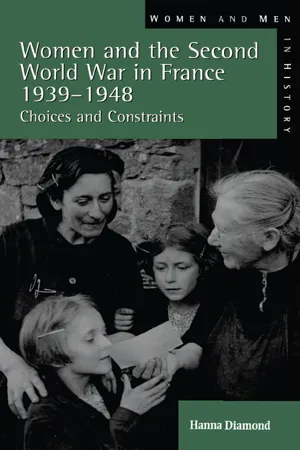
Women and the Second World War in France, 1939-1948
Choices and Constraints
- 248 pages
- English
- ePUB (mobile friendly)
- Available on iOS & Android
eBook - ePub
About this book
This is the first book (in either English or French) to offer readers an overview of women's experience of the Second World War and its immediate aftermath in France. It examines objectively the part that women played in both collaboration and resistance, synthesising much recent scholarship on the subject in French and English, and drawing on the author's own extensive research (including oral testimony) in Toulouse, Paris, and West Brittany. The findings are complex, and the immensely varied testimony challenges easy generalisation. This will be relevant for courses on French studies, French and European history and Women's studies.
CHAPTER ONE
Introduction
From one war to another
No history which deals with any aspect of twentieth-century France, and particularly one which is concerned with women, can ignore the devastating impact of the First World War on French society. Most families were directly affected by it, with at least one male member who was killed or maimed. Hardly had the country had time to recover when more upheaval was to come. Although France was not hit as early as other European countries by the world depression, when it did arrive it was longer lasting. One consequence of this economic hardship was a period of social and political upheaval. Fear of Fascism led to unprecedented anti-fascist demonstrations and the election of a left-wing Popular Front government, a coalition of radicals, socialists and communists, from 1936 to 1937, presided over by Leon Blum.
Hitler had come to power in Germany in 1933 and his expansionist aims increased throughout his dictatorship. Most of the population of France, like that of the rest of Europe, refused to allow itself to believe that another war was a serious possibility. French governments between 1933 and 1939 failed to define a clear policy towards Hitler’s Germany. The outbreak of the Spanish Civil War in 1936 distracted European attention away from Germany, but French government policy towards it was confused. French Republicans felt bound to support the Spanish Republicans, but the British policy of non-intervention prevailed in French government circles. The French again followed the British lead in their relations with Germany by adopting the approach of appeasing Hitler in order to prevent another war. After the signing of the Munich agreement in 1938, many believed that Hitler’s expansionist aims had been satisfied, and it was hoped that war had been postponed, if not completely avoided. However, after the invasion of Poland by German troops on 1 September 1939, Daladier, Prime Minister of France, along with the British government honoured their alliance and declared war on Germany two days later.
The French were not totally unprepared for war, but had concentrated all their efforts on a defensive policy, investing in a fortified border along the eastern frontier, known as the Maginot line, which stopped short of Belgium. After several months of inactivity known as the phoney war, in May 1940 German tanks were able to break through the Ardennes forest in Belgium and into France, thus circumventing the Maginot line. German advance was swift. The Maginot line collapsed, and huge numbers of refugees fled south in the wake of the German army in a phenomenon that has become known as the exodus. What had began as a stream took on massive proportions as people headed south using every conceivable means of transport, many simply on foot. Between 15 May and 20 June at least six million French women and men (perhaps as many as eight million) left their homes. As some towns in the north emptied, others further south filled.1 Historians have shown that this was an experience that particularly affected women, children and the elderly.2 Belgian refugees arrived in the southern part of the country, quickly followed by French men and women from the north and east of France and the area around Paris. In an atmosphere of fear and panic, the population of the major towns in the south swelled enormously. Local authorities found it hard to feed and find shelter for all those who needed it. The shops emptied and certain products disappeared altogether. For many, whether they were on the move or witnessing the presence of numerous refugees in the town or village square, this event had a major impact. Despite unpleasant stories that have survived about locals charging refugees for a glass of water, it appears that many families took in and helped people, and for some women this kind of activity served as a consciousness-raising experience, which may in some cases have established a predisposition to later resistance (see Chapter 5).
Paris was declared an open city, and the authorities of Paris surrendered to Germany on 14 June 1940. The defeat was complete. The French government fled south from Paris ahead of the advancing German forces, stopping first at Tours and then moving on to Bordeaux. On 17 June, Marshal Philippe Pétain offered himself as leader to the French people in a radio broadcast suggesting that the country should agree to an Armistice. A day later, a little-known General Charles de Gaulle, in a speech transmitted from London by the BBC, rejected any thought of Armistice and called for the battle to continue. Few people heard the BBC broadcast. It was Pétain with his entourage who were able to gain full powers on 10 July 1940 when the députés of the Third Republic meeting in the casino of the town of Vichy (the only local place able to accommodate them all) almost exclusively voted in his favour. Vichy immediately became the new centre of government.
Pétain’s announcement that he was seeking an Armistice was received with some relief in the atmosphere of confusion, overcrowding and general disorientation. Its political significance was often overlooked since for many it appeared to represent the end of a nightmare. According to the terms of the Armistice, Alsace-Lorraine was annexed to Hitler’s Reich and ten departments from the Somme to the Doubs were attached to the Brussels command: an area known as the reserved or forbidden zone. The rest of France was divided into two main zones, with a dividing line running from the Pyrénées up to Tours and then across to the Alps just south of Dijon (see map). The northern Occupied zone, covering over half the country, more than half of its population, and the greater part of its resources, was invaded and administered by the Germans. The Non-Occupied zone, south-west of the line, the zone libre, otherwise known as the zone sud, was placed under the authority of Pétain based in Vichy. Until its suppression in March 1943, the line of demarcation between the two zones functioned as a real territorial frontier. It was manned by German soldiers and special papers were necessary to be able to cross from one zone to the other. The north and east coastal areas had an even more intense German presence, and permits were again required both for travel within and entry into these areas. In 1941, a forbidden coastal zone was created which ran from Dunkerque to Hendaye along the coast and covered the territory 30 km inland.
In the weeks following the Armistice, the authorities urged people to return home, and many did so, hoping to have news of absent relations. Most were relieved to be spared another war like that of 1914–18. The fighting over, demobilized soldiers returned. Women in the Finistère recalled husbands and fathers returning home on foot, some after walking for several days. These households soon readapted to the return of their men, and family life resumed its prewar pattern, but under the changed circumstances of the war. However, not all the men returned. About 92,000 soldiers had been killed3 and 1,850,000 had become prisoners-of-war in Germany.4 Of these prisoners, the vast majority were young married men who left wives and young families in France. Their time of absence could vary. Some were able to escape in the course of the war, and Azéma estimates that by 1944 only 940,000 were left in Germany.5 However, most prisoners who were absent from their homes were away for a full five years, leaving their families to manage without them.
From the summer of 1940, French people set about carrying on with their lives as best they could, but life was strikingly different in the two zones of France. In the northern zone, the population had to learn to live in close proximity with Germans. All information was controlled, and it took some time before they realized that the shortages that they were experiencing were a direct consequence of German requisitioning. The German presence was postponed for two years for those living in the southern zone, where the Vichy government under Pétain took charge. The true impact of the Occupation may have been delayed for those living in the so-called ‘free zone’, but they were subjected to the National Revolution launched by Vichy which was designed to purge the country of the decadence which had led to its defeat. This involved a desire to return to traditional values. The Republican motto of ‘Liberty, Egality, Fraternity’ was replaced with that of ‘Work, Family and Homeland’. The purification process focused particularly on Jews, and Vichy passed a series of anti-Semitic statutes without being asked to by the Germans. From 1942, ‘Jew’ had to be stamped on their identity cards and, once identified, they were barred from holding jobs in administration; a 2 per cent quota in medicine, law and teaching meant that many lost their jobs. Foreign Jews (and later French Jews) were rounded up and then handed over to the Germans.
The existence of the southern zone, the domain of the Vichy government, was brought to an abrupt end in November 1942 after the Allied invasion of North Africa, when the Germans marched across the demarcation line, installing themselves across the country from the Pyrénées to the Italian frontier. The introduction of STO (Service de Travail Obligatoire) in February 1943, which forcibly drafted French men to work in Germany, after the failure of the voluntary Relève scheme, triggered further hostility towards the Germans. Although most French people had supported Pétain in 1940, perhaps believing that he was playing a ‘double game’ and working ultimately in the interests of France, the reality of the Vichy government, as no more than a puppet for the Germans, now gradually became apparent.
De Gaulle’s speech on 18 June 1940, rejecting the Armistice and calling for the battle to continue, was heard by few people. Gradually his regular broadcasts on the BBC gained a following which grew as the months went by, and he began to become a key figure and rallying point for those who rejected the German presence. Inside France, despite the courageous gestures of some rare individuals, it was more difficult for people to organize opposition, particularly in the Occupied areas. In 1941–42, groups of like-minded people (men and women) began to meet and organize networks and eventually to liaise with de Gaulle in London. Early resistance was often the result of contacts between friends who felt the need to do something. The nature of their efforts depended on where they were. In the north, resistance was predominantly directed against the German presence. The earliest resistance in the south took the form of small groups of refugees who helped Jews and other political refugees to escape from concentration camps and from the country. The crucial date given by most commentators as the time when resistance began to emerge is 1942. For many, the Occupation of the zone libre in November 1942 revealed the true link between the Vichy regime and the Germans. The time for attentisme was past and people were increasingly having to accept or reject the idea of Vichy and Occupation. Until this time, the worries of daily life prevented many people from taking an interest in political and military events. The realities of ‘collaboration’ as defined by the Vichy government and the increasing difficulties of daily life, lack of food and shortages of every kind, led some people to withdraw their support from the regime. For those who were prepared to take the risks involved, the Resistance was beginning to offer them an alternative, and by 1942 resistance groups were becoming increasingly established. Networks like Libération, Combat and Franc-Tireur appeared at first in the southern zone and later in the northern zone. Initially, these different organizations were far from being structured: people were rarely formally affiliated to them, but worked with one or two others. A number might have belonged simultaneously to several different groups. At first, their main concern was to create a clandestine press in an attempt to try to convince the public that action was necessary and possible.
Over the next two years, networks of resistance became increasingly organized and liaised with de Gaulle in London and then Algiers. From Christmas 1944, preparations for invasion by the Allies intensified. A provisional government was established in Algiers which organized departmental and local Liberation committees (Comités Départementaux de Libération, CDL) to deal with local administration after the departure of the German forces. From May 1944, resistance activities increased, and in some parts of the country the population was drawn into open street battles with the Germans as the maquis intensified their guerrilla warfare aimed at disorganizing transport and destabilizing the enemy. The invasion of the Allies in Normandy on 6 June was taken as a signal for resistance groups across the country to increase their activity. This led to a cycle of attacks by the Resistance, often followed by vicious repression by the Germans. The ensuing withdrawal of the German army was unpleasant and often bloody as fighting troops carried out revenge attacks on civil populations.
Events of the Liberation varied across France with different degrees of impact on local populations as different parts of France underwent liberation from the Germans in different ways. Many of those in urban areas experienced bombing as the Allies attacked key industrial targets. In some regions, the liberation was achieved without the help of the Allies (the Alps, the Jura and much of the South-West and the Massif Centrale). By 26 August, de Gaulle was able to march triumphantly down the Champs Elysées. Although in some areas there was drawn-out fighting – pockets of Brittany, for example, remained under the control of Germans until 1945 – most of France was liberated by September 1944.
The Liberation was a painful period of transition for the country, which moved from being an occupied, defeated power under an authoritarian government to a restored Republic somewhat answerable to the Allies. Politically, there were tensions about who was to step into the power vacuum created by the German withdrawal after the discrediting and collapse of the Vichy administration. On a local level, the appointed government officials and officers of de Gaulle’s GPRF (Gouvernement Provisoire de la République Française) sometimes found themselves in competition with communist bodies, certain Resistance movements and even the Americans. However, this power struggle was not very long-lasting and there seems to have been no serious move on the part of the communists to make a bid for power. In a matter of weeks, de Gaulle was able to establish himself as the legitimate power base of the new Republic. His visits around the country from September to November 1944 exerted a calming influence on...
Table of contents
- Cover Page
- Half Title page
- Series page
- Title Page
- Copyright Page
- Contents
- Acknowledgements
- Abbreviations
- Map
- 1. Introduction
- PART ONE: Women’s Lives during the War and the Occupation, 1939–44
- PART TWO: Women’s Lives after the Occupation, 1944–48: A Liberation?
- Conclusion
- Glossary
- Bibliographical Essay
- Chronology
- Index
Trusted by 375,005 students
Access to over 1.5 million titles for a fair monthly price.
Study more efficiently using our study tools.
Frequently asked questions
Yes, you can cancel anytime from the Subscription tab in your account settings on the Perlego website. Your subscription will stay active until the end of your current billing period. Learn how to cancel your subscription
No, books cannot be downloaded as external files, such as PDFs, for use outside of Perlego. However, you can download books within the Perlego app for offline reading on mobile or tablet. Learn how to download books offline
Perlego offers two plans: Essential and Complete
- Essential is ideal for learners and professionals who enjoy exploring a wide range of subjects. Access the Essential Library with 800,000+ trusted titles and best-sellers across business, personal growth, and the humanities. Includes unlimited reading time and Standard Read Aloud voice.
- Complete: Perfect for advanced learners and researchers needing full, unrestricted access. Unlock 1.5M+ books across hundreds of subjects, including academic and specialized titles. The Complete Plan also includes advanced features like Premium Read Aloud and Research Assistant.
We are an online textbook subscription service, where you can get access to an entire online library for less than the price of a single book per month. With over 1.5 million books across 990+ topics, we’ve got you covered! Learn about our mission
Look out for the read-aloud symbol on your next book to see if you can listen to it. The read-aloud tool reads text aloud for you, highlighting the text as it is being read. You can pause it, speed it up and slow it down. Learn more about Read Aloud
Yes! You can use the Perlego app on both iOS and Android devices to read anytime, anywhere — even offline. Perfect for commutes or when you’re on the go.
Please note we cannot support devices running on iOS 13 and Android 7 or earlier. Learn more about using the app
Please note we cannot support devices running on iOS 13 and Android 7 or earlier. Learn more about using the app
Yes, you can access Women and the Second World War in France, 1939-1948 by Hanna Diamond in PDF and/or ePUB format, as well as other popular books in History & French History. We have over 1.5 million books available in our catalogue for you to explore.