- 164 pages
- English
- ePUB (mobile friendly)
- Available on iOS & Android
eBook - ePub
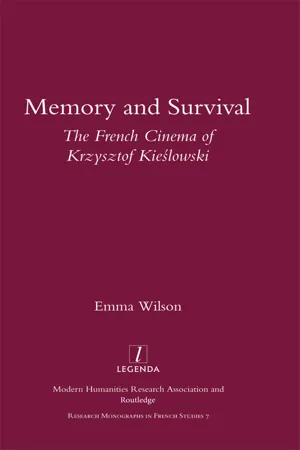
Memory and Survival the French Cinema of Krzysztof Kieslowski
About this book
"Kieslowski's last films have indelibly marked the past decade. His cinema has renewed the representation of the human subject and emotion in film: space and luminous surface reveal the finest, most fragile impressions of states of mind and human consciousness. This study is the first to offer specific focus on Kies'lowski's last films, on his French-language cinema and its place within the broader context of French film-making. Engaging with Deleuze's discussions of the time-image, and recent work in trauma theory, Emma Wilson offers radical insights into the innovation in Kies'lowski's explorations of memory, temporality, loss and desire. A charged defence of Kies'lowski's work, Memory and Survival offers new readings of this cinema of blind chance and fleeting beauty."
Information
Chapter 1
Images in Crystal
La Double Vie de Véronique
I Bilingual Film
In his dialogues with Claire Parnet, Deleuze speaks of the necessity of rendering language strange, and of being a stranger to one’s own mother tongue: ‘Etre comme un étranger dans sa propre langue. Faire une ligne de fuite.’1 The line of his argument is slippery (as he admits); the texts he cites, Kafka, Beckett, exist always already between languages, between cultures, yet lead Deleuze to state the desire to become ‘bilingue même en une seule langue’, to dispossess a language of its singularity, its similarity to itself. We may wonder how these thoughts, and wishes, apply, displaced, to contemporary cinema. Cinema is an art, and an industry, where directors shift more and more easily between languages, nations and locations. In a critical climate which has favoured the charting of national cinemas, where is the place of bilingual film?
This question will be explored in discussion of La Double Vie de Véronique (1991), in dialogue with Deleuze.2 La Double Vie de Vérotiique was Kieślowski’s first bilingual film. His position as a Polish director, making a film largely with French money—the film was produced and financed by Sidéral Productions (Paris), Tor Production (Warsaw) and Studio Canal+ (Paris)—and partly in France, was not unambiguous. Compare the thoughts of his compatriot, Andrzej Wajda, in 1981: ‘Peuton rester artiste et créer hors de son pays? Peut-on être écrivain si on est coupé de sa langue? Peut-on être metteur en scène si on est éloigné de son vrai sujet? Je crois que non.’3 A decade later this is the wager Kieślowski takes up in La Double Vie de Véronique. The intervening decade perhaps makes its own difference. Wajda stated, also in 1981: ‘ce qui m’intéresse vraiment, c’est de montrer l’origine de certains complexes, des sentiments de la Pologne contemporaine’. This was also the remit, and design, of much of Kieślowski’s filmmaking of this period. His early work on documentaries, from his years at the Lodz film school until 1980, demonstrates a desire to make the complexes of his country visible, to record and to testify (despite the weight of censorship). Exemplary in these terms is his From a Night Porter’s Point of View (1977). In the mid 1970s, Kieślowski turns gradually to making feature films which bear the influence of his documentary work, and it is only in the 1980s that fictional and visual narrative dominate his work.
Rather than seeing a division between the two forms of film-making, Kieślowski posits a continuum. Vincent Amiel quotes him saying: ‘Quand je faisais des documentaires, j’étais très près de la vie, des gens vrais. Cela me permettait de savoir comment les gens réagissent, comment ils fonctionnent dans la vie.’4 This attention to emotion, and to reaction, later informs and nourishes Kieślowski’s feature films. If the complexes of Kieślowski’s country are made visible in his documentaries, his Polish language films—notably Camera Buff (1979), Blind Chance (1981) and No End (1984), through to the ten short films of Decalogue (1988)—themselves work also, arguably, to represent the specificity of Polish concerns within the confines of this decade.5
Is there instead a break between Kieślowski’s Polish filmmaking and his work, with French funding, in France and Switzerland? La Double Vie de Véronique, split between France and Poland, may represent the opening of dialogue between East and West in Europe ironically concretized in the fall of the Berlin Wall and established in Poland gradually at the end of the 1980s, coming together with the bid for a market economy, the legalization of trade unions and the relaxation of censorship. Is the Polish filmmaker, in 1991, in a position ethically (and financially) to remain an artist but to work outside his own country? Does history open the way for the filmmaker to explore difference, and to render his own filmmaking different to itself?
Here it may be important to account for the perspective offered on this question by different critics (from different linguistic backgrounds) who work on Kieślowski. The work of Paul Coates has been particularly important in these terms, since Coates offers discussion of Kieślowski’s Polish work in its Polish context, allowing this then to filter his later discussions of Kieślowski’s French cinema. This leads to rather different conclusions from those I will develop here. My study will, I hope, show an appropriate awareness of Kieślowski’s Polish filmmaking, whilst deliberately focusing on his French cinema and its context. This is not intended to privilege Kieślowski’s French cinema over his Polish cinema but rather to draw on the perspective offered by my own critical background in order to precipitate a different reading of this overdetermined, hybrid cinema. In its francophone focus, my work is indebted to the analyses of Kieślowski which have been initiated in the journal Positif and pursued in particular by the critic Vincent Amiel. Ironically, however, despite this affiliation with French critical approaches, I am committed to thinking of Kieślowski’s cinema as always already double, different and differently indigenous.
The interest of La Double Vie de Véronique lies in the fact that both its conditions of production, and its represented subject, frame these issues of bilingual filmmaking directly, yet its final stance, with relation to difference, is unexpected. Indeed the move from Kieślowski’s Polish to French cinema is seemingly as seamless as his move from documentary to feature films. La Double Vie de Véronique may be read as a pivotal film, allowing the shift from Decalogue to the trilogy, incorporating both the Polish and French languages, and produced and designed by both Polish and French workers. Sight and Sound published an article with the apt title ‘Kieślowski Crossing Over’. Yet the irony of the film is that it depends, precisely, on a narrative of uncanny similarity and resemblance. I will argue, indeed, that La Double Vie de Véronique works to recall Kieślowski’s Polish filmmaking and simultaneously to look forward to his work in the trilogy in such a way that the difference between the two is denied. Kieślowski works to disrupt the easy mapping of his cinema into separate time bands and national boundaries. His interest is in interference, or, in Deleuze’s terms, in the coexistence of separate sheets of past and present in the very body of his filmmaking. In this way temporal and national locations are insistently placed under erasure: Kieślowski’s cinema will be seen to present its own re-working of Deleuze’s concept of the time-image.
II The Image
The image itself—its capacities and properties—is the prime abiding concern of Kieślowski’s filmmaking. La Double Vie de Véronique is a film which takes representation as its subject, and in this it is certainly not singular in Kieślowski’s work. Indeed, in the dialogue it creates about representation, La Double Vie de Véronique is linked crucially both to what has come before and to what will come after.
Looking backwards to begin with: the film was rendered possible for Kieślowski, and literally afforded, by the international success of Decalogue (itself already in part an internationally funded venture). This success led Kieślowski to meet with French producers and to agree to work outside Poland. Beyond this financial and practical link, Decalogue and La Double Vie de Véronique are also linked both thematically and symbolically. To explain these links necessitates a foray into the exegesis which surrounds Decalogue.
There has been much discussion about the relation between the Ten Commandments and the ten short films of Decalogue. Christopher Dunkley suggests: ‘we are invited to match up a different commandment with each story but […] I suspect Kieślowski has good reasons for refusing to say which is which.’6 Dunkley suggests that Kieślowski was not concentrating exclusively on one commandment in the case of each film. Christopher Garbowski, contrarily, while recognizing the interrelation of the separate Commandments, both as they appear in the Old Testament and as they appear in Decalogue, demonstrates links between the commandments, as they appear in order, and the chronological series of ten short films. These links depend on the Catholic and Lutheran sequencing.7 However, anglophone readers of the screenplay of Decalogue will be puzzled to find that the text is prefaced by the Ten Commandments in the Anglican sequencing, which necessarily confuses the issue of connection between the separate commandments and films. The Catholic and Lutheran sequencing, seemingly followed in Decalogue, does not include a separate interdiction on representation. Paul Coates reminds us importantly of ‘the commandment’s absorption into the first in the Catholic numbering system’.8 However, Véronique Campan, depending herself on the Anglican sequencing, comments: ‘aucun [film] n’est directement consacré au second commandement: “Tu ne feras point d’image taillée”.’9 She adds: ‘Il est paradoxal, pour un montreur d’images, d’oublier l’interdit de la représentation.’ Her sense of the paradoxical absence of this interdiction in Decalogue still holds some resonance, despite her seeming unfamiliarity with the accepted sequencing in Kieślowski’s native Poland. But if Kieślowski does not contend directly with this question in Decalogue it is perhaps because he makes it his central subject in his subsequent film, La Double Vie de Véronique.
The image, and its betrayal of reality, its emptying out of living (or divine) presence, is the central ethical issue of Kieślowski’s film-making. Following this argument, La Double Vie de Véronique may be seen as a missing piece of Kieślowski’s Polish filmmaking, of his Decalogue, and as a pained meditation on the cult of the image in both Eastern and Western Europe. One of the first images the viewer sees in the film is a vast Soviet statue silhouetted against the sky, driven along in a truck to be destroyed. In a single gesture, Kieślowski illustrates the concrete reality of post-Communist Poland, the falling of its imposed idols and the interdiction on representation which will be the subject of this film.
In his concern with the perils of representation, Kieślowski revisits the territory of his first successful feature film, Camera Buff, which demonstrates the ways in which the cinematic medium corrodes and evacuates the subject it chooses, framing it in perpetuity, only to render its actual and temporal disappearance the more painful.
In this film, a factory worker, Filip, buys a small movie camera when his wife has a baby so that he can record the first part of the child’s life. His enterprise depends on keeping the past and arresting time. He is slowly led into further filmmaking at the factory where he works, and where he will work on small yet increasingly successful documentary films. Filip becomes obsessed with the ways in which filming and framing allow him ostensibly to control and re-view the world around him. Amiel aptly relates this discovery to Kieślowski himself, noting, as Kieślowski’s viewers are sure to, the similarity between the style of Filip’s embedded documentary about his fellow worker and the style of Kieślowski’s own documentaries.10 Amiel reads the film as an admission, on Kieślowski’s part, of the untenable position of the documentary maker, whose images necessarily transform the reality viewed, making it a spectacle.
What Amiel overlooks is an ambivalence on Kieślowski’s part towards imaging and representation of any order. Within the film, Filip eventually loses the very subjects he has set out to represent. His fascination with filming has drawn him, almost imperceptibly, further and further from his wife and child. In the final scene she leaves him, and even here Filip cannot resist watching how her image appears in cinematic terms, framed by the open door. Paul Coates argues: ‘At first the wife’s estrangement appears unmotivated: not until Filip achieves his limited fame could the camera be said to have come between them. She (like Kieślowski?) appears to subscribe to the ideology that deems the creator an unfeeling monster.’11 I would disagree in part with Coates’s suggestion of a link between the filmmaker’s position and that of the wife. The neglect of the wife and child is made apparent in the film by their increasing absence from Filip’s frame of vision. Their final departure is surely justified, yet the charge of the film is derived from the only perspective on this departure we are offered, that of Filip whose vision we share. The film’s position is double: it refuses to deny the fascination of vision and representation, yet crosscuts this with a recognition of the deleterious personal effects of such artistic practice. Where Kieślowski has expressed his enthusiasm for La Strada (1954), like Fellini, he seeks the pathos of revelation after loss and privileges destruction over reparation.
La Double Vie de Véronique returns to the issues in Camera Buff, working further, but without resolution, to explore the desire of the artist and necessary betrayal in representation. To look at these questions, and to analyse the status of the image in the film, I will refer to Deleuze’s work on cinema, and in particular on the time-image.
III ‘L’lmage-cristal’
Vincent Amiel has linked Kieślowski’s filmmaking to Deleuze’s concept of ‘l’image-cristal’. He notes: ‘On pourrait dire que le style de Kieślowski est tout entier fondé sur cette “cristallisation” qui met en regard des images d’époques différentes (sans que le recours au flashback soit utile), des images rêvées et des images du réel présent (sans qu’un fondu enchaîné ne serve de “protocole” à ce passage), des images de l’autre et des images de l’un (cf. en particulier La Double Vie de Véronique).’12 He continues, less convincingly, to justify a view of Kieślowski as realist rather than formalist: ‘Ce ne sont donc par exemple pas les reflets qui donnent à l’œuvre de Kieślowski sa clé; ce n’est pas seulement le jeu des apparences qui explique leur multiplicité. Ils se comprennent au contraire au sein d’un système plus large qui est celui de la vérité du monde.’ It is the question of truth, and of the revelatory power of film, broached here, which is troubling.
In elaborating the concept of the time-image, Deleuze draws on Bergson’s theses on time, memory and perception. These Deleuze sums up (conveniently) in the following terms: ‘le passé coexiste avec le présent qu’il a été; le passé se conserve en soi, comme passé en général (non-chronologique); le temps se dédouble à chaque instant en présent et passé, présent qui passe et passé qui se conserve.’13 He reveals how certain films engage with and embody this understanding of time, showing us ‘comment nous habitons le temps, comment nous nous mouvons en lui, dans cette forme qui nous emporte, nous ramasse et nous élargit’. But this does not necessarily suggest that these films reveal a truth about time, or the truth about the world. Deleuze explores the proximity between a Bergsonian understanding of time and duration and the stylistic and technical developments of modern cinema. For Deleuze, cinema, and his own philosophical approach to cinema, allow the viewer to think through concepts of cinema and concepts addressed by the cinematic medium. Bergson’s theses about time afford a new way of thinking about cinema, and cinema itself provides a different medium for exploring the position of the subject in time, and the locating of time in the subject.
Countering Amiel, I contend that Kieslow...
Table of contents
- Cover
- Half Title
- Title
- Copyright
- CONTENTS
- Dedication
- Acknowledgements
- Preface: In Memoriam
- 1 Images in Crystal: La Double Vie de Véronique
- 2 Amnesia and the Time-Image: Trois Couleurs: Bleu
- 3 Voyeurism and Futurity: Trois Couleurs: Blanc
- 4 Identification and Disaster: Trois Couleurs: Rouge
- Conclusion: Home Movies
- Filmography
- Bibliography
- Index
Trusted by 375,005 students
Access to over 1.5 million titles for a fair monthly price.
Study more efficiently using our study tools.
Frequently asked questions
Yes, you can cancel anytime from the Subscription tab in your account settings on the Perlego website. Your subscription will stay active until the end of your current billing period. Learn how to cancel your subscription
No, books cannot be downloaded as external files, such as PDFs, for use outside of Perlego. However, you can download books within the Perlego app for offline reading on mobile or tablet. Learn how to download books offline
Perlego offers two plans: Essential and Complete
- Essential is ideal for learners and professionals who enjoy exploring a wide range of subjects. Access the Essential Library with 800,000+ trusted titles and best-sellers across business, personal growth, and the humanities. Includes unlimited reading time and Standard Read Aloud voice.
- Complete: Perfect for advanced learners and researchers needing full, unrestricted access. Unlock 1.5M+ books across hundreds of subjects, including academic and specialized titles. The Complete Plan also includes advanced features like Premium Read Aloud and Research Assistant.
We are an online textbook subscription service, where you can get access to an entire online library for less than the price of a single book per month. With over 1.5 million books across 990+ topics, we’ve got you covered! Learn about our mission
Look out for the read-aloud symbol on your next book to see if you can listen to it. The read-aloud tool reads text aloud for you, highlighting the text as it is being read. You can pause it, speed it up and slow it down. Learn more about Read Aloud
Yes! You can use the Perlego app on both iOS and Android devices to read anytime, anywhere — even offline. Perfect for commutes or when you’re on the go.
Please note we cannot support devices running on iOS 13 and Android 7 or earlier. Learn more about using the app
Please note we cannot support devices running on iOS 13 and Android 7 or earlier. Learn more about using the app
Yes, you can access Memory and Survival the French Cinema of Krzysztof Kieslowski by Emma Wilson in PDF and/or ePUB format, as well as other popular books in Languages & Linguistics & Languages. We have over 1.5 million books available in our catalogue for you to explore.