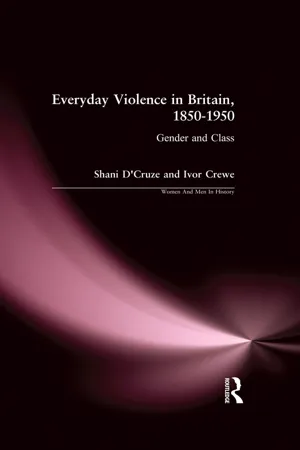
The diverse violence of modern Britain is hardly new. The Britain of 1850 to 1950 was similarly afflicted. The book is divided into four parts.
'Getting Hurt' which looks at everyday violence in the home (including a chapter on infanticide).
'Uses and Rejections' two chapters on the use of violence within groups of men and women outside the home (for example, violence within youth gangs, and male violence centred around pubs).
'Going Public' three chapters on how violence was regulated by law and the professional agencies which were set up to deal with it.
'Perceptions and Representations' this final section looks at how violence was written about, using both fiction and non-fiction sources.
Throughout the book the recurring themes of gender, class, continuity and change, public/private, and experience, discourses and representations are highlighted.
- 246 pages
- English
- ePUB (mobile friendly)
- Available on iOS & Android
eBook - ePub
About this book
Part I
The uses of violence
Chapter One
Domesticity and the problem of wifebeating in nineteenth-century Britain: working-class culture, law and politics1
‘Take heed of yoking yourselves with untamed heifers’, the Revd William Seeker warned young men looking for wives in the seventeenth century. He told them to choose hardworking, loving women who could be partners in life, but also firmly declared, ‘The wife may be a sovereign in her husband’s absence, but she must be subject in her husband’s presence.’2 By the nineteenth century, the softer domestic ideal of separate spheres prevailed. Husbands were to be breadwinners who supported and protected their wives, while wives were to stay at home, submissive and obedient, responsible for the smooth running of the household. Did this notion discourage wifebeating? This chapter will argue that, while the domestic ideal may have improved women’s lives in some ways, it did not prevent domestic violence, and may even have excused it. The persistence of the patriarchal notion that husbands should rule the household, however softened by domesticity, could allow husbands to enforce their dominance with violence. As Methodist Adam Clarke declared, ‘Superior strength gives the man domination, affection and subjection entitle the woman to love and protection.’3 If a woman did not subject herself to her husband, she could be blamed for his battering.
During the seventeenth and eighteenth centuries, legal authorities allowed husbands to ‘correct’ their wives with moderate violence if they would not submit. But during the nineteenth century, wifebeating slowly became illegal. Did women owe this protection to the domestic ideal? To answer this question, this chapter will examine how women in the early nineteenth century took advantage of increasing legal disapproval of violence in general, in order to seek protection from battering. By the second half of the nineteenth century, the domestic ideal certainly inspired Parliament to pass specific laws against wifebeating, but these laws must also be understood as a response to working-class and feminist politics.
Domestic violence and working-class culture
While middle-class moralists originated the domestic ideal, working-class people had appropriated it for their own by mid-century. This ideal did, to be sure, represent an improvement over earlier marital norms. In the seventeenth and eighteenth centuries, plebeians believed marriages should be both companionate and patriarchal; husbands and wives should work together to support the family; yet ultimately, husbands should dominate their wives. The clash between husbands’ desire to dominate and the assertiveness of wives, conscious of their important contribution to the family economy, could produce domestic violence. For instance, ballad-writer and collier David Love wrote that his wife ‘strove to get the upper hand’ but T… asserted my authority, which caused great contention’.4
Artisanal culture particularly could produce hostility toward women. Artisans fraternally bonded in their workplaces and clubs through heavy drinking, which robbed their families of income, and loosened inhibitions on violence. They faced competition from low-waged female labour, yet had to rely on their wives to help support the family. Domestic violence was less common among weavers, because whole families worked together at home. But when unemployment and low wages immiserated weavers, domestic violence increased.5
By the 1830s, radical working men denounced wifebeating as part of their larger effort to reform working-class culture and develop a disciplined working-class movement. Chartist John Watkins lamented, ‘How many take that vengeance on themselves, or their wives and children, which they should take on their tyrants!’6 Trade unionists promised women that, they remained at home instead of competing with men at work, their husbands would bring home their wage instead of drinking it at the pub. This ideal restricted women’s freedom and ignored the reality of their labour, but it did have certain advantages for women. Many women would rather stay at home than work ten hours a day in a factory, and they obviously preferred that their husbands be respectable, peaceful and sober, rather than drunken, violent and rough. By the 1860s, this ideal permeated popular culture: for instance, in his poem ‘God Bless these Poor Wimmen that’s Childer’ [have children] Thomas Brierly, the popular Lancashire dialect poet, wrote,
If fmaddest un’vilest o’ men
Wumjust made i’ wimmen a fortneet [were just made into women a fortnight]
They’d never beat wimmen again. 7
Wumjust made i’ wimmen a fortneet [were just made into women a fortnight]
They’d never beat wimmen again. 7
But working-class people found that the ideal often contradicted reality. Working men often could not earn enough to be the breadwinner; working wives faced endless housework and childrearing, and often needed to bring in money for the family as well. The tensions between the ideal and the reality, and the difficulty of raising a family on low wages in poor housing conditions, could spark domestic violence. For instance, when a Glasgow tailor’s wife told him to go look for work, he threatened to murder her.8 When docker Michael McCarthy gave five shillings to his common-law wife, she scornfully commented, ‘We are very rich – we owe three shillings for rent, and what are we to do with this small trifle?’ Enraged, he demanded it back, and stabbed her when she refused.9
But it was not only unemployment or poverty that caused domestic violence, for employed men and even middle-class men were known to beat their wives. Rather, the ideal of domesticity itself could excuse violence. For instance, the popular song ‘I should dearly like to marry’ depicted the ideal wife as loving, patient, and a good wife and mother, but concludes,
She must always be good tempered, but never on me frown
And thank me very kindly,
If I chance to knock her down …
And if I beat her with a poker
She must never say a word.10
And thank me very kindly,
If I chance to knock her down …
And if I beat her with a poker
She must never say a word.10
The domestic ideal could excuse violence against those wives whom their husbands perceived as failing to fulfil their domestic responsibilities.11 One working man, arriving home drunk and hungry, threw his wife down the stairs because she had not cooked his midday meal.12 Charles McKay, a Glasgow hamcurer, stabbed his wife when she did not have breakfast ready for him.13
Many battered wives, however, did not passively accept wifebeating. Although a certain amount of ‘rough usage’ seems to have been considered normal among working-class husbands and wives, the ideals of marriage limited the extent of acceptable marital violence.14 Conversely, a purely domestic role did not render women totally powerless, for separate spheres implied that women had agency, as well as responsibility, in running the household. As Shani D’Cruze writes, ‘women’s perceptions of their own social identities as household managers and defenders of their household’s reputations… could form a basis for the complaints they brought to the courts about violence they considered to be illegitimate and unjustified’.15 In her study of late nineteenth-century London, Ellen Ross portrays homes and streets divided into distinct male and female worlds, husbands and wives with separate social lives and financial responsibilities. But conflict erupted on the border between masculine and feminine space, when husbands interfered in the wives’ domestic domain or wives tried to prevent husbands from spending their wages at the pub.16
When women were dependent on their husbands, they found it difficult to resist domestic violence and to demand help from magistrates. Wives who continued to engage in paid labour may have had a greater ability to assert themselves against violent husbands, although husbands still had a legal right to all their wives’ earnings.17 On trial for stabbing his estranged wife Phoebe, Abraham Moss asked her, ‘Did I not bring up the children for thirty-one years, and provide for you in respectability, and with hardwork and honesty?’ She retorted, ‘I… stood in frost and snow with fruit to support my children – I supported them.’18 However, married women’s wage-earning came under increasing disapproval by the second half of the nineteenth century.
Wifebeating and the law in the nineteenth century
Until 1853, legal authorities did not decisively pronounce that wifebeating was illegal. In the eighteenth century, wives could swear out ‘articles of the peace’, similar to a restraining order, against violent husbands, but these documents were often ineffective in gaining help from authorities. The author of the most influential handbook for magistrates, Richard Burns, vaguely advised magistrates that ‘some say’ a man could ‘correct’ or ‘chastise’ his wife without forfeiting his sureties under an article of the peace.19 The notion that a man could beat his wife with a stick as big as his thumb was not a legal precedent, but people widely believed it to be so.20 Nonetheless, many women came to magistrates to charge their husbands with assaulting them; they had their own notion of justice, and believed they deserved protection from violent husbands. Magistrates could do little, however, partly because in general the laws against violence mandated only slight punishments for any assault short of rape or murder.
During the early nineteenth century, the legal system did begin to provide some protection for battered women because violence in general became less acceptable. The weakness of the laws against assaults began to threaten the legitimacy of the state as violent offenders escaped with light sentences. Inspired by the French revolution, radicals declared that the discrepancy between harsh penalties for property crimes and leniency toward violence proved that the law excluded all but the propertied from its benefits.21 In response to these threats to state authority, Parliament passed Lord Ellenborough’s Act in 1803 which, for the first time, imposed death sentences on attempted murder and grievous bodily harm.
The state moved toward more extensive regulation of violence as the middle class, motivated by Evangelicalism and humanitarianism, demanded rational, efficient protection. Middle-class men rejected the old notion of honour and hierarchy defended by violence; instead, they espoused rationality and self-control, achieving manhood through hard work in the public sphere, rather than aggression within personal relations.22 Furthermore, for the middle class, private morality necessarily accompanied public, political virtue. While they upheld the sanctity of their own homes, they believed that they should interfere in the private lives of working people, for the perceived disorder and crime in working-class families and communities threatened society as a whole. In response to these concerns, by the 1830s, police surveillance and long prison sentences replaced the threat of death as the means for the state to regulate violence.23 By 1837, the death penalty was removed as the punishment for grievous bodily harm, in order to increase the prosecution and conviction rates for this offence.
The new protectionist intrusion into working-class lives had ambiguous consequences for women. The law now offered women potential protection from violence through the police and through greater sanctions against serious assaults. But it also diminished women’s control over the prosecution process. And women’s increasing economic dependency limited their ability to envision prison for their husbands. By the mid-nineteenth century, working-class wives were less likely to work outside of the home, and female occupations were scarce and miserably paid. Despite these constraints, some battered wives still struggled to use the law for their own ends. They found that different levels of the criminal justice system varied in their responsiveness to women; from the police, to the magistrates’ courts, which settled cases or passed them on to the higher courts; finally to the Old Bailey, the London higher court where juries tried felony cases.
...Table of contents
- Cover
- Half Title
- Series Page
- Title
- Copyright
- CONTENTS
- Acknowledgements
- Abbreviations
- Foreword
- Introduction: Unguarded passions: violence, history and the everyday
- PART I THE USES OF VIOLENCE
- PART II THE REGULATION OF VIOLENCE
- PART III THE REPRESENTATION OF VIOLENCE
- Selected Bibliography
- Index
Trusted by 375,005 students
Access to over 1.5 million titles for a fair monthly price.
Study more efficiently using our study tools.
Frequently asked questions
Yes, you can cancel anytime from the Subscription tab in your account settings on the Perlego website. Your subscription will stay active until the end of your current billing period. Learn how to cancel your subscription
No, books cannot be downloaded as external files, such as PDFs, for use outside of Perlego. However, you can download books within the Perlego app for offline reading on mobile or tablet. Learn how to download books offline
Perlego offers two plans: Essential and Complete
- Essential is ideal for learners and professionals who enjoy exploring a wide range of subjects. Access the Essential Library with 800,000+ trusted titles and best-sellers across business, personal growth, and the humanities. Includes unlimited reading time and Standard Read Aloud voice.
- Complete: Perfect for advanced learners and researchers needing full, unrestricted access. Unlock 1.5M+ books across hundreds of subjects, including academic and specialized titles. The Complete Plan also includes advanced features like Premium Read Aloud and Research Assistant.
We are an online textbook subscription service, where you can get access to an entire online library for less than the price of a single book per month. With over 1.5 million books across 990+ topics, we’ve got you covered! Learn about our mission
Look out for the read-aloud symbol on your next book to see if you can listen to it. The read-aloud tool reads text aloud for you, highlighting the text as it is being read. You can pause it, speed it up and slow it down. Learn more about Read Aloud
Yes! You can use the Perlego app on both iOS and Android devices to read anytime, anywhere — even offline. Perfect for commutes or when you’re on the go.
Please note we cannot support devices running on iOS 13 and Android 7 or earlier. Learn more about using the app
Please note we cannot support devices running on iOS 13 and Android 7 or earlier. Learn more about using the app
Yes, you can access Everyday Violence in Britain, 1850-1950 by Shani D'Cruze,Ivor Crewe in PDF and/or ePUB format, as well as other popular books in History & British History. We have over 1.5 million books available in our catalogue for you to explore.