eBook - ePub
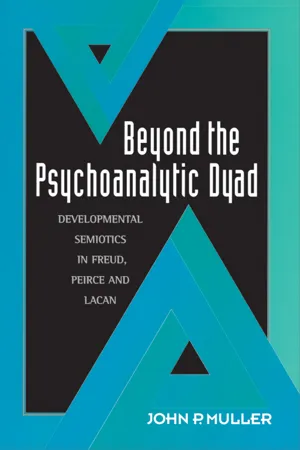
Beyond the Psychoanalytic Dyad
Developmental Semiotics in Freud, Peirce and Lacan
- 240 pages
- English
- ePUB (mobile friendly)
- Available on iOS & Android
eBook - ePub
About this book
In this original work of psychoanalytic theory, John Muller explores the formative power of signs and their impact on the mind, the body and subjectivity, giving special attention to work of the French psychoanalyst Jacques Lacan and the American philosopher Charles Sanders Peirce. Muller explores how Lacan's way of understanding experience through three dimensions--the real, the imaginary and the symbolic--can be useful both for thinking about cultural phenomena and for understanding the complexities involved in treating psychotic patients, and develops Lacan's perspective gradually, presenting it as distinctive approaches to data from a variety of sources.
Information
Part Two
Registers of Experience
5
The Real and Boundaries
Walking or Falling into the Wild
A recent New Yorker article (Brown, Feb. 8, 1993) presented the fatal life course of Chris McCandless, a 24-year-old college graduate who wandered for two years and was found dead of starvation in Alaska. I believe his desperate wandering, an aberrant version of the Australian Walkabout, exemplifies at the extreme what Erik Erikson (1959) called a “life crisis” whose solution required a “moratorium” on routine activities. Chris’s moratorium, insofar as it may be viewed as a compulsive effort to attain the Real, Lacan’s register of undifferentiation, failed because there was no structure available to keep him on this side of the boundary of life. Such compulsive movement toward the edge contrasts with the effort others make to avoid collapsing into the Real; they often do this by cutting themselves, as if to place a secure mark at the boundary of the Real.
The “Real” is a notion to be distinguished from reality as its epistemological frontier; if reality is a system of images, logical categories, and labels, yielding a differentiated, usually predictable sequence of experience, then the Real is what lies beyond as the unimaginable, nameless, undifferentiated otherness in experience. Lacan stated: “In other words, behind what is named, there is the unnameable. It is in fact because it is unnameable, with all the resonances you can give to this name, that it is akin to the quintessential unnameable, that is to say to death” (1954–55, p. 211). To make contact with the Real usually causes great anxiety, which may be thrilling for some, fragmenting for others. We receive hints of the Real in the details of Chris’s death: when his decomposing body was discovered in the shelter of an old bus in the Denali wilderness, the presence of a horrific odor stopped the hunter who found him. When the writer Brown visited the site five weeks later he was told, “The smell’s gone,”but his guide said, referring to the cot where the body had been, “I might have to put a tarp down before I sleep there again” (1993, p. 37). Smells have permeable boundaries; the tarp will provide a barrier against the Real for the next sleeper.
Boundary Loss in Conrad’s Heart of Darkness
It may be difficult to experience the progressive loss of boundaries as the Real is approached; it has, however, been powerfully conveyed in certain literary works and I think it gives Conrad’s Heart of Darkness (1899) its persisting appeal. The loss of boundaries begins almost immediately, in the second paragraph: “The sea-reach of the Thames stretched before us like the beginning of an interminable waterway. In the offing the sea and the sky were welded together without a joint” (1899, p. 3).
The waterway is “interminable” because it has no defined end: the journey’s end up-river in Africa will be in the undefinable Real. The absence of the horizon line, what the late Francois Peraldi used to point to as the basic differentiation in Chinese ideographs, suggests the absence of a fundamental orienting structure, the division between heaven and earth.
After an inland trek Conrad’s protagonist, Marlow, finds his boat has sunk; as he waits for repairs and learns of Kurtz, the station chief at his destination, he observes the “‘smell of mud, of primeval mud … the high stillness of primeval forest … great, expectant, mute … I wondered whether the stillness on the face of the immensity looking at us … were meant as an appeal or as a menace’” (1899, p. 27). Marlow has encountered the edge of his civilized reality, and as he steams up-river he joins a cosmic regression toward massive dedifferentiation:
Going up that river was like travelling back to the earliest beginnings of the world, when vegetation rioted on the earth and the big trees were kings. An empty stream, a great silence, an impenetrable forest. The air was warm, thick, heavy, sluggish. There was no joy in the brilliance of sunshine. The long stretches of the waterway ran on, deserted, into the gloom of overshadowed distances. … The broadening waters flowed through a mob of wooded islands; you lost your way on that river as you would in a desert, and butted all day long against shoals, trying to find the channel, till you thought yourself bewitched and cut off for ever from everything you had known once—somewhere—far away—in another existence perhaps. (1899, p. 34)
As one moves toward the Real, the usual categories of experience, that is, the logic of space, time, and causality, no longer afford the stability of differentiated structures. The loss of familiar signs leads to a pervasive sense of alienation:
We penetrated deeper and deeper into the heart of darkness … . We were wanderers on a prehistoric earth, on an earth that wore the aspect of an unknown planet. (1899, p. 35–36)
The loss of signification, the breakdown of the process of semiosis, of signs eliciting interpretations, is complete:
We could not understand because we were too far and could not remember, because we were travelling in the night of first ages, of those ages that are gone, leaving hardly a sign—and no memories. (1899, p. 36)
As they continue up-river, the inevitable dedifferentiation occurs:
It was not sleep—it seemed unnatural, like a state of trance. Not the faintest sound of any kind could be heard. You looked on amazed, and began to suspect yourself of being deaf—then the night came suddenly, and struck you blind as well. (1899, p. 40)
Nothing can be differentiated in this dark stillness: there are no gaps, no separations, no absences, as if we had entered Peirce’s category of Firstness, of immediacy and indeterminateness. The coming of daylight, ordinarily reassuring by highlighting differences and boundaries, fails in this primeval place:
When the sun rose there was a white fog, very warm and clammy, and more blinding than the night. It did not shift or drive; it was just there, standing all round you like something solid… What we could see was just the steamer we were on, her outlines blurred as though she had been on the point of dissolving, and a misty strip of water, perhaps two feet broad, around her—and that was all. The rest of the world was nowhere, as far as our eyes and ears were concerned. Just nowhere. Gone, disappeared; swept off without leaving a whisper or a shadow behind. (1899, pp. 40–41)
Neither the symbolic register (no whisper) nor the imaginary register (no shadow) can gain a hold on the undifferentiated Real.
The Russian sailor, explaining how he became Kurtz’s assistant, tells Marlow, in words that could have been spoken by Chris McCandless,
“I went a little farther,” he said, “then still a little farther—till I had gone so far that I don’t know how I’ll ever get back. Never mind. Plenty time. I can manage.” (1899, p. 55)
The loss of boundaries is not just perceptual and logical but also moral, for the Russian says of Kurtz that “there was nothing on earth to prevent him killing whom he jolly well pleased” (1899, p. 57), and on the riverbank of his station Kurtz made of his killing a perverse sign of the Real, as Marlow describes:
You remember I told you I had been struck at the distance by certain attempts at ornamentation, rather remarkable in the ruinous aspect of the place. Now I had suddenly a nearer view, and its first result was to make me throw my head back as if before a blow. Then I went carefully from post to post with my glass, and I saw my mistake. These round knobs were not ornamental but symbolic; they were expressive and puzzling, striking and disturbing—food for thought and also for vultures if there had been any looking down from the sky. … I had expected to see a knob of wood there, you know. I returned deliberately to the first I had seen—and there it was, black, dried, sunken, with closed eyelids—a head that seemed to sleep at the top of that pole, and, with the shrunken dry lips showing a narrow white line of the teeth, was smiling too, smiling continuously at some endless and jocose dream of that eternal slumber. (1899, p. 58)
Marlow is not so much frightened by death itself as by Kurtz’s being beyond limits. As Marlow pursues the ailing Kurtz in the jungle, he realizes:
don’t you see, the terror of the position was not in being knocked on the head—though I had a very lively sense of that danger too—but in this, that I had to deal with a being to whom I could not appeal in the name of anything high or low … There was nothing either above or below him, and I knew it. He had kicked himself loose of the earth. Confound the man! he had kicked the very earth to pieces. He was alone, and before him I did not know whether I stood on the ground or floated in the air.” (1899, p. 67)
But the dissolution of horizons, the perceptual, logical, and moral loss of boundaries, eventually leads to the darkness of death, the Real as the place of death; Marlow tells us:
I had turned to the wilderness really, not to Mr. Kurtz, who, I was ready to admit, was as good as buried. And for a moment it seemed to me as if I also were buried in a vast grave full of unspeakable secrets. I felt an intolerable weight oppressing my breast, the smell of the damp earth, the unseen presence of victorious corruption, the darkness of an impenetrable night …(1899, p. 63)
Walking into the Wild: The Negation of Boundaries
Chris McCandless seemed compulsively drawn to this frontier of the Real, drawn by its unboundedness. Most of us can probably acknowledge fantasizing about negating some boundaries; a recent advertisement appealed to such a desire. In a sepia photograph, a man was shown riding a horse in beach water, against a fading horizon line between ocean and sky, with the words, “The essence of living without boundaries: Safari for men by Ralph Lauren.” Unlike most of us, however, Chris seemed intent on actively erasing all boundaries, all conventional categories and limits. While hitchhiking in Alaska, his driver asked him if he had a hunting license, and Chris said he did not: “Why should the government tell us what we can hunt? Fuck all those rules,” he responded (Brown, 1993, p. 42). On a W-4 form he wrote in capital letters: “EXEMPT EXEMPT EXEMPT” (1993, p. 38). He began to use a different name, one he created: “Alexander Supertramp.” When asked if he had a compass, he said: “I don’t want a compass … I don’t have to know where I am,” and when asked about a map, he responded: “I don’t want to know where I’m going” (1993, P. 42). When his driver asked why he would give away his watch, he stated: “I’m just going to throw it away. I don’t want to know what day it is, or what time it is” (1993, p. 42). He seemed desperate to erase all conventional markers, all semiotic indicators not of his making, as if to reach some non-arbitrary, ultimate limit from where he might begin to be. Such repudiation of semiotic limits stamps Beckett’s The Unnamable (1959):
At the most obvious level the refusal of the speaker in The Unnamable to enter into language as code, is very specifically linked to the assumption of identity since what he finds intolerable is the confraternity implied in adopting the shared language of humanity.
At a deeper level however … a much more radical refusal becomes evident. The factitious demarcations by which language structures the universe are by turns derided and dissolved. (Cox, 1994, p. 88–89)
Without the bond between names and things, reference points dissolve, the subject becomes lost in “the unthinkable unspeakable” (Cox, 1994, p. 89).
Perhaps, in Winnicott’s phrase, Chris had an “urgent need not to be found” (1963, p. 185). Brown writes: “He craved blank spots on the map, at a time when his father was designing radar that could produce maps from space—maps that could practically show the beaver in the pond. Chris wanted to take nature unfiltered, unscreened, alone, and he found a characteristic solution to the problem of maps without blank spots: he threw the maps away” (1993, p. 40). Chris’s desperate attempt to throw away all signs, to erase all markers, even to the point of getting lost in the Real, may have been a response to being objectified, severely constrained, negated by the signifiers others placed on him. As Winnicott put it:
At the centre of each person is an incommunicado element, and this is sacred and most worthy of preservation. (1963, p. 187)
This preservation of personal isolation is part of the search for identity, and for the establishment of a personal technique for communicating which does not lead to violation of the central self. (1963, p. 190).
We do not have much information, but we are told that Chris’s father said, “I misread him” (Brown, 1993, p. 39), and Chris himself scratched onto a plywood-covered window of his deathbed shelter:
Two Years He Walks The Earth. No Phone, No Pool, No Pets, No Cigarettes. Ultimate Freedom. An Extremist. An Aesthetic Voyager Whose Home is The Road. Escaped from Atlanta. (1993, p.44)
He had graduated from college in Atlanta and last saw his parents there two years earlier. Since then he had been wandering; his favorite song was “King of the Road.” During his final weeks in Alaska he read Tolstoy’s The Death of Ivan Ilyich and wrote in the margins: “Civilization—Falsity—A Big Lie” (1993, p. 45). He had also scratched on the plywood in the shelter:
And Now After Two Rambling Years Comes the Final and Greatest Adventure. The Climactic Battle To Kill The False Being Within And Victoriously Conclude the Spiritual Revolution! Ten Days and Nights of Freight Trains and Hitching Bring Him to the Great White North No Longer to Be Poisoned By Civilization He Flees, and Walks Alone Upon the Land To Become Lost in the Wild. (1993, p. 44)
The poison of civilization may have been, in extreme form, the constraints every adolescent must struggle against in order to find a way to be more than just the object of someone else’s semiotic code and desire. Winnicott states:
At adolescence when the individual is undergoing pubertal changes and is not quite ready to become one of the adult community there is a strengthening of the defences against being found, that is to say being found before being there to be found. That which is truly personal and which feels real must be defended at all cost, and even if this means a temporary blindness to the value of compromise. (1963, p. 190)
The compulsion to erase boundaries, without compromise, had a tragic and ironic outcome in Chris’s case, for without a map he could not find a way to cross the Teklanika River, now a swollen boundary, to reach help, and so he starved to death; on August 5, two weeks before he died, he wrote in his journal:
Day 100! Made it! But in weakest condition of life. Death looms as serious threat, too weak to walk out, have literally become trapped in the wild—no game. (Brown, 1993, p. 46)
The grandiose capital letters, which earlier called attention to their author, have here dropped out, in conformity to some acknowledgment of limits, both semiotic as well as physical.
Chris’s “life crisis” indicates that the issues of boundaries and identity are, as Erikson describes it, life and death matters:
On the other hand, should a young person feel that the environment tries to deprive him too radically of all the forms of expression which permit him to develop and integrate the next step, he may resist with the wild strength encountered in animals who are suddenly forced to defend their lives. For, indeed, in the social jungle of human existence there is no feeling of being alive without a sense of identity. (1968, p. 130)
What Erikson perhaps believed, but did not state, is that developing a sense of identity is a semiotic process, involving an exchange of signs, in mutual recognition with an other, according to a code as a stable Third. Because semiotic processes define relationships from before birth, they define identity as rooted in kinship and cultural forms of address in specific social settings. Semiotic breakdown results in loss of identity, if we affirm, as the anthropologist Milton Singer states, “the conception of the self as a semiotic structure and process of communication” (1989, p. 233).
When the social jungle of adolescence becomes impassable, when the transition to manhood or womanhood has no meaningful path, then what Erikson called a “psychosocial moratorium” becomes urgent:
A MORATORIUM is a period of delay granted to somebody who is not ready to meet an obligation or forced on somebody who should give himself time. By psychosocial moratorium, then, we mean a delay of adult commitments, and yet it is not only a delay. It is a period that is characterized by a selective permissiveness on the part of society and of provocative playfulness on the part of youth, and yet it often leads to deep, if often transitory, commitment on the part of youth, and ends in a more or less ceremonial confirmation of commitment on the part of society. (1968, p. 157)
In referring to Shaw’s moratorium, Erikson (1968) describes Chris McCandless: “Potentially creative men like Shaw build the personal fundament of their work during a self-decreed moratorium, during which they often starve themselves, socially, erotically, and, last but not least, nutritionally, in order to let the grosser weeds die out, and make way for the growth of their inner garden. Often when the weeds are dead, so is the garden” (1968, p. 41–42). For Chris the process of semiosis, the ground and matrix of significance, had become paralyzed, fixated, rigidified. In order to survive at all as a human subject, Chris compulsively sought to negate all imposed meaning and erase all conventional distinctions, the gross weeds choking his life; he desperately declared himself to be exempt from all conventional limits, and placed himself beyond human contact. He represents an extreme type, unclaimable and unaccountable, as if exempt from context and constraint.
Dissolution at the Edge of the Real
The psychological effects of such a compulsion toward the Real are portrayed by Paul Bowles in The Sheltering Sky, in his character Port, a troubled young composer, in whom we find an obsession with going to the edge to test the limits of Western ways of anchoring reality. The novel is marked by a mounting dread of what lies beyond the edge. For example, Port and his wife, Kit, sit on a cliff gazing at the vast North African desert below:
“You know,” said Port, and his voice sounded unreal, as voices are likely to do after a long pause in an utterly silent spot, “the sky here’s very strange. I often have the sensation when I look at it that it’s a solid thing up there, protecting us from what’s behind …”
“From what’s behind?”
“Yes.”
“But what is behind? …”
“Nothing, I suppose. Just darkness. Absolute night.” (1949, pp. 100–101).
When the sky is experienced as a protective covering against the undifferentiated Real, the vision of what may lie “behind” opens upon the vision of death and of those silent infinite spaces that so terrified Pascal (1670). As Port becomes deathly ill, he begins to experience the breakdown of his symbolic system and struggles to maintain an imagistic hold on the consequent destructuring of reality:
He did not look up because he knew how senseless the landscape would appear. It takes energy to invest life with meaning, and at present this energy was lacking. He knew how things could stand bare, their essence having retreated on all sides to beyond the horizon, as if impelled by a sinister centrifugal force. (1949, p. 165)
Later, near death, as semiosis shuts down, his mind struggles to avoid collapsing into a dedifferentiated mass:
He opened his eyes. The room was malignant. It was empty. “Now, at last, I must fight against this room.” But later...
Table of contents
- Cover
- Half Title
- Title Page
- Copyright Page
- Dedication
- Table of Contents
- Acknowledgments
- Introduction
- I. Developmental Semiotics
- II. Registers of Experience
- Conclusion
- References
- Name Index
- Subject Index
Trusted by 375,005 students
Access to over 1.5 million titles for a fair monthly price.
Study more efficiently using our study tools.
Frequently asked questions
Yes, you can cancel anytime from the Subscription tab in your account settings on the Perlego website. Your subscription will stay active until the end of your current billing period. Learn how to cancel your subscription
No, books cannot be downloaded as external files, such as PDFs, for use outside of Perlego. However, you can download books within the Perlego app for offline reading on mobile or tablet. Learn how to download books offline
Perlego offers two plans: Essential and Complete
- Essential is ideal for learners and professionals who enjoy exploring a wide range of subjects. Access the Essential Library with 800,000+ trusted titles and best-sellers across business, personal growth, and the humanities. Includes unlimited reading time and Standard Read Aloud voice.
- Complete: Perfect for advanced learners and researchers needing full, unrestricted access. Unlock 1.5M+ books across hundreds of subjects, including academic and specialized titles. The Complete Plan also includes advanced features like Premium Read Aloud and Research Assistant.
We are an online textbook subscription service, where you can get access to an entire online library for less than the price of a single book per month. With over 1.5 million books across 990+ topics, we’ve got you covered! Learn about our mission
Look out for the read-aloud symbol on your next book to see if you can listen to it. The read-aloud tool reads text aloud for you, highlighting the text as it is being read. You can pause it, speed it up and slow it down. Learn more about Read Aloud
Yes! You can use the Perlego app on both iOS and Android devices to read anytime, anywhere — even offline. Perfect for commutes or when you’re on the go.
Please note we cannot support devices running on iOS 13 and Android 7 or earlier. Learn more about using the app
Please note we cannot support devices running on iOS 13 and Android 7 or earlier. Learn more about using the app
Yes, you can access Beyond the Psychoanalytic Dyad by John P. Muller in PDF and/or ePUB format, as well as other popular books in Psychology & Mental Health in Psychology. We have over 1.5 million books available in our catalogue for you to explore.