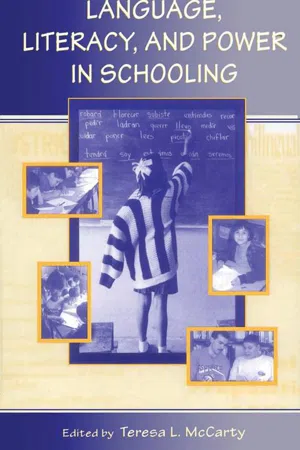
Language, Literacy, and Power in Schooling brings critical ethnographic perspectives to bear on language, literacy, and power in culturally and linguistically diverse contexts, showing how literacy and schooling are negotiated by children and adults and how schooling becomes a key site of struggle over whose knowledge, discourses, and literacy practices "count." Part I examines tensions between the local and the general in literacy development and use; Part II considers face-to-face interactions surrounding literacy practices in ethnically diverse classrooms; and Part III widens the ethnographic lens to position literacy practices in the context of globalization and contemporary education policies. Each section includes a substantive introduction by the editor and a synthetic commentary by a leading literacy researcher.
Above all, this is a book oriented toward social action. Unpacking the complexity of literacy practices and experiences in diverse settings, the authors seek not only to build new knowledge, but to inform and transform the pedagogies and policies that limit human potentials. The chapters in this volume have much to teach us about the roots of inequality and the possibilities for positive change. Together, they highlight the urgent need for critical literacy researchers to engage politically, confronting education policies that deny the rich multiplicity of human literacies, thereby carving ever-deeper cleavages between those with and without access to literacies of power.
The dual focus on language and literacy with critical-ethnographic accounts of identity and schooling speaks to a growing constituency of scholars and practitioners concerned with the role of literacy and discourse in alternatively affirming or negating knowledge, power, and identity, both within and outside of schools.
- 352 pages
- English
- ePUB (mobile friendly)
- Available on iOS & Android
eBook - ePub
Language, Literacy, and Power in Schooling
About this book
Information
I
“Taking Hold” of Local Literacies
How is literacy appropriated for local ends? In colonial, neocolonial, and diasporic contexts, how are local epistemologies asserted and new norms established for what and whose literacy “counts”?
These questions lie at the heart of the chapters in this part of the volume. Part I’s theme is inspired by Kulick and Stroud’s (1993) ethnographic study of literacy in Gapun, a rural and then “newly literate” village of about 100 people in Papua New Guinea. “[F]ar from being passively transformed” by English literacy, Kulick and Stroud (1993) state, Gapun villagers “actively and creatively [applied] literacy skills to suit their own purposes and needs,” injecting it with functions and communicative strategies used in speech (p. 3). Instead of asking how literacy affects people, Kulick and Stroud found themselves asking how people “seize hold” of those aspects of literacy that have meaning and utility in their everyday lives. (See also McLaughlin’s [1992] analysis of English and Navajo literacy, and Street [2001, pp. 8–9].)
This section explores the processes through which local, subaltern communities “take hold” of literacy. What these processes mean for communities, individuals, and the institutions in which they participate is illustrated across a broad range of settings and moments in time. The chapters contribute not only to our understanding of situated, changing, and everyday literacies (see, e.g., Barton, Hamilton, & Ivanic, 2000; Knobel, 1999; Lankshear, 1997), but also to our understanding of the relationship of these literacies to local social organizations and to broader issues of political participation and linguistic human rights.
Elsie Rockwell begins this discussion with a historical analysis of Indigenous literacy in the Chiapas highlands. She argues that literacy, much more than simply alien knowledge to be learned, is a cultural practice forged collectively in particular historical circumstances. Rockwell also demonstrates how oral tradition and literacy intertwine; as she puts it, both writing and speaking are “practices constructed in the context of asymmetrical power relationships,” and both are part of the appropriation of literacy for local ends. Rockwell’s examination highlights especially the need to recover a historical perspective in our understandings of literacy and literacies.
The next three chapters bring Indigenous experiences to the present moment. Each of these chapters, and Robert Whitman’s that follows, present counternarratives—texts and acts that disrupt and disturb “grand stories,” challenging the practices that legitimate the status quo (Peters & Lankshear, 1996, p. 2). Sheilah Nicholas explains how both literacy and schooling are being coopted by Hopi people to revitalize their language and culturally valued practices. Here, reading and writing occur “as part of an indigenist effort to represent themselves, their endangered language, their disrupted history” (Collins & Blot, 2003, p. 159). Nicholas’s personal narrative embodies this process: Stripped of her native Hopi language by her early socialization and schooling, she “put it aside” for many years. Only in adulthood was she able to reclaim her Hopi language and identity. As Nicholas relates, she continues to fight for this most basic human right. Her story can be seen as an insider’s analysis of the way that literacy is shaped by a group’s social organization and needs—and as a microcosm of a larger, worldwide struggle for language minority rights (see also Collins, 1998; Fishman, 1991, 2001; Grenoble & Whaley, 1998; May, 2001; McCarty, 2003; Nettle & Romaine, 2000; Phillipson, 2000; Skutnabb-Kangas, 2000).
In the subsequent chapter, I document how the micro processes involved in asserting Indigenous literacies and education rights collide with larger bureaucratic texts. Drawing on my long-term ethnographic work with one Navajo community school, I examine how bilingual teachers quietly but insistently reclaimed their own literacies and pedagogical power—”the power within”—asserting their role as change agents and recentering the community- based mission of their school. This account also problematizes discourses of minority teacher and student empowerment; rather than a final destination or end result, local empowerment in neocolonial contexts is viewed as an ongoing struggle for self-determination and for linguistic, cultural, and education rights.
Perry Gilmore and the late David M. Smith explore self-empowerment struggles among Australian Aboriginal and Native Alaskan adult learners. This chapter, too, narrates counterstories (even “counterplaques”) of deliberate resistance by Indigenous students to mainstream academic texts that misrepresent and distort their abilities and experiences. Like the Mayan, Hopi, and Navajo communities described in previous chapters, the Native people with whom Gilmore and Smith worked legitimated subaltern knowledge. Gilmore and Smith introduce the notion of situated freedom, arguing that power is never granted but is rather seized and created in contested social space.
Robert Whitman concludes the empirical chapters with an illuminating student “narration of self.” Carefully examining the narrative of a Latina high school student through detailed sociolinguistic microanalysis, he shows how the taken-for-granted discourse of standardized tests indexes powerful negative consequences. Whitman probes deeply into the ways in which ascribed marginalized identities are constructed and resisted across a “moral landscape of peers, teachers, classroom, and community.”
In commenting on these chapters, Ray McDermott (re)positions language as a resource (see also Ruiz, 1988). Not unlike Gee’s (2001) discussion of primary and secondary discourses, McDermott notes that “nothing is more inhibiting than what a people already know how to say,” yet nothing is more liberating than learning new linguistic forms. Why then are minority language speakers so often forced to make either-or choices between the language they know and the language of wider communication? Why are bilingualism, multilingualism, and multiliteracies so often viewed as problematic? As the chapters and McDermott’s commentary show, larger social, political, and economic forces make problematic that which is natural and beneficial— thereby limiting what McDermott (quoting the Irish poet Seamus Heaney) calls “further entries into language.”
Together, these chapters illustrate the complexity of local literacies, their structuring within local social systems and larger networks of power, and the dynamic interplay of the local and the central (Street, 2001) in real time and real people’s lives. The chapters also reveal the dangerous sterility of universalist or autonomous views of literacy and the reductive pedagogies they impose. At the same time, the studies here wedge open new spaces of possibility— alternatives to an either-or, unilingual, and monoculturalist divide. Informed by insiders—those who often are the targets of standardizing regimes—these chapters show the emancipatory potentials that arise when local literacies are claimed and appropriated for local ends.
REFERENCES
Barton, D., Hamilton, M., & Ivanič, R. (Eds.). (2000). Situated literacies: Reading and writing in context. London: Routledge.
Collins, J. (1998). Understanding Tolowa histories: Western hegemonies and Native American responses. New York: Routledge.
Collins, J., & Blot, R.K. (2003). Literacy and literacies: Texts, power, and identity. Cambridge, UK: Cambridge University Press.
Fishman, J.A. (1991). Reversing language shift. Clevedon, UK: Multilingual Matters.
Fishman, J.A. (2001). Can threatened languages be saved? Reversing language shift, revisited: A 21st century perspective. Clevedon, UK: Multilingual Matters.
Gee, J.P. (2001). Literacy, discourse, and linguistics: Introduction and What is literacy? In E.Cushman, E.R.Kintgen, B.M.Kroll, & M.Rose (Eds.), Literacy: A critical sourcebook (pp. 525–544). Boston: Bedford/St. Martin’s.
Grenoble, L., & Whaley, L.J. (Eds.). (1998). Endangered languages: Current issues and future prospects. Cambridge, UK: Cambridge University Press.
Knobel, M. (1999). Everyday literacies: Students, discourse, and social practice. New York: Peter Lang.
Kulick, D., & Stroud, C. (1993). Conceptions and uses of literacy in a Papua New Guinean village. In B.Street (Ed.), Cross-cultural approaches to literacy (pp. 30–61). Cambridge, UK: Cambridge University Press.
Lankshear, C., with Gee, J.P., Knobel, M., & Searle, C. (1997). Changing literacies. Buckingham, UK: Open University Press.
May, S. (2001). Language and minority rights: Ethnicity, nationalism and the politics of language. Harlow, UK: Longman/Pearson Education.
McCarty, T.L. (2003). Revitalising Indigenous languages in homogenizing times. Comparative Education, 39, 147–163.
McLaughlin, D. (1992). When literacy empowers: Navajo language in print. Albuquerque: University of New Mexico Press.
Nettle, D., & Romaine, S. (2000). Vanishing voices: The extinction of the world’s languages. New York: Oxford University Press.
Peters, M., & Lankshear, C. (1996). Postmodern counternarratives. In H.A.Giroux, C. Lankshear, P.McLaren, & M.Peters (Eds.), Counternarratives: Cultural studies and critical pedagogy in postmodern spaces (pp. 1–40). New York: Routledge.
Phillipson, R. (Ed.). (2000). Rights to language: Equity, power, and education. Mahwah, NJ: Lawrence Erlbaum Associates.
Ruiz, R. (1988). Orientations in language planning. In S.L.McKay & S.C.Wong (Eds.), Language diversity: Problem or resource? (pp. 3–25). Boston: Heinle & Heinle.
Skutnabb-Kangas, T. (2000). Linguistic genocide in education—Or worldwide diversity and human rights? Mahwah, NJ: Lawrence Erlbaum Associates.
Street, B.V. (Ed.). (2001). Literacy and development: Ethnographic perspectives. London: Routledge.
1
Indigenous Accounts of Dealing With Writing
Elsie Rockwell
Centra de Investigation y Estudios Avanzados, Mexico D.F.
The central assumption of this chapter is that the May a people of Chiapas, Mexico, as many other groups described in the literature, have had a long history of developing strategies to deal with the dominant uses of literacy. Native accounts of incidents involving writing offer clues to the ways Indigenous communities have perceived, resisted, and appropriated literacy in their ongoing struggle for survival. In this chapter, I interpret accounts taken from texts published by Native writers during the past decade, against the background of the social history of the region. Within municipalities marked by the lowest literacy levels in the country, the significant uses of literacy among the Native people of Chiapas appear linked to religious and political movements and the struggle for land, rather than to the expansion of schooling. I argue that by approaching literacy as a cultural practice forged collectively in particular social processes, rather than as alien knowledge to be learned, we may gain perspective on the apparent resistance to schooling among Native peoples and find novel ways of approaching literacy in ongoing projects.
Rabbit asked his grandmother for some new huaraches. In exchange, she asked him for two crocodile’s teeth. After wondering how to obtain the teeth, Rabbit decided he would offer to teach the crocodile to read and calculate. When the crocodile was busy with reading and doing sums, he struck him on the very spot of his tail where his soul lies, and thus killed him. Then he pulled out two teeth, and went happily home to get his new sandals.
—Chiapas Maya folktale1
Literacy is undeniably linked to power. As Cook-Gumperz and Keller- Cohen (1993) expressed it, “literacy is a hegemonic and counter-hegemonic instrument, one creating and maintaining power as well as enabling resistance” (p. 285). In tracing the theme of power and writing through the documented history of Chiapas, Mexico, I wish to contribute some thoughts on one aspect that has received little attention: Those in power tend to both undermine and deny the literacy of the groups they rule or dominate. The record shows that literacy is not a newcomer to the Chiapas highlands, but has long played a role in shaping collective Indigenous experience. To bring this history into the present, I draw examples from some of the recently published narratives of Native authors that suggest ways in which communities have encountered writing in their everyday life in the context of domination. Finally, I briefly link this historical perspective to current debates on how—and whether—to go about literacy programs in Indigenous communities in Mexico.
My argument does not hinge on the spread of literacy—that is, the number of literate individuals at any given moment. Rather I focus on the collective relationship to literacy, produced through a specific history of appropriation of writing. I understand appropriation in this context as a collective cultural process that occurs under conditions of asymmetrical power relationships, as tools or signs of a dominant group are taken up by subordinate groups and incorporated— often with new meanings and uses—into their own cultural history (Bonfil, 1991; Chartier, 1995). Research on literacy has documented many instances of the appropriation of literacy among groups that are not at the center of power (e.g., Bloch, 1998; Collins & Blot, 2003; Fabre, 1993; Hornberger, 1996). In situations of domination, the appropriation of literacy may involve strategic avoidance of writing, as well as strategic uses of written language. My focus on literacy is not intended to deny the wealth and strength of oral tradition in this region, but rather, to consider it as part of this history of appropriation.2
ORAL CULTURES OR MULTIPLE LITERACIES?
The discussion of literacy in Chiapas is often framed by the assumption that Indigenous cultures are inherently “oral.” However, an obvious question arises: How did the Maya people of Chiapas, who in the past possessed what is increasingly recognized as a sophisticated writing system,3 come to be considered over a period of 400 years members of an oral culture? Scholarly references to Mayan literacy generally concern pre-Hispanic writing systems restricted to a specialized caste in a distant past, seen as irrelevant to present- day debates. In the realm of education, an evolutionary model pervades programs and policies designed to help Indians achieve universal literacy through schooling. In either case, the Indian towns’ postconquest experience with alphabetic writing is ignored.
An alternative perspective on present-day concerns, based on the notion of multiple literacies that has gained sway in the field, would take into account the long-term history of the Native peoples’ experience in dealing with writing. Although Hornberger (1996) and other scholars (Kartunnen, 1998; Richards & Richards, 1996) tend to restrict the notion of Indigenous literacy to writing in the Native language, I include Native uses of written Spanish as part of the history of appropriation of writing. Throughout the colonial and national periods, Indian communities in Mexico encountered and engaged in a variety of literacy practices, particularly in the domains of religion and governance, which had a direct bearing on their destinies. It is only by tracing the history of these practices in particular r...
Table of contents
- Cover Page
- Title Page
- Copyright Page
- Preface
- Introduction: The Continuing Power of the “Great Divide”
- I: “Taking Hold” of Local Literacies
- II: Literacy Practices in Diverse Classroom Contexts
- III: Literacies and Knowledges in a Changing World Order
- Afterword Reclaiming Critical Literacies
Trusted by 375,005 students
Access to over 1.5 million titles for a fair monthly price.
Study more efficiently using our study tools.
Frequently asked questions
Yes, you can cancel anytime from the Subscription tab in your account settings on the Perlego website. Your subscription will stay active until the end of your current billing period. Learn how to cancel your subscription
No, books cannot be downloaded as external files, such as PDFs, for use outside of Perlego. However, you can download books within the Perlego app for offline reading on mobile or tablet. Learn how to download books offline
Perlego offers two plans: Essential and Complete
- Essential is ideal for learners and professionals who enjoy exploring a wide range of subjects. Access the Essential Library with 800,000+ trusted titles and best-sellers across business, personal growth, and the humanities. Includes unlimited reading time and Standard Read Aloud voice.
- Complete: Perfect for advanced learners and researchers needing full, unrestricted access. Unlock 1.5M+ books across hundreds of subjects, including academic and specialized titles. The Complete Plan also includes advanced features like Premium Read Aloud and Research Assistant.
We are an online textbook subscription service, where you can get access to an entire online library for less than the price of a single book per month. With over 1.5 million books across 990+ topics, we’ve got you covered! Learn about our mission
Look out for the read-aloud symbol on your next book to see if you can listen to it. The read-aloud tool reads text aloud for you, highlighting the text as it is being read. You can pause it, speed it up and slow it down. Learn more about Read Aloud
Yes! You can use the Perlego app on both iOS and Android devices to read anytime, anywhere — even offline. Perfect for commutes or when you’re on the go.
Please note we cannot support devices running on iOS 13 and Android 7 or earlier. Learn more about using the app
Please note we cannot support devices running on iOS 13 and Android 7 or earlier. Learn more about using the app
Yes, you can access Language, Literacy, and Power in Schooling by Teresa L. McCarty in PDF and/or ePUB format, as well as other popular books in Education & Education General. We have over 1.5 million books available in our catalogue for you to explore.