- 314 pages
- English
- ePUB (mobile friendly)
- Available on iOS & Android
eBook - ePub
About this book
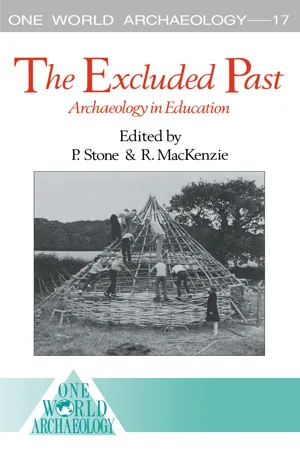
A ground-breaking book that examines the uneasy relationship between archaeology and education. Argues that archaeologists have a vital role to play in education alongside other interpreters of the past. Contributors from different countries and disciplines show how the exclusion of aspects of the past tends to impoverish and distort social and educational experience.
Information
1 The study of our universal cultural heritage through the Unesco Associated Schools Project
ELIZABETH KHAWAJIKE*
Background to the Associated Schools Project
'The wealth of humanity is also in its diversity. All of its aspects should be protected: cultural, biological, philosophical, spiritual'. This statement was one of the 16 principal conclusions of the Conference of Nobel Prize winners that met in Paris in 1988.
Today's world cultural heritage is derived from those ancient and more recent civilizations that preceded it, which made discoveries and advances in all fields, for example, in science, medicine, mathematics, the arts, philosophy, literature, architecture, and music.
Learning about past discoveries and advances is an essential factor in locating the present, in comprehending the interconnections between one civilization and another, and in understanding contemporary world issues and problems. At a time when the diversity of the world heritage is threatened by a trend towards uniformity, there is a need to reinforce and preserve the cultural identities of the different peoples of the world. At the same time it is important to ensure increased contact and exchanges between cultures to foster creativity, progress and international cooperation.
Over the past three decades, one of the Unesco programmes that seeks to promote a better understanding and awareness of other countries and their cultures has been the Associated Schools Project (ASP) which includes over 2000 institutions at the preschool, primary, secondary, and teacher-training levels of education in 97 countries. Its main objectives are to promote educational activities designed to improve international understanding and peace, and to encourage and facilitate contacts and exchanges between participating institutions at national, regional, and international levels.
The ASP was launched in 1953, and has focused particularly on the development of new and effective teaching methods, techniques and materials. For example, institutions taking part in the ASP have developed a wide range of methods aimed at enhancing the promotion of education for international understanding in the classroom (Unesco 1983, 1986c). In many countries the ASP has contributed to the production of new and effective teaching material on various topics related to international understanding. Recent examples include a manual on the study of world problems in the classroom (Bulgaria), a handbook for pupils and teachers on interdependence in the Indian Ocean (Mauritius), teaching guidelines on human rights (Chad), reference material on education and development (Costa Rica), a handbook on 'International understanding at school: methods and techniques' (Guatemala) and teaching guidelines for the observance of the International Day of Peace (Finland).
The ASP includes institutions at the preschool, primary, secondary, and teacher-training levels of education that are invited to submit annual reports for eventual inclusion in Unesco's biannual bulletin (Unesco 1986d). Schools interested in joining the ASP (for which there is no charge) can contact their own National Commission for Unesco.
The ASP gained considerable international recognition in 1974 (Unesco 1974):
Those concerned with Associated Schools in Member States should strengthen and renew their efforts to extend the programme to other educational institutions and work towards the general application of its results.
Its important role in multi-cultural education was also recognized (Unesco 1974):
Member States should promote, at various stages and in various types of education, the study of different cultures, their reciprocal influences, their perspectives and ways of life, in order to encourage mutual appreciation of the differences between them. Such study should, among other things, give due importance to the teaching of foreign languages, civilizations and cultural heritage as a means of promoting international and intercultural understanding.
In keeping with the guiding principles of the 1974 Recommendation, the ASP seeks innovative and effective ways and means to impart to pupils a sound knowledge of the past; not only their own cultural heritage but also those of others, all of which contribute to our universal cultural heritage. In addition, learning about other cultures enables young people to learn more about their own country and culture, their origin, history, ancient traditions and customs.
Intercultural learning at the national level
The effectiveness of the ASP was recently evaluated (Unesco 1980):
We stand at a critical point in history. We are witnessing for the first time the emergence of a global civilization based on the diversity of cultures and societies. But our technology has far outstripped the capacity of our social institutions to cope with it and both pose a striking challenge to those values which guide all of us in our response to the awesome global problems of conflict, injustice, disease and poverty.
The Associated Schools Project of Unesco as a voluntary world-wide network . . . has achieved a remarkable record of helping teachers and students to understand better these awesome problems and the efforts of the International community to deal with them.
Such support for the ASP is based on the success of various of its projects.
Bulgaria
In Bulgaria, 2 of the 30 institutions taking part in the Project specialize in the study of other cultures - the National Secondary School of Culture L. Jivkova and the National School of Ancient Languages and Culture Constantine Cyril. The existence of these two schools is significant and reflects the importance given to the study of both ancient and modern cultures in the country.1
The L. Jivkova ASP school created a club called 'The Young Tourist Guide' that organizes travelling seminars to eight Bulgarian sites. Pupils study historical sources written in Greek, Latin and ancient Bulgarian during such summer work camps.
A series of archaeological and historical expeditions has been undertaken, together with the Unesco Club of the Constantine Cyril School, during which pupils traced an important part of their historical past, and documented and recorded ancient Bulgarian songs, some previously unknown outside their locality of origin. During these expeditions students also took part in excavations jointly supervised by their teachers and archaeologists. They studied the impact of folklore on church music and the continuity of folk music in different regions of Bulgaria during various historical periods. Over the last three years pupils have visited more than 520 towns, villages and monasteries and have registered 828 old folk songs, some of which are now sung by the students' choir and have become generally popular. The L. Jivkova school also maintains a close link with an experimental school attached to the University of Athens and every year an overseas school visit is organized to improve proficiency in Greek, to establish friendships with Greek students, and to visit the remains of Greek sites.
As a basis for school discussions about the need to preserve the world cultural heritage, many ASP schools in Bulgaria study Unesco conventions (for example Unesco 1954, 1970, 1972). A number of these schools also show Unesco films on international campaigns to restore and preserve some of the world's great masterpieces, in order to sensitize pupils to the need for international cooperation in this field. Films shown have included Borobudur: beyond the reach of time; Haiti: three monuments, one symbol; The hidden treasures of Cappadocia; Hue: memories for tomorrow; and The Saving of Venice.
Brazil
Unesco believes that international cooperation and peace can be enhanced through a better knowledge of other cultures. An important first step in this process is for young people to learn more about their own country, its past history and its present role in world society. An ASP school in Brazil decided to compile an album of material on Brazil and its rich cultural heritage to be made available to other Associated Schools in the country. Teachers from many different subject areas, including geography, history, art, and music, took part in this interdisciplinary project. In addition to carrying out considerable bibliographical research, pupils were put in direct contact with experts who could speak authoritatively about Brazil's past and present cultural diversity. Pupils then organized debates and discussions about this information. As a result, the young people not only got to know aspects of their own country better, particularly its multiethnicity, but also Brazil's major contributions to world culture.
Cyprus
The Fifth Lyceum School in Cyprus decided to explore Unesco's global safeguard programmes to save the world's cultural heritage. Four main rescue operations were chosen for analysis: Nubia and Philae, Borobudur, the Acropolis in Athens (see Fig. 1.1), and Paphos in Cyprus. Children were divided into groups to study each site. They consulted relevant documents and reference materials, including the Unesco courier and The world cultural heritage. Once each group had completed its research, the entire project was published in the school newspaper. Thematic exhibitions of other preservation projects were also arranged in a general exhibition on 'Nature and culture: our common heritage'. This exhibition lasted three weeks and was visited by hundreds of people from outside the school. It included an explanation of Unesco's role in the movement to safeguard cultural property, as well as of the link between these activities and the aims of the ASP.
This whole approach proved to be very effective, and pupils became quite expert in their knowledge of various cultural agreements and, in particular, the world heritage list of protected monuments.
This project was linked directly to existing courses within the curriculum. Pupils were able to appreciate that history, geography, art, and literature have relevance outside the classroom, and they were able to learn much more about their own culture, since one of the chosen areas was Cyprus itself.

Figure 1.1 The Athenian Acropolis was one of the rescue sites studied by Cypriot children as part of the Associated Schools Project.
Malta
A girls' secondary school decided to study one of the old world civilizations in a project entitled 'Egypt: its past and present'. The pupils made extensive use of the library, tourist agencies and the Embassy of the Arab Republic of Egypt, which provided useful reference materials. Egyptian culture was studied in terms of history, religion, geography, politics, agriculture and architecture, both past and present. Some novel activities were undertaken, including a mathematics lesson on volume, in which a model pyramid was used to demonstrate the principle involved. The pupils enjoyed the challenge of learning about another nation and its culture in two contrasting time frames. In this way their knowledge of Egypt as an ancient civilization was complemented by studying it as a modern country in the wider world. The multidisciplinary approach permitted the children to carry out indepth studies of various features of Egyptian civilization in a way that would have been impossible in a single subject topic.
International cooperation contributes to the promotion of our universal cultural heritage
Federal Republic of Germany
The Anna Schmidt Schule invited pupils from the ASP Washington International School (USA) and the Ommcn International School (Netherlands) to join them in Cyprus at an archaeological excavation at Kalavasos village near the important Bronze Age site of Aighos Dimitrios. Under the tuition of experienced archaeologists, the young people took part in the excavation, thereby gaining knowledge about the development of early Mediterranean civilization, as well as experience of making the past come alive.
During their visit the pupils were housed with local families and all were highly appreciative of the warm welcome extended to them. Thus they not only gained a valuable cross-cultural experience of modern life in Cyprus, but also established firm friendships with pupils from the other countries, and with their Cypriot hosts.
Poland
In an effort to enable ASP teachers from abroad to learn more about Polish civilization...
Table of contents
- Cover
- Title
- Copyright
- List of contributors
- Foreword
- Contents
- Preface
- Introduction: the concept of the excluded past
- 1 The study of our universal cultural heritage through the Unesco Associated Schools Project
- 2 Archaeology in Indian universities
- 3 Archaeology in Nigerian education
- 4 Archaeology and education in Kenya
- 5 Education and the political manipulation of history in Venezuela
- 6 The right to a past: Namibian history and the struggle for national liberation
- 7 Still civilizing? Aborigines in Australian education
- 8 The affirmation of indigenous values in a colonial education system
- 9 The missing past in South African history
- 10 The teaching of the past of the Native peoples of North America in US schools
- 11 Whispers from the forest: the excluded past of the Aché Indians of Paraguay
- 12 The earth is our history book: archaeology in Mozambique
- 13 Culture houses in Papua New Guinea
- 14 The reconstruction of African history through historical, ethnographic and oral sources
- 15 The excluded present: archaeology and education in Argentina
- 16 Archaeology in the Alberta curriculum: an overview
- 17 'In fourteen hundred and ninety-two, Columbus sailed . . .': the primacy of the national myth in US school
- 18 Education and archaeology in Japan
- 19 The Black historical past in British education
- 20 Popularizing archaeology among schoolchildren in the USSR
- 21 Children and the past in Poland: archaeology and prehistory in primary schools and museums
- 22 Rediscovering Rome's hidden past
- 23 New Archaeology, New History – when will they meet? Archaeology in English secondary schools
- 24 'Well, in the Neolithic . . .': teaching about the past in English primary schools
- 25 Archaeology in the Toronto school system: the Archaeological Resource Centre
- Index
Trusted by 375,005 students
Access to over 1.5 million titles for a fair monthly price.
Study more efficiently using our study tools.
Frequently asked questions
Yes, you can cancel anytime from the Subscription tab in your account settings on the Perlego website. Your subscription will stay active until the end of your current billing period. Learn how to cancel your subscription
No, books cannot be downloaded as external files, such as PDFs, for use outside of Perlego. However, you can download books within the Perlego app for offline reading on mobile or tablet. Learn how to download books offline
Perlego offers two plans: Essential and Complete
- Essential is ideal for learners and professionals who enjoy exploring a wide range of subjects. Access the Essential Library with 800,000+ trusted titles and best-sellers across business, personal growth, and the humanities. Includes unlimited reading time and Standard Read Aloud voice.
- Complete: Perfect for advanced learners and researchers needing full, unrestricted access. Unlock 1.5M+ books across hundreds of subjects, including academic and specialized titles. The Complete Plan also includes advanced features like Premium Read Aloud and Research Assistant.
We are an online textbook subscription service, where you can get access to an entire online library for less than the price of a single book per month. With over 1.5 million books across 990+ topics, we’ve got you covered! Learn about our mission
Look out for the read-aloud symbol on your next book to see if you can listen to it. The read-aloud tool reads text aloud for you, highlighting the text as it is being read. You can pause it, speed it up and slow it down. Learn more about Read Aloud
Yes! You can use the Perlego app on both iOS and Android devices to read anytime, anywhere — even offline. Perfect for commutes or when you’re on the go.
Please note we cannot support devices running on iOS 13 and Android 7 or earlier. Learn more about using the app
Please note we cannot support devices running on iOS 13 and Android 7 or earlier. Learn more about using the app
Yes, you can access The Excluded Past by Robert MacKenzie,Peter Stone in PDF and/or ePUB format, as well as other popular books in Social Sciences & Archaeology. We have over 1.5 million books available in our catalogue for you to explore.