- 238 pages
- English
- ePUB (mobile friendly)
- Available on iOS & Android
eBook - ePub
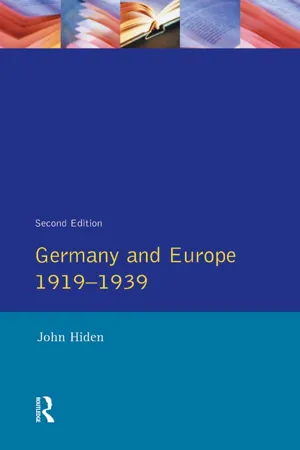
Germany and Europe 1919-1939
About this book
This is the only short study in English to survey Germany's foreign policy from a German viewpoint across the entire inter-war period. The approach, which sets Germany in her full European context, is not narrowly diplomatic; and it gives as much attention to the Weimar years of the 1920s as it gives to the more familiar story of Germany's international relations under the Third Reich. John Hiden has now thoroughly revised his text to take account of new scholarship since the book first appeared in 1977.
PART ONE
Germany
CHAPTER ONE
From War to Peace, 1918–21
What happens when a nation’s external and internal situation is subject to sudden change, as was the case with Imperial Germany when it suffered military defeat and revolution in the space of a few weeks at the close of the First World War? It is a truism to argue that such a collapse provided the opportunity to think afresh the tenets of foreign policy,1 but this barely does justice to the speed of events in Germany. In early October 1918, the German Army High Command (OHL) unexpectedly but insistently urged the stunned civilian leaders to ask the Allied Powers for an armistice and a peace treaty based on the American President Wilson’s famous ‘Fourteen Points’ of January 1918. Prince Max of Baden was appointed to head a new, if shortlived government. His task was to prevent a new and crushing military attack by the Entente, but it signalled the end of the ‘military dictatorship’ which Generals Ludendorff and Hindenburg had exercised since 1916 in their capacity of war heroes extraordinaire. In late October, Germany transformed itself into a constitutional monarchy and on the 24th of that month Ludendorff was dismissed. By 9 November, the Kaiser had been compelled to abdicate as the revolution got under way. Wilhelm Solf, the last Foreign Minister of the Empire, woke up, as it were, the first Foreign Minister of the Republic, servant to the all-socialist Provisional Government which was composed on 10 November 1918, the Council of People’s Commissars.
It was a time almost for reflexes rather than long-sighted planning in the field of foreign policy as elsewhere. Certainly, a study of German foreign policy in these months offers no neat solution to the political scientist’s problem about the relative importance of internal and external factors.2 The near-simultaneous transition from war to cease-fire, from Empire to Republic demonstrated, rather, the interaction between domestic and foreign events. President Wilson’s insistent calls for proof positive of a genuine change in Germany’s power structure played an important part in the general slide towards revolution. The demands were made in the exchange of notes which Prince Max of Baden’s government conducted with Wilson prior to the Armistice. Consequently, the Kaiser’s failure to confirm the extent of the October reforms by a more ready abdication appeared to the German masses as the obstacle to the conclusion of a speedy and reasonable peace; the more intolerable in that the shattering news of imminent defeat made the whole war effort seem tragically wasted. Conversely, when the Kaiser had gone it was apparent that there was a connection between the way in which internal order was restored and the sort of policy pursued towards the outside world.
A mere ten weeks separated the formation of the revolutionary Provisional Government of 10 November 1918 from the appearance in January 1919 of the first Republican parliamentary government which was responsible to the newly elected National Assembly. In that brief period the vision of radical reforms which had helped to fuel the revolution in the first place faded. This process was charted by the growing split between the two main wings of the German socialist movement, the Independent Social Democrats (USPD) and the Majority Social Democrats (SPD) and by the final resignation of the USPD from the Council of People’s Commissars on 27 December 1918. Along with the burial of the ideal of socialist unity which had inspired the provisional goverment in the first place went the demise of the still more revolutionary plans of the radical shop stewards and the Spartacists, later to become the German Communist Party (KPD). Their leaders, Rosa Luxemurg and Karl Liebknecht were buried too, literally, in January 1919, after their bloody execution at the hands of the Freikorps (volunteer forces).
The failure of revolution was only in part the result of policies pursued by the SPD leaders; only in part the reflection of their own preference for a return to normalcy and the restoration of their links with the moderate bourgeois parties of Germany. These contacts had been nurtured in the Empire and had culminated in the reforms of October 1918 only to be rudely interrupted by the revolution.3 Under Friedrich Ebert’s guidance, the top SPD leadership sought to resume the dialogue with other parties and groups as soon as possible. Many have regretted that the SPD did not instead concentrate on forcing through sweeping reforms of the social and economic system. The reality was, however, that hardly anybody in Germany wanted a Bolshevik-style revolution. Moreover, the established forces of imperial Germany remained influential. The maintenance of the Imperial bureaucracy, symbolised by Solf’s continuing presence in the German Forign Office, the survival of the German officer corps, founded on Ebert’s use of the Army to maintain internal order after 10 November, the successful evasion of socialist reforms by German business – all of these come as no real surprise when the magnitude of the problems thrown up by the transition from war to peace is taken into account.4 Germany was not Russia after all. The German Workers’ and Soldiers’ councils were modelled along Russian lines, but on 16 December they voted themselves out of power by agreeing to the elections for the National Assembly. The extent to which the conceptions of Ebert and the SPD found general support was reflected in the voting at these elections. The SPD, together with the moderate bourgeois parties willing to support the new Republic, the Centre Party and the Democrats, received the overwhelming share of votes.
Such internal realities helped to define the range of choices immediately open to German foreign policy. Most obviously, its commitment to prevent more radical revolution in Germany made it impossible for the provisional government to pursue an active policy of rapprochement with Lenin’s Russia. A network of contacts had sprung up between the German Workers’ and Soldiers’ Councils and representatives from the Russian Soviets in the earliest days of the German revolution and this was hardly welcome to the SPD or USPD members of the government.5 Joffe, the Soviet Ambassador to Berlin, had been expelled on 5 November for revolutionary propagandising. To the domestic pressures preventing the premature development of closer relations between the new Germany and the new Russia was added the weight of external factors.6
THE IMPACT OF THE ARMISTICE
The Armistice which Germany signed with the Allied Powers on 11 November 1918 created additional obstacles to any normalisation of German-Russian relations. It demanded that Germany abrogate not only the Treaty of Bucharest with Romania but the Treaty of Brest-Litovsk, which had governed German-Russian relations since March 1918. Technically, this put Germany in a state of war with Russia. In fact Lenin had also declared Brest-Litovsk null and void in November and Germany’s Embassy in Moscow had not been filled after the murder of their Ambassador Count Mirbach, in July 1918. The Armistice reflected the determination of the Western Allies to stop Bolshevism from spreading to Central Europe. In effect the Germans were associated with the Allied intervention against the Bolshevik regime. Whereas the territories occupied by German troops in Western Europe at the end of the war were to be evacuated more or less immediately, Germany was only to evacuate those occupied areas in the east formerly belonging to Russia when the Allies deemed the moment suitable (Article XII).
Other provisions in the Armistice included the predictable arrangements for the immediate repatriation of prisoners of war and the forbidding of Germany damaging property as it evacuated occupied territories. The financial clauses called for the return of gold seized from Belgium, Romania and Russia and, ominously, for ‘reparations for damage done’. The overwhelming preoccupation of the Allies with their own security was reflected in the demand for the surrender of heavy arms and vehicles and for the immobilisation of the German fleet. Moreover the left bank of the Rhine was to be occupied by Allied troops, together with the bridgeheads of Mainz, Cologne and Coblenz and a surrounding stretch of thirty kilometres. The crippling blockade of Germany was to be continued for the time being and in effect this was made harsher by the ban on Germany’s merchant naval activity. As a means of securing German’s continued good behaviour until the conclusion of a peace treaty, the Armistice was made renewable after an initial period of thirty-six days.
The Armistice brutally underlined the extent of Germany’s military defeat. The scale of adjustment required of German foreign policy may be seen from a brief look back at the conditions existing when Germany signed its victorious peace with the Bolshevik forces in March 1918 at Brest-Litovsk. In this present study it is impossible to discuss at any length the controversies about German war aims, 1914–18. No attempt can be made to answer the question to what extent the annexationist policies pursued by the Germans in Europe after 1914 were conceived before war broke out. All that can safely be assumed here is that the Imperial war aims at least fulfilled many of the requirements of Germany’s rulers, of its military, landowning and industrial élites, and that these aims received at least the approval of large sectors of German society during the war. Fritz Fischer’s summary of Germany’s war aims as they stood in 1918 can therefore serve as a useful yardstick against which to measure the dramatic limitations imposed by the Armistice.
A survey of Germany’s war aims at the beginning and in the middle of 1918, when German self-confidence was at its peak in the expectation of early victory, discloses a picture of an imperium of grandiose dimensions. In the West: Belgium, Luxemburg, Longwy-Briey, linked with Germany on such terms as to make possible the adherence of France and Holland and to isolate Britain and force her to recognise Germany’s position; in the East: Courland, Livonia, Estonia and Lithuania, from Reval to Riga and Vilno, the Polish Frontier Strip and Rump Poland all closely fettered to Germany; in the South-east: Austria-Hungary clamped into Germany as a cornerstone, then Rumania and Bulgaria, and beyond them the Ottoman Empire as an object of Germany’s Asiatic policy. Command of the Eastern Mediterranean was to compel the adherence of Greece and secure the route through Suez, while the domination of the Black Sea guaranteed the economic mastery of the Ukraine, the Crimea and Georgia, and the command of the Baltic compelled Sweden and Finland, with their riches, to take the German side. On top of all this was the position of at least economic hegemony in Rump Russia.7
Such an extended European power base was to be the precondition of Germany’s bid for world power. The Armistice obviously removed for the foreseeable future any prospect of reviving the imperial war aims in Western Europe. What remained was an aversion to the Western Powers and a determination to recover Germany’s status at their expense which was nutured by the survivors of Imperial Germany’s establishment, by its military leaders and by its unrepentant nationalists. They could capitalise on the resentment of the wider German public but they could do little directly in 1918/19, beyond trying to frustrate the slow and painful emergence in the German Foreign Office and in some of the political parties of a more realistic policy towards the Western Powers (p. 65). But what of East Europe where the situation was more confused owing to the continuing fighting of the Bolshevik forces and the highly uncertain outcome of the revolution in Russia? Could the unrepentant elements in Germany salvage something of Imperial war aims before it was too late?
On 18 November 1918, the Council of People’s Commissars discussed the issue of German-Russian relations in order to clarify the policy to be pursued towards Lenin and the Bolsheviks, who were pressing precisely for this while still counting on revolution in Germany. There was unanimous agreement in th...
Table of contents
- Cover
- Half Title
- Title Page
- Copyright Page
- Table of Contents
- List of tables
- Acknowledgements
- Introduction
- Part One: Germany
- Part Two: Germany and the European Powers, 1921–1939
- Part Three: Conclusion
- Bibliographical Essay
- Tables
- Map: Treaty Settlements in Europe, 1919–26
- Index
Trusted by 375,005 students
Access to over 1.5 million titles for a fair monthly price.
Study more efficiently using our study tools.
Frequently asked questions
Yes, you can cancel anytime from the Subscription tab in your account settings on the Perlego website. Your subscription will stay active until the end of your current billing period. Learn how to cancel your subscription
No, books cannot be downloaded as external files, such as PDFs, for use outside of Perlego. However, you can download books within the Perlego app for offline reading on mobile or tablet. Learn how to download books offline
Perlego offers two plans: Essential and Complete
- Essential is ideal for learners and professionals who enjoy exploring a wide range of subjects. Access the Essential Library with 800,000+ trusted titles and best-sellers across business, personal growth, and the humanities. Includes unlimited reading time and Standard Read Aloud voice.
- Complete: Perfect for advanced learners and researchers needing full, unrestricted access. Unlock 1.5M+ books across hundreds of subjects, including academic and specialized titles. The Complete Plan also includes advanced features like Premium Read Aloud and Research Assistant.
We are an online textbook subscription service, where you can get access to an entire online library for less than the price of a single book per month. With over 1.5 million books across 990+ topics, we’ve got you covered! Learn about our mission
Look out for the read-aloud symbol on your next book to see if you can listen to it. The read-aloud tool reads text aloud for you, highlighting the text as it is being read. You can pause it, speed it up and slow it down. Learn more about Read Aloud
Yes! You can use the Perlego app on both iOS and Android devices to read anytime, anywhere — even offline. Perfect for commutes or when you’re on the go.
Please note we cannot support devices running on iOS 13 and Android 7 or earlier. Learn more about using the app
Please note we cannot support devices running on iOS 13 and Android 7 or earlier. Learn more about using the app
Yes, you can access Germany and Europe 1919-1939 by John Hiden in PDF and/or ePUB format, as well as other popular books in History & 20th Century History. We have over 1.5 million books available in our catalogue for you to explore.