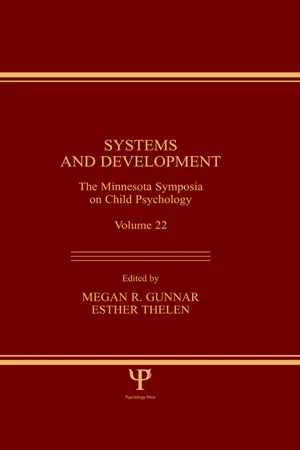
This volume covers the 22nd Annual Minnesota Symposia on Child Psychology. The theme of the conference was the use of a systematic approach to the study of development. An analysis of systems theory, its applications to the study of development, its benefits, and its drawbacks are considered. The contributors, among the leaders in this field, discuss the application of systems concepts to the analysis of core issues in areas as diverse as motor and social development.
eBook - ePub
Systems and Development
The Minnesota Symposia on Child Psychology, Volume 22
- 260 pages
- English
- ePUB (mobile friendly)
- Available on iOS & Android
eBook - ePub
Systems and Development
The Minnesota Symposia on Child Psychology, Volume 22
About this book
Information
Publisher
Psychology PressYear
2014Print ISBN
9781138996687
9780805804096
Edition
1eBook ISBN
9781317784722
1 | Ontogeny and the Central Dogma: Do We Need the Concept of Genetic Programming in Order to Have an Evolutionary Perspective? |
The title of this chapter implies that it is possible to have an evolutionary perspective without the concept of genetic programming (and without any of its surrogates, which proliferate wildly in the psychological and biological literature). This is indeed the case, but before considering how it can be accomplished and why it is important, we would do well to ask why evolution and programming have been assumed to be inextricably joined.
My discussion begins with some remarks on the need to integrate evolutionary and developmental studies, two areas that have been estranged from each other for some time. The rift is hardly surprising; evolutionary theory has been associated with a view of development as centrally controlled and predetermined. It is a view rejected by many who are deeply acquainted with the interactive systems that actually generate living forms, but one that fits an old tradition of preformationist thinking. We look at the standard definition of evolution as changes in gene frequencies, a definition that seems to require genetic control of ontogeny. Problems with this way of linking evolution to development are reviewed, along with some inadequate attempts to solve them. The concepts of inheritance and ontogeny are reformulated, and the idea of the developmental system is offered as a way of having an evolutionary perspective without being saddled with an untenable doctrine of one-way flow of developmental “information” from the nucleus to the phenotype.
KNOWLEDGE AND THE SHADOW BOX
Seeing
Howard Gruber and Isabel Sehl (1984) have studied the ways people cooperate to construct knowledge that is not available to either of them alone. Pairs of people are presented with a box in which shadows of an object can be seen. Because each looks at the object from a different angle, each sees a different shape. One might see a circle, for example, whereas the other sees a triangle. Together, the partners must construct an object that could project both those shapes. Clearly, some ways of working are more effective than others. Domination is not particularly helpful in moving beyond a one-sided view. Mindless compromise in the absence of real constructive work (the object is partly round and partly triangular) would obviously be inadequate as well.
I suggest that some of the reasons that developmentalists and evolutionists have had difficulty communicating with each other are related to the presuppositions they bring to the shadow box we call science, and thus, what they construct there. Sometimes they have had divergent interests, and the language in which they have communicated has prevented them from realizing it.
Viktor Hamburger (1980) has described the exclusion of embryology from the neo-Darwinian synthesis. The lack of mutual understanding between developmentalists and evolutionists he describes has had its counterpart at the behavioral level; witness the exchanges in the 1950s, 1960s and 1970s between American comparative psychologists and European ethologists (Lehrman, 1953, 1970; Lorenz, 1965). To some extent these groups talked past each other because they were interested in different matters. But I think they also had genuinely different conceptions of development.
Four Points of View: Chaos at the Shadow Box
The ethologist Niko Tinbergen (1963) suggested that when people ask why an animal does something, there are four possible biological interpretations of the question. Many students of animal behavior have been guided by his explication of the “four whys”: (a) the evolutionary history of the behavior, (b) its survival value, (c) the mechanisms by which it occurs, and (d) its development. Tinbergen thought that failure to distinguish these questions had caused considerable confusion. It still does. Developmental psychologists have not traditionally thought about the first two: when they have, they have not always kept their “whys” straight, nor have they necessarily been helped by their colleagues in biology. Too often, the price of admission to the biological brotherhood has been a view of development marked by reliance on essentially preformationist assumptions–assumptions decidedly uninformed by systems thinking, despite a vocabulary liberally sprinkled with systems terms (e.g., Fishbein, 1976; Scarr & McCartney, 1983). The notions of genetic programs and instinct, for instance, draw some of their authority from their associations with evolutionary thought, but carry all sorts of other implications about mode of development and kinds of mechanism: autonomy, internality, spontaneity, naturalness, and resistance to perturbation. They neatly tie together the four “whys” that Tinbergen distinguished. (He did not claim that they were unrelated, just different. He even discussed some ways of relating them, 1963; see also P. Bateson, 1985.)
Imagine for a moment two people at a shadow box. This time they have been given different instructions: One is to discern the object’s shape, the other must determine whether it is moving. Imagine also that they must use an ambiguous vocabulary. “Rooving,” for instance, means both “round” and “moving.” One partner reports the object’s rounded contour, and the other concludes that it is mobile. I am suggesting, in this crude way, that their plight resembles that of scientists who must work with ambiguous terms like inherited, genetic, biological, maturational, and so on.
The ambiguity of these terms permits the blurring of Tinbergen’s “whys.” If one worker discovers that a bit of behavior is present in phylogenetic relatives, for instance, the other may conclude that it will be developmentally stable. If one claims that a pattern is adaptive, the other may deduce that it develops independently of experience. Evidence for one “why” masquerades as evidence for another. If aims and terms were clarified researchers might conclude that they were pursuing separate projects, and that they had nothing to say to each other. But it is not separatism that is the goal: rather, the recognition of differences that is the prerequisite to fruitful collaboration. A great deal of conceptual work is required as well. Integration, after all, is not the same as conflation. Furthermore, because these notions of “biological bases” seldom segregate neatly into developmentalists’ and evolutionists’ heads, coherence within fields suffers even if there is no interest in interdisciplinary work.
EVOLUTION AND THE CENTRAL DOGMA
The Argument
The usual way of construing the relationship between ontogeny and phylogeny involves several interrelated ideas. First, evolution is defined by changes in gene frequencies. The genes are thought to produce phenotypes by supplying information, programs, or instructions for the body and for at least some aspects of the mind. Some genes produce better phenotypes than others and are differentially passed on. Although in this view the environment is necessary for proper development, its effects on the phenotype are evolutionarily irrelevent because only inherited traits are transmitted in the DNA. Causal power and information are carried in that DNA, and living things are created by an outward flow of causality and form from the nucleus.
This conception of the ontogeny-phylogeny relationship seems to require a dual view of development, one kind for inherited traits and one for everything else. This is true even though statements are routinely made about the interaction of nature with nurture and the impossibility of attributing traits completely to one or the other. Despite their reassuring ecumenical ring, such statements either retain the dichotomy or turn it into a continuum. Emblematic of a trendy but failed interactionism, they appear in response to a multitude of developmental observations that call traditional formulations into question; their shortcomings are examined later. (For critiques of this kind of well-intentioned but conceptually misguided interactionism, see Lewontin, Rose, & Kamin, 1984; Oyama, 1981, 1982, 1985; Tobach & Greenberg, 1984.) Although they scornfully dismiss “extreme views” that attribute behavior entirely to the genes or entirely to the environment, the devotees of this popular interactionism mistake compromise and relabelling for conceptual resolution.
Many have expressed their unhappiness with the contradictions and faulty inferences that accompany these accounts of the ontogeny-phylogeny relationship. They have tried to formulate a unified conception of ontogeny (P. Bateson, 1983; Gottlieb, 1976; Johnston, 1987; Klopfer, 1969; Lehrman, 1970; Schneirla, 1966; Tobach, 1972). Not surprisingly, they have often had difficulty communicating effectively with colleagues who hold the dominant dualistic view. Indeed, it can be argued that the nature-nurture dichotomy will continue to dominate our theories and research as long as we continue to speak of traits, programs, or encoded potential, as being transmitted.
The Goal
We need to alter our conceptions of ontogeny and phylogeny before we can bridge what Hamburger (1980) called the “nucleocytoplasmic gap.” We do not need more conciliatory declarations that nature and nurture are both important, but rather a radical reformulation of both. The conventional model equates nature with the genes and nurture with experience. Experience is usually taken to mean learning, so many other factors are automatically ignored (Lehrman, 1962). (Hence the interchangeability of “innate vs. learned” with “genes vs. environment,” as in Gould, 1982, p. 250, 1985.) This model should make it impossible to refer to any aspect of the phenotype as nature. To do so would be either to confuse genotypic and phenotypic levels or to rely on a conception of development in which some parts of the phenotypes are contained in, or formed by, the genes. Nevertheless, both errors are commonly made, for it is with phenotypes that we are ultimately concerned. People become obsessed with genotypes insofar as they think that genotypes prefigure phenotypes. In the face of the conceptual disarray that accompanies the use and misuse of this model, I propose the following reconceptualizations, in which genes and environment are part of a developmental system that results in phenotypic nature:
1. Nature is not transmitted but constructed. An organism’s nature–the characteristics that define it at a given time–is not genotypic (a genetic program or plan causing development) but phenotypic (a product of development). Because phenotypes change, natures are not static but transient, and because each genotype has a norm of reaction, they are not unitary but multiple.
2. Nurture (many levels of developmental interactions) is as crucial to typical characters as to atypical ones, as necessary to universal characters as to variable ones, as basic to stable characters as to labile ones.
3. Nature and nurture are therefore not alternative sources of form and causal power. Rather, nature is the product of the process of the developmental interactions we call nurture. An organism’s nature is simply its form and function. Because nature is phenotypic, it depends on developmental context as profoundly and intimately as it does on the genome. To identify nature with that genome, then, is to miss the entire developmental story in much the same way that preformationist explanations have always done.
4. Evolution is thus the derivational history of developmental systems.
Conduits and Messages
George Lakoff and Mark Johnson (1980), a linguist and a philosopher, present an “experientialist” alternative to objectivist and subjectivist theories of knowledge. Properties of objects are produced in interaction, rather than residing in the objects or being completely arbitrary and subjective, and metaphor plays a central role. Their attempt to provide a third way, a synthesis that transcends a traditional antithesis, provides some striking parallels with my attempt to use constructivist interaction1 to move beyond nativism and environmentalism.
They describe the “conduit metaphor” for language, in which ideas or meanings are objects that can be placed in the containers we call words and sent along a conduit (communication) to a hearer. The meanings then reside in the sentences and are independent of speaker or context (pp. 10–12, citing Reddy). The objectivist theory of communication is based on this conduit metaphor: Fixed meanings are sent via linguistic expressions (p. 206). In a similar way, I suggest, natural selection is thought to place knowledge about the environment (or instructions for building organisms) into the genes, which are the vehicles by which these biological meanings are transmitted from one generation to the next. The context-independence of meanings in the conduit metaphor is consistent with the connotations of autonomy and necessity that accompany the ideas of instinct and genetically driven development. (On context-sensitivity in systems theory, see Valsiner, 1987.) The details of the communication metaphor tend not to be well worked out in biological discourse (Johnston, 1987; Oyama, 1985), but I think the objectivist (and preformationist) overtones are robust (Cohen, 1979).
Perhaps biologists’ propensity to speak of molecular letters, words, and sentences, of genetic codes and grammars, is partially due to these notions of life as language. The genes become the repository of true nature; molecular meanings are contained in a phenotypic vessel, which is sometimes treated with so little regard as to render it virtually transparent. Witness some psychologists’ willingness to bypass the phenotype by speaking of people responding to children’s “genetic propensities” and “genetic differences” rather than to the children themselves (Plomin, 1986, pp. 110, 129). Similarly, Scarr and McCartney (1983, p. 433) refer to experiences that “the genotype would find compatible.” They use the term, developmental system but insist that genes and environment play different roles in it: The genes, of course, play the determining role. (Despite the importance of both, that is, some causes are more equal than others. For contrast, see Fogel & Thelen, 1987, and Valsiner, 1987, on systems dynamics and Goodwin, 1982, and Oyama, 1981, on phenocopies.)
THE CENTRAL DOGMA: HYPOTHESIS AND METAPHOR
The genes appear to link evolution and development in two ways. They are the material link that promised to make sense of heredity. A conceptual link was forged by the adoption of Francis Crick’s Central Dogma of the one-way flow of information (from genes to proteins, never from proteins in toward the genes, Crick, 1957) as the ruling metaphor for development. The metaphor takes many forms (programs, blueprints, instructions; see Newman, 1988; Oyama, 1985), but they always involve the emanation of basic developmental causation from the DNA. An outward flow of information and power achieves the translation of the genetic message in ontogeny.
A subtle transition is thus made from “messages” about molecules to messages about bodies and minds, quite a different thing, whether we realize it or not. The shift is from transmission of genes to transmission of traits. Focus on the gene as prime mover of ontogeny leads to all sorts of assumptions about genetic control of development as the defining characteristic of certain traits (biological, inherited, programmed); this in turn leads to the need for another kind of process to explain everything else.
The more reductionist one is, the harder it is to appreciate the gap between the molecular and the organismic levels. The kind of reductionism I am speaking of here is not the provisional single-mindedness that allows detailed investigation of a mechanism. It is rather the desire to interpret the whole world in terms of that mechanism, or at least, in terms of the level at which it was studied. It is the failure to shift levels or point of view, whether from inability or from some conviction that to do so would be soft-headed. The genetic program holds a fatal attraction for such minds.
Crick’s Central Dogma has com...
Table of contents
- Cover
- Half Title
- Title Page
- Copyright Page
- Table of Contents
- Preface
- 1. Ontogeny and the Central Dogma: Do We Need the Concept of Genetic Programming in Order to Have an Evolutionary Perspective?
- 2. Developmental Roots of Behavioral Order: Systemic Approaches to the Examination of Core Developmental Issues
- 3. Self-Organization in Developmental Processes: Can Systems Approaches Work
- 4. The Developing Family System
- 5. Some Amplifying Mechanisms for Pathologic Processes in Families
- 6. Commentary: Process and Systems
- 7. Commentary: General Systems and the Regulation of Development
- Author Index
- Subject Index
Trusted by 375,005 students
Access to over 1.5 million titles for a fair monthly price.
Study more efficiently using our study tools.
Frequently asked questions
Yes, you can cancel anytime from the Subscription tab in your account settings on the Perlego website. Your subscription will stay active until the end of your current billing period. Learn how to cancel your subscription
No, books cannot be downloaded as external files, such as PDFs, for use outside of Perlego. However, you can download books within the Perlego app for offline reading on mobile or tablet. Learn how to download books offline
Perlego offers two plans: Essential and Complete
- Essential is ideal for learners and professionals who enjoy exploring a wide range of subjects. Access the Essential Library with 800,000+ trusted titles and best-sellers across business, personal growth, and the humanities. Includes unlimited reading time and Standard Read Aloud voice.
- Complete: Perfect for advanced learners and researchers needing full, unrestricted access. Unlock 1.5M+ books across hundreds of subjects, including academic and specialized titles. The Complete Plan also includes advanced features like Premium Read Aloud and Research Assistant.
We are an online textbook subscription service, where you can get access to an entire online library for less than the price of a single book per month. With over 1.5 million books across 990+ topics, we’ve got you covered! Learn about our mission
Look out for the read-aloud symbol on your next book to see if you can listen to it. The read-aloud tool reads text aloud for you, highlighting the text as it is being read. You can pause it, speed it up and slow it down. Learn more about Read Aloud
Yes! You can use the Perlego app on both iOS and Android devices to read anytime, anywhere — even offline. Perfect for commutes or when you’re on the go.
Please note we cannot support devices running on iOS 13 and Android 7 or earlier. Learn more about using the app
Please note we cannot support devices running on iOS 13 and Android 7 or earlier. Learn more about using the app
Yes, you can access Systems and Development by Megan R. Gunnar,Esther Thelen in PDF and/or ePUB format, as well as other popular books in Psychology & Developmental Psychology. We have over 1.5 million books available in our catalogue for you to explore.