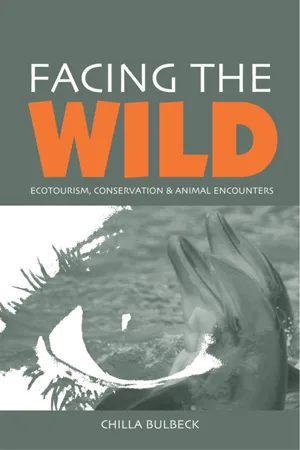
What do wild animals mean to humans? Will they survive both rampant habitat loss and extinction caused by human encroachment and, as ecotourists, our enthusiasm for them? With ecotourism now the fastest growing segment of tourism, and encounters with wild animals - be it swimming with dolphins, going on safari or bird watching - ever more popular, these are critical questions. Yet until now little has been known about why people crave encounters with wild animals and the meaning for the ecotourism industry, conservation efforts and society at large.
Facing the Wild is the first serious empirical examination of why people seek out animals in their natural environment, what the desire for this experience tells us about the meanings of animals, nature, authenticity and wilderness in contemporary industrialized societies, and whether visitors change their environmental perspectives and behaviour, as the custodians of wildlife parks would like them to. The book explores the contradictions and ambivalence that so many people experience in the presence of 'wild nature' - in loving it we may diminish it and in the act of wanting to see it we may destroy it. Ultimately the book makes a case for 'respectful stewardship' of a 'hybrid nature' and provides insight for both practitioners and ecotourists alike.
- 336 pages
- English
- ePUB (mobile friendly)
- Available on iOS & Android
eBook - ePub
About this book
Part 1
Back to Nature Tourism

Introduction – Part 1
The world is a book; he who stays at home reads only one page.
(Augustine in the 2nd century AD in Sofield, 1991, p56)
Authentic Tourism
The tourism industry is a favoured child of globalization, feeding and feeding off the information superhighway, shipping lanes and airport terminals (Weston, 1989, p43). Indeed, the last frontier of tourism is not Antarctica or the floor of the Atlantic Ocean, but outer space.1 Studies breathlessly recount the phenomenal growth of the tourism industry, ‘the greatest continuing mass movement of peoples in human history’ (Horne, 1992, pix). The oft-cited prediction that tourism would be the largest industry in the world at the millennium (Urry, 1992, p1; Rojek, 1997, p70) is indicated by the facts that tourism accounts for 7.5 per cent of world trade (Rojek, 1997, p70) and that there are over 670 million arrivals at international ports (Addley, 2001, p22).2 Tourism employs more people than any other industrial sector – over 112 million people, one of every 15 workers in the world. Travel is the major foreign exchange earner for the US and for many developing countries (McLaren, 1998, p13).3 Or, as Deborah McLaren (1998, p13), in an attack on the economic and environmental degradation caused by tourism, puts it: ‘With annual revenues of almost $3 trillion, its economic impact is second only to that of the weapons industry’. In 1988, tourism contributed 6 per cent to Australia’s Gross Domestic Product (GDP), almost equivalent to the contribution of the rural sector (Carroll, 1991a, p18). In 1992, Australia had to export 50 tonnes of coal to generate the same earnings as two Japanese honeymooners spending a week in Australia (Rowe, 1993, p7).4
The earliest travellers are often imagined as pilgrims on their journey to the Holy Land, whether Jerusalem or Mecca.5 It is common, also, to posit tourism as the contemporary version of a religious calling (Pearson, 1991, p126) ‘in its concern with pilgrimages, with authentic relics and with regeneration through communion with Nature, Art, the Authentic, the Past and other forms of spiritual refreshment’ (Horne, 1992, p76), a quest lampooned by David Lodge (1992, p75) in his novel Paradise News. Even the word ‘holiday’ echoes ‘holy-day’ (Davidson and Spearritt, 2000, pxviii).
The industry of tourism is premised on a ‘vacationing infrastructure’: a financially comfortable population who have won vacations as part of their working conditions,6 which they could experience in resorts, holiday camps or hotels and to which they could travel by way of railways, steamers or other transportation. The infrastructure of transportation and vacation destinations was assembled in the US during the last half of the 19th century (Aron, 1999, p167). To this material infrastructure, Patricia Jasen (1995, p10) adds the symbolic infrastructure of guidebooks describing itineraries all could follow. For example, Walkabout was founded by the Australian National Travel Association in 1934 (Davidson and Spearritt, 2000, p80). Guidebooks and the guided tour left and leave most of the country blank, directing the tourist towards predetermined ways of seeing the landscapes (Horne, 1992, p24).
Frederick Billings, president of the Northern Pacific Railroad, was involved in the creation of Yosemite and Yellowstone National Parks (Spence, 1999, p36). Billings believed ‘commerce could serve the cause of conservation by bringing visitors to a site worthy of preservation’, where nature worship replaced other forms of religion (Spence, 1999, p37). In Canada, friendly societies, mechanics’ institutes, Sunday schools, temperance societies and many employers organized outings by steamer and rail (Jasen, 1995, p127). In Australia, the opening of the Blue Mountains to tourism was an unintended side effect of the railway line to Bathurst (Davidson and Spearritt, 2000, p15). A paddle steamer especially fitted for ‘excursionists’ or day-trippers encouraged the development of Queenscliff and Sorrento (Sydney suburbs) from 1872. In 1896, the first road map of Victoria was produced, an increasing number being produced from the 1920s (Davidson and Spearritt, 2000, pp163–164). After World War II, the motorcar became the major means of transportation in Australia and North America (Davidson and Spearritt, 2000, pp34–35).
Dean MacCannell (1976, p41) has famously argued that ‘Modern man has been condemned to look elsewhere, everywhere, for his authenticity, to see if he can catch a glimpse of it reflected in the simplicity, poverty, chastity or purity of others’. This ‘elsewhere’ might be another time (heritage tourism), another place (ethnic tourism) or another species (ecotourism) (see Horne, 1992, p105). ‘The tourist hopes to find enlightenment in the “real lives” of other species, people and places’ (Jarvis, 2000, p38). Tourism rhetoric is full of claims to authenticity: ‘the very place where . . . ’, ‘a real piece of the true Crown of Thorns’, ‘original’, ‘actual’ (MacCannell, 1976, p14). However, the tourist is forever deprived of this goal, his or her very presence declaring the staged nature of the experience. Tourists desire that wilderness areas be ‘pristine and unaltered by humans’ (Ross, 1988, p317), but the destination cannot be so far off the beaten track as to deny access. The best a privileged few might achieve is access to a staged back region, usually sanitized, for example when zoo friends are given a behind the scenes tour (MacCannell, 1976, pp94, 99, using Erving Goffman’s notion of front and back regions).
Where some forms of tourism merely require the infrastructure of transportation and accommodation, special interest tourism must also provide an experience, a transformation of the self. Special interest tourists are more likely to be free independent travellers (FITs) than group inclusive tourists (GITs) who are members of a package tour. The acronyms FITs and GITs suggest a hierarchy of tourist types and of class differences. As with other displays of taste, Pierre Bourdieu (1984, pp50, 55) suggests that an ‘aesthetic disposition’ can be expressed in tourism. Teachers and intellectuals choose ‘walking, camping, mountain or country holidays’ while the old bourgeoisie choose hotel holidays in spa towns (Bourdieu, 1984, p28). The working class enjoy participatory entertainment (Bourdieu, 1984, p34) in casinos rather than in culture contact, preferring the sights at Blackpool to those of beaching whales (Crick, 1989, p327; Urry, 1990, p10; see also Savage et al, 1992, pp109–110; New South Wales Tourism Commission, 1989a, pp65–67). Some special interest tours, as with the Grand Tour in the late 17th century, also require intellectual capital. The experience may require knowledge of the poetic heritage of the Lake District (Urry, 1990, p86), an ability to differentiate a complex ecosystem and a stand of conifers (Urry, 1990, p99) or apprehension that wildlife is in its natural setting with minimum disturbance (Varcoe, 1988, p27). A study tour requires preparatory homework to appreciate the experience (Varcoe, 1988, p27).
Ecotourism
The term ecotourism overlaps with other terms like adventure tourism, nature-oriented tourism, alternative tourism, appropriate tourism, soft tourism (tourisme doux), responsible tourism, ethical tourism, environment-friendly travel, green tourism, sustainable tourism and nature tourism (Miller and Kaae, 1993, p39). Ecotourism, as a concept, dates from at least 1965, when Nicholas Hetzer called for a rethinking of culture, education and tourism and promoted an ‘ecological tourism’. For Hetzer, ecotourism attempts minimum environmental impact, maximum respect for host cultures, maximum economic benefits to the host country’s grass roots and maximum ‘recreational’ satisfaction for participating tourists (Miller and Kaae, 1993, p39). Over time the significance of ‘relatively undisturbed or uncontaminated natural areas’ (Boo, 1990, pxiv) has lost ground to a greater prominence for learning, ecological sustainability and the wellbeing of local people. Indeed Janet Richardson (1993, pp9, 11–14) suggests that areas of disturbance may yield the greatest learning potential, noting the goal of fostering understanding, participation and conservation, through activities like tree planting and turtle tagging (similarly, see the Commonwealth Department of Tourism’s 1994 definition of ecotourism in Jarvis, 2000, p43).
Claims concerning the weight of ecotourism within Australian tourism as a whole vary from only 1 per cent (Davidson and Spearritt, 2000, p245)7 up to one-third or more (Hodge, 2002, p40; Ralph Buckley in Chryssides, 2001, p42).8 A 1989 survey revealed that 70 per cent of the Australian travel market considered themselves to be environmentally conscious (Kangaroo Island Tourism Working Party, 1991, p4), suggesting the increasing popularity of the term as much as the green orientation of the tourism industry.9 Janet Richardson’s (1993) guide of Australian ecotours and nature-based holidays identified 18 that mentioned specific animals, such as ‘little penguins’ or ‘soaring eagles’, while half noted unspecified wildlife, fauna and flora, or activities such as bird watching, snorkelling or scuba diving.
It sometimes appears that ‘ecotourism is really just niche tourism for the rich’ or ‘less about the environment than about reducing the guilt of wealthy travellers and feeding the human ego’ – ‘egotourism’ (Jarvis, 2000, p44). David Brooks (2000, pp10–11), in his tongue-in-cheek Bobos in Paradise, suggests that the new elite of bobos, bourgeois bohemians, have combined economic success with free spirit rebellion, largely through their consumption choices. Holidays become ‘dial-an-ordeal’ (Brooks, 2000, p210) or ‘useful vacations’ (Brooks, 2000, p203) in which bobos learn, or achieve spiritual or emotional breakthroughs: ‘we don’t just want to see famous sights; we want to pierce into other cultures. We want to try on other lives’ (Brooks, 2000, p206; see also Eagles, 1992 for Canada). An article in a magazine directed at young Singaporean women advocated ‘ecotourism’: ‘Feed wild dolphins, hug a koala or admire the birds’, ‘getting away from it all – without of course being too far from the comforts of home such as air conditioning in summer or TV in the evenings’. Along with watching dolphins and birds, the article noted that in December and January Australian swimming pools and beaches ‘fill up with hunks and other watchable bodies’ (Lee, 1994, pp258, 259). Indeed the ecotourist tag has become so valuable and abused that an accreditation process has been established in Australia, accrediting some 300 tours (Ralph Buckley in Chryssides, 2001, p45).
Ecotourism and cultural tourism draw on the market of ‘bobos’, middle class, educated urbanites from North America, Europe and increasingly Japan (Ryel and Grasse 1991, p171; Whelan 1991, p5; see also Kierchhoff 1986, p8 for Germany). The survey of visitors to animal encounter sites in Australasia offers some support for the claim that special interest tourists belong to the better educated and/or higher income segments of society. Table A3.11 (in Appendix 3) reveals that the tertiary educated were less worried about good transportation and good eating and rest facilities. The results for important factors when planning a trip overseas generally support the contention that people with higher socioeconomic status focus on self-actualizing needs and those with lower socioeconomic status focus on more physiological needs (see Table A3.22 which uses the factors corresponding to Maslow’s hierarchy of needs, as adapted to the tourist experience by Pearce and Caltabiano, 1983, p18). With the exception of the chance to see animals, the tertiary educated tend to choose the experience factors (at the top of Table A3.22) and the less well educated the security factors (at the bottom of the table), although the chance to relax was the most important consideration across the range (chosen by 52 per cent of respondents: the understanding of ‘chance to relax’ may vary across the socioeconomic range mirroring a desire for experience among the higher socioeconomic groups and representing lazing around for other groups
– I am indebted to Kim Allen for this insight). However, blue collar workers chose the chance to be alone in the environment at a higher rate than the other categories of employment, while the chance to shop is more appealing to managers and professionals, suggesting, as Brooks (2000) does, that higher socioeconomic background tourists have more cultural and financial capital.
Managing Authenticity
Given that there is normally an entry fee, animal encounter sites must improve on the unanticipated experience (Mullan and Marvin, 1987, pp80–82). A pragmatic problem thus presents itself for the managers of ‘authentic’ encounters. If the notion of ‘authenticity’ depends upon the animal being in its ‘natural habitat’ and thus free to ‘choose’ the encounter, the tour promoters may not be able to guarantee an ‘encounter’. The dilemma is addressed in various ways in encounter site publicity: by (almost) guaranteeing an animal contact, by proclaiming the very closest of encounters, by noting the diversity of experiences to be had, by emphasizing the authentic nature of the experience. Sometimes, especially if the scenery is powerful in its own right, visitors respond to the beauty of even distant animals. Sometimes, too, visitors are promised an education or that they will feel good by participating in conservation. If interpretation is appropriate, visitors can learn about the animals in their natu...
Table of contents
- Cover Page
- Half Title page
- Title Page
- Copyright Page
- Contents
- List of Figures and Tables
- List of Acronyms and Abbreviations
- Acknowledgements
- Part 1 Back to Nature Tourism
- Part 2 The Nature of Modern Society
- Appendices
- Notes
- References
- Index
Trusted by 375,005 students
Access to over 1.5 million titles for a fair monthly price.
Study more efficiently using our study tools.
Frequently asked questions
Yes, you can cancel anytime from the Subscription tab in your account settings on the Perlego website. Your subscription will stay active until the end of your current billing period. Learn how to cancel your subscription
No, books cannot be downloaded as external files, such as PDFs, for use outside of Perlego. However, you can download books within the Perlego app for offline reading on mobile or tablet. Learn how to download books offline
Perlego offers two plans: Essential and Complete
- Essential is ideal for learners and professionals who enjoy exploring a wide range of subjects. Access the Essential Library with 800,000+ trusted titles and best-sellers across business, personal growth, and the humanities. Includes unlimited reading time and Standard Read Aloud voice.
- Complete: Perfect for advanced learners and researchers needing full, unrestricted access. Unlock 1.5M+ books across hundreds of subjects, including academic and specialized titles. The Complete Plan also includes advanced features like Premium Read Aloud and Research Assistant.
We are an online textbook subscription service, where you can get access to an entire online library for less than the price of a single book per month. With over 1.5 million books across 990+ topics, we’ve got you covered! Learn about our mission
Look out for the read-aloud symbol on your next book to see if you can listen to it. The read-aloud tool reads text aloud for you, highlighting the text as it is being read. You can pause it, speed it up and slow it down. Learn more about Read Aloud
Yes! You can use the Perlego app on both iOS and Android devices to read anytime, anywhere — even offline. Perfect for commutes or when you’re on the go.
Please note we cannot support devices running on iOS 13 and Android 7 or earlier. Learn more about using the app
Please note we cannot support devices running on iOS 13 and Android 7 or earlier. Learn more about using the app
Yes, you can access Facing the Wild by Chilla Bulbeck in PDF and/or ePUB format, as well as other popular books in Business & Hospitality, Travel & Tourism Industry. We have over 1.5 million books available in our catalogue for you to explore.