![]()
1 Historical groundings: the global formation of racism
Key issues in this chapter:
- Race as a social and political construct
- The development of pre-modern race ideas
- The many different forms of race thinking
- The centrality of race to the formation of modernity
- Colonial genocide and race
- The development of resistance to racial oppression and the development of black consciousness
At the end of this chapter you should be able to:
- Understand the origins of race thinking
- Discuss the significance of historical contexts for race thinking
- Recognise genocide and its importance in colonial relations
- Understand the ways in which resistance to racial oppression has developed
- Discuss the contribution made by key black voices including W.E.B. Dubois and Frantz Fanon to the sociology of racism and ethnicity
Introduction
‘We recognize and affirm that, at the outset of the third millennium, a global fight against racism, racial discrimination, xenophobia and related intolerance and all their abhorrent and evolving forms and manifestations is a matter of priority for the international community, and that [there is] a unique and historic opportunity for assessing and identifying all dimensions of those devastating evils of humanity with a view to their total elimination.
(World Conference Against Racism 2001: 9)
This book seeks to inspire a response to this planetary challenge. The most recent attempt to recognise all the many and varied forms of racism across the globe was at the World Conference Against Racism, held in Durban in 2001. Over 4000 non-governmental organisations and over 250 nations were represented, and all were concerned to address the operation of race and racism in their specific regional, national and local contexts. Inevitably conflict and discord arose with competing claims for recognition and reparations, for example for Atlantic slavery and over exploitation of indigenous peoples. But this event illustrated the huge complexity and variety of ways in which ideas of race and racism operate across the globe. In order to understand why and how racism has become such a critical source of global concern we need to examine the historical ways in which it has come into being.
The complex origins and the ongoing power and durability of race provide a central focus for this chapter. Race ideas have taken many different forms in different places and have been mobilised both to implement imperial conquest and domination and to voice narratives of emancipation and liberation. This chapter consists of three sections introducing the origins of race thinking, its mobilisation in mass violence and its use in strategies of opposition and resistance.
Firstly, this chapter will consider the development of archives of race thinking and notions of racial origins and ancestry to name and label perceived divisions between groups of people. Early pre-capitalist sources, or archives of knowledge, and contexts for race thinking will be discussed with attention to differing forms of white, black, yellow, Islamic, Semitic and gypsy racial categorisation. Particular consideration will be given to the development of both European forms of race thinking and racial systems of thought emerging from other regional contexts such as China and Japan.
Secondly, the links between colonialism, genocide, mercantile capitalism and plantation slavery will be examined. The intertwining of race with imperial expansion, the rise of nation states and the formation of racialised modernity will be identified. Genocidal strategies in Africa and Australia will provide case study material.
Thirdly, the progressive power of race to mobilise groups in the context of struggles of resistance, emancipation and liberation will be examined, for example opposition to slavery, African nationalism, Pan-Africanism and Négritude. The contribution of Edward Blyden, W.E.B. Du Bois and Frantz Fanon to these debates will be highlighted. This chapter will then provide a historical grounding in the global formation of race introducing the complexity of race thinking and its power to inspire both mass violence and mass resistance.
Origins: the complex global roots of race
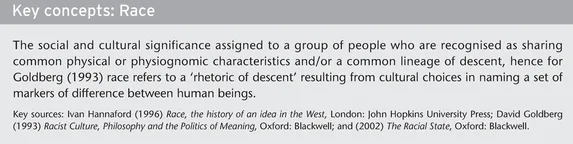
Across the world as civilisations and societies emerged, ideas of race have had practical adequacy for people in helping them make sense of their social and cultural position. The history and origins, or etymology, of the notion of race reveals a wealth of differing meanings (see Hannaford 2004: 5), from which emerged the central understanding that it refers to a ‘rhetoric of descent’.
Naming, categorising and frequently mis-recognising people’s characteristics, levels of civilisation, mental and physical abilities, cultures, sexual mores and/or biological kinship are required to construct racial differences. They involve the construction of myths of many forms. The ability of natural science to determine the truth or accuracy of these myths has often been highly questionable, as Chapter 2 explores in more detail. Racial myths have often been treated as self-evident truths in many societies.
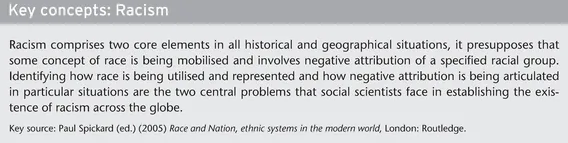
Race ideas comprise many differing forms, elements and discursive strategies. This chapter is concerned to open up the ways in which some of these processes operate. Race ideas have often been intertwined with other notions of blood and kinship ties, descent, lineage and genealogy, and have been used by societies in the representation and making of both internal and external hierarchies of difference and belonging. Emerging constructions of colour and race in highly varying forms have been identified in many pre-modern societies including the Greco-Roman empire and in East Asia. The purpose of this section is to examine the durability and pervasive nature of elements of race-thinking over millennia, and particularly evidence prior to the development of mercantile capitalism. The many different ways in which race has been coupled with negative associations and linked to social action is at the core of understanding how racism works:
The formation of race thinking in Europe and the Middle East
Classical racism
The development of Western mercantile capitalism inaugurated the development of major international circuits of racialised human relations, for example Atlantic slavery. But, race thinking has deeper roots and the importance of recognising pre-capitalist, ‘pre-modern racism’ in Europe and elsewhere has also been strongly advocated (Delacampagne 1983, 1990). Here, modern racist discourse is seen as drawing upon and requiring elements of older discourses which are identified in the writings of ancient philosophers and medieval theologians and scholars. Delacampagne argues that the naturalised superiority of Hellenic culture in relation to both external ‘barbarians’ and naturalised internal divisions between propertied Greek adult males and women and slaves both involved the derivation of the cultural characteristics of a group from its biological characteristics. In addition, Aristotle discussed the nature of both the Hellenic race and other peoples, and there was strong evidence of colour symbolism in ancient Greek and Roman cultures, with whiteness being associated with positive values and blackness with death and the underworld. It has been argued that the reductionist move of inferring people’s culture from their physical characteristics was not specifically racial in character, as it was applied to many different groups that were not defined in racial terms (Goldberg 1993). But not only is a focus on minority and migrant culture differences a constituent element of many forms of contemporary racist discourse today, but the denial of racism in the Greco-Roman empire has also been strongly rejected in recent scholarship. Benjamin Isaac’s (2004) book entitled The Invention of Racism in Classical Antiquity makes a number of key claims. He identifies ‘proto-racism’ as the linking together of the character of entire peoples being determined by geography, with hierarchies determined by blood ties or lineage (autochthony) which is exemplified in the writings of Ptolemy of Alexandria. He also identifies assumptions that mixed descent would corrupt human qualities and argues that eugenics originated in the writings of Plato and Aristotle where it was seen as necessary for the upper class to maintain racial superiority. This work was drawn upon in the popularisation of eugenics in the nineteenth and twentieth centuries. Classification of peoples according to external physical features and derivation of characters and destiny from these, physiognomics, was shown to be highly popular. For example, Pliny the Elder provided an account of ‘monstrous races’ in the first century AD (Jahoda 1999: 3–4). Comparison of foreign people to animals and other forms of xenophobia and ethnic hatred are identified as becoming more hostile and aggressive in the context of imperialist and expansionist moments. Strong anti-Oriental attitudes emerged in accounts of Persians and here Isaac identifies a direct determinate link between imperialism and the inferiorisation of Asiatics. Proto-racism is also identified in Roman views of subject peoples, the idea of collective natural slavery was intertwined with patterns of conquest, subjugation and governance. This linking of proto racism and imperialist ideology is exemplified in the work of Tacitus in presenting Roman views on Germans (Isaac 2004: 515). Far from being irrational and nonsensical, then, these ideas were seen in many cases as a core element in the specification, delineation and political construction of these civilisations and societies.
Anti-Judaism and anti-semitism
Also in the Roman empire anti-Judaism became established. For example, there were anti-Jewish pogroms and riots in Alexandria at the time of Emperor Caligula and both Romans and Greeks refused to grant Jews citizenship rights (Laquer 2006: 41). By the fifth century Jews had spread throughout the Roman empire. They subsequently became the object of demonisation and hostility driven by the Christian church, blamed for the death of Jesus Christ, and were subject to mass violence by the Crusaders across Europe and mass expulsions from English territories 1288–90, and notably in Spain, Portugal, Bohemia and Italy in the late Middle Ages (Poliakov 1975). By 1500 a well-established Jewish presence had disappeared from large areas of Western Europe (Edwards 1994). Religious anti-Judaism developed with a range of stereotypes, hostility and discrimination that later transformed into secular anti-semitism, which vilified Jewishness in the context of modernity and emerging nationalisms and highlighted ideas of racial difference (Bauman 1989) (also see sections on racial Palestinianisation in Chapter 5 and contemporary anti-semitism in Chapter 6).
Middle-Eastern racism
Ancient Hebrews thought interbreeding between different natural kinds abhorrent and saw it as leading to the development of a race of wild giants which is more clearly articulated in the Curse of Ham. (The story of Noah’s son Ham is told in Genesis 9:18–25.) This biblical story involved God cursing black Africans with eternal slavery and has been used as the single greatest justification for slavery for millennia (Goldenberg 2003). Here Hebrews fused notions of blackness with ideas of bondage, pagan idolatry and accursedness. Use of the colour black as a metaphor for evil is found in all periods of Jewish literature and as David Goldenberg argues categorisation of humans by skin colour is found in Jewish, Christian and Muslim biblical texts from the seventh century onwards. Noah’s sons are seen as representing the three skin colours of the world’s population, with black indicating inferiority. Bernard Lewis (1971) confirms the existence of colour-coded identities and related forms of discrimination in the pre-modern Middle East, which became more fixed in the context of Islamic conquests of Asia and Africa and related processes of enslavement. This argument fits with that of historians such as Frank Snowdon (1970) who finds no evidence of anti-black racism prior to the sixth century, and Alistair Bonnett (2000) who emphasises the prevalence of whiteness in the formation of social identities in non-European and pre-modern societies and also the complex variation of positive and negative connotations.
Christian European racism
Following the rise of Islam and the Arab conquest of North Africa, notions of anti-blackness and Islamophobia became fused in the term ‘Moors’, with later became detached into ‘white Moors’ and ‘Blackamoors’ (Jahoda 1999: 27). The Jewish and Moorish presence in Spain which lasted for a millennium and their subsequent decimation and explusion is seen as a critical moment in the making of the race idea in Western civilisation. This involved the setting of Jews and Muslims outside the political community, the end of multi-faith civility, legitimised violence, and racial distinctions determined by a test of purity of blood to assess Spanish descent from those who had resisted the Moorish invasion in the eighth century and those who did not (Hannaford 1996). In confronting Islam, the symbolism of the black demon was transferred to Muslims, as Jan Nederveen Piertese (1994) notes; in early medieval paintings black Saracens are represented torturing Christ. A key thread to the making of a Christian Europe was opposition and denigration of Muslims as barbaric heathens, illegitimately occupying the Holy Land, and showing excessive violence and uncivilised morals and sexuality....