The authors of this book join a growing number of voices calling for teachers in diverse, inclusive schools to move beyond facilitating social participation in classroom activities and consider ways to intellectually engage ALL learners. They draw on emerging work linking critical theory with disability issues; work being done in curriculum studies around issues of social justice teaching, authentic instruction, service learning, and critical pedagogy; and the movement in the field of special education away from a deficit-driven model of education to an orientation that values students' strengths and gifts. Access to Academics for ALL Students: Critical Approaches to Inclusive Curriculum, Instruction, and Policy:
*examines the perceptions teachers hold about students with disabilities, students who are racially and ethnically diverse, students using English as a second language, students labeled "at risk," students placed in both "high" and "low" academic tracks, and students in urban schools;
*highlights how students who traditionally have been denied access to challenging work and educational opportunities can be supported to participate in academic instruction; and
*provides ideas for recognizing and challenging inequities, offers a framework for fostering access to academics for students with a range of strengths and needs, and explores pragmatic ways of increasing academic success for all learners.
This volume is appropriate for both undergraduate and master's level courses in curriculum and instruction, methods of teaching (special and general education), inclusive education, multicultural education, and cultural foundations of education. It will serve as a resource for elementary and secondary teachers, for school administrators, and for parents.
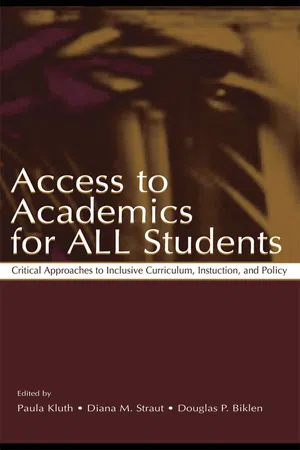
eBook - ePub
Access To Academics for All Students
Critical Approaches To Inclusive Curriculum, Instruction, and Policy
- 224 pages
- English
- ePUB (mobile friendly)
- Available on iOS & Android
eBook - ePub
Access To Academics for All Students
Critical Approaches To Inclusive Curriculum, Instruction, and Policy
About this book
Information
Topic
EducationSubtopic
Education GeneralChapter 1: Access to Academics for All Students
Paula Kluth
Douglas P. Biklen
Diana M. Straut
Syracuse University
Inclusive schooling, the educational movement that paved the way for students with disabilities to enter general education classrooms, has given thousands of students opportunities to participate in “typical” schooling experiences. Since the 1970s, students with disabilities have had increased opportunities to develop a wider range of relationships, to attend general education classes, and to engage in the same educational activities and lessons as their peers without disabilities.
While all of these types of participation are critical to the social, emotional, and intellectual growth of students, we are increasingly interested in examining the next steps in inclusive education. Now that so many students with disabilities have secured access to general education environments, educators are becoming more critical of the curriculum and instruction offered to learners with unique learning characteristics. In our own work as teacher educators, we have seen how those committed to inclusive schooling are moving beyond participation and considering ways to challenge and intellectually engage learners with disabilities. Consider the following examples:
A student with Down syndrome, Isaac, is interested in the popular picture book, Where the Wild Things Are. Isaac’s teacher, realizing that her young student loves to be dramatic, develops a class play around the story. The class works collaboratively to write the script, learn the lines, and create the scenery and props necessary for the production. Through these activities, Isaac’s teachers develop opportunities for students to “engage with literacy and numeracy skills, problem-solving and critical thinking processes, and interpersonal capacities.” (Kliewer, 1998, p. 77)
When the special education referrals in one school district begin to skyrocket, one team of educators attempts to fix the curriculum instead of looking to “repair” the students. A special educator, a math teacher, and a technology education teacher join forces to teach a diverse group of students with and without disabilities. The teachers introduce the concept of “measuring and predicting natural world occurrences related to the functions of distance, rate, and time” by setting up a car derby course and letting students crate cars to race on the course. Students calculate the car’s straightaway speed during each trial. They also construct a graph to show the relation between the release points on the ramp and the car speeds on the straightaway. A student who has a history of struggling in math, earns a perfect mark on the unit posttests. She whispers to one of her teachers, “Don’t tell my parents about this. They will faint.” (Bottge, 2001, p. 69)
A 10th-grade social studies teacher designs a unit titled, “Can you be free if you are not treated equally?” She adopts the approach of creating lessons based on a “central idea” so that all students can participate and so they can access the challenging course content:
Some students in my class could answer using information from the reading and by thinking about the progress of Civil Rights in this country. One or two students had to approach this question from their own personal experiences/ perspectives. Amro knew he was treated differently from his brothers because of his disability, and he has a strong opinion about that. If we start with his personal experiences, it’s a little bit easier for him to make a connection with the civil war. (Onosko & Jorgensen, 1998, pp. 77–78)
Although these three examples certainly illustrate how students with disabilities are accessing academic skill and content in inclusive classrooms, it is equally clear that the curriculum and instruction highlighted in each example would be engaging and appropriate for learners with a variety of needs, skills, gifts, interests, and abilities. In this volume, we suggest that inclusive ideology and practices can serve as a catalyst for creating more challenging and meaningful educational experiences for ALL students including students of color, students who are ethnically diverse, students who use English as a second language, students labeled at risk, students in vocational tracks, and students in both rural and urban schools. Many educators, in fact, are beginning to understand inclusive schooling as a reform or movement that addresses all learners, not just those with disabilities ( Jorgensen, 1998; Kluth, Diaz-Greenberg, Thousand, & Nevin, 2002; Oyler, 2001; Sapon-Shevin, 1999).
Some see inclusion as a way of thinking, an orientation, or an ideology. Others view it as a set of practices or a policy. Udvari-Solner (1997) offered a definition that incorporates both pragmatic and philosophic issues:
[inclusive schooling] propels a critique of contemporary school culture and thus, encourages practitioners to reinvent what can be and should be to realize more humane, just and democratic learning communities. Inequities in treatment and educational opportunity are brought to the forefront, thereby fostering attention to human rights, respect for difference and value of diversity. (p. 142)
Like Udvari-Solner, we define inclusive education as something that supports, impacts, and benefits all learners. We see inclusion as an educational orientation that embraces differences and values diversity. Further, we view inclusion as a revolution, a social action, and a critical political movement. We also see inclusion as a way to boost academic opportunities and successes for all learners in public schools.
Specifically, this text is concerned with one often-ignored aspect of inclusive pedagogy: access to academics. We have chosen the term access to academics carefully, believing that it captures an important principle for educators, namely that participation or inclusion in schooling is not enough for any learner. All students deserve to be educated in ways that make them struggle, think, work, and grow. Students should have opportunities to tackle “hard work,” they should be intellectually stretched.
To that end this volume asks a simple, but specific and important question: How can inclusive schooling and the practices associated with it, help all learners gain academic access? In the following chapters, we explore how educators are finding ways of making academic instruction available to all students, irrespective of social and economic class, gender, ethnicity, language, disability, or other factors often associated with access. In this chapter, we provide the following: (a) a framework for thinking about access- to-academics; and (b) an explanation of how school culture can support access-to-academics and (c) teaching practices that support access-toacademics in inclusive classrooms.
THROUGH A CRITICAL FRAME: WAYS OF THINKING ABOUT ACCESS
The dominant discourse style in education implies that there are right ways and wrong ways of going about education, that best ways can be scientifically determined, and that the work of educators is to employ “most appropriate” and “best” practices. In this book we attempt to navigate a far more tentative course in figuring out what to do or to recommend. While we embrace the notion of using scientific inquiry (in the sense of the social sciences where inquiry follows established or, at least, discussed and negotiated, traditions) at the same time, we attempt to step outside of the dominant discourse which we believe assumes too much certainty and not enough criticism.
We begin by comparing two ways of thinking about education; claiming authority to define reality versus an interpretive, critical stance toward teaching and learning. Although we do not believe there are only two ways of thinking about education, we understand that it might be useful to compare these two paradigms so that we may illustrate what type of thinking and beliefs we used in developing our access-to-academics framework; that is, in providing an overview of both paradigms we can illustrate not only the orientation we adopted but what types of thinking we attempt to challenge in this book.
Claiming Authority to Define Reality in Teaching and Learning
At the outset of this discussion, we want to clarify what we mean by the dominant discourse style in education—which we wish to set aside and even challenge. We do so with the full knowledge that embedded in the text of this book may be many contradictions of our own thesis; examples where we have engaged in practices characteristic of the dominant discourse.
Traditionally and currently, much educational research takes the form of experiments designed to establish a truth. Consider, for instance, an example of research on school behavior. In the Journal of School Psychology, Henington and colleagues (Henington, Hughes, Cavell, & Thompson, 1998) employed a scale for measuring and assigning classifications of aggression and then of relating gender to aggression. They describe their study and findings:
(The) procedure allowed for the classification of children into one of four groups: children high on overt aggression only (OA), children high on relational aggression only (RA), children high on both relational aggression and overt aggression (combined aggressive, or CA), and nonaggressive children (NA).
There was a statistically significant relation between gender and aggressive classification. More boys than girls were identified as OA. Furthermore, more boys than girls were identified as CA.
Our critique of this account is not that the authors have deviated from principles of social science, but that such an account, presented authoritatively, implicitly encourages us to embrace the findings as stated, and thus to participate in a process of decontextualizing education and, in this case, student behavior. Further, if we accept such findings more or less uncritically, we participate in a process of creating a discourse about education that is fundamentally undemocratic.
The study decontextualizes student behavior by virtue of the fact that we do not see the moments in which students do one thing or another. We are not informed about how students interpret their own actions. We do not get to see how different ways of being or doing are privileged within student culture but not adult or teacher culture. We do not see how teachers engage students academically and socially and how the culture of a classroom changes the dynamics of students’ relationships and ways of interacting with each other. In short, we see too little; we are left with the unmistakable impression that aggression is definable as something specific that belongs to individual people not to circumstances or to particular cultural contexts.
To the extent that participants in education, including teachers, parents, and students, are not heard from in this research, the study encourages an undemocratic way of talking about education. True, no piece of research will completely offer the multiplicity of voices within education, but we feel that this study silences too much; we are troubled that the authors define aggression in a particular way without acknowledging that they are not reporting on a reality, but are actually creating a way of thinking about behavior, or what they determine to be aggression. The authoritative voice of the researchers leaves the reader feeling that the behavior is in the student and that work must be done to the student. The implications of this work are many; this way of writing and theorizing about behavior impacts how policies are written, how students are viewed, and how schools are organized.
Adopting an Interpretive, Tentative, Critical Stance Toward Teaching and Learning
Now, having considered an example from what we have described as the overly authoritative dominant discourse, consider an example from a more interpretive tradition. Dyson (1997), in the book Writing Superheroes, studied young children’s talk and writing to understand how they construct their understandings of themselves, how they negotiate their relationships with each other, and how they make sense of each other. After two boys, Thomas and Aloyse, have been suspended from school for hitting a girl, Monique, two students have the following conversation (beginning with Holly stating the moral of the classroom story):
Holly: You’re not supposed to slap girls, ’cause girls are not that strong, like boys.
Tina: HUH! The yellow girls are. Like you. You just don’t know. You can use your strength. But you just don’t know you can. I used it before.
(Tina is African American; Holly is biracdial—African American and European American—“yellow,” in Tina’s terms.)
Holly: I can beat up Aloyse. You saw me beat up Aloy—you saw me slap Aloyse twice.
Tina: You saw me beat that boy up. Right here. (Tina points to the upper part of her arm, bent at the elbow.) That’s your strength, Right there . . .
Holly: I know. I slapped Lawrence.
Tina: I slapped him and air punched him. (Tina acts out her swift moves.)
Holly: I slapped him five times and punched him six times.
Tina: You must really like him. If you punch him and slap him, that means you like him.
Holly: I hate him! (distressed) I was just joking. (Dyson, 1997, p. 12)
As Dyson then explained, this story has multiple levels. At one level, it is a moral tale: Boys shouldn’t use their “superior strength and hit a girl” (p. 12). But then it’s far more complicated for it is also “open to interpretation and reinterpretation as the two children struggled with their own desires to be seen by each other as both tough and female, desires complicated by ideologies of gender, strength, love, and, in less explicit ways, race, and class . . . (and) a serious punch . . . may become a teasing ‘love tap’ in children’s cultures” (p. 12).
We find Dyson’s interpretive style of inquiry especially appealing, in part because the analysis is forever shifting, but also because it focuses on understanding the meanings that students make of their worlds, including the educational context. We cannot imagine addressing the agenda of access- to-academics without also having a strong commitment to understanding the complexity of school culture, of a variety of ideological perspectives that manifest themselves in school culture as well as in discourses about schooling, and intimate understandings of how students as well as teachers construct their worlds. We use this example and the discussion that follows to identify five tenets of a critical stance toward teaching and learning.
Multiple, Often Conflicting, Frames or Viewpoints Exist in the World. In Dyson, in this book, and in many recent narrative-style, interpretive accounts of education (Kliewer, 1998; Maran, 2000; Meier, 1997; Michie, 1999; Moses & Cobb, 2001; Orenstein, 1994), we can find evidence of the principles underlying critical inquiry. As in the example of the two girls conversing about hitting and what it means, critical inquiry examines multiple points of view. A teacher, using a critical frame, would note or record her own perspectives on a whole range of issues, including for example hitting, but would not treat these as a correct understanding. A teacher as observer, like the researcher, would attempt to be self-conscious about his or her stance in regard to any particular questions. Dyson, for example, did not approach these children or others in the classroom she studied with assumptions about what social rules the children would have or with determined understandings of how students thought about popular culture. Instead, she assumed that she would have to learn about the students’ understandings from them and that she would also need to learn more about children’s popular culture by studying it herself and then by talking to children about her own analyses. Above all, she assumed that what she would find would not be discrete answers but rather “messy” ones.
We Can and Must Learn From “Local Knowledge” Students Bring to the Classroom. A related characteristic to the notion that critical inquiry involves accounting for multiple viewpoints is the idea that it involves data gathering from the ground up. Glaser and Strauss (1967) called this grounded theory; others have termed it local knowledge (Kliewer & Biklen, 2001); recognition and value is afforded to the knowledge that resides within a study’s participants. Again, the example of Holly and Tina’s conversation illustrates this, where Dyson reports on a conversation and then attempts, with grounded data or local knowledge (i.e., her classroom conversations and observations), to begin, however tentatively, to construct an understanding of relationships between culture, ideology, immediate events, children’s development, self-definition, literacy, and so forth. Were it not for a critica...
Table of contents
- COVER PAGE
- TITLE PAGE
- COPYRIGT PAGE
- PREFACE
- CHAPTER 1: ACCESS TO ACADEMICS FOR ALL STUDENTS
- CHAPTER 2: TOWARD STANDARDS FOR DIVERSE LEARNERS: EXAMINING ASSUMPTIONS
- CHAPTER 3: ACADEMIC ACCESS AND THE FAMILY
- CHAPTER 4: SEEING ALL STUDENTS AS LITERATE
- CHAPTER 5: EQUITY FOR ALL LEARNERS OF MATEMATICS: IS ACCESS ENOUG?
- CHAPTER 6: ACCESSING POWER THROUGH INTENTIONAL SOCIAL STUDIES INSTRUCTION: EVERY DAY FOR EVERY STUDENT
- CHAPTER 7: AUTO MECHANICS IN THE PHYSICS LAB: SCIENCE EDUCATION FOR ALL
- CHAPTER 8: PROVIDING ACCESS TO ARTS EDUCATION: AN ILLUSTRATION THROUGH MUSIC
- CHAPTER 9: IN THE POOL, ON THE STAGE, AND AT THE CONCERT: ACCESS TO ACADEMICS BEYOND CLASSROOM WALLS
- CHAPTER 10: ACADEMICS, ACCESS, AND ACTION
Trusted by 375,005 students
Access to over 1.5 million titles for a fair monthly price.
Study more efficiently using our study tools.
Frequently asked questions
Yes, you can cancel anytime from the Subscription tab in your account settings on the Perlego website. Your subscription will stay active until the end of your current billing period. Learn how to cancel your subscription
No, books cannot be downloaded as external files, such as PDFs, for use outside of Perlego. However, you can download books within the Perlego app for offline reading on mobile or tablet. Learn how to download books offline
Perlego offers two plans: Essential and Complete
- Essential is ideal for learners and professionals who enjoy exploring a wide range of subjects. Access the Essential Library with 800,000+ trusted titles and best-sellers across business, personal growth, and the humanities. Includes unlimited reading time and Standard Read Aloud voice.
- Complete: Perfect for advanced learners and researchers needing full, unrestricted access. Unlock 1.5M+ books across hundreds of subjects, including academic and specialized titles. The Complete Plan also includes advanced features like Premium Read Aloud and Research Assistant.
We are an online textbook subscription service, where you can get access to an entire online library for less than the price of a single book per month. With over 1.5 million books across 990+ topics, we’ve got you covered! Learn about our mission
Look out for the read-aloud symbol on your next book to see if you can listen to it. The read-aloud tool reads text aloud for you, highlighting the text as it is being read. You can pause it, speed it up and slow it down. Learn more about Read Aloud
Yes! You can use the Perlego app on both iOS and Android devices to read anytime, anywhere — even offline. Perfect for commutes or when you’re on the go.
Please note we cannot support devices running on iOS 13 and Android 7 or earlier. Learn more about using the app
Please note we cannot support devices running on iOS 13 and Android 7 or earlier. Learn more about using the app
Yes, you can access Access To Academics for All Students by Paula Kluth,Diana M. Straut,Douglas P. Biklen in PDF and/or ePUB format, as well as other popular books in Education & Education General. We have over 1.5 million books available in our catalogue for you to explore.