![]()
Chapter 1
Bodiless Exultation?
For Case, who’d lived for the bodiless exultation of cyberspace … the elite stance involved a certain relaxed contempt for the flesh. The body was meat.
William Gibson
Neuromancer, 1984
Revelations can be found in the most mundane of moments. At least this was the experience in my thinking about cyberspace. My rather modest revelation occurred during a bright and otherwise uneventful afternoon in the fall of 1997, just after the air had taken on that invigorating crispness so characteristic of New England autumns. Returning home from the gym, still sweaty and sore from my workout, I mixed a protein shake, sat down at my computer, and connected to the Internet, intending only to check my e-mail before showering. But when my modem made those familiar beeps and hisses as it reached out over the phone lines, something was aroused in me—curiosity perhaps—that would divert me from my innocent aims. I was drawn to a place that had become a fixture in my daily life, a place that was at times comfortable and reassuring, like a well-worn easy chair, and at other times exhilarating and intimidating, like a less-than-savory bar that holds the promise of carnal discovery. That place was a chat room—a virtual environment in cyberspace—known to its patrons simply as #gaymuscle.
The first thing I noticed upon entering was the topic of the day—“We’re going to pump *clap* you up!”—which, not surprisingly, reflected Brutus’s fondness for the Saturday Night Live characters Hans and Franz. The next thing I noticed was one of the regulars, a weight lifter of considerable strength and girth named NCLifter, conspicuously scratching his groin and spitting. Plutarch, another recognized patron of this place, took the opportunity to comment on NCLifter’s macho performance. The two have a long-standing rivalry and are well matched not only in personality and wit but also in build. Although such a display may have put off newcomers, I had grown accustomed to such antics and engaged in my customary greetings. To my surprise, #gaymuscle was quite active for a weekday afternoon, with the competing conversations of a dozen or so people lending the place a boisterous atmosphere. A small smile worked its way across my face when two of my closest friends returned my greetings, their presence providing me with a certain sense of satisfaction.
Someone new to the scene was inquiring about the place to see if anyone else was in Phoenix. Publicly calling out, he asked if there were any “desert rats” in attendance, to which NCLifter quickly countered that only “gym rats” were present. A moment later, Plutarch revealed that he was in Sierra Vista, only a few hours away from Phoenix, adding that he visits Tucson most weekends. Characteristic of his sense of humor, Smilee contributed a crass remark about Plutarch’s sex life, to which NCLifter added an inarticulate expression of his dismay. No doubt the new guy quickly learned that there is little sense of propriety in this place.
Although they were not participating in any of the conversations, two others in the place drew my attention. Umgawa, who usually involves himself in any discussion, maintained a silent vigil from the sidelines. I considered privately messaging him but decided against it. Not only had our relationship become overshadowed by an emotional awkwardness, but also I suspected that he was at that moment too engrossed in his work to pay attention to any online activities. Several patrons do this—hang out here while at work, alternating their attention between #gaymuscle and their professional responsibilities. Often such people are present during weekdays in name only.
The other individual attracting my attention was Msclfreak. He, like Umgawa, was not participating in any of the energetic exchanges, but this was not unexpected. Msclfreak seldom engaged in public conversations anymore, preferring private chats with those who already knew him. Unable to resist, I sent him a private message, attempting to initiate a brief tête-à-tête of our own. My pulse quickened the instant he responded to my invitation. It is well known among my friends that I harbor an intense attraction for Msclfreak, and our conversations generally carry sexual undertones. I told Msclfreak about my workout in hopes that he, as an experienced bodybuilder, could offer a few training tips and perhaps a few words of encouragement. Of course, discussions of training often serve as preludes to more erotic discussions of bodily performances.
In the next moment, a competitive bodybuilder named PECS entered and was immediately greeted by many of the regulars, including myself. Possessing one of the most muscularly developed bodies on #gaymuscle, PECS has garnered a certain celebrity among the patrons, a celebrity he most assuredly encourages. In keeping with his flamboyant image, PECS began giving out roses to his friends and fans. He offered roses to Younghung, Britannic, and me before stopping to comment that NCLifter is too “butch” to appreciate such a gesture. When NCLifter confirmed this, Plutarch had an outburst of laughter. I couldn’t help laughing as well and, with a prodigious grin on my face, made a brief comment on how amusing I found all of this. With a fading chuckle, I reclined back into my chair and savored the sensation of being someplace familiar, the sensation of being among friends, just as another old chum entered the room.
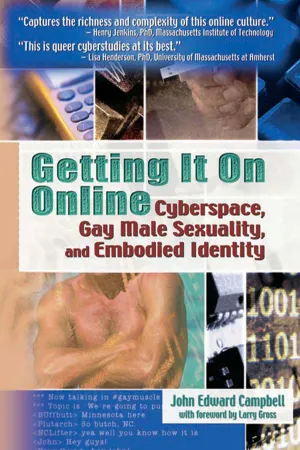
Well, at least that’s how it all felt at the time. In actuality, it looked like this:
*** Now talking in #gaymuscle
*** Topic is ‘We’re going to pump *clap* you up!’
*** Set by Brutus on Wed Sept 29 15:19:04
<BUffbutt> Minnesota here
*NCLifter spits and scratches his balls
<Plutarch> So butch, NJ.
<NCLifter> yea well you know how it is
<John> Hey guys!
*** BigNY has joined #gaymuscle
<Younghung>hey john!
<Brittanic>john! how ya doing?
<sk8rboy21> <—Phoenix
<sk8rboy21> any desert rats here?
<NCLifter> nah just gym rats
<John> Hey younghung, hey brittanic—doing well thanx!
<sk8rboy21> hmmm
<Plutarch> A few hours southeast of ya, sk8rboy
<sk8rboy21> where you at Plutarch? Tucson?
<Plutarch> Sierra Vista, actually. Although I get into Tucson most every weekend.
*** topme-20 has quit IRC (Ping timeout: 180 seconds)
<Smilee> still cruisin for cock out in AZ huh plu
<Smilee> can’t you take a hint? :)
<NCLifter> uuuuuuuuuuuuuuuuuuuuuuuuuuuuuuuuuuuuuh
*** PECS has joined #gaymuscle
<Younghung> PECS!
<John> PECS!
<Brittanic> hey pecs!
<NCLifter> hey jimmy
<PECS> kiddies!
* PECS gives Younghung a rose
* PECS gives John a rose
* PECS gives Brittanic a rose
<PECS> lifter youre to butch for a rose
<NCLifter> damn right!
<Plutarch> LOL
<John> too funny! :)
*** Mastertop has joined #gaymuscle
I recall that as I continued to chat into the late afternoon, I felt the sweat drying on my skin and the growing pressure on my bladder from the protein shake. I also remember how those bodily demands were countered by the elation I experienced as Msclfreak described what he could do to me with his body—perhaps a different form of physical imperative. Indeed, it seemed that bodies were involved in every aspect of this online experience. Those sensations originating from my own body—the sweat drying on my skin, the pressure building in my bladder, the blood rushing to my groin—only heightened my awareness of the distant bodies of those I was interacting with but could not physically see. I was reading text on the screen, but I was thinking and feeling in terms of flesh. While Msclfreak may have been some 3,000 miles away from me at the time, my thoughts were focused on the qualities of his body: its thickness, its hardness, its capacity for growth. Although I had never met either NCLifter or Plutarch in person, I held a substantial impression of their considerable bulk and strength. PECS may have been giving me a virtual rose in a virtual space, but my mind never questioned the tangibility of his sculpted physique sitting before the keyboard. It was in this moment that revelation was found: bodies remain very much a part of the experience of the virtual.
BODIES IN CYBERSPACE …
As this brief recollection illustrates, my experience of cyberspace exists in sharp contrast to those fantastical images of technological disembodiment found in so much science fiction. For those I have encountered online, cyberspace is about anything but the “bodiless exultation” William Gibson envisioned in his dystopic novel, Neuromancer. Yet this seductive image of bodily transcendence in cyberspace has proliferated not only in the pages of cyberpunk fiction and such Hollywood fare as The Lawnmower Man (1992), Johnny Mnemonic (1995), and The Matrix (1999)—ironic that the notion of disembodied existence should prove so sexy in the popular consciousness—but also in the pages of many academic works. In the final decade of the twentieth century, a number of Western intellectuals began postulating that a new subjectivity was evolving from online interaction. Perhaps prematurely, some argued that this emerging online subject would be like the Greek god Proteus, possessing the ability to transform the self at will. For these social scientists and philosophers, the capacity to transcend the corporeal constitutes the liberating potential of cyberspace and the technological panacea for oppressive social hierarchies. Freed from our burdensome material selves, they proclaim, we become fluid entities, overcoming those societal stigmas inscribed on the body—race, gender, age, size, beauty, what have you.
Whether it is proclaimed to offer our salvation or our ruin, the more extreme arguments surrounding cyberspace are based on a fundamentally similar supposition conflating online interaction with bodily transcendence. This conflation, in turn, rests on an essentialized understanding of “the body” as solely a physical object—a corporeal shell containing and confining some ethereal and cognitive self. Thus to interact where, in theory, the body is absent is to be liberated from those social prohibitions imposed on the body. In essence, these arguments, condemnatory and celebratory alike, are predicated on the conviction that there is a radical disjuncture between experiences in the physical world and those found in cyberspace. I identify this position as the online disembodiment thesis.
The story I relate in this book counters this enticing vision of bodiless exultation with a more sensual portrait of cyberspace. Here I will tell the story of a group of men who utilize Internet technologies to find others that share their erotic predilections. This is a story of carnal exploration and community formation, as well as a story of bodybuilders and musclebears and chubby chasers. Specifically, this is a story of three distinct social scenes on Internet Relay Chat (IRC): #gaymuscle, a community formulated around images of the muscular male body; #gaychub, a community celebrating male obesity, where—in diametric opposition to #gaymuscle—fatness holds considerable value; and finally, #gaymusclebears, a space representing the erotic convergence of the obese and muscular male body emerging out of the gay male “bear” subculture. The channels that serve as the nexuses for these social scenes represent virtual spaces constructed by gay men for the discussion, exploration, and eroticism of the male body. This is the story of how it is that the body remains present in these virtual spaces replete with their own vernaculars and conventions, cultural practices and social taboos. And as with all good stories, this story endeavors to make a point.
Examining the vital role the body plays in defining these online spaces offers insight into how individuals negotiate their relationship to their physical-world self through computer-mediated communication technologies. Indeed, the social practices emerging in these virtual environments expose the critical role of culture and language in constituting what we understand as “the body.” Investigating how the body is (re)incorporated into social relations in these online communities also allows me to complicate the online disembodiment thesis. As I will demonstrate, for interactants on these channels, the body is both a shared reference for online communication and a primary component of online identity. The body remains present in cyberspace because what we refer to as “the body” is at once a physical form and a discursive configuration apprehending the physical, and it is this discursive configuration that accompanies individuals into these virtual environments and shapes online interaction.
Of interest here is not only the formulation of online communities around particular conceptions of the desirable body but also the very intensity of the discussions surrounding the body in spaces generally purported to be lacking all physicality. Because each channel—#gaymuscle, #gaychub, and #gaymusclebears—is oriented toward the exploration and eroticism of various images of the male body, these online interactants have had to devise textual means of reconstructing the body in cyberspace. I endeavor to complicate simplistic understandings of the body as a “natural” basis of identity by examining how the body is experienced on these channels. I also attempt to challenge some of the generalizations surrounding social relations in cyberspace, especially in regard to gender and sexuality, by assuming a grounded approach to these very particular online communities. My observations suggest that gay men have been quick to employ computer-mediated communication technologies to expand their social networks, and I want to understand how this adoption of Internet technologies is fueled by physical-world needs. That is, I am keenly interested in how offline social relations shape online behavior. In pursuing this goal, I find ethnography a particularly useful mode of inquiry.
Historically, ethnography has been understood as a method of anthropological investigation based on immersion in a particular cultural community. The investigation of ethnographic research is not only to observe and record a community’s ostensible social structures and practices but also to gain an appreciation for the more elusive tacit cultural assumptions of a particular population. Conventionally, this immersion involved living in proximity to the community of study (in the so-called field) and participating with community members in key social institutions. More recently, however, understandings of proximity have been complicated as anthropologists use ethnography as a means of studying communities with which they already identify (see, for instance, the insightful work of Kath Weston [1991, 1998]). Although initially associated with cultural anthropology, ethnography has become a critical mode of inquiry for those working under the rubric of cultural studies, exemplified in the work of Paul Willis (1977), Dick Hebdige (1979), Janice Radway (1984), Henry Jenkins (1992), and Angela McRobbie (1991). In my use of ethnography, I endeavor to extend this line of scholarship into the realm of the virtual.
Cultural studies scholars are not so much interested in examining specific cultural phenomena in isolation, but rather seek to understand how particular (sub)cultural communities and practices relate to and reflect the larger social and political context. Central to scholarly work following in the intellectual trajectory of the Birmingham Centre for Contemporary Cultural Studies is the theory of “articulation” (Sterne, 1999). This theory holds that all social institutions are complexly interconnected and that seemingly independent economic and political spheres do in fact influence each other (such as the military and the commercial media). Therefore, by studying specific cultural artifacts, insights can be gained into the institutions producing such artifacts and, indirectly, into the broader power dynamics shaping those producing institutions. The cultural studies commitment to theory—that is, the commitment to relating the concrete and particular to a more holistic and abstract reality—arises from the imperative to understand how social hierarchies are deployed and maintained and how they can be resisted and subverted. An important dimension of this larger intellectual project is comprehending how individuals incorporate cultural artifacts (such as mass-media products) into their negotiation of daily life and how those artifacts influence the ways people make sense out of the world they live in. As Paul Willis (1978) poignantly points out,
it is one of the fundamental paradoxes of our social life that when we are at our most natural, our most everyday, we are also at our most cultural; that when we are in the roles that look the most obvious and given, we are actually in roles that are constructed, learned and far from inevitable. (p. 184, emphasis original)
A notable influence in this study of everyday life is the French philosopher Michel de Certeau, who explores how individuals employ cultural products in ways unforeseen by th...