eBook - ePub
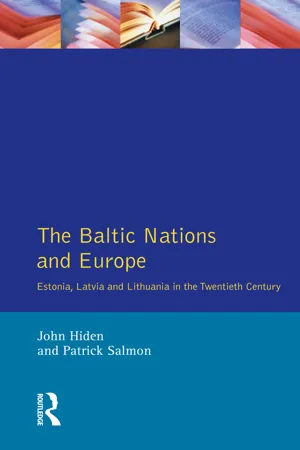
The Baltic Nations and Europe
Estonia, Latvia and Lithuania in the Twentieth Century
- 240 pages
- English
- ePUB (mobile friendly)
- Available on iOS & Android
eBook - ePub
The Baltic Nations and Europe
Estonia, Latvia and Lithuania in the Twentieth Century
About this book
Of all the Soviet Union's subject nationalities, the three Baltic republics, Estonia, Latvia and Lithuania, were the most determined and best organised in seizing the opportunities created by glasnost and perestroika to win freedom from Moscow's grip.
At the time of first publication, in 1991, the final section of the book was speculative. Now for this revised edition, the authors have provided a new final chapter which brings the story up to date -- and the three republics to political independence again.
Part One
Awakening
Chapter One
Against the Odds
The native inhabitants of the three present-day republics of Estonia, Latvia and Lithuania are directly descended from the tribes who settled on the eastern shores of the Baltic some 4,000 years ago.1 They have lived there far longer than any of the peoples who have ruled over them since the middle ages – whether Scandinavians, Germans, Poles or Russians. ‘The kernel of the historical awareness of the Baltic peoples is the fact that they are directly descended from the original inhabitants of their countries.’2 Both the Lithuanians and the Latvians belong to the Indo-European race (Lithuanian, as nineteenth-century philologists were delighted to discover, is the closest living language to Sanskrit) while the Estonians are, like the Finns and Hungarians, of Finno-Ugric stock. Closely related to the Estonians are the Livs, a few thousand of whom are still to be found in northern Latvia. The Baltic peoples have never expanded beyond their native homelands. These, however, they have clung to tenaciously.
Their achievement is all the more remarkable in that the three races have been subjected over the centuries to the ebb and flow of war and conquest. The geographical position of the Baltic lands, at the point where East meets West, has made them a battleground for a succession of races and states striving for economic and political mastery in the region. By the time they became the victims of other peoples’ ambitions in the early middle ages, the Baltic races had evolved viable pagan tribal societies which fought and traded successfully with their neighbours across the sea and in the interior of eastern Europe.3 ‘Many praiseworthy things could be said about these peoples with respect to their morals’, wrote Adam of Bremen around 1075, ‘if only they had the faith of Christ whose missionaries they cruelly persecute.’4 Already, however, geography had transcended distinctions of race to separate the Estonians and Latvians in the north from the Lithuanians further south. Whereas the latter lived in impenetrable forests, isolated from the sea, the territories of the Estonians and Latvians, ‘the tiny outlet of a zone stretching half-way across Asia’, were important staging posts for trade between the interior of Russia and the western world.5 In Estonian territory, Tallinn (Reval) on the coast and Tartu (Dorpat/Iurev) inland emerged as centres where furs, wax and slaves from the Russian hinterland were exchanged for salt, textiles and weapons.6 The principal routes into the interior were, however, the rivers. Of the great rivers of eastern Europe only one, the Daugava (Düna/Dvina), ran through territories inhabited by the Baltic peoples. On its banks lived the Latvian tribes: Lettigallians to the north and Semigallians to the south. Another major river, the Nemunas (Memel/Nemen/Niemen), skirted the lands of the Lithuanians further south but was less important as a trading artery.
The Baltic peoples could coexist with their European neighbours as long as all lived at roughly the same economic, social and technological level. By the twelfth century at the latest these conditions no longer existed. Both the Scandinavians and Germans to the west and the Slav states of the east were becoming better organised and better armed. They were also showing an increasing interest in the Baltic lands. Those coming from the west had the advantage, however, in that they were infused by an aggressive Catholicism which enabled them to combine missionary zeal and material advantage.
The imprint of foreign domination, at first Swedish and Danish and later German, was most marked on the two most northerly peoples, the Estonians and the Latvians. Unlike the Lithuanians, they were brought into the medieval Catholic world by conquest and forcible conversion – a brutal process which lasted for the whole of the thirteenth century. Thereafter they were subject almost continuously to political, social and economic domination by others. The provinces into which they were divided by their medieval conquerors corresponded only partially to ethnic divisions. The province of Estonia (Estland) comprised most of present-day Estonia, but Livonia (Livland) was carved out of the territories of the Estonians and Livs further south, and those of the Latvian tribes. A third province, Courland (Kurland), was detached from Livonia in the sixteenth century.
In the late twelfth century the German crusading orders, thwarted in the Holy Land, turned their attention to the pagan tribes of the eastern Baltic. While the Teutonic Order subdued the Old Prussians’, the most westerly of the Baltic tribes, and absorbed them into a German colonial system, further north the Brotherhood of the Sword established a Christian, military state in Livonia. Its chief religious and commercial centre was the city of Riga at the mouth of the Daugava, founded in 1201 - after Lübeck the earliest German foundation on the Baltic Sea.7 In 1346 a weakened Danish crown sold its right to Estonia, which had been subjugated by the Danes in the thirteenth century, and both Estonia and Livonia came under the rule of the Teutonic Order. The military monks established a German social, political and economic ascendancy which was to survive the dissolution of the Order and the secularisation of its lands during the Reformation of the sixteenth century. The rule of German landowners over a native Baltic peasantry, and the dominance of German merchants in commercial centres such as Riga and Tallinn persisted through the ensuing centuries of Swedish, Polish-Lithuanian and Russian rule.
In the sixteenth and seventeenth centuries the political geography of the Baltic provinces was subjected to further contortions as the region’s great powers sought to succeed to the patrimony of the Teutonic Knights. As the Swedes established themselves in Estonia and fought the Russians for control of Livonia, the Lithuanians and their Polish allies created the Duchy of Courland out of the territory of southern Livonia. Then, in the seventeenth century, the eastern part of Livonia, Latgale, came under the direct control of Lithuania. The Latvians, formerly divided between two provinces, were now divided among three. To these political divisions were added religious ones as Livonia and Courland remained Lutheran while the position of Roman Catholicism was consolidated in Latgale, along with the rest of Lithuania.
With the Treaty of Nystad of 1721, marking the formal absorption of Estonia and Livonia into the Russian empire, Peter the Great confirmed the privileged position of the Baltic Germans and of the Lutheran Church in the Baltic provinces. Those privileges were to be acknowledged by successive Russian rulers up to Alexander II in 1856. The German-ruled Russian Baltic provinces (to which Courland and Latgale were added after the third partition of Poland) enjoyed a far-reaching autonomy within the tsarist empire. Although Baltic German hegemony was to be undermined by the tsarist government’s policy of russification during the nineteenth century and was ended by the emergence of independent Baltic states after the First World War, the German presence was to be finally eliminated only during the Second World War.
The Lithuanians to the south carved out a path which was different from and, for several centuries, more successful than that of their Baltic neighbours. They owed their initial success to the impenetrability of their territories, their military prowess and a remarkable succession of rulers in the thirteenth and fourteenth centuries. Under pressure from the Teutonic Order the Lithuanian tribes achieved political unity in 1248 under the ‘modernising autocrat’, Grand Duke Mindaugas.8 For tactical reasons Mindaugas converted to Christianity but his people did not. Nor, for a long time, did his successors. In fact the Lithuanian pagan religion reorganised itself and confronted the social, political and spiritual challenge of the Christian churches with considerable success. The Lithuanians not only held their own against the Teutonic order but also extended their influence far into the interior, over Belorussia and such Russian cities as Kiev and Smolensk, as they fought both the Tatars and the princes of Muscovy. When they ultimately entered western Christendom the last pagans in Europe did so on their own terms. In 1386 their ruler Jogaila (Jagiello) married a Polish queen and ordered the mass baptism of his subjects. He did so because ‘he was moved by the prospect of winning the Polish kingdom, not by kindness.’9 In 1410 Lithuania allied with Poland to inflict a decisive defeat on the Teutonic Knights at Tannenberg. Thereafter Lithuania and Poland rose and fell together. At first loosely joined, the two countries were formally united in 1569. In the eighteenth century the sprawling Polish-Lithuanian commonwealth fell victim to the anarchic politics of its nobility and the rise of powerful, predatory neighbours: Prussia, Austria and Russia. With the third and final partition of Poland in 1795 Lithuania, along with Latgale and the semi-independent duchy of Courland (formerly part of Livonia), was absorbed into the Russian empire.
Although all three Baltic peoples had been subdued by the tsarist state by the end of the eighteenth century, the Lithuanians continued to be divided from the Estonians and the Latvians. The divisions have persisted to the present day. True, the three nations have been brought together by the traumas of the twentieth century but it is all too easy to overlook their differences in emphasising their ‘common fate’. Those differences are fundamental and more important than those which exist between Latvia and Estonia, although these too should not be underestimated. The Lithuanians remained faithful to Roman Catholicism; the Estonians and Latvians fell to the advance of Lutheranism. In the tsarist empire Lithuania remained under the influence of a Polonised aristocracy, in contrast to the German ruling class of Estonia, Livonia and Courland. Economic developments also diverged. The Baltic provinces became major centres of Russian industry and trade whereas Lithuania remained an agrarian backwater. Almost every historical generalisation that can be made about the Latvians and Estonians has to be modified to take account of the Lithuanians. The persistence of historic traits, often lost from view amidst the turmoil of recent events, provides vital clues to the differing ways in which today’s Baltic republics have responded to the challenges arising from the breakup of the Soviet system.
In the Russian empire the native peasantry of the provinces of Estonia, Livonia and Courland continued to live under a German landed aristocracy until the end of the First World War. The larger towns of the three provinces also remained predominantly German in population and culture. Nevertheless their ethnic diversity became more marked in the second half of the nineteenth century, as industrialisation gained pace and landless peasants flocked to the cities. The population of Riga, totalling just over 100,000 in 1867, was 42.8 per cent German, 25.1 per cent Russian, 23.5 per cent Latvian and 5.1 per cent Jewish.10 By 1897, when the population had risen to over 280,000 and Riga had become the sixth largest city in the Russian empire, the proportions of Latvian and German speakers had been reversed; there were now 45 per cent Latvian and only 22 per cent German. Other important centres of industry were to be found in Liepaja (Libau), Tallinn, Pärnu (Pernau) and Narva. Tartu (Dorpat), by contrast, became important as a major centre of German culture for all three Baltic provinces. Its famous university, founded by the Swedes in the seventeenth century, was refounded by Alexander I at the beginning of the nineteenth century as a German-speaking institution (it later became a Russian-speaking, and finally an Estonian-speaking university). By contrast, Lithuania saw relatively little urban growth. It had, however, in Vilnius (Wilna/Vilna/Vilno) a city of great ethnic and cultural diversity. For Jews, who made up a large part of its population, it became from the late fifteenth century ‘the northern Jerusalem’ – one of the leading centres of their culture and scholarship.11
Ruling as proxy for the tsar, and often rising to the highest levels of the central government in St Petersburg, the Baltic Germans stamped their mark on the autonomous Baltic provinces. Throughout their lands they ruled in a self-consciously medieval spirit, enforcing their control through the exclusive provincial estates (Ritterschąften) and the city guilds and corporations. German was the language of administration, justice and education. Of Tartu (then Dorpat) and its university it has been said that ‘its intrinsically German character differed from a Russian institution as much as the gloomy gothic towers of Tallinn or Riga did from the gleaming domes of the Kremlin.’12 The entrenched power of the Baltic German rulers and the pervasiveness of German culture in the Baltic provinces were such important obstacles to the growth of Latvian and Estonian national identities during the nineteenth century that the erosion of the German position in the last decades of tsarist rule merits particular attention.
The most concerted challenge came in the second half of the century with the tsarist government’s policy of russification.13 By then the regime had become less tolerant of Baltic German autonomy. While the system of regional administration had been valued for its efficiency by Russian bureaucrats of the eighteenth century, those of the nineteenth century had more confidence in the strength of Russian institutions. The tsars, in particular Alexander III, who came to the throne in 1881, felt less need to placate their Baltic German partners in government. The archaic privileges of the Baltic Germans became a natural target for both Russian nationalists and those attempting to modernise and centralise the imperial administration. Panslavists found the anachronistic position of the Baltic German ruling caste a thorn in their side and were determined to bring the provinces into line with the rest of the empire. In his six-volume work, Borderlands of Russia: The Russian Baltic Coast (1868–76), the Slavophil publicist Iurii Samarin declared that it was time for the Baltic provinces to stop trying to isolate themselves from Russia and ‘to be convinced at last that . . . they are not an advance post of Germany . . . but a western, maritime borderland of Russia.’14
It was ominous when Tsar Alexander III failed to reconfirm Baltic German rights on his accession to the throne. This was followed in 1885 by the introduction of Russian as the compulsory language of government and administration. Russian was also introduced into the school system up to and including university level. In 1893 the university of Dorpat (Tartu) became the university...
Table of contents
- Cover Page
- Half Title page
- Title Page
- Copyright Page
- Contents
- List of maps and charts
- Preface
- Introduction
- dedication
- Part One Awakening
- Part Two States of Europe 1918–40
- Part Three Eclipse 1940–85
- Part Four Reawakening
- Part Five Conclusion
- Bibliographical Essay
- Maps and Charts
- Index
Trusted by 375,005 students
Access to over 1.5 million titles for a fair monthly price.
Study more efficiently using our study tools.
Frequently asked questions
Yes, you can cancel anytime from the Subscription tab in your account settings on the Perlego website. Your subscription will stay active until the end of your current billing period. Learn how to cancel your subscription
No, books cannot be downloaded as external files, such as PDFs, for use outside of Perlego. However, you can download books within the Perlego app for offline reading on mobile or tablet. Learn how to download books offline
Perlego offers two plans: Essential and Complete
- Essential is ideal for learners and professionals who enjoy exploring a wide range of subjects. Access the Essential Library with 800,000+ trusted titles and best-sellers across business, personal growth, and the humanities. Includes unlimited reading time and Standard Read Aloud voice.
- Complete: Perfect for advanced learners and researchers needing full, unrestricted access. Unlock 1.5M+ books across hundreds of subjects, including academic and specialized titles. The Complete Plan also includes advanced features like Premium Read Aloud and Research Assistant.
We are an online textbook subscription service, where you can get access to an entire online library for less than the price of a single book per month. With over 1.5 million books across 990+ topics, we’ve got you covered! Learn about our mission
Look out for the read-aloud symbol on your next book to see if you can listen to it. The read-aloud tool reads text aloud for you, highlighting the text as it is being read. You can pause it, speed it up and slow it down. Learn more about Read Aloud
Yes! You can use the Perlego app on both iOS and Android devices to read anytime, anywhere — even offline. Perfect for commutes or when you’re on the go.
Please note we cannot support devices running on iOS 13 and Android 7 or earlier. Learn more about using the app
Please note we cannot support devices running on iOS 13 and Android 7 or earlier. Learn more about using the app
Yes, you can access The Baltic Nations and Europe by John Hiden,Patrick Salmon in PDF and/or ePUB format, as well as other popular books in History & European History. We have over 1.5 million books available in our catalogue for you to explore.