- 176 pages
- English
- ePUB (mobile friendly)
- Available on iOS & Android
eBook - ePub
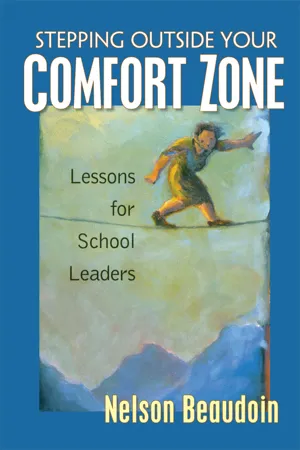
Stepping Outside Your Comfort Zone Lessons for School Leaders
About this book
This book proves that great things can happen when school leaders refuse to settle for business-as-usual. You can achieve success for your schools and students if you steer clear of the familiar and the comfortable. With over 34 years of experience in educational leadership, Nelson Beaudoin was Maine's 2000 NASSP Principal of The Year. His book demonstrates how to generate school-wide enthusiasm for replacing timeworn routines and procedures, give students a voice and personalize the learning process, initiate innovative programs and practices, implement comprehensive school reform, nurture and inspire your faculty,and have fun at work and let your humanity show.
Information
Topic
PedagogíaSubtopic
Educación general1
Making a Difference
Beacons of Hope
Don’t Underestimate the Potential Influence of Educators
It is easy for me to view young people as carriers of great potential. While society seems bent on keeping score and ranking people from good to bad, I follow a different path. Everyone is a masterpiece in the making. I came about this philosophy as a result of my own experiences. The following story illustrates how I went from the bottom of the heap to a position of leadership. It is not your typical rags to riches tale. I am certainly not rich—nor did I start out in rags. It is, however, a story about my academic awakening that leaves me hopeful as we strive to encourage each student to succeed and try to make a difference in each student’s life.
I grew up in a bilingual family in which French was spoken at home. My early recollections of schooling are flooded with memories of confusion and struggle. I was stuck between two cultures and two languages. I was not a whole person in either area. Kids my age played little league baseball while I traveled to Franco-American events. Kids my age had a language they were confident in using and with which they could express their personality. I was suspended between two worlds and could not really express myself in either. Back in the 1950s, kids like me were trapped by the desire to be Americanized while parents were attempting to keep their foreign customs intact.
I often see students give up on academic work because of their fear of failure. I had done that very thing in elementary school. It was easier to not try than it was to expose my weaknesses. In particular, I remember shutting down in language arts. That subject was always so confusing to me. I thought in French, but had to speak and write in English. As a result, my grades were mediocre at best.
Once I entered high school I was tracked in standard classes. Teachers had low demands, and I delivered what was expected. My report cards were dominated by Ds and Cs. Occasionally I would stumble across a teacher I liked and would squeeze out a B. I spent my school hours anticipating basketball practice and avoiding exposing my academic deficiencies. Luckily though, I was not a huge behavior problem. My one trip to the principal’s office occurred when I kidded a teacher in a history class about being a war baby As she explained the term, I remarked that she must have been a Revolutionary War baby. Neither she nor the principal appreciated my sense of humor.
My school experience followed a fairly uneventful path. I put forth mediocre effort, received mediocre results, and comforted myself with low aspirations. Several events occurred that allowed this pattern to crack and finally break. The first occurred in basketball when an adult recognized me in a positive way. I had been cut from the eighth grade basketball team in favor of several athletic sixth graders. After one of these boys was injured, the coach asked me to fill in. You have no way of knowing how bad I was at basketball, but here’s a little insight: I had scored a basket in an intramural game that the coach was watching. This was the only basket I had ever scored in an official game. I played about nine games with the eighth grade team after being added to the roster, and I never came close to scoring another basket. Two years later, in a junior varsity game, I scored ten points and was called to a meeting involving my coach and the varsity coach. They praised me for the improvement I had shown over the past two years and were obviously happy to have me in the program.
Although I did not become an All-American player—not even close—I did go on to enroll in college so that I could continue playing basketball. My career goal was to become a coach, because those two coaches who had given me the time of day were my heroes. They fueled my motivation for the game, and I wanted to be just like them. They had made a difference for me. How many students walk through the halls of our schools without ever being noticed? I was indeed one of the lucky ones.
My academic awakening came a little later. In fact, my growth in this area was incremental and continues to this day. During my junior year my family moved to a new community, and I transferred to a different high school. By some twist of fate or scheduling mix-up, I was placed in an Honors English class. As you probably remember, language arts was a struggle for me even in the general track. Here I was, a new kid in town, placed in an English class with the brainiacs. The English teacher knew I had limited skills—the red ink on my returned papers proved that. Yet on most of my papers he wrote positive comments about my ideas. I would earn an A for my thoughts and an F for my writing, averaging out to a C. I found this class interesting and worked hard to keep up with my new classmates. By the end of the year I was doing B work and occasionally mustered up the courage to participate in class discussions. This teacher believed in me, just as my coaches had before him. I respected him and in turn wanted to deliver what he expected of me.
A year later, when I was participating in graduation, I was solidly in the bottom third of my class, so I certainly wasn’t expecting any awards. Yet I received a National Commended Scholars Award, which was based on my performance on the PSAT test. The honor was not a result of my verbal score, but I had done well in the math section. Apparently I had some ability after all; I had just become conditioned to think otherwise or at least to keep it hidden.
My academic life has been a series of these small discoveries, each providing me with more confidence. A less than stellar college transcript revealed some isolated A’s. They happened to be in the toughest courses because they were taught by a professor who thought I was his best student. I made sure not to disappoint him. I also was given an extremely difficult student teaching assignment because my supervising teacher felt I could rise to the occasion. I didn’t disappoint her either.
All of these situations included a similar scenario. Someone expected more from me than I expected from myself. The teachers believed in me and gave me the courage to take a risk. Our schools are filled with youngsters who should be provided with challenges. They need to believe that they can achieve and receive the support to do it. Teachers can be much more than transmitters of information—they can be transmitters of hope. One caring teacher or coach can become a beacon of hope for a student who would otherwise go through school without success. I was fortunate enough to have several of them. Since entering the educational profession, I have worked to be that beacon for others.
My academic and personal transformations have continued through each decade of my life. In my twenties I came to believe I could be a leader on our faculty. In my thirties I started to confront my verbal weaknesses. I began writing and speaking with more confidence. My forties led to my belief that I could manage a school well, and I thus became a principal. And now in my fifties I have been encouraged to put my experiences in writing. Each of these progressions has been influenced by other people—the many beacons in my life who unknowingly guided me outside my comfort zone.
A Haircut and an Oil Change
Our Words and Actions Can Have a Profound Influence
One Monday, I was rushing out of my office on my way to some mission in another part of the school. As I got to the end of the long hallway leading out of the main office area, I realized that I had mindlessly walked past the receptionist’s area without saying good morning to our wonderful secretary I turned and wished her a good morning, and she replied, “Good morning Mr. Beaudoin. You had your oil changed this weekend, didn’t you?”
This question stopped me in my tracks. I indeed had had my oil changed on Saturday, but how did she know? I glanced down at my fingernails to see if perhaps they were revealing oil stains and walked back to her desk to find out where she had gotten this information.
I asked her how she knew that I had had my oil changed. Had she been in my community on Saturday? I live an hour away from school, so that was unlikely.
She replied, “Of course not. I just know these things. There is not much you can do without my knowing it.”
After a long pause and giggle, she decided to end my confusion by saying, “My daughter told me once that you always get your oil changed on the same day that you get a haircut. I noticed your nice haircut, so it stands to reason that you got your oil changed too.”
It seems that after a snow day several years before, her daughter, who graduated last June, had complimented me on my haircut. I had made some foolish response like “I love snow days. I get to do all the things that are long overdue. I not only went to the barbershop; I also got my oil changed.”
The receptionist and I had a great chuckle that morning. As I walked away, my mind started racing. How did this subject ever come up in their family conversation? Knowing this student well, I pictured the daughter insisting to her mother that because she had a hair appointment, she absolutely had to have her oil changed too! I can see her laughing as she qualified the idea to her puzzled mother—by simply stating that is what her principal does.
This story shows the untold influences we have on the students we serve. If my receptionist’s daughter remembered my comments about a haircut and an oil change enough to repeat them at the dinner table, what else does she remember? How often does what I say get talked about at family gatherings? Did I ever make a comment to her about ethical choices, about how to treat others, or how to work through the peaks and valleys of daily life? My hunch is that there is something in her memory bank about me that has more relevance than an oil change. As educators, we can have profound influence on students. On occasion, we are fortunate enough to find out what a difference we made, but more often than not what we contribute goes undetected. We can only hope that we use this gift of influence wisely. As educators, we must remember the potential significance of our words and actions.
I Love This Job
Choosing a Positive Attitude Is Not Easy-You Have to Work at It
After a regional track meet ten years ago, I was invited to a gathering at the home of a coach who lived in a community where I used to work. At the party, I bumped into many old friends and was able to share what I was currently doing and to find out where the years had taken them. Among those with whom I struck up conversations, one in particular stays with me to this day.
I ran into an old colleague who had coached for me years earlier. When he asked how things were going in my new job, I responded with a rolling of the eyes and a sarcastic remark, “It’s going.” His comment, upon hearing my reply, went something like this: “Gosh, Nelson, are you ever going to be satisfied in your work? Every time I talk to you, you’re lamenting about how difficult and challenging your position is.” At the time I did not give much thought to his comment other than to clarify that I really did not hate my job as much as I might have implied.
Today I look back on that simple conversation and see much more meaning than I did back then. Now, when an old acquaintance asks me how things are going, my answer is usually much more upbeat. I say that I am really having fun or that I am still enjoying my school and great things are happening.
What has happened to me over the past decade that has changed how I speak about my work? Am I more successful, am I more committed to what I am doing, am I confronted with fewer problems, or has my outlook changed?
I believe that in all of my positions in education I have enjoyed a high degree of success. My wife and my family will tell you that I have always been committed to my work, perhaps to a fault. And, as societal pressures increase along with educational mandates, I am certainly not facing fewer problems. Without question, my outlook has changed!
A number of things may have contributed to this change in attitude. But ultimately, a change of job status was the key. I have moved to the position of principal, whereas ten years ago I was an assistant principal. Part of my frustration was that, as an assistant, I had all of the responsibility of running a school, but I had very little voice in the decision-making process. I worked hard and effectively, but I never really felt that I had much of a say in the programs I was overseeing. The frustration usually developed because I knew that if I were in charge, I would do things differently.
During all my years as an assistant I was the guy who did all the grunt work, which included the not-so-glamorous routine of monitoring discipline, attendance, and facilities management, as well as calling substitutes (boy, did I hate that). At best, this was repetitive work with little or no opportunity for seeing progress. There would always be discipline issues; students and teachers would always be absent. And if one leak in the roof was addressed, another would soon spring up.
I felt like a gerbil on a wheel. I was working hard but making seemingly little progress. This work was an everyday expectation, a foregone conclusion, and the opportunities for feeling like I was making a difference were limited. It was not that my work was not appreciated or that I didn’t get my share of praise. It was, simply, that I was in a fairly routine position. I had difficulty perceiving that my efforts had much of an impact. All of this changed when I became a principal.
I remember an exercise that I participated in during the 2001 NASSP Principal of the Year convention in Washington, D.C. We were trying to address the projected shortage of school administrators and were asked to generate lists of the positive and negative aspects of our roles as school leaders. I had little difficulty generating a list of positives.
Of interest, my list was nearly the antithesis of the negatives listed above. The principalship provides you an incredible amount of responsibility and the voice to accompany it. It provides you with an endless variety of tasks, from ordinary to inventive. And, most important, the principalship affords one the possibility of making a difference, a difference that isn’t isolated but instead is extremely public. There are opportunities to create feelings of optimism in others and, through that hope, to invoke change.
I love what I do, and I guess I always have. Looking back, I see that the work I did as a coach, a teacher, an athletic administrator, and an assistant principal offered many of the same opportunities, but I didn’t recognize them. Part of my transformation from a somewhat cynical educator to one who exudes hope is probably the result of my feeling responsible for all of the other people in my organization. Without my realizing it, sitting in the leader’s chair has allowed me to take risks, to venture outside my comfort zone, for the sake of my students, staff, and the community. I no longer have to accept the status quo that in the past had placed limits on my work or my imagination. Although my actions in previous positions may have been seen as somewhat “out of the box,” I had not felt empowered to truly follow my own beliefs. My work had been restricted by perceived controls imposed by others, whereas in the role as principal I began to feel a greater freedom to follow my heart.
Today my assistants have to perform many of the same tasks that I once did. However, I hope that they view their work more positively because of my leadership, which includes an effort to empower others through shared decision making, encouraged innovation, and mutual trust.
I have always felt that an organization will eventually take on the personality of its leader. I set out every day to make a difference. By seeking to improve the quality of our programs and learning for our students, I create championship moments for others. This commitment leads to an ongoing cycle of positive reinforcement.
When I was an athletic administrator, I viewed the issuing of football equipment as a repetitive drudgery. It simply marked the beginning of yet another fall sports season. My hunch is that the coach saw this new season as an opportunity to start an undefeated campaign. He saw a new beginning, with little thought of seasons past.
As principal, I see the annual ninth grade orientation program as a new opportunity to reaffirm our commitment to great work. The feeling of ultimate responsibility helps me view things more positively—much like a coach. You really can choose your attitude, and as a principal, I have learned to polish that skill. When I am introduced to someone as a high school principal, I typically receive words of sympathy. I work hard to dispel those perceptions because people should know that I have one of the greatest jobs going. Choosing the proper attitude about your work requires a concerted effort. I now put all of my effort into what is best for my students. The concerns about personal comfort, fear of failure, or encountering possible problems take a back seat to the more important question of student outcomes. In doing this, I sacrifice a little control, but I create opportunities to truly make a difference. Principals are in a unique position—they can positively affect the lives of nearly every...
Table of contents
- Cover Page
- Half Title page
- Title Page
- Copyright Page
- Fm chapter
- Dedication
- List of Contributors
- Contents
- Preface
- 1 Making a Difference
- 2 Images of Leadership
- 3 Giving Students a Voice
- 4 Educational Change
Trusted by 375,005 students
Access to over 1.5 million titles for a fair monthly price.
Study more efficiently using our study tools.
Frequently asked questions
Yes, you can cancel anytime from the Subscription tab in your account settings on the Perlego website. Your subscription will stay active until the end of your current billing period. Learn how to cancel your subscription
No, books cannot be downloaded as external files, such as PDFs, for use outside of Perlego. However, you can download books within the Perlego app for offline reading on mobile or tablet. Learn how to download books offline
Perlego offers two plans: Essential and Complete
- Essential is ideal for learners and professionals who enjoy exploring a wide range of subjects. Access the Essential Library with 800,000+ trusted titles and best-sellers across business, personal growth, and the humanities. Includes unlimited reading time and Standard Read Aloud voice.
- Complete: Perfect for advanced learners and researchers needing full, unrestricted access. Unlock 1.5M+ books across hundreds of subjects, including academic and specialized titles. The Complete Plan also includes advanced features like Premium Read Aloud and Research Assistant.
We are an online textbook subscription service, where you can get access to an entire online library for less than the price of a single book per month. With over 1.5 million books across 990+ topics, we’ve got you covered! Learn about our mission
Look out for the read-aloud symbol on your next book to see if you can listen to it. The read-aloud tool reads text aloud for you, highlighting the text as it is being read. You can pause it, speed it up and slow it down. Learn more about Read Aloud
Yes! You can use the Perlego app on both iOS and Android devices to read anytime, anywhere — even offline. Perfect for commutes or when you’re on the go.
Please note we cannot support devices running on iOS 13 and Android 7 or earlier. Learn more about using the app
Please note we cannot support devices running on iOS 13 and Android 7 or earlier. Learn more about using the app
Yes, you can access Stepping Outside Your Comfort Zone Lessons for School Leaders by Nelson Beaudoin in PDF and/or ePUB format, as well as other popular books in Pedagogía & Educación general. We have over 1.5 million books available in our catalogue for you to explore.