eBook - ePub
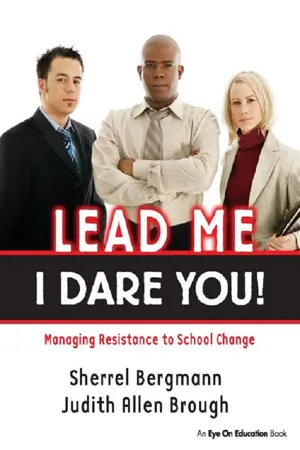
Lead Me, I Dare You!
Managing Resistance to School Change
- 144 pages
- English
- ePUB (mobile friendly)
- Available on iOS & Android
eBook - ePub
About this book
This original book shows you how to understand and collaborate with the most difficult members of your staff. Tied together by real-world "success stories" about school change and succinct leadership tips, the parctical advice in this book is supported by research and is presented in a conversational style.
Information
1
Defining the Degree of Followership
Penny Principal was hired because the retiring superintendent was tired of hearing parents and teachers complain that the high school was out of control. Teachers complained about the lack of decision making in the building. In her interview, she seemed like the perfect leader for the building. Her goals were to raise test scores and to implement the state curriculum. Her goals were sound, but her methods created chaos.
Penny Principal was “in charge” of her building. She worked very hard to develop her authoritarian style and did not let anyone forget that she made all the decisions. She only believed in self-empowerment and did not even allow teachers to talk at faculty meetings. She ran her building like a military command center, with no interaction between herself and anyone else. She was totally unapproachable to students and staff and gave weekly calendars of items that must be accomplished. All lesson plans were subject to careful scrutiny and criticism. Parents avoided the school as much as possible. She followed every state mandate to the letter and vowed never to let flexibility enter her building. She ruled by fear and intimidation and wondered, after the first year, why the scores had gone down and teachers were asking for transfers. She was the perfect example of how to lose support for the administration. Teachers whispered to each other in the parking lot, “Be careful what you ask for in a leader, you might get it.”
In the next county, a new leader had been hired for the local elementary school. In only six weeks, his school was filled with reluctant followers.
Dr. Daily Decree had a list of credentials that amazed the school board. He was a specialist in several content areas, a constant participant in conferences and workshops, and a bandwagon hopper. The only skill he lacked was the ability to work with people. Every week, he decreed some change in his elementary school. He would go off to a conference, gather some new ideas, and tell his staff to start doing them. His most famous flop was the magic circle. With proper staff development, the magic circle is a great way for students to share ideas and concerns. However, this school leader did not believe staff development was necessary. On Monday morning, he announced that every classroom that day would have a magic circle for 15 minutes. Unfortunately, he had failed to tell his teachers what this was, so speculation and frustration were high among the staff members. Some wondered whether it was an assembly, others thought that it might have something to do with the lighting, and most just dismissed it as another one of his strange ideas. No one did anything different, but most waited to see whether anything would happen in their classrooms. His leadership style and lack of direction created an entire community of fearful resistant followers.
Both of these leaders had personal flaws that kept them and their schools from achieving. Their styles caused such dissension in their buildings that the teachers became distrustful of anyone holding a leadership position. The concept of the reluctant follower is not new to schools or human history. It is human nature to be skeptical of change. Every leader faces reluctance on the part of his or her followers and reluctant followers can become leaders. Leaders can learn how to deal with reluctant followers by studying those who have been both successful and unsuccessful.
Throughout history, kings and queens who ruled by birthright faced whole countries of reluctant followers and used many means to silence or remove them. Some were sent from the country, whereas others were tortured and even lost their heads. Resistance to leadership took the form of wars, underground movements, and civil disobedience. Some of the greatest leaders of all time were quietly sabotaged by reluctant followers. Others, such as Abraham Lincoln, were openly attacked by newspapers and public speakers.
Leaders are often faced with reluctant followers because of ideals, ideas, or personal grievances. Political and religious leaders are especially vulnerable to the spoken and written actions of those who disagree with their vision and policies. However, we know from history that reluctance to follow is not necessarily a negative trait.
Our nation was founded by reluctant followers who used subversive resistance and then active resistance to dump the tea in Boston Harbor and then start the Revolutionary War against the leadership of England. Those followers became the leaders of our new country and fostered new ideas about the effectiveness of dissent. Later, dissent against leadership and personal power fueled the civil rights and women’s movements, proving that not all followers who dare leaders are negative influences. Some followers who resist leadership actually have better ideas, better problem-solving skills, and a set of universal values that are larger than a single issue.
Great leaders often have to swim against the current of popular opinion. When the number of reluctant followers becomes larger than the number of supporters, leaders search for a core of supporters who have a clear idea of the mission and goals of the organization. They must identify the degree of dissent, the purpose of dissent, and the level of commitment to dissent. Great leaders see their constituents as sharing a universal view of the purpose and goals of the organization. They use that core of support to help them sway reluctant followers. Kids call this “peer pressure.” Leaders fail because they are unable to find a core of support for their universal ideas or ideals. They fail to analyze the culture in which they are functioning and fail to understand those who refuse to follow. Other leaders fail because they do not model the changes they want to see in others. As Gandhi said, “Be the change you want to see in the world.” Leaders cannot say one thing and do something else. Historically, leaders have been removed from their leadership position when they could not muster a majority of followers.
When leaders are appointed for some reason other than their skills and knowledge, they run a higher risk of having reluctant supporters. Perhaps one of the most helpful research projects of the past decade looked at the leadership of great companies. In identifying the variables that made for successful leaders, the researchers found that “good to great leaders seem to have come from Mars. Self-effacing, quiet, reserved, even shy—these leaders area paradoxical blend of person humility and professional will. They are more like Lincoln and Socrates than Patton and Caesar” (Collins, 2001, p. 13). In addition, they found that great leaders got the right people on the bus, the wrong people off the bus, and the right people in the right seats—and then “they figured out where to drive it” (p. 13). These words of wisdom from successful businesses can be directly applied to leadership in schools and the quest to bring along reluctant followers.
Leadership and Followership Begin at an Early Age
Leadership and followership are observable when children play. Watch an elementary school recess and look at who decides what will be done during free time. The classic children’s game “Follow the Leader” requires a leader who is either self-selected, appointed by the group, appointed by an adult, or next in line when taking turns. Usually, children take turns, and everyone gets to practice leading and following. The concept is simple: One child leads the group in a task, and the rest of the group tries to do the same task. However, there are some children who never want to be the leader and some who always want to dominate. Children who are more verbal tend to make decisions for others. Some follow but try to sabotage the efforts of the group.
As children become adolescents, the concept of the game is the same, but the leaders emerge in athletics, academics, student government, church groups, and street gangs. Again, they are selected, elected, appointed, or anointed, either by themselves or by the group. Though there may be reluctant followers, they usually drop out rather than speak out in the group. The common element is that a group is attempting to achieve a common goal and someone is in charge of moving them toward that goal. Leadership among adolescents may be the most tenuous of all, as group loyalties change so frequently. Adolescents can develop positive leadership skills when they are provided with opportunities through the school and the community.
Adults are quick to notice leadership characteristics in adolescents that are both positive and negative. They may also notice those adolescents who participate in life only as followers. The leaders and followers of childhood eventually end up as members of a community in which their actions can make a significant difference in the lives of others. That community may be a school, a business, a religious group, a government, or an organization with a common mission. Adults continue to play Follow the Leader, but the tasks are more difficult, and the consequences of not following are more complex.
Whether schools lead society or follow society is a frequent topic of debate among scholars and school leaders. The extent to which a business is socially responsible as part of its profit making is a common topic in board meetings and the news media. Whether religious groups can maintain their followers and remain true to their philosophy is what religious leaders ponder. Whether a government is leading a country or culture in the “right direction” is determined by elections and wars. In the end, it is all about common goals, continuous progress, how a leader obtains leadership, how much the leader is willing to share power, and the attitudes of the followers.
Leaders need followers in order to achieve the goals of the organization. With increasing access to information about the organization, whether it is a school, business, or religious group, followers have become more empowered and well informed. Most school leaders realize that creating a highly qualified group of followers is critical to increasing the performance of students.
What, then, are the essential qualities of effective followers? According to research by Robert E. Kelley (1988),
♦They are able to set their own goals and decide what role to play within the organization.
♦They are committed to a purpose beyond themselves.
♦They work to improve their own skills and strive to do their best.
♦They are honest, credible, and courageous. They are also self-reliant, enthusiastic, and intelligent.
Being truthful to leaders is essential in the school setting, where information about students is readily shared. Good leaders respect followers who speak up and share their ideas. Reluctant followers who withhold information and refuse to give honest opinions are inclined to hide information that might make them or their teaching look bad. They tend to be critical, cynical, apathetic, and alienated. They focus on what can go wrong rather than what is possible (Bjugstad, Thach, Thompson, & Morris, 2006, p. 308).
Many reluctant followers dwell on problems rather than seek solutions. They may create a culture of low morale and regression rather than one of progress.
Four Types of Followers
Kelley (1988) defines four types of followers: L.
1. Alienated followers who are capable but cynical.
2. Conformist followers who are the “yes” people of the organization. They do their jobs and follow orders.
3. Passive followers who require constant direction and let the leader do the thinking for them.
4. Exemplary followers who are independent, innovative, and willing to question the leadership. They work well with others and represent the organization in a positive and consistent manner.
A main goal of leadership is to get reluctant followers to take an active role in the progress of the organization and thus take ownership of the ongoing success. In schools, tea...
Table of contents
- Cover
- Title Page
- Copyright Page
- Table of Contents
- Acknowledgments
- Introduction: Lead Me — I Dare You! Managing Resistance to School Change
- 1 Defining the Degree of Followership
- 2 Identifying Reluctant Followers: Who Are They and Why Do They Refuse to Follow the Leader?
- 3 Assessing the Impact of Personality on Leading and Following
- 4 Defining Leadership Characteristics and Their Impact on Reluctant Followers
- 5 Motivating Reluctant Followers
- 6 Minimizing the Dare: Strategies for Communicating With Reluctant Followers
- 7 Helping Followers Become Leaders
- 8 Confronting Those Who Will Not Change: Who Killed Learning in the Seventh Grade?
- Epilogue
- Index
Trusted by 375,005 students
Access to over 1.5 million titles for a fair monthly price.
Study more efficiently using our study tools.
Frequently asked questions
Yes, you can cancel anytime from the Subscription tab in your account settings on the Perlego website. Your subscription will stay active until the end of your current billing period. Learn how to cancel your subscription
No, books cannot be downloaded as external files, such as PDFs, for use outside of Perlego. However, you can download books within the Perlego app for offline reading on mobile or tablet. Learn how to download books offline
Perlego offers two plans: Essential and Complete
- Essential is ideal for learners and professionals who enjoy exploring a wide range of subjects. Access the Essential Library with 800,000+ trusted titles and best-sellers across business, personal growth, and the humanities. Includes unlimited reading time and Standard Read Aloud voice.
- Complete: Perfect for advanced learners and researchers needing full, unrestricted access. Unlock 1.5M+ books across hundreds of subjects, including academic and specialized titles. The Complete Plan also includes advanced features like Premium Read Aloud and Research Assistant.
We are an online textbook subscription service, where you can get access to an entire online library for less than the price of a single book per month. With over 1.5 million books across 990+ topics, we’ve got you covered! Learn about our mission
Look out for the read-aloud symbol on your next book to see if you can listen to it. The read-aloud tool reads text aloud for you, highlighting the text as it is being read. You can pause it, speed it up and slow it down. Learn more about Read Aloud
Yes! You can use the Perlego app on both iOS and Android devices to read anytime, anywhere — even offline. Perfect for commutes or when you’re on the go.
Please note we cannot support devices running on iOS 13 and Android 7 or earlier. Learn more about using the app
Please note we cannot support devices running on iOS 13 and Android 7 or earlier. Learn more about using the app
Yes, you can access Lead Me, I Dare You! by Sherrell Bergmann,Judith Brough in PDF and/or ePUB format, as well as other popular books in Education & Education General. We have over 1.5 million books available in our catalogue for you to explore.