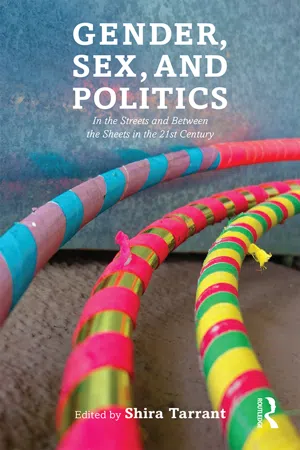
Gender, Sex, and Politics: In the Streets and Between the Sheets in the 21st Century includes twenty-seven chapters organized into five sections: Gender, Sexuality and Social Control; Pornography; Sex and Social Media; Dating, Desire, and the Politics of Hooking Up; and Issues in Sexual Pleasure and Safety. This anthology presents these topics using a point-counterpoint-different point framework. Its arguments and perspectives do not pit writers against each other in a binary pro/con debate format. Instead, a variety of views are juxtaposed to encourage critical thinking and robust conversation. This framework enables readers to assess the strengths and shortcomings of conflicting ideas. The chapters are organized in a way that will challenge cherished beliefs and hone both academic and personal insight. Gender, Sex, and Politics is ideal for sparking debates in intro to women's and gender studies, sexuality, and gender courses.
eBook - ePub
Gender, Sex, and Politics
In the Streets and Between the Sheets in the 21st Century
- 346 pages
- English
- ePUB (mobile friendly)
- Available on iOS & Android
eBook - ePub
About this book
Information
Part I Gender, Sexuality, and Social Control
The first section of Gender, Sex, and Politics includes a series of essays that explore how gender and sexuality are used as tools of social control. These six essays focus on street harassment, reproductive justice, and transgender politics. Thematically connecting each of the topics in Part I are three central questions: How is sexuality used as a form of social control; whose bodies are regulated; and who does the regulating?
Catcalls on the street, abortion politics, and emerging debates about transgender identity can have a deeply personal impact. However, these issues are not only matters of individual struggle. It is important to think about how gender and sexuality are deployed as vehicles to control groups of people and curtail our freedom. The essays in this section raise questions about gender, race, and stereotypes, while suggesting ways of improving our politics and fighting back against injustice.
In chapter 1, “Hollaback! You Have the Power to End Street Harassment,” Emily May and Samuel Carter describe how and why the global Hollaback! movement got started. As violence prevention educator Jackson Katz writes, we like to say the United States is the most free nation in the world. Yet the prevalence of street harassment and the threat of sexual violence mean that half the population does not feel free to simply walk down the street. We therefore need to think about street harassment in terms of its effect and impact in terms of social control. Comments from “You’d look good on me” to groping, flashing, and assault are a daily, global reality for women and LGBTQ individuals. Street harassment is one of the most pervasive forms of gender-based violence and one of the least legislated against. Street harassment is rarely reported, and it is culturally accepted as “the price you pay” for being a woman, or for being gay, or for being gender nonconforming. Street harassment is actually a form of social control that interferes with the basic right to walk down the street in safety and without harm.
In chapter 2, “‘But Look at What She Was Wearing!’ Victim Blaming and Street Harassment,” Kimberly Fairchild explains that blaming female survivors for their own sexual victimization is still highly present in society. Researchers consistently find that victim blame occurs in rape cases and that a strong source of that blame rests on perceptions of how provocative the woman appeared. Victim blaming also happens in less severe forms of sexual victimization, specifically street harassment. In two studies, female participants judged a sexy or non-sexy victim of street harassment. Both studies found a significant difference in who got blamed: The sexy victim was viewed to be more at fault for the harassment. This raises important questions about victim blaming in sexual assault and sexual harassment when it comes to seeking help and justice.
In chapter 3, Aura Bogado further takes up the issue of street harassment, sexual violence, and victim blaming by addressing the unexamined racism and white normative presumptions of the global SlutWalk movement. As Bogado explains in “SlutWalk: A Stroll Through White Supremacy,” rape, slut-shaming, and reclaiming the term “slut” is highly impacted by the intersections of gender, race, and class. Ignoring the politics of racism exacerbates the problems of social control and sexual violence—including when this happens among seemingly progressive activist movements.
In chapter 4, “The Body Wars: Sexuality, Social Control, and What Texas Can Teach Us,” Carrie Tilton-Jones writes about the summer of 2013, “when the eyes of the world turned to Texas as we rose up by the thousands to fight against one of the worst anti-abortion bills in recent memory.” Tilton-Jones recounts Senator Wendy Davis’s 11-hour filibuster, the sea of orange-clad protesters, the nail-biting down-to-the-wire finale. This chapter about grassroots political activism is instructive because it is part of a much larger struggle over gender and reproductive justice in Texas and beyond. As Tilton-Jones explains, the rhetoric around sexuality and reproduction—driven by an overwhelmingly white, male, conservative legislature—constitutes a fierce attempt to regulate and control anybody that does not look like them.
Continuing the conversation about reproductive justice, Caroline Held-man blends her personal story with a political dilemma in chapter 5, “The Abortion Debate: How Do We Talk With Each Other When We Disagree?” As Heldman acknowledges, the subject of abortion is so often fraught and difficult for people to talk about when we agree—let alone when we don’t. This chapter suggests pragmatic solutions to the unproductive stalemates around abortion debates in order to maximize constructive solutions and to minimize the imposition of social beliefs on others. This chapter also attests to the fact that strongly held beliefs about abortion can radically change, as Heldman describes her deeply personal story of demonstrating against abortion as a child and seeking an abortion as an adult.
Part I ends with a chapter by Noah E. Lewis titled “Sex and the Body: A 21st-Century Understanding of Trans People.” Lewis begins by asking, How much would someone have to pay you to physically transition and live as the other sex for the rest of your life? This question sets the stage for readers to carefully consider the personal, practical, political, and biological aspects of transgender issues.
Hollaback! You Have the Power to End Street Harassment
Emily May and Samuel Carter
DOI: 10.4324/9781315817798-1
Summer was starting and it was hot. Like many other New Yorkers, we spent our days at tolerable jobs with our minds looking forward to happy hour at 5:30 p.m., barbeques on Friday, and trips to the beach the following morning. We were all fresh out of college or a graduate program, and eager to figure out just where we fit in this humongous metropolis. It was 2005. Insurgent attacks were growing in Iraq, Tony Blair had just won re-election in the UK, and Hurricane Katrina had yet to make landfall in New Orleans.
We were a group of seven friends—the kind that coalesces without much rhyme or reason. Some of us went to college together. A few were close friends of someone’s cousin who recently moved to the city. Some of us were dating. But all of us were drawn to each other, finding ways to see some combination of the group once, twice, or three times a week.
And we talked. About a lot of things. The kind of free-wheeling conversations that are inspiring, frustrating, challenging, and disturbing. In a way, it was a kind of post-graduation reality check. All our freshly minted degrees were now bearing the weight of the workaday world, monthly rent checks, and a world beyond the lecture hall, where you needed more than a quote from Foucault to justify an argument. We were helping each other get by.
We talked about technology. We talked about Bush. We talked about these new things called blogs. We talked about how ridiculous it was that a recently upgraded cell phone came with a crappy camera embedded in it.
And we talked about the tremendous disparity between people around the world. Global inequalities laid bare by the middling War on Terror. We talked about racism and the very beginnings of the current wave of European oppression of North Africans and Muslims. And we talked about gender—a lot. We were three men and four women, all a bit queer, and we grappled every time we met up about our experiences and various social views on sex. We were upset and we were angry, and we had the time and energy, the space and community to explore these things. It was wonderful.
Gender was a particularly rich theme of our conversations, both because of who we were—and where we were. In New York City, people’s experiences of daily life can be very diverse. Neighborhoods are wildly different, with their own cultures, styles, and demographic mix. Yet as we talked about our lives in our neighborhoods, and our commutes to work, and the parks and cafes where we went to sit and read, something profound emerged. The women of our group—Emily May, Lauren Spees, Kaja Tretjak, and Anna Weichselbraun—had a vastly different set of experiences in public space than the men, enduring a constant (and, sadly, predictable) barrage of foul comments, violations of personal space, and groping from strangers on the subway and the streets of the city.
For the men in our group—Elan Abrel, Sam Carter, and Colin Weatherby—hearing these stories from these friends with whom we had so much respect and affection—it was heartbreaking. And eye-opening, because this was a different way to imagine our city. In fact, it was a way to understand New York as two cities—one as experienced by women, the other by men. And this kind of visceral inequality, testified to by our friends across the table, shook us profoundly. The women found the men’s reaction to their stories a bit quaint and naïve but they were also struck that these men, who had been living in this world for well over twenty years, could be so surprised by what was, for the women, a daily occurrence.
Stories were shared. The conversation continued. We kept circling back to this basic experiential difference between the sexes, but never coming to any real conclusions beyond “this sucks.”
Then, in the last week of August, we heard about Thao Nguyen.
On August 19, 2005, Thao was riding the R train. She looked up only to discover a man, wearing all black and sitting across from her, making eyes at her. Then she noticed that he was exposing himself and masturbating. Thao did not avert her eyes and bury herself in a book. She did not get up and leave the train car. Instead, she took out her cell phone, and took a photo of the man. And when she got offthe train, she tried to report the incident. In her words:
I got off at 34th street and reported it to a token booth operator. She was very helpful and directed me to a policewoman. The policewoman wrote down my description of the man and I asked her if she wanted the picture but she didn’t take it. She told me that she would radio other offi cers and they would be on the lookout for that man. I couldn’t believe she didn’t take the picture, it had a pretty clear view of this person. 1
And then Thao took a second bold step. She shared her story on Flickr, where it quickly went viral. Gothamist picked it up first, then the New York Daily News, which ran the photo on the front page of their tabloid.
It was one of those stories that New Yorkers were all buzzing about. Gothamist was flooded with comments. Additional women came forward and recognized the man. Eventually, Dan Hoyt, the subject of Thao’s snap turned himself in to the police.
But, perhaps most significant to our group, all of a sudden everyone in the city was talking about this incident. It felt like everyone either had a similar story of public masturbation, or they knew someone who did. Reading the Gothamist comments thread was like reading a summary of our debates (with some terribly sexist comments thrown in).
We sat around the table at a nondescript bar in Hell’s Kitchen and we picked apart what had happened. Essentially, Thao had taken an action against her harasser using a digital tool that we all carry in our pockets, and then proceeded to share it with her broader community. It had sparked public debate. As we went through the timeline of the media story, we found ourselves revisiting familiar ground: use of this new personal technology, the power of the Internet and emerging social media, the rise of blogs, and, of course, gender.
At that moment we realized that it was completely within our power to keep this conversation alive in New York City. We could start a new site dedicated to sharing the kind of photos and stories that Thao Nguyen had, and make it open to everyone in New York to talk about. Looking back, without even realizing it, we had been talking about this project all summer long.
Street Harassment in the USA: Male Privilege of Not Knowing2
Joe Samalin
During a sexual violence prevention training with forty enlisted air force men (“airmen”), one young white man stood up and said that he had never thought about this issue before, until early one morning during an overseas deployment a few years ago. Let’s call him Dan. As he awoke and poked his head out of his tent, Dan happened to see a friend, a female airman (females are called airmen, too), walking by at a fast clip, her head down. He wished her good morning, but she ignored him. Dan called out louder, and a third time, with no response. He then ran out of his tent and caught up to her, asking why she hadn’t responded.
She seemed startled and Dan asked her if everything was ok. She explained that she was on her way to the chow hall for breakfast, and she hated the walk. It was a long one from her tent, and she got through it by keeping her head down and muscling through as best she could. Dan was completely stumped about what she meant. Rather than explain, she told him to walk with her, and he agreed.
As Dan described that walk to the chow hall, you could see he was viscerally reliving the experience. He said he didn’t know what to expect or what the issue was. And yet as they walked, he became aware of a strange sensation. At first he couldn’t put his finger on it but the feeling grew, and eventually he knew exactly what it was. It was the ...
Table of contents
- Cover Page
- Frontmatter
- Half Title Page
- Series
- Title Page
- Copyright Page
- Contents
- Preface
- Acknowledgements
- Introduction
- PART I: Gender, Sexuality, and Social Control
- PART II: Pornography
- PART III: Sex and Social Media
- PART IV: Dating, Desire, and the Politics of Hooking up
- PART V: Issues in Sexual Pleasure and Safety
- Notes on Contributors
- Index
Trusted by 375,005 students
Access to over 1.5 million titles for a fair monthly price.
Study more efficiently using our study tools.
Frequently asked questions
Yes, you can cancel anytime from the Subscription tab in your account settings on the Perlego website. Your subscription will stay active until the end of your current billing period. Learn how to cancel your subscription
No, books cannot be downloaded as external files, such as PDFs, for use outside of Perlego. However, you can download books within the Perlego app for offline reading on mobile or tablet. Learn how to download books offline
Perlego offers two plans: Essential and Complete
- Essential is ideal for learners and professionals who enjoy exploring a wide range of subjects. Access the Essential Library with 800,000+ trusted titles and best-sellers across business, personal growth, and the humanities. Includes unlimited reading time and Standard Read Aloud voice.
- Complete: Perfect for advanced learners and researchers needing full, unrestricted access. Unlock 1.5M+ books across hundreds of subjects, including academic and specialized titles. The Complete Plan also includes advanced features like Premium Read Aloud and Research Assistant.
We are an online textbook subscription service, where you can get access to an entire online library for less than the price of a single book per month. With over 1.5 million books across 990+ topics, we’ve got you covered! Learn about our mission
Look out for the read-aloud symbol on your next book to see if you can listen to it. The read-aloud tool reads text aloud for you, highlighting the text as it is being read. You can pause it, speed it up and slow it down. Learn more about Read Aloud
Yes! You can use the Perlego app on both iOS and Android devices to read anytime, anywhere — even offline. Perfect for commutes or when you’re on the go.
Please note we cannot support devices running on iOS 13 and Android 7 or earlier. Learn more about using the app
Please note we cannot support devices running on iOS 13 and Android 7 or earlier. Learn more about using the app
Yes, you can access Gender, Sex, and Politics by Shira Tarrant in PDF and/or ePUB format, as well as other popular books in Social Sciences & Gender Studies. We have over 1.5 million books available in our catalogue for you to explore.