eBook - ePub
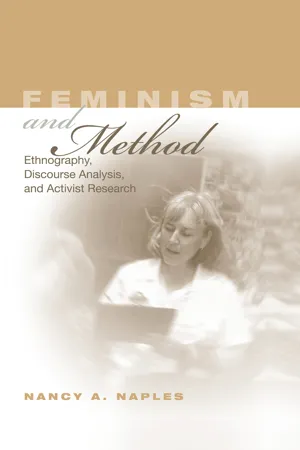
Feminism and Method
Ethnography, Discourse Analysis, and Activist Research
- 280 pages
- English
- ePUB (mobile friendly)
- Available on iOS & Android
eBook - ePub
About this book
Naples draws on different research topics, such as welfare, poverty, sexual identity, and sexual abuse, to illustrate some of the most salient dilemmas of feminist research: the debate over objectivity, the paradox of discourse, the dilemma of "standpoint," and the challenges of activist research. By linking important feminist theoretical debates with case studies, Naples illustrates the strategies she developed for resolving the challenges posed be postmodern, Third World, postcolonial, and queer studies.
Information
PART I
Introduction
CHAPTER 1
Feminism and Method
Throughout my career as a feminist sociologist, I have sought to address the following questions: How does a researcher negotiate the power imbalance between the researcher and researched? What responsibilities do researchers have to those they study? How does participatory research influence analytic choices during a research study? How do strategies of self-reflection alter ethnographic practice? Feminist scholars have consistently raised such questions, suggesting that if researchers fail to explore how their personal, professional, and structural positions frame social scientific investigations, researchers inevitably reproduce dominant gender, race, and class biases.1 I draw on my empirical work and three different methodological approaches—ethnography, narrative and textual analysis, and activist and participatory research—to demonstrate the materialist feminist framework I developed to make visible how power operates during the research process and in the production of narrative accounts.
Over fifteen years ago, feminist philosopher Sandra Harding (1987) asked: “Is There a Distinctive Feminist Method of Inquiry?” In answering the question, she distinguished between epistemology (“a theory of knowledge”), methodology (“a theory and analysis of how research does or should proceed”), and method (“a technique for . . . gathering evidence”) (pp. 2–3). She pointed out the “important connections between epistemologies, methodologies, and research methods” (p. 3). Following Harding, I start with the assertion that the specific methods we choose and how we employ those methods are profoundly shaped by our epistemological stance. Our epistemological assumptions also influence how we define our roles as researchers, what we consider ethical research practices, and how we interpret and implement informed consent or ensure the confidentiality of our research subjects. The goal of my approach to teaching research methods in the social sciences and interdisciplinary women’s studies is to foreground the epistemological assumptions that guide our choice of different methodologies, how we proceed to implement particular methods, and how we determine what form the written product should take. For example, while researchers who draw on positive or interpretive2 theoretical traditions might utilize a methodology that generates oral narratives or ethnographic data, what counts as data and how these data are interpreted and reported will vary significantly depending on the specific epistemological stance undergirding the research process. Since there are diverse feminist perspectives, it follows that there are different ways feminist researchers identify, analyze, and report “data.”
How one defines the nature of the relationship between researcher and researched also depends on one’s epistemological stance. Of course, a researcher does not have complete autonomy in shaping relations with subjects of his or her research. Research subjects have the power to influence the direction of the research, resist researchers’ efforts and interpretations, and add their own interpretations and insights. As Leslie Bloom (1998, 35) astutely observes: “The idea that the researcher has ‘The Power’ over the participant [in a research study] is an authoritative, binary discourse that may function to disguise the ways that ‘the flow of power in multiple systems of domination is not always unidirectional’ ” (Friedman 1995, 18). She concludes with the observation that “power is situated and contextualized within particular intersubjective relationships.”3 As I demonstrate in this book, ethnographers negotiate and renegotiate relationships with the members of the communities they study through particular and ongoing everyday interactions. These interactions are themselves influenced by shifting relationships among community residents. In the chapters to follow, I illustrate my epistemological and empirical solutions to this dilemma and to related problems faced by feminist social scientists.
I share the lessons I have learned through investigations in four areas of my U.S.-based research: first, exploration of women’s politicization, community activism, and feminist praxis; second, analyses of the processes of racialization and rural economic development; third, the construction and implementation of U.S. social policy; and finally, analysis of oppositional movements against poverty, racism, sexual abuse, and other inequalities and oppressions. I link important feminist theoretical debates on positionality, interpretive authority, and activist research with case studies to illustrate the strategies I have developed for confronting the particular challenges posed by feminist postmodern, third world, postcolonial, and queer scholars.4 These challenges include how to explore women’s experiences “in similar contexts across the world, in different geographical spaces, rather than as all women across the world” and how to understand “a set of unequal relationships among and between peoples, rather than a set of traits embodied in all non-U.S. citizens (particularly because U.S. citizenship continues to be premised within a white, Eurocentric, masculinist, heterosexist regime)” (Alexander and Mohanty 1997, xix, emphasis in original).
This book differs from more traditional methods books in the social sciences that detail the techniques of specific methods such as survey research, interview and focus group research, historical research involving archival materials, ethnography, or participant observation.5 Rarely do such texts make explicit the theoretical assumptions that are implicated in the methods chosen. The argument put forth in most methods books is that the method one chooses should be the most appropriate for specific research questions you wish to answer. While I agree with this sentiment, I also caution that the methods we choose are not free of epistemological assumptions and taken-for-granted understandings of what counts as data, how the researcher should relate to the subjects of research, and what are the appropriate products of a research study. Furthermore, seldom do the authors of traditional methods books acknowledge that the questions researchers ask are inevitably tied to particular epistemological understandings of how knowledge is generated.6
This point has been well established in the field of anthropology where over the last 20 years researchers have grappled with the intersection of representation, subjectivity, and power in the practice of ethnography.7 Third world and postcolonial feminist scholars call on ethnographers to reflect on their research and writing practices in light of political, moral, and ethical questions that arise from the inherent power imbalances between many ethnographers and those they study. Feminist ethnographers have responded to these challenges by examining how certain cultural representations in ethnographic accounts contribute to colonialist practices and further marginalize the lives of third world and other nonwhite peoples, even as they are brought to the center of analysis.8 Concerns about the dynamics of power inherent in the practice of social research have been raised about methods used in other disciplines as well.
Feminism and Method also differs from feminist texts that critique social scientific research methodologies but fail to offer strategies to negotiate the problems raised. In contrast to these more abstract critiques of social scientific practice, a number of recent publications provide more guidance to feminists in the social sciences interested in finding solutions to the challenging critiques of research practice. These texts also include case examples of empirically based research that highlight feminist research strategies.9
A popular book that offers a useful, almost encyclopedic, overview of feminist methods in the social sciences is Feminist Methods in Social Research by Shulamit Reinharz (1992). Following a comprehensive review of feminist methods with illustrations from diverse feminist studies, Reinharz identifies ten features that appear consistently in efforts by feminist scholars to distinguish how their research methods differ from traditional approaches. These include the assertion that a feminist approach “aims to create social change,” “strives to represent human diversity,” and “attempts to develop special relations with the people studied (in interactive research)” (p. 240). However, Reinharz does not attend to the theoretical underpinnings of the research methods she chronicles, nor does she distinguish between the epistemologies that are implicated in the specific methods. What counts as desirable “social change”? How do different feminist theoretical perspectives inform the application of different methods? How do different perspectives influence the strategies considered effective for representing “human diversity”? What types of relationships are possible between a researcher and those she or he studies? In Feminism and Method, I attempt to address some of these questions by foregrounding the theoretical assumptions of different methods I use in my research and presenting some of the empirical solutions I found to the dilemmas posed by contemporary critiques of social research.
Feminism and Method highlights several interrelated feminist epistemologies—namely, standpoint theory, materialist feminism, and “postmodern” theories of discourse and power. A multidimensional standpoint epistemology informs how I conduct and interpret ethnographic research. My approach is further enriched by incorporation of insights from racialization theories developed by critical race theorists, most notably Michael Omi and Howard Winant (1986). I also draw on Michel Foucault’s theory of discourse for my materialist feminist analysis of oral narratives and texts such as legislative hearings and other policy documents. My efforts to engage in participatory activist research is guided by Dorothy Smith’s (1987) standpoint methodology, which she terms institutional ethnography, and Nancy Fraser’s (1989) analysis of the politics of need interpretation. Another theoretical strand that has influenced my methodological practice is phenomenology, as articulated in the sociological approaches of social constructionism and symbolic interactionism.10 Instead of viewing these theoretical and methodological approaches as distinct and mutually exclusive, I utilize insights from these perspectives to enrich my materialist feminist analytic approach.
Some of the critical historical materialist and feminist theoretical approaches I draw on are defined as “modernist”; others, like Foucauldian discourse analysis, are categorized as “postmodernist.” However, I resist the dichotomous distinction between modernist and postmodernist theories that has fueled much recent feminist debate.11 By defining Foucault’s genealogical approach as postmodern and placing it in opposition to Marxism and other frameworks said to be modernist, parties to the debate reduce the complexity of both Foucault’s thought and Marxist theories. For example, as political scientist Kathi Weeks (1998) argues, the reduction of Marxism to a limited terrain of “the modern” is accomplished by making “invisible Marxist alternatives to the Enlightenment” (p. 59). By setting up a rigid divide between so-called modernist and postmodernist approaches, this “oppositional logic” succeeds in reducing “modernism to a straw figure, to a homogeneous model of Enlightenment thought” (p. 59). Cultural studies scholar Wendy Hesford (1999) also challenges a divide between modernism and postmodernism that conflates “the deconstruction of the subject with the erasure of human agency” (p. 26). This “modernist-postmodernism paradigm” has been elicited by both adherents and critics of feminist standpoint theories to position standpoint epistemology, since it draws on the Marxist theory, firmly within a modernist paradigm.12
Kathy Ferguson (1991) compares and contrasts postmodern genealogical analyses with interpretive standpoint projects like political theorist Nancy Hartsock’s as follows: “The interpretivist envisions a more enabling alternative toward which we are invited to struggle, while the genealogist insists that those structures and processes that we take to be thoroughly liberating will also be constraining. The interpretivist holds up for us a powerful vision of how things should be, while the genealogist more cautiously reminds us that things could be other than they are” (p. 333). She concludes that “the advocates of these two projects often speak as if the two were in total opposition to one another. . . . But the two projects connect to one another in important ways” (p. 335).13 I view my development of a materialist feminist standpoint theory that incorporates important insights of postmodern analyses of power, subjectivity, and language as a powerful framework for exploring the intersection of race, class, gender, sexuality, region, and culture in different geographic and historical contexts.
Organization of the Book
In the next chapter, I discuss the feminist theoretical frameworks that inform my approach to research with particular focus on feminist standpoint epistemologies, postmodern and postcolonial critiques of ethnographic practice, and materialist feminism and discourse analysis. In the next sections, I emphasize three methodological strategies: ethnography, narrative and textual analysis, and activist and participatory research. In part II, I demonstrate the power of materialist feminist standpoint epistemology and reflective practice for feminist ethnography. Part III addresses the usefulness of a feminist materialist discourse analysis for social policy and oral narrative research. Part IV focuses on some of the limits and possibilities for activist and participatory research.
Part II: Standpoint Epistemologies, Reflective Practice, and Feminist Ethnography
Part II outlines how I negotiate the challenges of ethnographic research by drawing on the insights of standpoint epistemology and reflective practice. In chapter 3, I describe how feminist ethnographers center women’s standpoint in their fieldwork and highlight knowledge that develops from shifting the ethnographic angle of vision to the everyday lives of women. Women were either viewed primarily in the so-called private sphere of the family or ignored in traditional ethnographic research.14 Feminist scholars emphasize how women’s lives are rendered invisible or marginalized in traditional ethnographies by a presumed separation between public and private spheres.15 Beginning in the 1970s, researchers informed by a feminist call to describe women’s experiences and perspectives in their own words began to make women’s lives central in ethnographic and other qualitative accounts.16 For example, anthropologist Deborah Fink (1986) describes her research on rural women in the Midwestern United States as “feminist in that it is based on the assumption that women have been major participants and have stories to tell that will clarify the events that have shaped rural life and made it distinctive” (p. 7).
Chapter 3 concludes with a discussion of a feminist standpoint perspective on the “insider/outsider” debate (namely, which vantage point is preferable for ethnographic investigation) and calls into question this rigid construction. Rather than viewing ethnographic investigation as unmediated description or interpretation of transparent social reality, my materialist feminist approach seeks to reveal the processes through which both the researcher and those who are the subjects of the research come to select, understand, and interpret the complex social and political processes evident in specific contexts.
In chapter 4, I further develop a feminist standpoint analysis of the “insider/outsider” debate begun in chapter 3. I explore the shifting quality of insider/outsider status in my long-term ethnographic study of economic and social restructuring of two small rural towns in southwest Iowa. The changes in racial and ethnic composition of these historically white European American towns resulted from the expansion of a local food processing plant that contributed to an increase in Mexican and Mexican American residents. The process of racialization documented in the course of the fieldwork demonstrates how insider/outsider positions were ever-shifting and permeable social positions. My conceptualization of what I term the “outsider phenomenon” calls into question the dichotomy between insider and outsider that has been a mainstay of ethnographic analysis. By highlighting the material as well as the discursive processes in and through which “outsiderness” was constructed a...
Table of contents
- Cover
- Title page
- Copyright page
- Dedication page
- Contents
- Preface
- Acknowledgments
- Part I: Introduction
- 1 Feminism and Method
- 2 Epistemology, Feminist Methodology, and the Politics of Method
- Part II: Standpoint Epistemologies, Reflective Practice, and Feminist Ethnography
- 3 Standpoint Analysis and Reflective Practice
- 4 The Insider/Outsider Debate: A Feminist Revisiting
- 5 Standpoint Epistemology: Explicating Multiple Dimensions
- Part III: Feminist Materialism, Discourse Analysis, and Policy Studies
- 6 Community Control: Mapping the Changing Context
- 7 The Gendered Social Contract: Constructing the “New Consensus”
- Part IV: Activism, Narrative, and Empowerment
- 8 Bringing Everyday Life to Policy Analysis
- 9 Survivor Discourse: Narrative, Empowerment, and Resistance
- 10 Survivors Going Public: Reflections on the Limits of Participatory Research
- Part V: Conclusion
- 11 Negotiating the Politics of Method
- Appendices
- Notes
- References
- Index
Trusted by 375,005 students
Access to over 1.5 million titles for a fair monthly price.
Study more efficiently using our study tools.
Frequently asked questions
Yes, you can cancel anytime from the Subscription tab in your account settings on the Perlego website. Your subscription will stay active until the end of your current billing period. Learn how to cancel your subscription
No, books cannot be downloaded as external files, such as PDFs, for use outside of Perlego. However, you can download books within the Perlego app for offline reading on mobile or tablet. Learn how to download books offline
Perlego offers two plans: Essential and Complete
- Essential is ideal for learners and professionals who enjoy exploring a wide range of subjects. Access the Essential Library with 800,000+ trusted titles and best-sellers across business, personal growth, and the humanities. Includes unlimited reading time and Standard Read Aloud voice.
- Complete: Perfect for advanced learners and researchers needing full, unrestricted access. Unlock 1.5M+ books across hundreds of subjects, including academic and specialized titles. The Complete Plan also includes advanced features like Premium Read Aloud and Research Assistant.
We are an online textbook subscription service, where you can get access to an entire online library for less than the price of a single book per month. With over 1.5 million books across 990+ topics, we’ve got you covered! Learn about our mission
Look out for the read-aloud symbol on your next book to see if you can listen to it. The read-aloud tool reads text aloud for you, highlighting the text as it is being read. You can pause it, speed it up and slow it down. Learn more about Read Aloud
Yes! You can use the Perlego app on both iOS and Android devices to read anytime, anywhere — even offline. Perfect for commutes or when you’re on the go.
Please note we cannot support devices running on iOS 13 and Android 7 or earlier. Learn more about using the app
Please note we cannot support devices running on iOS 13 and Android 7 or earlier. Learn more about using the app
Yes, you can access Feminism and Method by Nancy A. Naples in PDF and/or ePUB format, as well as other popular books in Social Sciences & Feminism & Feminist Theory. We have over 1.5 million books available in our catalogue for you to explore.