We know that gender traits and mental disorders are based on social, cultural, personal and physiological background. In order to formulate the best management plan for the patient, the mental health practitioner needs to incorporate all available information.
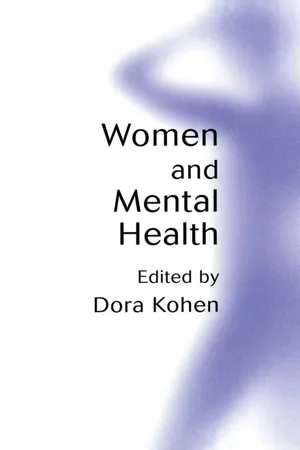
Women and Mental Health provides a comprehensive overview of the most prominent mental health problems in women today.
Examining the physiological, social and psychological factors of mental illness, and providing an up-to-date perspective on the etiology of different disorders, the book will help mental health professionals formulate the best management plan for the individual.
Covering issues including perinatal psychiatric disorders, depression, eating disorders, schizophrenia, and alcohol and drug abuse - from a female perspective - Women and Mental Health will prove a valuable tool for all those working in the fields of mental health.
- 239 pages
- English
- ePUB (mobile friendly)
- Available on iOS & Android
eBook - ePub
Women and Mental Health
About this book
Information
Chapter 1
Introduction
Dora Kohen
Although women as a gender do live longer than men, they have more mental health problems. The individual’s risk of encountering health problems is influenced by biological, political, economic, social and psychological adversities. In women the biological basis of mental health problems is concentrated mainly around the menses, childbirth and the menopause. Studies of social trends and epidemiological issues have established that women beset by a lifetime of social and psychological disadvantage, coupled with long years of childbearing and neglect, often end up experiencing poverty, isolation and chronic psychological disability. Because of a preference for male children, in many parts of the world female children may receive less care, nutrition and emotional support. Poverty, discrimination and possible violence towards the female child have long-lasting, debilitating and other adverse effects on the woman’s physical as well as mental health (Craft, 1997a,b,c). In adults long-term unemployment, and/or income inequalities can lead to psychological problems and women who face disparities may become more vulnerable. Adverse social trends in childhood and adulthood may accumulate as risk factors over subsequent decades.
The history of psychiatric disorders and psychological differences between men and women are long standing. Madness in women has been recognized in all cultures and mad behaviour has been attributed to different causes including divinity, passion and alcohol. Hippocrates in the fourth century BC described madness in women as related to the womb or ‘hysteron’ in Greek and hence the term ‘hysteria’. According to this belief all madness in women stemmed from the womb and womb-related functions. The idea that the womb increased women’s vulnerability to mental disfunction and mental weakness continued for centuries. In the middle ages and later women were either deemed psychologically lesser and weaker creatures and therefore not deserving equal rights or, if they diverted from the narrow norm, they were seen as dangerous and burnt as witches. Their childbearing functions made them special but still not equal to men. The menopause was especially thought to be a period of great irritability and distress. In 1890 Kraepelin coined the term ‘Involutional Melancholia’ for a syndrome describing agitated depression, hypochondriasis and delusion in menopausal women. This was a diagnostic category in DSM-I and DSM-II until it was excluded from DSM-III in the 1970s due to lack of evidence as a specific psychiatric diagnosis.
On one hand, women may be seen as fragile, irritable, oversensitive and fluctuating in mood and therefore be given diagnoses such as hysteria and involutional melancholia. On the other hand, real issues such as socio-cultural and personal inequalities that may make a difference to the mental health and quality of life of women have not received the recognition and attention they deserve. In the last decades social psychiatry, clinical psychology, sociology and social sciences in general have contributed to an in-depth understanding of the social determinants of mental illness. Modern methodological data and validated and reliable computerized clinical instruments have brought better understanding and more powerful definitions which in turn have led to better clinical classification. In most instances, it is possible to differentiate between crisis situation, disease states and personal traits and there are established reliable criteria for caseness. Special instruments and statistical tools to differentiate social variables from psychological components have been widely accepted. Accumulation of data on social and psychological determinants of mental disorders have been sufficient to make valid generalizations and draw conclusions. But the recommendations drawn from this reliable data have not yet been fully implemented.
EPIDEMIOLOGY AND MENTAL HEALTH IN WOMEN
Gender differences in the prevalence of psychiatric disorders have been known for several centuries. With the modern understanding of epidemiology it is well established that women have a higher prevalence of depression, dysthymia, deliberate self-harm, seasonal affective disorder, generalized anxiety disorder, panic attacks, social phobias and eating disorders, including anorexia nervosa, bulimia and obesity, than men.
The OPCS (Office of Population Censuses and Surveys) for psychiatric morbidity in Great Britain, commissioned by the Department of Health, the Scottish Home and Health Department and Welsh Office, provided information on the prevalence of psychiatric problems among the adult population, their associated social disabilities and the use of services (Meltzer et al., 1995). The survey revealed that women were more likely to have neurotic psychopathology as compared to men. Women were around twice as likely to have somatic symptoms and phobias and more likely to have fatigue, obsessions, poor concentration, forgetfulness, compulsions, panic attacks and depressive ideas. Also statistically, the odds of the disorders were increased by being female. The odds of generalized anxiety disorder were increased by about two thirds and the odds of mixed anxiety and depressive disorder were increased by more than two thirds in females.
When considering epidemiological issues in women with mental health problems, one needs to take into account that some psychiatric problems and diagnoses are more common in women, some psychiatric diagnoses deserve attention because of their differing clinical implications in women and some psychiatric diagnoses are exclusive to women.
Some psychiatric disorders are more common in women
All neurotic disorders, including generalized anxiety disorder, panic disorder, obsessive compulsive disorders, agoraphobia and other phobias, have higher prevalence rates in women. There is a marked sex difference in all studies in which both sexes have been examined. Females exceed males in a ratio of 3:2 to 2:1. Studies assessing specific populations give an insight into the extent of the issue and the needs of the female population. Hagnell (1966) studying a Swedish population found a lifetime expectancy for neurosis of 7.5 per cent for men and 17 per cent for women. The epidemiological catchment area studies (ECA) in the US has shown that both at 6 months prevalence and at lifetime prevalence, the rates show that women have three times more phobias and at least twice as much obsessive compulsive disorder as men (Myers et al., 1984; Robins et al., 1984). Women with obsessive compulsive disorders are more likely to suffer from comorbid anorexia and food and weight-related obsessions.
Studies have shown that life events, social class, housing and employment have a complex interaction and are associated with the mental health of women as much as with that of men.
Depression
All estimates of the prevalence of depression show that it is twice as common in women as in men. The difference is maximal in young adults and decreases with age. Women have a high incidence of depression in their reproductive years while men do not. Also social class differences in the prevalence of depression, which showed higher rates of affective disorder in working class women, has been confirmed by Brown and Harris (1978). Social roles, biological, hormonal and genetic characteristics have all been implicated in the origins of higher prevalence rates of depression. Chapter 2 and Chapter 5 contain detailed information on the biological basis, and treatment and management issues in depression.
Anxiety disorders and panic attacks
Generalized anxiety disorder (GAD) is the commonest psychiatric disorder in the population and is more prevalent in women. Women with GAD are more likely to experience depression, panic attacks and post-traumatic stress disorder which are frequent in all women (Robins et al., 1984). The biological reasons of this increased frequency of GAD in women needs further elucidation. Heritability for anxiety disorders and panic attacks has only a specific influence on the emergence of clinical symptoms. Environmental factors such as increased demands on the person, lack of reward systems, low self confidence and past history of various forms of abuse play a considerable role in increasing the rates of women with anxiety disorders.
The risk of panic disorder is twice as high in females as in males. The sex difference can be difficult to interpret but it is now well established that the sex ratio is characteristic of the disorder and not a selection bias. The diagnosis of panic disorder with agoraphobia is three times more common in women (Bourdan et al., 1988).
Eating disorders
Eating disorders such as anorexia nervosa, bulimia nervosa and obesity are predominantly seen in women. Estimates of the incidence of anorexia nervosa, which are mainly derived from case registers, show a range of 0.24 to 14.6 per 100,000 of the female population per annum. The majority of studies show that the incidence has increased in recent years (Lucas et al., 1991). The syndrome seems to be uncommon in men and only a maximum of 10 per cent of the cases are male. The incidence of bulimia nervosa among young women in Britain and North America is generally between 1 per cent and 2 per cent but male cases are rare. This syndrome has become more common over the past three decades. Chapter 8 contains detailed information and discussion on treatment and management issues in patients with eating disorders.
Deliberate self-harm
Deliberate self-harm (DSH) is an indicator of social deprivation and a marker of long-term social and psychiatric problems. It is closely associated with unemployment, overcrowding, substance abuse, previous child sex abuse and physical abuse. It has been a major health problem in the UK in the last three to four decades. There are 150,000 documented acts of DSH per year in the UK. The majority of these cases are women. It is more prevalent in the lower social classes and is seen in association with juvenile delinquency, cruelty to children, and single parenthood. Most attempts of DSH occur in an interpersonal context and can be better understood from a socio-cultural point of view.
DSH is commonly encountered among adolescents and young adults aged between 15 and 25. It has a higher prevalence in women at all ages, although after the age of 50 years the gender difference is not statistically significant. There has been a general decline in the rate in the 1970s in older teenage girls (Sellar et al., 1990). But there has been an upward trend in the late 1980s especially in older adolescent women (Hawton and Fagg, 1992). Hawton et al. (1997) have shown a substantial increase in DSH rates during the last decade. There has been an increase of 62 per cent in males and 42 per cent in females and an increased rate of repetition in both genders, particularly in females.
Women tend to use drug overdose, the majority being paracetamol with or without antidepressants, while men who DSH may use more violent and dangerous methods. The increase of paracetamol abuse has been most marked in females in whom the paracetamol overdose increased from 29.6 per cent in 1985 to 52.6 per cent in 1995. Among the population admitted to general hospital following DSH, male patients took their own discharge more often than females.
An average of 10.2 per cent of all DSH patients each year are admitted to inpatient psychiatric care. This proportion is on the increase and the change is more marked in females than males (Hawton et al., 1997). The increased rate of DSH and demographic characteristics of the patient population should be taken into consideration in planning future services.
Women and psychiatric consequences of child sex abuse
Childhood Sex Abuse (CSA) and rape of adult females are both associated with severe psychological and psychiatric problems. One in 6 women and 1 in 10 men in the general population have been victims of child sex abuse (Baker and Duncan, 1985; Finkelhor et al., 1990). When psychiatric patients are assessed for CSA the rates show that around 30 per cent of female patients report CSA (Chu and Dill, 1990).
CSA may have an irreversible effect on the child’s development. Even if victims do not fulfil the criteria of psychiatric caseness they are found to have long-lasting personal difficulties such as distrust, low self-esteem, insecurity, sleeping difficulties and isolation. Sexual dysfunction has been seen in a majority of sexually abused women. Psychosexual development is usually arrested an...
Table of contents
- Cover
- Half Title
- Title Page
- Copyright Page
- Table of Contents
- List of tables
- List of contributors
- Preface by Dora Kohen
- 1 Introduction
- 2 A physiological perspective
- 3 Gender and culture: a sociological perspective to mental health problems in women
- 4 Psychological perspectives on women’s vulnerability to mental illness
- 5 Depression in women
- 6 Women and schizophrenia
- 7 Perinatal psychiatry
- 8 Eating disorders
- 9 Alcohol and drug misuse in women
- 10 Psychiatric services for women
- Index
Trusted by 375,005 students
Access to over 1.5 million titles for a fair monthly price.
Study more efficiently using our study tools.
Frequently asked questions
Yes, you can cancel anytime from the Subscription tab in your account settings on the Perlego website. Your subscription will stay active until the end of your current billing period. Learn how to cancel your subscription
No, books cannot be downloaded as external files, such as PDFs, for use outside of Perlego. However, you can download books within the Perlego app for offline reading on mobile or tablet. Learn how to download books offline
Perlego offers two plans: Essential and Complete
- Essential is ideal for learners and professionals who enjoy exploring a wide range of subjects. Access the Essential Library with 800,000+ trusted titles and best-sellers across business, personal growth, and the humanities. Includes unlimited reading time and Standard Read Aloud voice.
- Complete: Perfect for advanced learners and researchers needing full, unrestricted access. Unlock 1.5M+ books across hundreds of subjects, including academic and specialized titles. The Complete Plan also includes advanced features like Premium Read Aloud and Research Assistant.
We are an online textbook subscription service, where you can get access to an entire online library for less than the price of a single book per month. With over 1.5 million books across 990+ topics, we’ve got you covered! Learn about our mission
Look out for the read-aloud symbol on your next book to see if you can listen to it. The read-aloud tool reads text aloud for you, highlighting the text as it is being read. You can pause it, speed it up and slow it down. Learn more about Read Aloud
Yes! You can use the Perlego app on both iOS and Android devices to read anytime, anywhere — even offline. Perfect for commutes or when you’re on the go.
Please note we cannot support devices running on iOS 13 and Android 7 or earlier. Learn more about using the app
Please note we cannot support devices running on iOS 13 and Android 7 or earlier. Learn more about using the app
Yes, you can access Women and Mental Health by Dora Kohen in PDF and/or ePUB format, as well as other popular books in Psychology & History & Theory in Psychology. We have over 1.5 million books available in our catalogue for you to explore.