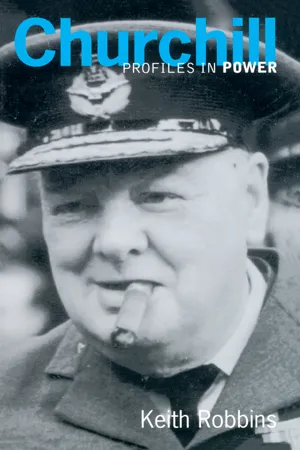
Keith Robbins provides an excellent introduction to Winston Churchill's dramatic rise to power and traces the unpredictable way his career moved between triumph and tragedy. Providing a vivid picture of the political landscapes through which he moved, it outlines his career and uncovers what made possible Churchill's leading role in national and world affairs.
eBook - ePub
Churchill
About this book
Information
TO MY FORMER COLLEAGUES IN THE DEPARTMENT OF MODERN HISTORY UNIVERSITY OF GLASGOW 1980–1991
Chapter 1
WINSTON, THE HOUSE OF CHURCHILL AND THE DESTINY OF BRITAIN
· · ·
HIS FATHER’S SON
Winston Churchill was born in the heart of England on St Andrew’s Day, 30 November 1874. His place of birth was Blenheim Palace, the magnificent house built at Woodstock in rural Oxfordshire between the years 1705 and 1722. It was the gift of a grateful sovereign to John Churchill, first Duke of Marlborough, conqueror of the French and victor in the battle of Blenheim. Kings and princes from across Europe had to confess that even their palaces could not compare with the stately home of the Spencer Churchills, Dukes of Marlborough. The Victory column in the grounds of the palace reminded all visitors of a great English soldier’s achievements – and of the rewards of success. John Churchill was Winston’s ancestor. A baby born at Blenheim was liable to have an unusual perspective on life.1
The bells of Woodstock rang out in deferential celebration: baby Winston could be a future Duke of Marlborough. In manhood he might be guardian of the lake, the bridge and miles of glorious park. He would possess the power of a great English aristocrat, secure in his estates and preeminent in social position – there were only twenty dukes in the country. Like the 7th Duke, Churchill’s grandfather, he might sit in the House of Commons before succeeding to the title. The borough of Woodstock offered an easy route to Westminster. Its voters were well-schooled in the notion that they should support the Churchill family. There might subsequently be a ducal role in government, perhaps in a not too onerous capacity. Like the 7th Duke, and previous dukes, Winston might marry the daughter of a duke, a marquess or an earl. The House of Churchill would go on for ever. It never entered anyone’s head that this aristocratic cherub would lead his country in a desperate struggle for survival. Hitler and Stalin, with whom he shared the world stage, ruthless and rootless wielders of power after the collapse of the old order in Europe, the order of aristocratic power and presumption, were inconceivable.
Even in Oxfordshire in the 1870s, however, the appearance of unchanging stability was a little deceptive. It was unlikely that the Marlboroughs would be swept away by invading peasants, but by the 1870s they were not insulated from the crisis of agriculture which, to greater or lesser degree, afflicted all great estates in the years of the ‘Great Depression’. The story was one of falling rents and declining land values. There was no coal to be mined in Blenheim Park, but there was an alternative source of financial salvation on the far horizon. It was an Atlantic connection.2
The 7th Duke had two surviving sons (and six daughters). He came to feel that his heir was rather a ‘disappointment’ and that the continued restoration of the family’s fortunes more might rest on his younger son, Lord Randolph, whose undistinguished Eton career had been followed by a period at Merton College, Oxford. In 1874 he had been elected to the House of Commons as MP for the ‘family borough’ of Woodstock – though there was increasing local opposition to the notion of a ducal ‘nominee’. He had completed the statutory European tour and acquired experience of carousing. His walrus moustache made an impression on ladies. He was good with horses and words. The Prince of Wales admitted him to his circle. Combined, these attributes offered much promise, but he was the younger son of a relatively poor duke who had a rather large house and household to maintain.3
In April 1874 he married Jennie Jerome in the British Embassy Chapel in Paris. The Prince and Princess of Wales sent a generous present, and the prince’s private secretary was his best man. The couple had met the previous summer at a Cowes Ball, but the subsequent negotiations for the marriage had not been straightforward. No previous Spencer Churchill had married the daughter of an American stockbroker. Randolph’s father noted that Jennie’s father had been bankrupt once, and might become so again. On the other hand, he appeared to have a capacity for making (though also for spending) a great deal of money. At this particular phase in Jerome’s financial cycle, however, he fortunately seemed comfortably placed, though from a ducal perspective he still gave every appearance of being a vulgar kind of man. The allowance which Mr Jerome and the Duke proposed to make naturally required careful consideration; and there was a possible offspring to be taken into account. The outcome permitted the lease of a house in Mayfair and the underwriting of the social life which would accompany it. Such provision, ample though it was, did not fully take into account the ambitions and activities of Randolph and Jennie.4
Blenheim, in all its splendour, was to be in the background throughout Winston Churchill’s life, and even in death it was not out of sight. It is possible to see the tower of Bladon church from the palace. It was to Bladon churchyard that Winston was taken in 1965 for burial alongside his mother and father amongst the Churchill graves. Throughout his life he paid frequent visits and the most mixed memories came flooding back. He showed great skill in deciding that it would be sensible to propose to his future wife in Blenheim’s Temple of Venus. He could not write a life of Marlborough without spending time at Blenheim. In the summer of 1938, he and Anthony Eden, newly resigned as Foreign Secretary, gloomily spent the evening on the terrace discussing the future of Europe. In 1947 he addressed a major Conservative rally in its grounds, sensing that he might yet turn the political tide in his favour.
Yet it was never his palace. Uncle George, who also had an American girl as his second wife, had a son, ‘Sunny’, who succeeded as 9th Duke in 1892. Three years later Sunny married Consuelo Vanderbilt. She brought with her from the United States an income of £20,000 a year and income from a fund of £500,000. Blenheim needed such resources. It also needed a son, apparently, to keep out the little upstart, Winston. The son was achieved but the marriage ended in divorce. Sunny’s second wife, whom he married in 1921, was also American. In the event, the birth of a son meant that Winston was never to be Duke of Marlborough. If he had succeeded to the title he would never have become Prime Minister. The days were passing, indeed had passed, when a duke might realistically aspire to be Prime Minister. As a mere duke, of course, Winston would also not have been the subject of more biographical studies, large and small, than any other Englishman in the twentieth century. An accident to his cousin, and the future shape of his life would have been altered.
A paradox was therefore apparent from childhood: it was indisputable that as a Churchill he sprang from the ‘ruling class’ but only because he was the son of a younger son might he even aspire to be a real ‘ruler’. Yet, as he grew up, it might be his aristocratic pedigree which would preclude such a possibility. The Second Reform Act, passed in 1867, had proved a risky ‘leap in the dark’. In extending the franchise to give the vote to one in three adult males in England and Wales, the immediate effect had been to produce in 1868 a Liberal government presided over by Gladstone. It was that administration which had been defeated in the 1874 General Election in which Lord Randolph was elected to the House of Commons. At the age of seventy, Disraeli became Prime Minister. He had an opportunity to demonstrate that the Conservative Party could survive and flourish in the eyes of an extended electorate. It remained to be seen what contribution to this cause would be made by the dandy twenty-five-year-old member for Woodstock. Upon the outcome might depend the future career of baby Winston.
It was reasonable for the political world to suppose that Lord Randolph’s career would be colourful and erratic. It was not reasonable for that world to predict that he would be dead at the age of forty-five. It did not know that he was already afflicted with syphilis. He struggled against this disease for the rest of his life, sometimes apparently with success, before it eventually killed him. While there is debate about the circumstances which produced the illness, there is little doubt now about its nature. The gravity of the complaint, which was sometimes suspected, may help to explain the impatience and unpredictability attaching to Lord Randolph’s behaviour.
Churchill was certainly ambitious but he did not confine himself to politics, narrowly defined. He spoke only occasionally in the Commons and threw himself into a vigorous round of social engagements. In 1876 his conduct in a private matter involving the Prince of Wales and a lady brought him into disfavour at court. It led not to a duel with the prince in Rotterdam – an initial possible outcome – but to Randolph going to Dublin, in effect into ‘exile’, to act as unpaid secretary to his father who had recently been appointed Viceroy of Ireland. Whilst in Dublin, Irish politics occasionally interfered with hunting and the social life of the Viceregal Lodge. In addition, Lord Randolph spasmodically returned to London to make a few disconcerting speeches in the Commons. There was, for example, an assault in 1878 on the government’s own County Government Bill which, he believed, attacked the right of property and undermined the independence of local self-government. He called it a radical and democratic measure which violated Tory principles. The attack was successful and confirmed the impression that Lord Randolph could be a coming man, particularly since the first steps were being taken to end the Churchills’ banishment from court circles. It was not to be until 1884, however, that Randolph and the Prince of Wales sat down at table together again.
Gladstone and the Liberals won the 1880 General Election. Lord Randolph could not be said to have been particularly concerned with the welfare of his constituents over the preceding few years. He held his Woodstock seat only narrowly, despite the mobilisation of the Marlborough influence in his favour. The Liberal Cabinet looked so powerful and Northcote, the Conservative leader in the Commons, so weak. Randolph was impatient. Together with associates in the so-called ‘Fourth Party’ he embarked upon a series of parliamentary skirmishes which sometimes embarrassed his own side as much as the government. His speeches and his conversation sparkled with phrases that admirers found apt and incisive. His opponents recognised that he was rather a ‘star’ in the provinces. Disraeli died in 1881 and the subsequent arrangement whereby Lord Salisbury led the Tory Party in the Lords and Northcote in the Commons was not working well. Lord Randolph believed that he could manage a more effective Opposition, and increasingly behaved accordingly. He wrote to Northcote in 1883 declaring that in Parliament he had always acted on his own account and would continue to do so. He supposed that the results of such action had not been at all unsatisfactory.
It cannot be said, nevertheless, that the minutiae of policy, the delights of style or the intricacies of parliamentary strategy formed the daily diet on which young Winston was raised. He had a brother – who may not have been his father’s child – born in 1880 and a devoted nanny, but his parents were aloof and detached. Neither Randolph nor Jennie allowed their lives to centre on their children. They were frequently apart and frequently ill in the early 1880s. In 1881 they despatched Winston to St George’s School near Ascot. It was not a success. He was taken away by his mother three years later and sent to a small school in Brighton. He had been beaten and was rather frail. Lord Randolph came to Sussex, but he did not come to see his son. However, just ten, the boy by the seaside knew about General Elections. At the end of 1885 he wrote to his father wishing him success in the Birmingham seat which he was contesting, though he probably did not fully understand the campaign’s significance.5 The Third Reform Act of 1884, which extended the franchise to some two out of three adult males in England and Wales, was followed by a Redistribution Act. One of the boroughs to be disfranchised was Woodstock. Lord Randolph was forced to look for a new seat and, never one for half measures, announced that he would campaign against the venerable John Bright in Central Birmingham and, by implication, challenge the Liberal hegemony over the city’s politics established by Joseph Chamberlain. Winston was sorry that the challenge failed but was relieved to know that Lord Randolph was elected instead for South Paddington, a safe seat.
In the space of a few years, Lord Randolph had become a ‘name’. Politics became his passion. There was scarcely any manoeuvre, or perhaps the word is conspiracy, with which his name was not linked. He had managed to insinuate himself into the highest levels of the National Union of Conservative and Constitutional Associations, a body founded in 1867 which aspired to represent constituency opinion within the Conservative party. At the end of 1883 he had been present at the formation of the ‘Primrose League’. In its initial conception its historian, Martin Pugh, sees the League as an extra-parliamentary ‘Fourth Party’ rather than an embryonic mass organisation. Banners and badges, however, feature prominently in its public activity. To what end was this hectic effort? Probably even Lord Randolph himself was not clear. He certainly had no respect for Northcote as party leader. Did he aspire to be party leader himself without further ado? The thought may have passed through his mind but even he might have supposed such an ambition premature. That left a relationship with Lord Salisbury in which the two men were both antagonists and partners. Salisbury saw Churchill as a popular figure who could undermine Northcote in the country in a way which he could not do himself. On the other hand, the National Union might place a demotic spanner in the workings of aristocratic government. In turn Churchill could make his own terms, or at least be in a strong position in a Salisbury government. An accord between the two men was reached in the summer of 1884. When a Conservative government was formed in June 1885 – the Liberals having been defeated in the Commons – Salisbury became Prime Minister and Lord Randolph became Secretary of State for India.
Salisbury was lugubriously pensive where Churchill was exuberantly garrulous but they were both reacting to the evident challenge to men of their order. The electoral changes of 1884–5 and the attack on ‘corrupt practices’ in an Act of 1883 threatened to remove the political role of the aristocracy. Salisbury had opposed the 1867 Reform Act and such were his forebodings then that he was somewhat surprised to find himself evidently still a major political figure nearly twenty years later. He thought hard and prayed hard. The British Constitution was a mixed constitution. If the Commons became dominant, would property be safe and if property was not safe could liberty survive? He was thinking of his country seat, Hatfield House, but not only of Hatfield House. The word ‘democracy’ – if it really implied that ‘the people’ should control government – was a rather uncomfortable one. Churchill, for his part, affected not to find ‘democracy’ alarming, provided the adjective ‘Tory’ was placed in front of it. In Birmingham in April 1884 he had urged his audience to ‘Trust the People’ and declared that he had no fear of democracy (by which, like most contemporaries, he meant not so much a system of government as ‘the power of the people’). It should be the policy of the party to rally the people round the Throne and to unite the Throne with the people. He did not pray as hard as Lord Salisbury, but he also put in a good word for the Church of England, an institution which elevated the life of the nation and consecrated the acts of the State. Churchill appeared confident and Salisbury gloomy, but between them two representatives of ‘old’ families could perhaps conduct another skilful political adjustment in the century of aristocratic retreat.
Churchill’s success in South Paddington had not been sufficiently repeated by Conservatives elsewhere in the country. However, the Liberals were in difficulties caused by Gladstone’s announcement in opposition of his conversion to Home Rule for Ireland – a step which upset many in his own party. The early months of 1886 were full of extraordinary twists and turns in which Lord Randolph featured prominently. Adherence to steadfast principle will not explain the behaviour of any of the leading figures – Gladstone, Chamberlain, Salisbury and others – so we need not think of Lord Randolph’s performance as exceptionally unprincipled. From his Dublin days onwards, he had made speeches in condemnation of coercion in Ireland and prized his Irish political contacts. Now, however, his opposition to Home Rule was fierce and even led him to speak favourably of the previously despised Ulster Tories. He was willing to ‘play the Orange card’ – that is to say identify with the Ulster opposition to Home Rule – and visit Belfast personally: it was inconceivable, he told his audience there, that the British nation would be so apostate as to hand over the Loyalists of Ireland to the domination of an Assembly in Dublin. Home Rule was simply an exercise to gratify the ambition of an old man in a hurry – Churchill’s gift for a striking phrase had not deserted him. He floated the idea of a ‘party of Union’ which could fight against the impending disaster. Whatever its prospects, the Liberal Party had become the party of internal division, and Churchill had played a full part in encouraging the Liberal dissidents and causing the government to fall.
He had his reward by being made Chancellor of the Exchequer and Leader of the House in the government Salisbury formed after the Tories were successful in the General Election of July 1886. He was only thirty-six. Queen Victoria thought him ‘mad and odd’ but saw that his appointment could not be helped. She could not have suspected that this amazing man, who appeared to be successfully storming every political citadel, would be out of the government by the end of the year. Perhaps Lord Salisbury did. There were disagreements in Cabinet and the Prime Minister was amply provided with illustrations of Churchill’s lack of judgment. It would not have been so bad if the Chancellor had refrained from pressing his views on foreign policy. His moodiness and arrogance were tolerable when relieved by his humour, but humour was increasingly absent. This was not the ideal spirit in which to approach the reconciliation of departmental claims in the framing of his first Budget. Churchill was uncompromising. He was determined to reduce expenditure and declared that he could not be responsible for finance if he had to yield to demands for increased spending. Epistolary exchanges followed.
The Duchess of Marlborough, who happened to be staying at Hatfield House, the Prime Minister’s residence, awoke on the morning of 23 January to the news that her son had resigned and that his resignation had been accepted. It appeared that the Prime Minister was sanguine about this outcome. Prophecies that the government could not survive the loss of such a talented and popular figure proved false. At the beginning of 1887 Lord Randolph entered the political wilderness from which he never returned. Lord Rosebery, a man of comparable brilliance and comparable ultimate failure, was one of the few to be able to give him encouragement. In the short life that lay ahead of Churchill there were glimpses of former glories and flashes o...
Table of contents
- Cover
- Half Title
- Title Page
- Copyright Page
- Table of Contents
- Preface
- CHAPTER 1 Winston, the House of Churchill and the Destiny of Britain
- CHAPTER 2 The Parliamentary Pursuit of Power
- CHAPTER 3 Making War and Peace 1914–1922
- CHAPTER 4 Down and Out? 1922–1939
- CHAPTER 5 In Command of War 1939–1945
- CHAPTER 6 Loss of Power 1945–1955
- CHAPTER 7 Epilogue: Triumph and Tragedy
- Further Reading
- Chronology and Publications
- Index
Trusted by 375,005 students
Access to over 1.5 million titles for a fair monthly price.
Study more efficiently using our study tools.
Frequently asked questions
Yes, you can cancel anytime from the Subscription tab in your account settings on the Perlego website. Your subscription will stay active until the end of your current billing period. Learn how to cancel your subscription
No, books cannot be downloaded as external files, such as PDFs, for use outside of Perlego. However, you can download books within the Perlego app for offline reading on mobile or tablet. Learn how to download books offline
Perlego offers two plans: Essential and Complete
- Essential is ideal for learners and professionals who enjoy exploring a wide range of subjects. Access the Essential Library with 800,000+ trusted titles and best-sellers across business, personal growth, and the humanities. Includes unlimited reading time and Standard Read Aloud voice.
- Complete: Perfect for advanced learners and researchers needing full, unrestricted access. Unlock 1.5M+ books across hundreds of subjects, including academic and specialized titles. The Complete Plan also includes advanced features like Premium Read Aloud and Research Assistant.
We are an online textbook subscription service, where you can get access to an entire online library for less than the price of a single book per month. With over 1.5 million books across 990+ topics, we’ve got you covered! Learn about our mission
Look out for the read-aloud symbol on your next book to see if you can listen to it. The read-aloud tool reads text aloud for you, highlighting the text as it is being read. You can pause it, speed it up and slow it down. Learn more about Read Aloud
Yes! You can use the Perlego app on both iOS and Android devices to read anytime, anywhere — even offline. Perfect for commutes or when you’re on the go.
Please note we cannot support devices running on iOS 13 and Android 7 or earlier. Learn more about using the app
Please note we cannot support devices running on iOS 13 and Android 7 or earlier. Learn more about using the app
Yes, you can access Churchill by Keith Robbins in PDF and/or ePUB format, as well as other popular books in Politics & International Relations & 20th Century History. We have over 1.5 million books available in our catalogue for you to explore.