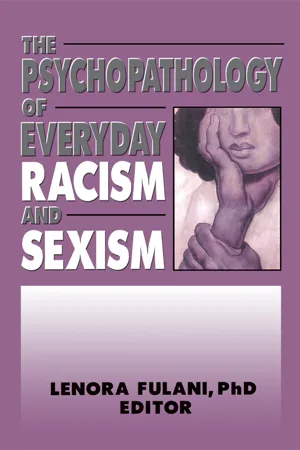
In this enlightening book, women of color eloquently and honestly articulate the impact of racism, sexism, and poverty on their personal lives and on the histories of their people. They express anger at the failure of traditional psychiatry and psychology--which tend to advocate assimilation, meaning the denial of one's cultural and historical identity--to understand the struggles and problems in their lives. The contributors to The Psychopathology of Everyday Racism and Sexism--who come from both inside and outside the psychological disciplines--examine newer therapies in which women are encouraged to identify and express emotional reactions to other people, racism, and abuse and to expose the humiliation they feel. These new therapeutic processes--representing a milestone in psychological theory and practice--help women of color develop their historical identity and reject socially-induced shame and degredation.The editor of this vital book is Lenora Fulani, a developmental psychologist and an active political leader. Dr. Fulani explores how a lack of power over one's life and deprivation of a sense of oneself as historical are commonly associated with psychological problems. The added stress of low social status, sexual exploitation, poverty, abuse, and drug and alcohol problems, result in an enormous sense of failure and incredible vulnerability to emotional stress. With passion and compassion, The Psychopathology of Everyday Racism and Sexism advocates an empowering sense of community based on the power of and love for the oppressed.
- 140 pages
- English
- ePUB (mobile friendly)
- Available on iOS & Android
eBook - ePub
The Psychopathology of Everyday Racism and Sexism
About this book
Information
Feminist Therapy with Hispanic/Latina Women:
Myth or Reality?
Myth or Reality?
Lillian Comas-Díaz is the former Director of the Yale Department of Psychiatry Hispanic Clinic and the former Director of the American Psychological Association’s office of Ethnic Minority Affairs. Currently, Dr. Comas-Díaz is the Co-Director of the Trans-Cultural Mental Health Institute in Washington, DC, where she also has a private practice. She has published extensively on psychotherapy with emphasis on ethnic minority women and transcultural psychotherapy. Dr. Comas-Díaz is involved with Amnesty International and went to Chile to investigate the effects of abuses of human rights on mental health.
INTRODUCTION
The relevance of feminist therapy to ethnic minority populations has been questioned. Most of these concerns arise from criticisms of the earlier feminist philosophy. Ethnic minority women’s alienation from the feminist movement stems from the women’s movement’s emphasis on the paid labor force and the subsequent escape from the confines of the home (Dill, 1983). Such emphasis is foreign to many women of color, who have worked all of their lives and will continue to do so. In their discussion of feminist therapy’s relevance to Black and Hispanic populations, Mays and Comas-Díaz (in press) state that ethnic minority women’s criticism of feminism arises out of two beliefs: (1) women’s oppression is the most fundamental oppression, and (2) sisterhood asserts that a female has more in common with another female regardless of ethnic, racial, or socioeconomic group. These feminist beliefs tend to neglect the crucial role that ethnicity, culture, race, and socioeconomic class play in the lives of women of color. This article examines the application of feminist therapy to Hispanic/Latina women.
FEMINIST THERAPY AND HISPANIC/LATINA WOMEN
Ethnicity and feminism have been opposing forces. Due to survival issues, many ethnic minority women tend to be more committed to their ethnic identity as opposed to their political identity as women (Dill, 1983). Moreover, their overriding commitment is with the improvement of their ethnic/racial group, for both female and male members. Takooshian and Stuart (1983) further discuss the conflict prevalent between feminism and ethnicity. They argue that ethnic women tend to resist feminism because it is egalitarian, universalistic, and moves from an imperfect present to a more perfect future. Conversely, ethnicity emphasizes group differences, it is particularistic, and seems to rely more on a traditional past.
The question remains: Is feminist therapy relevant to Hispanic/Latina women? or, Is the application of feminist therapy to Hispanic/Latina women a myth or a reality? There has been an increased awareness in feminism among Latin American women. These women are questioning their roles vis-à-vis the oppression that they experience imposed by their male counterparts (Costello, 1977). Moreover, Latin American writers are viewing feminism as a process leading towards women’s emancipation from their second class citizenship (Zayas & Silén, 1972). Defined as a set of political, economic and social values which support balanced power relations between the sexes, feminism is potentially relevant to all women. However, in order to be effective with Hispanic women, this perspective needs to be culturally embedded.
Current feminist therapy is conceptualized as a pluralistic, integrative, and dialectical perspective that has the potential to accommodate the complex, unique, and changing needs of Hispanic women. It calls for a dialectical relationship between its theory and practice. Current feminist therapy is not restricted by any particular theoretical orientation. It is a perspective that integrates feminist philosophy into theory, practice and ethical standards of traditional psychotherapies (Douglas & Walker, in press). As an interactive process, feminist therapy allows for the accommodation of the ethno-sociocultural variables, political influences, and women’s intrapsychic realities, and their consequent impact on the etiology, presentation, expectations, and approach to treatment of women of color (Mays & Comas-Díaz, in press).
Feminist therapy also entails a commitment to social change. When working with Hispanic/Latina women, as well as with other women of color, social change acquires pivotal relevance. Delivering services to Hispanic women requires an understanding of the sociopolitical forces that shape their lives, and demands an active involvement of these issues in treatment. Such a perspective examines the unique experiences of Hispanic women, acknowledging the influence that society has on them.
In the author’s clinical experience, using feminist therapy with Hispanic women can potentially result in a greater awareness and understanding of the oppressive effects of traditional sex role while functioning within the mainstream society. This approach also helps Latinas with their adaptation to cultural change, and offers them a more functional coping style. Hispanic/Latina women become more aware of their oppressive situations, explore more options, and are empowered to make informed decisions.
Feminist therapy can be perceived as a means of empowerment for Hispanic women. Given their long history of oppression, this perspective could help Hispanic women in their liberation process. The process of empowerment within the feminist psychotherapeutic context is identified by Mays and Comas-Díaz (in press) as helping women of color to:
1. acknowledge the deleterious effects of sexism and racism;
2. deal with feelings of anger and self degradation imposed by their status of ethnic minorities;
3. perceive themselves as causal agents in achieving solutions to their problems;
4. understand the interplay between the external environment and their inner reality; and
5. perceive opportunities to change the responses from the wider society.
A sixth factor that needs to be added to the empowerment of Hispanic women within the feminist psychotherapeutic context is the acknowledgment of the deleterious effects of elitism. Among the diverse Hispanic/Latino populations in the United States, social class becomes a differential variable. Latin American countries, like many other Third World countries, have clear demarcations along social class lines. In fact, many Latin American countries do not have a middle class as we know it in the United States. Thus, elitist attitudes, based on the dichotomous social class divisions, are transplanted to the United States. Feminist therapy, with its emphasis on social context, can help Hispanic/Latina women to identify their own elitism and prejudices, to confront the elitism that they may be subjected to by their own cultural group, and to develop a more egalitarian perspective.
Empowerment for Hispanic/Latina women also involves the satisfactory negotiation of conflictive cultural demands. For many Latinas this entails coping with culture change, acculturation, and biculturalism. More specifically, the process of empowerment helps to achieve the successful negotiation of traditional sex roles, with the changing sexual mores, and with the emergence of new ones. Notwithstanding these issues, feminist therapy requires the integration of a sociocultural perspective in order to be effective with the Hispanic female. Let us examine some of these variables.
SOCIALIZATION AND DEVELOPMENTAL ISSUES
The wide diversity among the Hispanic/Latino populations in the United States constitutes a mosaic. Hispanics are multicultural, multiracial, and multiethnic. Some of them have recently immigrated, while others have been in the U.S. since long before the arrival of the Pilgrims. Hispanics is a generic term used by the U.S. Bureau of the Census to designate persons of Spanish origin or descent, or those who designate themselves as Mexican, Mexican American, Chicano, Puerto Rican, Boricua, Cuban, or other Spanish/Hispanic. Some Hispanics designate themselves as Latinos, stressing their Latin American background. Regardless of self-designation, their attachment to the Hispanic culture and Spanish language is strong. While they share a common bond of cultural background, language, and religion, the different Hispanic groups have distinct profiles. Each group has its own perceptions of itself, other Hispanic/Latin groups, and of its place in the United States.
Hispanic/Latina women share a stronger and deeper common bond. Espin (1986) has identified this bond as resulting from four elements: Historical influences (colonization by Spain, cultural background), the experience of separation by (im)migration, the cognitive and affective effects of sharing a common language, and the experience of oppression. Obviously, this bond is further strengthened by the experience of being female within the Hispanic/Latino context.
Gender Issues
One feminist premise is that the socialization of women differs from that of men and that this socialization is destructive and oppressive to women. Let us examine its relevance to the Hispanic/Latino culture. Traditionally, the Hispanic family is patriarchal, with an authoritarian father, a “submissive” mother, and a mutual acceptance of this pattern. Throughout Latin America, San Martin (1975) found women’s subordination to men’s authority well-accepted.
Boys and girls are taught early on two very different codes of sexual behavior. Traditional Hispanic women are expected to be sentimental, gentle, intuitive, impulsive, docile, submissive, dependent and timid; while men are expected to be cold, intellectual, rational, profound, strong, authoritarian, independent, and brave (Senour, 1977). This rigid demarcation of sex roles encourages a double moral standard for the sexes, exemplified in the marianismo/machismo syndrome.
The concept underlying marianismo is based on the Catholic worship of the Virgin Mary, who is both a virgin and a madonna. Marianismo predicates that women are spiritually superior to men, and therefore capable of enduring all suffering inflicted by men (Stevens, 1973).
Taught to follow the Virgin Mary as their ultimate model, unmarried women are expected to be chaste and virginal and not to demonstrate interest in sex once they are married. When they become mothers, Hispanic women attain the status of madonnas and, accordingly, are expected to sacrifice in favor of their children and husbands. The self-sacrifice maxim is very common in the Hispanic/Latina culture. For example, the image of the Mater Dolorosa is prevalent among Mexican American women, who without being masochistic, appear to obtain satisfaction and fulfillment from “suffering” (Bach y Rita, 1982).
The counterpart of marianismo is machismo. This sex role literally means maleness or virility, but culturally it means that the man is the provider and responsible for the welfare, honor, and protection of the family. In its extreme form, machismo is manifested through physical dominance of women and excessive alcohol consumption (Giraldo, 1972). Furthermore, machismo dictates that the Hispanic male must constantly signal his sexual availability; seductive behavior is mandatory regardless of marital status (Sluzki, 1982). Paradoxically, the macho must protect his female relatives from the sexual advances of other men while making as many sexual conquests as possible. Though it has been argued that machismo is more prevalent among lower socioeconomic classes (Kinzer, 1973), it is nevertheless believed to influence behavior in all strata of the Hispanic/Latin American society (Giraldo, 1972).
Machismo has also been examined from a psychodynamic perspective. Aramoni (1982) argues that machismo can be perceived as men’s effort to compensate for their overpresent, powerfully demanding and suffering mothers, as well as an identification with their psychologically absent fathers. More recently, machismo has been examined from a socioeconomic and historical perspective, emphasizing more its characteristics as provider and supporter (both financially and emotionally) of the family members (De La Cancela, 1986).
A third sex role prevalent among some Hispanic/Latina women is hembrismo, which literally means femaleness. Hembrismo has been described as a cultural revenge to machismo (Habach, 1972). According to Gomez (1982), a male psychiatrist, hembrismo is a frustrated attempt to imitate a male, resulting in a primitive or rough female. This imitation occurs in a sociosexual spectrum of idealized roles, becoming a natural reaction within a historical context. Gomez further posits that hembrismo shares common elements with the women’s movement in the areas of social and political goals.
Comas-Díaz (1982) discusses hembrismo within the Puerto Rican society. She argues that hembrismo acknowledges the powerful position that the female has in her culture. The indigenous Puerto Ricans, the Taíno Indians, had a matriarchal society, under which family name, property, and tribal leadership were inherited through the females (Steiner, 1974). However, females did not utilize their power to oppress males. The females’ strong influence was further strengthened by spiritual power. Females had the power to invoke the spirits, which attributed an extraordinary importance to the female in an island ruled by the “earth mother concept” (Fernández-Méndez, 1972).
Presently, hembrismo connotes strength, perseverance, flexibility, and an ability for survival. However, it can be translated into the woman’s attempt to fulfill her multiple roles expectations as a mother, wife, worker, daughter, member of the community, etc.; in other words, the superwoman working the double jornada (double day; working at home and outside the home). This situation can precipitate stress and emotional problems for the woman behaving in the hembrista fashion. On the other hand, hembrismo can also explain the strength, motivation, and will power that characterize Hispanic females.
Acculturation
The construct of acculturation acquires a crucial significance while working with Hispanic/Latina women. Studies of immigrant families indicate that ethnic values and identification with the culture of origin are retained for many generations after the immigration has occurred (Greeley, 1981) and so, too, the impact of the translocation are manifest in clinical situations several generations after the move (Sluzki, 1979). For instance, sex roles among Hispanic women in the United States can be complicated (and confused) by the expectations imposed by the two different cultural contexts in which they operate. The Anglo culture tends to apply “masculine” criteria to the evaluation of women, ascribing the greatest value to those who distinguish themselves occupationally or professionally. Yet this tendency is contradicted enough to send mixed messages to the female. Consequently, for example, the Chicana is far surer of her role within the traditional Mexican American culture than she is in the mainstream, where her role is ambivalent (Senour, 1977). Apparently, this sureness of role that her Hispanic culture provides has not stopped the Chicana, nor other Latina women in the midst of cultural change, from exploring the behavioral alternatives available to her. This experimentation can lead to conflict within the nuclear unit as well as within the extended family. Feminist therapy can help Hispanic women to deal with these contradictions and help them distinguish the societal pressures from their ethnocultural realities, from their personal dynamics.
The diverse degrees of acculturation need to be examined in treatment, as they are often related to gender roles. To illustrate, Torres-Matrullo (1980) found a significant relationship between level of acculturation, level of education and family and sex role attitudes among mainland Puerto Rican women. Findings indicated that the traditional concepts of womanhood appeared to be changing toward a more egalitarian model due to the increased education and exposure to the American society, but that the sacredness of motherhood remained as a cultural value.
Several reactions to culture change and acculturation among Hispanic/Latina women have been reported. Within a psychotherapeutic context, Comas-Díaz (1982) discussed three reactions to acculturation which are described as fluid coping styles. Low in the acculturation spectrum is the culturally marginal woman who has limited contact with the mainstream society. Typical of this category is the Hispanic woman who (im)migrated during her middle age, has limited education, is Spanish monolingual, and rigidly adheres to her cultural values, resistant to change. The second classification is characterized by high acculturation and assimilation, to the point of denying the ...
Table of contents
- Cover
- Half Title
- Title Page
- Copyright Page
- Table of Contents
- EDITORIAL “All Power to the People!” But How?
- A Song
- En la Lucha: The Economic and Socioemotional Struggles of Puerto Rican Women
- I Am Your Sister: Black Women Organizing Across Sexualities
- I Am a Woman
- Asian-American Women: Psychological Responses to Sexual Exploitation and Cultural Stereotypes
- Feminist Therapy with Hispanic/Latina Women: Myth or Reality?
- The Impostor
- The Necessary Bitch
- “Conscious Subjectivity” or Use of One’s Self in Therapeutic Process
- First Dialogue
- Marxism, Psychoanalysis and Feminism: A View from Latin America
- Visit to the Dentist: Dialectics
- Poor Women of Color Do Great Therapy
Trusted by 375,005 students
Access to over 1.5 million titles for a fair monthly price.
Study more efficiently using our study tools.
Frequently asked questions
Yes, you can cancel anytime from the Subscription tab in your account settings on the Perlego website. Your subscription will stay active until the end of your current billing period. Learn how to cancel your subscription
No, books cannot be downloaded as external files, such as PDFs, for use outside of Perlego. However, you can download books within the Perlego app for offline reading on mobile or tablet. Learn how to download books offline
Perlego offers two plans: Essential and Complete
- Essential is ideal for learners and professionals who enjoy exploring a wide range of subjects. Access the Essential Library with 800,000+ trusted titles and best-sellers across business, personal growth, and the humanities. Includes unlimited reading time and Standard Read Aloud voice.
- Complete: Perfect for advanced learners and researchers needing full, unrestricted access. Unlock 1.5M+ books across hundreds of subjects, including academic and specialized titles. The Complete Plan also includes advanced features like Premium Read Aloud and Research Assistant.
We are an online textbook subscription service, where you can get access to an entire online library for less than the price of a single book per month. With over 1.5 million books across 990+ topics, we’ve got you covered! Learn about our mission
Look out for the read-aloud symbol on your next book to see if you can listen to it. The read-aloud tool reads text aloud for you, highlighting the text as it is being read. You can pause it, speed it up and slow it down. Learn more about Read Aloud
Yes! You can use the Perlego app on both iOS and Android devices to read anytime, anywhere — even offline. Perfect for commutes or when you’re on the go.
Please note we cannot support devices running on iOS 13 and Android 7 or earlier. Learn more about using the app
Please note we cannot support devices running on iOS 13 and Android 7 or earlier. Learn more about using the app
Yes, you can access The Psychopathology of Everyday Racism and Sexism by Lenora Fulani in PDF and/or ePUB format, as well as other popular books in Psychology & Ethnopsychology. We have over 1.5 million books available in our catalogue for you to explore.