![]()
Chapter 1
The Gene Rush: Finding New Value
in Aquatic Biodiversity
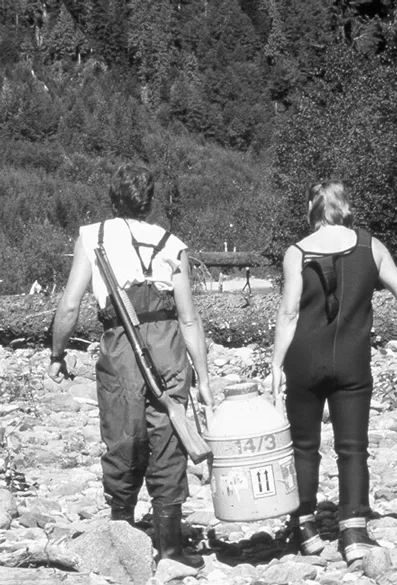
Salmon gene banking in bear country, British Columbia (Photo by Monica MacIsaac)
Out of sight, out of mind. Nowhere does the saying seem more appropriate than in the way we treat underwater life. Our scientific understanding of aquatic biodiversity lags far behind our knowledge of terrestrial life. Naturally, we're quicker to understand the potential for commercial exploitation than we are to decipher and deal with threats to aquatic biodiversity. Food fish aquaculture, which barely existed three decades ago, has since emerged as the fastest growing food industry. Along the ocean floor, the modern equivalent of the gold prospector is the pharmaceutical company researcher, sifting through samples of sponges, ascidians and other bottom-dwelling organisms in the hope of finding cures for cancer and other diseases. As in the plant world, advances in genetics signal that we've barely scratched the surface in our quest for new (and often controversial) uses for aquatic life, whether plugging a flounder gene into a strawberry to increase its resistance to frost or finding a way to use deep sea microorganisms to gobble up oil spills.
We are quickly learning how to expand our uses for the still largely untapped capital of the waters of the planet. But do we really know how to conserve that capital as an investment for the future? If we managed our financial assets the way we manage biological ones, we'd be going down the road to bankruptcy. Generally, global policies for the management of aquatic biodiversity are muddled, reactive and without teeth. Why? Largely because policy makers often lack access to the biological understanding needed for informed decisions and because governments typically cater to the noisiest and most influential ‘stakeholders’. There's nothing new about this reality, of course, but no one really likes to admit that it's so.
Understanding the current and potential values of any resource, as well as the threats that jeopardize those values, is the first step towards sound policy development. This chapter describes a diversity of new uses that humans are finding for aquatic biodiversity as well as the not-so-new human threats that continue to undermine the integrity of biological and genetic diversity. The chapter concludes with a case study on the ornamental fish industry in the Rio Negro in Brazil. The study illustrates just how difficult it can be to develop adequate strategies for the conservation and appropriate use of aquatic biodiversity in the face of ever advancing technologies. The Rio Negro story also illustrates the important role that rural communities can play in ensuring the sustainable management of aquatic biodiversity – a theme that we'll continue to develop throughout this book.
Why is genetic diversity so important?
Biological diversity is the sum total of genes, species and ecosystems – what has been described as the great evolving web of life made up of interdependent, fragile strands. Break a thread, and the strength of the whole suffers. Genetic diversity (genetic variability within species) holds the web together and can repair small breaks. Today, we hear a lot about the sustainable use of natural resources – and that means maintaining the biological and genetic diversity that provides the natural capital for human economies.
The diversity of aquatic life
The approximately 1.5 million living species that have been identified to date represent a tenth or less of the total number estimated to exist (Wilson, 1999). Largely because aquatic creatures inhabit a hidden world, far less is known about marine and freshwater species than about terrestrial ones.
Named terrestrial species outnumber those in ocean environments by seven to one, but the deep sea alone may contain 10 million species that have yet to be described (Norse, 1993). Communities of life on the ocean floor are the least understood ecosystems on the planet. Many of the deeper parts of the ocean are largely beyond the frontier of existing knowledge. Scuba divers can't work below about 92 m – about 1/250th of the depth of the deepest parts of the oceans. New forms of ocean life are constantly being discovered. It was only 25 years ago that life was found to exist in hydrothermal vents, approximately 2500 m below the surface, in international waters off Ecuador's Galapagos Islands. That led to identification of many new species of marine organisms, including bacteria adapted to life in near boiling water mixed with toxic chemicals issuing from the vents. Unique forms of tubeworms, crabs and clams that feed on the bacteria may be only the first of a multitude of other species to be discovered in vent ecosystems (Glowka, 1998a).
Freshwater systems are no less rich in the diversity of species that inhabit them. Perhaps 45,000 out of a million freshwater species have been described (McAllister et al, 1997). The abundance of aquatic life in coral reefs is far surpassed in many tropical rivers (Revenga et al, 2000). Freshwater ecosystems account for only about 1/100,000th of the water on the planet, yet contain an estimated 12 per cent of all animal species and 40 per cent of all recognized fish species (Abramovitz, 1995). As with terrestrial biodiversity, the diversity of life varies with geographical location: in both marine and freshwater ecosystems, the number and diversity of tropical species is far greater than in northern waters.
Although there are many more species on land than in water (May, 1988), more than half of all vertebrates are fishes. With the number of known marine and freshwater fish species currently around 25,000 and climbing (Nelson, 1994), there is clearly a high biological diversity at both the species and ecosystem levels. And scientific research is only now beginning to show the extent of genetic variation within aquatic species.
Conserving species and populations: the key to genetic diversity
The bigger the number of species lost, the greater the risk of fragmenting ecosystems irreparably. If one species disappears, another may increase in number to take its place, but if several are eliminated, something like a biological domino effect may occur. The elimination of a snail or trout or salmon species can trigger a cascading effect throughout the food chain that eventually leads other species to diminish or disappear as well. The diversity of biological systems helps ensure that a gap in an ecosystem is gradually filled and that eventually it is restored, if not to its original condition, then to a new and equally stable state.
Each individual in a species contains a vast number of genes – more than 700,000 in some animals (Wilson, 1988) – and this genetic diversity within and among animals enables populations to adapt to local environmental conditions. Each biological species is a closed gene pool – there is no significant exchange of genes between species in the natural world. But within species, genes are constantly exchanged and evolving. Different species of cone snail, for example, have developed different types of venom to suit their needs – depending perhaps on the types of predator and prey they encounter in a variety of ocean ecosystems. These adaptations are passed on, and ultimately further altered, through innumerable generations. A population of neon tetras in a Brazilian river may develop a different coloration than its downstream neighbours, perhaps ensuring better chances of survival in local conditions. Unfortunately for the fish, the rarer the population and its colouring, the more likely it is to be highly prized by discriminating collectors of ornamental fish. Variations in colorations and markings are produced by variations in genetic structures. A local ornamental fish population's desirable characteristic is a genetic resource.
When a species loses too many individuals, it becomes genetically more uniform and less adaptable to changing ecological conditions such as, in the case of an aquatic species, ocean warming or increased turbidity. That essential genetic diversity within a species – the quality that enables it to fill an ecological niche – evolves over hundreds of millions of years. Yet it takes only a blip in history to damage it beyond repair.
Scientific study of the occurrence and functions of genetic resources, though highly sophisticated now and using tools such as DNA fingerprinting, is very new. The science of genetics originated with the Austrian botanist Gregor Mendel's discovery of the laws of inheritance in the 1860s, but the structure and function of the DNA molecule wasn't elucidated until 1953. As genetics becomes more sophisticated, so too will the ability of scientists to identify, utilize and conserve both plant and aquatic genetic resources. In the meantime, with only a small fraction of aquatic species having been studied, their number and diversity are constantly being eroded through overexploitation and human development. Through carelessness or negligence, aquatic genetic diversity is gradually disappearing through an endless progression of small cuts that cumulatively tear a widening rent in the fabric of life.
The conservation of aquatic genetic diversity has yet to receive the attention it deserves. Thirty years ago, for example, fisheries managers in Canada had little evidence that the six Pacific salmon species were made up of many genetically isolated stocks. Today it is common knowledge that as many as 1000 such stocks migrate from the ocean to spawn in west coast streams. Many have become extinct during the last century as the result of logging activities, urban development and other human interventions. Today, fisheries conservation policies have become much more aggressive, thanks to the willingness of policy makers to make conservation decisions that may be very unpopular with commercial fishers. Unfortunately, continuing scientific uncertainty about the status of stocks and the reasons for population swings has fed public scepticism about policy shifts, especially after so many years when commercial importance of a stock overrode all other considerations. But the value of any given stock may become much more apparent in the future if it's the one with the genetic ability to adapt to climate change or to some other natural catastrophe. Unfortunately, the future, unknown values of genetic resources to humanity don't carry much weight in the political process. That, in a nutshell, is the fundamental dilemma facing sustainable development strategies.
Threats to the diversity of aquatic species
Plant biodiversity includes not only wild plants but also hundreds of thousands of varieties of food crops developed over centuries. Aquatic biodiversity, by contrast, is almost exclusively limited to wild stocks, and that biodiversity is threatened. FAO (2000) estimates that approximately 75 per cent of the world's marine fish species are fully exploited, overexploited, depleted or recovering from overfishing, and that catches will decrease if fishing is not reduced. Draggers trawling for bottom fish, using weighted nets that scour the ocean floor, can eliminate virtually all seabed life along the route. Coral reefs, which contain about 25 per cent of all marine fish species (McAllister, 1999), have gradually been destroyed and eroded by the fishers’ use of dynamite and cyanide – a practice that is illegal but difficult to control. Damage to reefs by ocean warming, which disrupts entire ecosystems, poses a potentially even more serious threat.
Depletion of life is no less a concern in rivers and lakes. Fish are probably the most threatened of all vertebrate groups (Bruton, 1995, cited in Froese and Torres, 1999), and freshwater species are ten times more likely to be threatened than marine and brackish water ones (Froese and Torres, 1999). One-fifth of all freshwater fish are considered to be extinct or endangered (Heywood, 1995). In North America alone, 123 freshwater animal species have been recorded as becoming extinct since 1900, and it has been estimated that extinction rates for freshwater fauna are five times higher than those for land creatures (Ricciardi and Rasmussen, 1999).
Although overfishing contributes to declines, particularly in marine species, damage to habitat is equally serious. Damming of the Columbia River system in the northwest US wiped out salmon populations to the extent that a recent search by the Nez Perce tribe produced only one Snake River sockeye. In Brazil, the country with the greatest known number of fish species, the routes of migratory populations in many rivers are blocked by dams. Other industrial activities can be just as devastating. In North America, careless logging has frequently damaged salmon spawning streams through a combination of effects, including increased water temperature through removal of streamside vegetation, blocking spawning channels with debris, and concealment of spawning gravel in silt runoff from road construction and logged areas. In some Brazilian rivers, ornamental fish species are threatened by the pollution and increased turbidity caused by gold mining. Even the removal of fruit trees bordering rivers eliminates the primary food source for some large migratory fish species.
Industrial agriculture throughout the world contributes to habitat damage through fertilizer and pesticide runoff. So too, for that matter, does runoff from urban lawns and gardens treated with pesticides and from toxic deposits left on every street by motor vehicles. The impacts of human activities on aquatic biodiversity are widespread. Too often, efforts to create policies to conserve it get short shrift in government. The long-term, intangible benefits of conservation are always a far tougher sell than the shorter-term economic benefits of business as usual.
Box 1.1 Lost Stocks: The Declining Genetic Variability of Pacific Salmon
For thousands of years, indigenous peoples of the west coast of North America have depended on salmon. Six species of salmon (chinook, coho, sockeye, chum, pink and steelhead) spawn in streams and lakes. Each species comprises hundreds of stocks, and each stock is adapted to a particular spawning environment to which it unerringly returns after an ocean journey that may cover thousands of kilometres and last several years (with the exception of the freshwater steelhead). While all belonging to the same species, different stocks do not interbreed because they are geographically isolated in separate spawning streams. Hence each is genetically unique. A stock's adaptation over thousands of years to a particular water temperature, rapidity of flow, combination of chemical components, etc, is reflected in many ways. The high oil content of Yukon chinook, for example, enables them to survive in frigid Arctic waters. Other chinook stocks, spawning more than 1500 km away in the comparatively warm waters of southern British Columbia, Washington or Oregon, have a far lower oil content because there's no evolutionary need for it.
Hundreds of these salmon stocks have become extinct as a result of human activities. Salmon are a ‘keystone species’ in a stream ecosystem, meaning that the ecosystem depends on the presence of spawning salmon. Salmon are an essential source of food for bears, eagles and other animals throughout the food chain. Their carcasses, carried into the forest by predators, even provide essential nutrients for the roots of trees (Harvey and Macduffie, 2002). When a stock is wiped out or severely reduced, the ecosystem it supports is also damaged. Extinct stocks can potentially be‘replaced’ with hatchery fish from other stocks (or stocks containing banked genes from the native stock), but because hatchery stocks have less genetic variability than wild ones, such ‘enhancement’ must be done carefully if the replacement stocks are not to be weaker and less adaptable than the originals.
Loss of a genetically unique stock can have far ranging repercussions. The commercial ocean fishery depends on a relatively small number of numerically large salmon stocks. These megastocks provide the numbers for the commercial fishery but do not represent the total genetic variability of each species. If a smaller, non-commercial stock becomes threatened, the variability it represents suddenly becomes inestimably valuable. For example, salmon stocks have evolved by adapting to precise ecological conditions and are susceptible to even minor variations. If climate change results in significant warming of the North Pacific, some stocks may be unable to adapt to temperature increases. If ocean warming happens to change the survival or geographic distribution of commercially important stocks, then the capacity to survive in the changed environment may reside in one of the many small stocks – in other words, in the reservoir of genetic variability.
Variations among wild salmon stocks will become increasingly important to the relatively new aquaculture industry as well as to the commercial fishery as fish farmers continue to look for desirable characteristics to introduce into cultured species. In the future, genetic variability will become as vital to food (and employment) security as it already is for the maintenance of healthy ecosystems.
Over countless generations, indigenous communities have acquired detailed knowledge of each stock's characteristics and habits. This knowledge, transmitted orally from generation to generation, became the foundation for traditional fisheries management practices and can make a valuable contribution to modern fisheries management. In addition, collections for fish farming and hatcheries may rely on the traditional knowledge of indigenous peoples for an understanding of the characteristics of different stocks and when, where and how to collect them. In this instance, as in many others, the economic value of aquatic genetic resources may be directly dependent on the traditional knowledge needed to obtain them. In the case of many salmon stocks, the knowledge may linger on but the stocks have already disappeared.
THE BLUE REVOLUTION: Unlocking the secrets of aquatic genetic resources
The application of biotechnology to aquaculture has sparked a ‘blue revolution’. The use of fish hatcheries to supply farms and enhance wild stocks is now commonplace, and we are now well into the second stage of the revolution, namely the use of genetic engineering – including splicing genes from one fish strain or species into another – to produce desired characteristics. If an aquaculture company in New England gets the green light from the US Food and Drug Administration, a ‘Super Salmon’ injected with a gene from an Arctic pout will become the first transgenic fish available to consumers. And the valuable commercial uses of aquatic genetic resources go beyond aquaculture and are not limited to genetic manipulation. By far the most active players in the field, at least in terms of financial investment, are pharmaceutical companies targeting the development of anti-cancer drugs and other medicines inspired by chemical compounds produced by marine organisms.
In 1999, the combined annual global market for products derived from genetic resources in several key sectors was estimated at between US$500 billion and $800 billion (ten Kate and Laird, 1999). Aquatic genetic resources accounted for a tiny fraction of that amount and, although the blue revolution is well underway and the pace of discovery has been dramatic, geneticists have barely scratched the ...