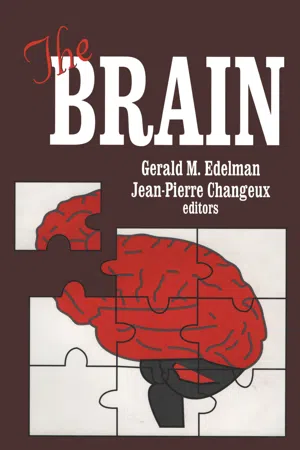
One of the vastly exciting areas in modern science involves the study of the brain. Recent research focuses not only on how the brain works but how it is related to what we normally call the mind, and throws new light on human behavior. Progress has been made in researching all that relates to interior man, why he thinks and feels as he does, what values he chooses to adopt, and what practices to scorn. All of these attributes make us human and help to explain art, philosophy, and religions. Motion, sight, and memory, as well as emotions and the sentiments common to humans, are all given new meaning by what we have learned about the brain. In an introductory essay, Vernon B. Mountcastle traces the progress made in brain science during this century. Gerald M. Edelman touches upon features of the brain that challenge the picture of the brain as a machine. Semir Zeki discusses artists and artistic expression as an extension of the function of the brain. Richard S. J. Frackowiak probes the functional architecture of the brain. Mark F. Bear and Leon N Cooper explore whether complex neural systems can be illuminated by theoretical structures. Jean-Pierre Changeux sheds light on the knowledge gained in recent years concerning the neurobiology and pharmacology of drug action and addiction. Alexander A. Borbuly and Giulio Tononi ponder the quest for the essence of sleep, illuminating its complex dynamic process. George L. Gabor Miklos examines variations in neuroanatomies and sensory systems between individuals of the same species as well as variations across the evolutionary spectrum. Emilio Bizzi and Ferdinando A. Mussa-Ivaldi explain how scientists have approached the study of movement, the problems encountered, and the solutions proposed. Marcel Kinsbourne explores the unity and diversity in the human brain. In the concluding essay, Andy Clark points to recent work in neuroscience, robotics, and psychology that stresses the unexpected intimacy of brain, body, and world, supporting his belief that the mind is best understood as a brain at home in its proper bodily cultural and environmental niche. The breadth and scope of subjects covered in this volume attest to the extraordinary progress taking place in the study of the brain. This brilliant collection of essays by those at the forefront of research in this area will be of interest to all those interested in human behavior. Gerald M. Edelman is director of the Neurosciences Institute and chairman of the Department of Neurobiology at the Scripps Research Institute. Jean-Pierre Changeux is professor at the Collbge de France and the Institute Pasteur.
- 291 pages
- English
- ePUB (mobile friendly)
- Available on iOS & Android
eBook - ePub
The Brain
About this book
Information
Subject Index
A
Absolutes
color and, 97-99
color liberating, 96-97
search for, 96
vs abstraction, 96
Alcohol, 150, 160
Amphetamines, 160
Animal sleep evolution and, 174-175
mammals investigations, 174
Apollinaire, Guillaume, 90
Art
artist as neurologists, 77-78
functions of, 76-77
purpose of, 78
Attention
brain organization and, 247
defects without awareness, 247-248
disorder awareness, 249
neuropsychology and, 247
temporarily normalizing, 248
uncentered brain, 248-249
unilateral neglecting, 248
Attention spans, 126-127
Autobiographical memory
anatomical recall, 124
process of, 123-124
Axom, 38
cerebral cortex, 7
nerve impulse conductivity, 4
neurons and, 4
B
Baddeley, Alan, 123
Balia, Giacomo, 93
Ballard, Dana, 270
Barbiturates, 149-150
Basal ganglia, functions of, 42
BCM algotithms
benefits of, 141
hippocampus theory validating, 138-140
origin of, 137
Berger, Hans, 20-21
Berlin, Isaiah, 2
Bernard, Claude, 6, 151
Biological psychology, 6
Biological variations
computer-like views, 207-208
evolutionary innovations, 208-210
Bizzi, Emilio, 228
Bjôrklund, Anders, 159
Blake, Helen, 168
Blood flow changes
activity patterns mappings, 21-22
approaches to, 22
Brain
anatomy vs physiology, 41-42
cell types in, 3
characteristics of, 37
complexity discontents, 47-51
consciousness, 56-67
evolution of, 259
fascination of, 258
functioning processes, 40-41
genetic algorithms and, 259-260
implications of, 272-276
mindfulness organ of, 257
Neural Darwinism Theory, 45-47
neuroanatomy of, 38-43
neuronal arbors spreading, 40
nonrepresentational memory, 51-56
object memory systems, 82
perception, 2...
Table of contents
- Cover
- Title Page
- Half Title
- Copyright Page
- Contents
- Preface
- Brain Science at the Century’s Ebb
- Building a Picture of the Brain
- Art and the Brain
- The Functional Architecture of the Brain
- From Molecules to Mental States
- Drug Use and Abuse
- The Quest for the Essence of Sleep
- The Evolution and Modification of Brains and Sensory Systems
- The Acquisition of Motor Behavior
- Unity and Diversity in the Human Brain: Evidence from Injury
- Where Brain, Body, and World Collide
- Subject Index
- Illustrations
Trusted by 375,005 students
Access to over 1.5 million titles for a fair monthly price.
Study more efficiently using our study tools.
Frequently asked questions
Yes, you can cancel anytime from the Subscription tab in your account settings on the Perlego website. Your subscription will stay active until the end of your current billing period. Learn how to cancel your subscription
No, books cannot be downloaded as external files, such as PDFs, for use outside of Perlego. However, you can download books within the Perlego app for offline reading on mobile or tablet. Learn how to download books offline
Perlego offers two plans: Essential and Complete
- Essential is ideal for learners and professionals who enjoy exploring a wide range of subjects. Access the Essential Library with 800,000+ trusted titles and best-sellers across business, personal growth, and the humanities. Includes unlimited reading time and Standard Read Aloud voice.
- Complete: Perfect for advanced learners and researchers needing full, unrestricted access. Unlock 1.5M+ books across hundreds of subjects, including academic and specialized titles. The Complete Plan also includes advanced features like Premium Read Aloud and Research Assistant.
We are an online textbook subscription service, where you can get access to an entire online library for less than the price of a single book per month. With over 1.5 million books across 990+ topics, we’ve got you covered! Learn about our mission
Look out for the read-aloud symbol on your next book to see if you can listen to it. The read-aloud tool reads text aloud for you, highlighting the text as it is being read. You can pause it, speed it up and slow it down. Learn more about Read Aloud
Yes! You can use the Perlego app on both iOS and Android devices to read anytime, anywhere — even offline. Perfect for commutes or when you’re on the go.
Please note we cannot support devices running on iOS 13 and Android 7 or earlier. Learn more about using the app
Please note we cannot support devices running on iOS 13 and Android 7 or earlier. Learn more about using the app
Yes, you can access The Brain by Jean-Pierre Changeux,Gerald M. Edelman in PDF and/or ePUB format, as well as other popular books in Biological Sciences & Philosophy History & Theory. We have over 1.5 million books available in our catalogue for you to explore.