Partnership is of growing importance in development work. Partnerships among state, private business, and civil society organizations are increasingly used to deliver the goods and services required for balanced growth and poverty reduction. Aid activities have shifted from a project focus to a more strategic and holistic focus on programs, sectors, and policies. With this new orientation, partnerships are often essential to deal with the added complexity and the larger number of agencies, groups, and stakeholders involved.The Partnership Dimension takes on the issues in a series of chapters divided into two general parts: Part 1, "Foundations of Partnership and Their Evaluation," covers the types of development partnership and critical issues involved, and Part 2, "Partnerships in Practice," then illustrates the aspects and lessons of partnership experience through a series of case studies. Many of the studies focus on the benefits of partnerships between institutions of government and civil society. Benefits include effective knowledge transfer, greater cross-national cooperation, the creation of new networks and capacity, and penetration of new markets. Private firms use partnerships with competitors to learn or reduce risk.There is much to learn about when, where, and how best to use partnerships, and, in particular, partnerships that involve less traditional combinations of actors, such as global partnerships for public policy, country-focused aid partnerships, private sector partnerships for knowledge creation, and partnerships for community development involving business, nongovernmental organizations, and government.Relatively little is known about the costs and benefits, and the risks and rewards, of different types of partnerships, or about how best to conduct partnerships for different purposes. This is why the current volume in the World Bank series is relevant for both development practitioners and policy analysts.
eBook - ePub
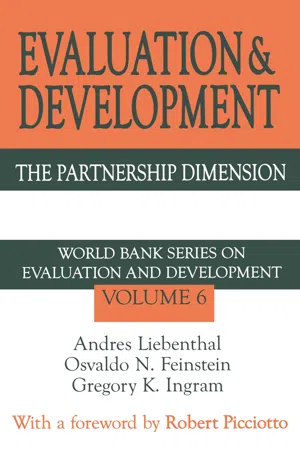
Evaluation and Development
The Partnership Dimension World Bank Series on Evaluation and Development
- 260 pages
- English
- ePUB (mobile friendly)
- Available on iOS & Android
eBook - ePub
Evaluation and Development
The Partnership Dimension World Bank Series on Evaluation and Development
Part 1
Foundations of Partnerships and Their Evaluation
1
Partnership as a Means to Improve Economic Performance
Douglass C. North
This chapter considers partnership from the standpoint of economic development in history. It first discusses the factors that underlie good economic performance, and then addresses the conditions necessary to put those factors in place. Partnership is seen as the collaborative effort by which we can create the conditions to improve performance.
Defining good economic performance should be a straightforward matter. Unfortunately, the economic and development theory that has evolved is inadequate in this regard. It takes as its model a world of laissez-faire and free markets. Yet, no successful political or economic market evolves naturally. A successful market must be structured, and if mies around the world, we find that if they do not work well, it is because they deliver high payoffs for doing things that are not productive or creative.
Economists have tended to underplay the role that politics plays in economic performance. In reality, it is economics that is secondary to politics. The first requirement for better economic performance is a polity that establishes a set of economic rules that encourages the development of appropriate incentives.
Encouraging Incentives
A polity that encourages the right incentives can be authoritarian or consensual. It must support or provide (1) an institutional matrix that produces a set of organizations and establishes a set of rights and privileges; (2) stable exchange relationships in political and economic markets; (3) an underlying structure that credibly commits the state to a set of political rules, and enforcement that protects organizations and exchange relationships; and (4) conformity as a result of some mixture of norm internalization and coercive enforcement. Only when this framework is in place can the necessary economic rules be established.
Among the conditions necessary for performance improvement is an effective price system—that is, a set of property rights that reduces the costs of transacting. Transaction costs in their simplest form are the costs of measuring and enforcing agreements. Where it is possible to measure exactly what is being exchanged, it is also possible to devise rules that can define whether or not exchange agreements are being observed. Where measurement is imprecise, however, the integrity of the relationship cannot be confirmed. This makes it messy and difficult to make exchanges, and enables corruption.
There are four main kinds of transaction costs. Their mitigation can be addressed through institutions.
The first cost is that of measurement. Goods and services have multiple dimensions that are valuable, and we must be able to measure all of them if we are to eliminate subterfuge and corruption. To make this possible, we need to establish a uniform system of weights and measures. We must also be able to measure exactly what is being exchanged. Measurement is becoming much more difficult as more complex kinds of things are exchanged—as, for example, in the capital markets and over the Internet.
The second cost is incurred in protecting individual property rights. A working judicial system is necessary to protect these rights. This is something we have long talked about, and which is absent in many developing countries.
The third cost has to do with enforcing agreements. As in the case of protecting property rights, mitigating this cost requires an effective judicial system; it also requires the creation of additional institutions to monitor agreements and punish defectors.
Integrating Dispersed Knowledge
The fourth transaction cost is the cost of integrating the knowledge that is dispersed throughout society. This cost can be mitigated—though only to some extent, given the complexity of modern society—through the establishment of a price system. This fourth transaction cost is often the most significant obstacle to moving from understanding performance in rich countries to understanding what must be done in poor countries. Consequently, it is at the heart of the problems with which we are concerned.
The dispersal of knowledge is a function of the specialization and division of labor that underlie economic growth. To support continuing growth, however, that dispersed knowledge should be brought together for the benefit of the broader society. Such integration can involve high transaction costs if the different parties do not trust each other or do not know how to measure the qualities and characteristics of each other’s work.
An effective price system can go a long way toward integrating dispersed knowledge, but there will always be externalities and information costs that are asymmetric among the different players. Nonetheless, a poor country trying to become wealthier must coordinate its economic performance, which implies integration of the disparate parts of its economy.
For us to help realize coordinated economic performance, we must also understand what kinds of transaction costs exist in a specific market. No two markets are the same, and radical alterations in information costs and technology continue to evolve. Thus, we must continually modify and revise our institutional frameworks. Recent World Bank projects in water and telecommunications have shown how difficult it is to create a framework within which players from different backgrounds, each with their own polities, technologies, and institutional arrangements, can be encouraged to do things the way we would want them to. Telecommunications, which has changed from being a natural monopoly to a rapidly evolving, competitive industry, strongly demonstrates that even a framework that works well will need to be modified over time.
A framework that does not work well brings its own problems. Paths that discourage incentives to produce and create tend to persist, once established; the institutional framework that engenders such paths can create entrenched interests that resist change.
Finding the Right Institutional Framework
How do we overcome these problems? Let us start with the political markets, the most crucial markets of all.
The formal rules are easy. The characteristics of a polity that encourages the right sort of incentives constitute a formal institutional matrix. But while they are a step in the right direction, formal rules are not sufficient: informal norms are needed that get people to play the game in ways that will make the formal rules effective, and they must be supported by enforcement mechanisms.
When Latin America became independent in the early nineteenth century, many of the newly independent countries adopted the U.S. Constitution, or something like it, believing that the rules that worked for the United States would also work for them. This proved not to be the case. The informal norms and enforcement characteristics of the U.S. market were radically different from those of Latin America. The original colonies of the United States bequeathed a heritage of self-assembly and self-government, but colonial rule in Latin America left no such foundation.
In countries that have no heritage of self-government, self-government cannot be created overnight, but authoritarian rule can provide a short-term solution. The examples of Singapore and the Republic of Korea show how it can be easier to put essential economic rules in place within the context of an authoritarian polity, but the long-term validity of this approach is less clear. Indonesia, for example, enjoyed a high rate of growth under an authoritarian regime, but now is disintegrating.
In the long run, a consensual polity may be the only way to go. But democracy is a difficult form of government, and it takes time to build the necessary human capital to support a successful consensual system. The task for aid, therefore, is a delicate and difficult one. With the assistance of NGOs and through partnerships between donors and recipients, we need to build up improvements in various sectors of the receiving society, such as health, education, and the judiciary, that not only raise the performance of those sectors but which also develop the human capital essential to a consensual polity.
Capitalizing on Local Conditions
What we need to bring to our partnerships with developing countries, therefore, is an understanding of the constraints and limitations imposed by the institutional structure of those countries. At what margins can cooperation and the dissemination of information and knowledge make partnership work effectively?
Crucially, we must not allow ourselves to become chained to the formal institutions that have worked in developed countries. China, for example, has none of the conditions that we think of as making for successful economic growth. It has no clearly specified property rights and it has a judicial system that is essentially arbitrary, but it has nonetheless achieved high rates of growth. It has been able to do this because it has provided informally a set of incentives that have been effective surrogates for the kind of formal institutions found in developed economies. (China’s most difficult problems lie ahead, since it must transform this system into one that will work in the future.)
Economists do not believe in culture. We tend to think that everybody is alike. But the lesson of China surely is that we should learn to see the heritage and the cultural background of the country as a benefit, and that we should seek to capitalize on this benefit to create the most effective development strategy possible.
Partnership is an incremental process. Results cannot be achieved overnight, but suggest this to a politician and the answer is always the same: “I am not going to be around in 20 or 50 years. I need things that are going to work in the short run.” Our time horizon is much longer than that of the politician, but the reality is that we must work within the politician’s time horizon. We must modify our advice accordingly. The results we are seeking are not possible in the short term, but by changing the game over time we can realize them incrementally.
A final challenge for partnerships is that of making knowledge transferable and communicable. Much of that knowledge is tacit rather than overt, and it is important that we find ways of codifying it to make it accessible to other people. If we can do this, we can use that knowledge in different cultures to help solve the many development problems we face.
Douglass C. North is Bartlett Burnap Senior Fellow, Hoover Institution; Department of Economics, Washington University.
2
Theoretical Foundations of Partnership
Robert Axelrod1
This chapter describes the theoretical foundations of a development partnership between an aid donor and a recipient. The framework offered is deliberately very simple, to best highlight certain important principles. Rather than furnish a full rendition of the complexities of partnerships for economic development, I seek to provide insight into some fundamental issues.
Because a donor and a recipient may have divergent as well as complementary interests, a partnership between the two can be analyzed in terms of a mixed-motive game between two players. The model used here is the iterated Prisoner’s Dilemma game, which can suggest some of the implications of selecting a partner, setting up a partnership, choosing a modus operandi, building trust, achieving selectivity, and performing monitoring and evaluation. We begin, however, by seeking to define what constitutes a partnership in development.
How Partnerships Differ from Other Kinds of Relationships
A working definition of partnership is a collaborative relationship between entities to work toward shared objectives through a mutually agreed division of labor. We can expand on this to further distinguish partnerships from other forms of aid relationships.
A partnership is not a gift. A partnership aims to take advantage of what the recipient, as well as the donor, can bring to the relationship. This can include local expertise, on-site workers, and a better understanding of priorities, needs, and constraints. Crucially, a partnership seeks also to establish joint ownership of the relationship and to build the capacity of the recipient government to undertake sustainable development.
A partnership is not a relationship based on one-sided conditionality—that is, on the imposition by the donor of conditions that would coerce the recipient to do things it does not want to do, in order to obtain resources.2 Some researchers question whether strict conditionality has been effective under any circumstances in promoting development (Gilbert, Powell, and Vines 2000). Partnership recognizes that both sides must be involved in defining the terms of the relationship.
A partnership is not a principal-agent relationship between a donor and a recipient. The donor in a partnership cannot prescribe the terms of the relationship in the way that an employer can specify terms of employment when hiring a worker.3
A partnership is not simply a team activity. On a sports team, everyone has the same interest in winning, and either everyo...
Table of contents
- Cover
- Half Title
- Title Page
- Copyright Page
- Table of Contents
- Acknowledgments
- Foreword
- Overview
- Part 1: Foundations of Partnerships and Their Evaluation
- Part 2: Partnerships in Practice
- Index
Trusted by 375,005 students
Access to over 1.5 million titles for a fair monthly price.
Study more efficiently using our study tools.
Frequently asked questions
Yes, you can cancel anytime from the Subscription tab in your account settings on the Perlego website. Your subscription will stay active until the end of your current billing period. Learn how to cancel your subscription
No, books cannot be downloaded as external files, such as PDFs, for use outside of Perlego. However, you can download books within the Perlego app for offline reading on mobile or tablet. Learn how to download books offline
Perlego offers two plans: Essential and Complete
- Essential is ideal for learners and professionals who enjoy exploring a wide range of subjects. Access the Essential Library with 800,000+ trusted titles and best-sellers across business, personal growth, and the humanities. Includes unlimited reading time and Standard Read Aloud voice.
- Complete: Perfect for advanced learners and researchers needing full, unrestricted access. Unlock 1.5M+ books across hundreds of subjects, including academic and specialized titles. The Complete Plan also includes advanced features like Premium Read Aloud and Research Assistant.
We are an online textbook subscription service, where you can get access to an entire online library for less than the price of a single book per month. With over 1.5 million books across 990+ topics, we’ve got you covered! Learn about our mission
Look out for the read-aloud symbol on your next book to see if you can listen to it. The read-aloud tool reads text aloud for you, highlighting the text as it is being read. You can pause it, speed it up and slow it down. Learn more about Read Aloud
Yes! You can use the Perlego app on both iOS and Android devices to read anytime, anywhere — even offline. Perfect for commutes or when you’re on the go.
Please note we cannot support devices running on iOS 13 and Android 7 or earlier. Learn more about using the app
Please note we cannot support devices running on iOS 13 and Android 7 or earlier. Learn more about using the app
Yes, you can access Evaluation and Development by Osvaldo N. Feinstein in PDF and/or ePUB format, as well as other popular books in Economics & Development Economics. We have over 1.5 million books available in our catalogue for you to explore.