eBook - ePub
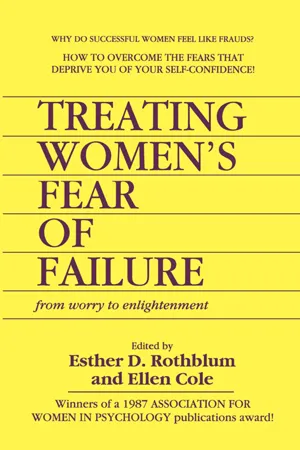
Treating Women's Fear of Failure
From Worry to Enlightenment
- 105 pages
- English
- ePUB (mobile friendly)
- Available on iOS & Android
eBook - ePub
About this book
This new book looks at an important issue--the emotional impact of success upon women--at a time when opportunities are more available to them than ever before. Using research, clinical experience, and personal anecdotes, the contributors examine the timely issues of women and worry, women's sense of their own entitlement, fear of success and fear of failure, and women's impostor feelings. The dilemma that feminist therapists frequently experience of encouraging women clients, often superbly qualified in their fields, to take a risk that might involve rejection or failure, is highlighted here. Therapists will recognize the often expressed fears of academic and intellectual failure, as well as the fears of various interpersonal failures that result from a combination of women's opportunities in society as well as socialization.
Information
The Phenomenon of Worry: Theory, Research, Treatment and Its Implications for Women
Worry is an increasingly widespread phenomenon in our society (Vernoff, Douvan & Kulka, 1981). We have all experienced worry, and it is reported often in clinical interactions and in the description of a variety of psychological complaints. However, despite the pervasiveness of this phenomenon, worry has been essentially ignored in the literature. Our research group has begun to examine the process of worry and the characteristics of the chronic worrier. Several findings are particularly relevant for the present discussion – worry is highly correlated with measures of anxiety and fear, and the majority of self-reported worriers are women. As such, this paper reviews worry research, theory, and treatment, and discusses implications of this area for women.
EARLY RESEARCH
Our interest in worry was initiated by certain findings in insomnia research (cf. Borkovec, 1979) and stimulated by our personal experience and our clients’ symptomatic reports. Insomniacs frequently complain of negative, cognitive intrusions when attempting to fall asleep. Reducing these intrusions through relaxation appears to be one of the most effective ways of improving sleep. Therefore, these negative cognitive intrusions, what we describe as “worry,” seem to play an important role in the maintenance and treatment of insomnia.
As we explored the literature, we realized that worry plays a role not only in insomnia but also in a variety of other clinical problems. Intrusive, negative thoughts and self-statements are symptomatic of depression and a variety of anxiety disorders (Beck, 1976; Dow & Craighead, 1982). DSM-III describes uncontrollable, negative ruminations as an important diagnostic criterion for many maladjustments, particularly obsessive-compulsive disorders. However, even with these indications the only previous efforts to examine worry exist in the test-anxiety literature (cf. Deffenbacher, 1980, for a review), Liebert and Morris (1976) reported two major and replicable components of test-anxiety: worry and emotionality. They defined worry as the cognitive component-a focus on negative performance and self-evaluation and a concern about failure. Emotionality refers to the more affective and physiological aspects of test-anxiety. Deffenbacher (1980) indicated that worry appears to be the more important and problematic variable as it interferes with performance.
Our research group became intrigued with this apparently important and widespread phenomenon that no one was examining. We began discussing worry, drawing on personal and clinical experience and the limited relevant literature. We then based our investigations on several preliminary hypotheses and impressions. Worry is a series of negative thoughts and images that intrude into awareness in an uncontrolled manner. Worry involves current life concerns. It is compelling, yet troublesome, recurring throughout the day, without providing solutions to the concerns pondered. Described in this manner, worry represents the cognitive component of anxiety, as suggested in the test-anxiety literature.
Our early research attempted to understand the worry process and to characterize the self-described “worrier.” Borkovec, Robinson, Pruzinsky and DePree (1983) found that worry tends to be about the future rather than the past or the present. Worry has a negative, anxious emotional tone that is reflected in worry content and the mood of chronic worriers. Worry is intrusive: it is difficult to shut off and distracts attention from the task at hand. In general, worry was found to correlate highly with measures of anxiety, depression, and fear.
The strongest relationship exists between worry and fear. The worry process results in emotional and physical reactions quite similar to those of fear although somewhat milder in intensity. Worry content is full of fears such as feeling self-conscious, making mistakes, and being criticized. In fact, the greatest concern for the worrier appears to be fear of social-evaluative situations.
These early results provided direction for further research. As we were aware that worry resembles fear, we examined the well-established paradigms that exist for fear. Eysenck (1979) found that fear can incubate, meaning that fear and arousal increase after brief or incomplete exposures to a feared stimulus. Alternately, complete or prolonged exposure produces extinction, or a decrease in fear. Borkovec et al. (1983) found that worriers generally experienced more negative, cognitive intrusions than non-worriers during a monotonous task. However, for both worriers and non-worriers, a 15-minute period of worry increased these intrusions in a subsequent task whereas a quiet relaxation period or a 30-minute worry period did not. This showed that the worry process can incubate. Additionally, we found that once worry was induced it had the same effect on chronic worriers and non-worriers. Differences between worriers and non-worriers are most apparent when they are not particularly worried.
Another fear paradigm helped further our understanding of worry. Mowrer’s two stage model of fear suggests that avoidance is crucial in maintaining fear (Mowrer, 1947). In the first stage we learn to avoid cues associated with fear-provoking stimuli. In the second stage, we learn to continue the avoidant behavior as it keeps us from encountering our fear. Perhaps worry functions in a similar manner. Worry does not typically involve well-developed problem-solving; instead it’s a review of all potentially fearful alternatives. Worry may be a review of scenarios to be avoided: it may function as a cognitive avoidance of some basic fears.
In early studies, worriers reported that they realize their worries are illogical and an ineffective means of coping. However, they feel that if they do not worry the feared event is somehow more probable. Therefore, not worrying is more anxiety-provoking than worrying. McCarthy and Borkovec (1983) found support for this notion. For both worriers and non-worriers, arousal decreased dramatically during a worry period, and then rose when subjects were asked to focus their attention on their breathing. The worry process may thus serve as a reinforcing, anxiety-reducing, cognitive avoidance of feared material.
Engaging in the worry process may help us avoid fearful situations, but it also seems to have a negative effect on our emotional state and attentional abilities. As in other studies, Pruzinsky (1983) and McCarthy and Borkovec (1983) found that worriers generally experience more cognitive intrusions and distractions during tasks than non-worriers. However, they also found that the worriers’ cognitive process was more continuous and contained more negative content. This continuous negative process may explain why worriers often report a more dysphoric mood. Additionally, these studies suggested that for chronic worriers, the worry process occurs frequently throughout the day even without obvious threatening or worrisome cues. What effect might these negative cognitions and affective states have on other processes? The test-anxiety literature again provides some suggestions.
Deffenbacher (1980) concluded that the worry component of test-anxiety consistently interferes with task performance. Worry increases as the potential for social evaluation or failure increases (Morris & Fulmer, 1976). This produces interference, because as worry increases, attention is distracted from the task and focused instead on self-evaluative cognitions (Mandler & Watson, 1966; Neale & Katahn, 1968).
These findings were examined in recent research on the general worry phenomenon. Worriers and non-worriers showed similar performances on simple decision-making tasks (Metzger, Miller, Sofka, Cohen, DiMareno, Bigley & Pennock, 1983). On a more complex categorization task, however, worriers took longer to make decisions when the stimuli were ambiguous. As the choice became unclear and it was possible to fail, worriers’ indecisiveness increased. Non-worriers showed no changes in their decision-making. If worry was induced by a 15-minute worry incubation period all subjects demonstrated the same indecisivcness. This strongly suggests that it is the worry process that is interfering with performance.
In summary, worry is an intrusive, negative cognitive habit. It is the cognitive component of anxiety, elicited by fearful thoughts or environmental events. The worry process interferes with daily functioning as it increases dysphoria and maintains core fears through cognitive avoidance. Additionally, worry inhibits performance by drawing attention to self-evaluative ruminations and away from the task at hand.
CHARACTERISTICS OF THE WORRIER
In our research, we have defined worriers to be those who report worrying fifty percent or more of each day and feel it is problematic for them. These individuals experience worry as an ongoing trait process. Non-worriers are those who report worrying twenty percent or less of each day and do not find worry to be a problem. These individuals experience worry as an intermittent, transient state.
Few differences distinguish chronic worriers from non-worriers. Surprisingly, the differences that do exist are only apparent when individuals are not particularly worried. If worry is induced, as in the incubation studies reported earlier, the worry process and its effects appear to be similar for everyone.
Chronic worriers do experience a generally more dysphoric and hostile mood, increased depression, and elevated trait and state anxiety (Borkovec et al., 1983). Additionally, worriers have more difficulty focusing their attention and take longer to make decisions when faced with ambiguity (Metzger et al., 1983). As incubation of the worry process eliminates most of these differences, it seems likely that the observed variations in affect and performance are due to the more frequent, ongoing worry process of the self-described worrier.
A variety of investigations have examined the characteristics of the chronic worrier. However, an important variable has often been overlooked or ignored: there exists almost no exploration of the fact that most self-reported worriers are female.
GENDER DIFFERENCE IN THE REPORT OF WORRY
In describing one of the earliest studies, Borkovec et al. (1983) reported that worry status was not proportional by gender – women outnumbered men. While screening for relaxation research, Johnson (1981) found that 40% of the females reported being worriers (by our operational definition), as compared to 16% of the males. In a study examining the incubation effects of worry, Borkovec et al. (1983) noted that 88% of their subjects were female. In two studies examining stimulus control treatments of worry, Borkovec, Wilkinson, Folensbee, and Lerman (1983) found that 80% of their high worry subjects were female. Finally, in the general group screening for research subjects it has been repeatedly observed that women report being worriers at a rate two to three times that of men. It would seem that strong indications of a gender difference exist in the report and/or the experience of worry.
Although the data strongly suggest that males and females differ in their report (and perhaps their experience) of worry, none of the research thus far has addressed this phenomenon. Few studies analyzed for gender differences, although some attempted to control for gender effects by having males and females represented proportionally across conditions. It is clear that the examination of apparent gender differences is crucial in any attempt to understand the etiology and process of worry, and the characteristics of the worrier.
To understand these potential differences it is first necessary to clarify the term “gender differences.” As Shcrif (1982) pointed out, there are many psychological terms that refer to various constructs and concepts regarding gender. Frequently, “gender differences” is used to refer to psychosocial effects, while “sex differences” is reserved for biological or physiological distinctions (Unger, 1979). Although it is impossible to unequivocally define differences as wholly psychosocial or biological, “gender difference” will be used throughout this discussion in reference to the observed psychological differences in worry for males and females,
What might gender differences mean? In the clinical literature, women report more psychological difficulties and are diagnosed as having disturbances more frequently than men (Gove, 1980; Verbrugge, 1980). Females also report higher rates of various disorders including anxieties and phobias (Chambless & Goldstein, 1980), depression (Weissman, 1980), and hysterical traits (Walowitz, 1972). However, various authors have suggested that what is reflected in these gender differences is not a difference between the sexes, but rather the psychosocial differences in their gender-role identification. This notion is particularly intriguing in light of recent depression research. Gender differences in adult depression are a consistent and reliable finding. However, Green (1980) found that in adolescents significant group differences existed for gender-role orientation but not gender. A feminine or undifferentiated gender-role identification was associated with depression regardless of gender. Current preliminary research in gender differences in worry shows strong tendencies in the same direction (Stavosky, 1986).
As Johnson (1980) emphasized, gender differences should be explored but not for the purpose of demonstrating that one gender has more psychological disturbances than the other. Rather, examining the relationship of gender, gender-roles, and emotional concerns can help clarify what occurs in the constitution and experiences of men and women and leads them in different problematic directions (Dohrenwend & Dohrenwend, 1976).
The gender difference in reported worrying may be influenced by two factors. First, women may learn to be more aware of internal states and may more freely disclose such information. Secondly, women may experience worry more frequently and to a greater degree. The contribution of these factors is explored as we discuss the possible theoretical origins of worry and the status of women in our society.
ETIOLOGY OF WORRY
We have some understanding of the experience of worry, the characteristics of the worrier, and how worry may interfere with other activities. But why do people worry? How does worry develop and how does it maintain? Finally, what are the constraints that lead women to worry (or report worry) more than men? To explore these questions we first discuss relevant models of fear and anxiety.
Worry as Fear
As we have discussed, the experience of worry is closely associated with the process of fear. Of course, fear is an adaptive response to real environmental threats, resulting in a behavioral “flight or fight” response. The worry sequence can also be initiated by a feared cue, and results in a cognitive process or response. However, the worrisome stimulus can spring from within, as a fearful thought or image. Our research indicates that the situations of most concern to the worrier are social-evaluative in nature. Our experience and various findings lead us to suggest that the underlying concern for the worrier is a fear of failure or rejection.
Fear can result in behavioral avoidance. Analogously, worry can be conceptualized as cognitive avoidance. People may engage in worry about any number of topics because it helps them to avoid confrontation with their underlying fear. The content of the current worry may be only distantly related to this real fear, hypothetically the fear of negative societal and self-perception.
If this is the case, then to avoid failure and rejection, mistakes must be avoided by either a...
Table of contents
- Cover
- Half Title
- Title Page
- Copyright Page
- Table of Contents
- EDITORIAL
- Women and Entitlement
- Fear of Failure in Women
- “I Know This Is Stupid, but …” Or, Some Thoughts on Why Female Students Fear Failure and Not Success
- The Imposter Phenomenon: An Internal Barrier to Empowerment and Achievement
- Career Aspiration in Black College Women: An Examination of Performance and Social Self-Esteem
- The Phenomenon of Worry: Theory, Research, Treatment and Its Implications for Women
- Achievement Related Fears: Gender Roles and Individual Dynamics
Trusted by 375,005 students
Access to over 1.5 million titles for a fair monthly price.
Study more efficiently using our study tools.
Frequently asked questions
Yes, you can cancel anytime from the Subscription tab in your account settings on the Perlego website. Your subscription will stay active until the end of your current billing period. Learn how to cancel your subscription
No, books cannot be downloaded as external files, such as PDFs, for use outside of Perlego. However, you can download books within the Perlego app for offline reading on mobile or tablet. Learn how to download books offline
Perlego offers two plans: Essential and Complete
- Essential is ideal for learners and professionals who enjoy exploring a wide range of subjects. Access the Essential Library with 800,000+ trusted titles and best-sellers across business, personal growth, and the humanities. Includes unlimited reading time and Standard Read Aloud voice.
- Complete: Perfect for advanced learners and researchers needing full, unrestricted access. Unlock 1.5M+ books across hundreds of subjects, including academic and specialized titles. The Complete Plan also includes advanced features like Premium Read Aloud and Research Assistant.
We are an online textbook subscription service, where you can get access to an entire online library for less than the price of a single book per month. With over 1.5 million books across 990+ topics, we’ve got you covered! Learn about our mission
Look out for the read-aloud symbol on your next book to see if you can listen to it. The read-aloud tool reads text aloud for you, highlighting the text as it is being read. You can pause it, speed it up and slow it down. Learn more about Read Aloud
Yes! You can use the Perlego app on both iOS and Android devices to read anytime, anywhere — even offline. Perfect for commutes or when you’re on the go.
Please note we cannot support devices running on iOS 13 and Android 7 or earlier. Learn more about using the app
Please note we cannot support devices running on iOS 13 and Android 7 or earlier. Learn more about using the app
Yes, you can access Treating Women's Fear of Failure by Ellen Cole,Esther D Rothblum in PDF and/or ePUB format, as well as other popular books in Psychology & History & Theory in Psychology. We have over 1.5 million books available in our catalogue for you to explore.