The chapters in this volume represent some of Dennis Wrong's best and most enduring essays. Initially published as Skeptical Sociology, this collection displays his ability to write compellingly for general intellectual audiences as well as for academic sociologists. The book is divided into sections that represent Wrong's major areas of interest and investigation: "Human Nature and the Perspective of Sociology," "Social Stratification and Inequality," and "Power and Politics." Each section is preceded by a short introduction that places the articles in context and elaborates and often sheds new light on the contents.
The essays in the first section were written with polemical intent, directed against the assumptions of academic sociology that prevailed in an earlier period. Part two calls attention to the neglect by functionalists of power, group conflict, and historical change; Wrong shows that failure to consider them made functional theories of stratification especially vulnerable. The third section is more heterogeneous in subject and theme than the others; all the essays in it touch in some way on power or politics.
Included in this volume is Wrong's celebrated and much-quoted article "The Oversocialized Conception of Man in Modern Sociology." Other significant essays reveal the author's views on many timely topics of sociological concern, such as the quests for "community" and for "identity"; the Freudian, Marxian, and Weberian heritages in sociology; social class in America; meritocracy; a theory of democratic politics; humanist, positivist, and functionalist perspectives; and the sociology of the future. The Oversocialized Conception of Man is an indispensable volume for sociologists, political theorists, and historians.
Dennis H. Wrong is emeritus professor of sociology at New York University. He is the author of The Problem of Order, Population and Society, Class Fertility Trends in Western Nations, Power: Its Forms, Bases, and Uses (also published by Transaction), and The Modern Condition (forthcoming).
- 322 pages
- English
- ePUB (mobile friendly)
- Available on iOS & Android
eBook - ePub
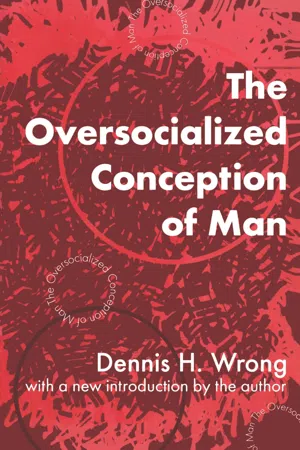
The Oversocialized Conception of Man
About this book
Information
PART ONE
Human Nature and the Perspective of Sociology
Introduction
ALL THE ESSAYS in this section were written with a polemical intent, directed against the leading assumptions of academic sociology and social criticism influenced by it that prevailed in the 1950s and early 1960s. I was not interested solely in critical demolition, however, for I also wished to present corrected versions of or alternatives to the ideas I assailed. Yet the first three articles, at least, were contributions to what was soon to become a widespread assault on both science-building and consensual sociology, an assault that by the mid-1970s had unmistakably triumphed.1
“C. Wright Mills and the Sociological Imagination” was originally printed in Commentary in 1959 under the title ‘The Failure of American Sociology.” Unlike the other four essays in the section, it does not deal specifically with conceptions of human nature or of the relation of self to society, although it adumbrates the theme of an oversocialized conception of man that is the subject of the two following essays. Its discussion of Mills’s now-famous polemic helps to locate the later articles in the context of the attack on conventional sociology that was building up steam at the time.
The second and third articles are clearly companion pieces. “The Oversocialized Conception of Man in Modern Sociology” is my most frequently cited and reprinted publication. It obviously owes the attention it has received to the strategic timeliness of its criticism of the then-prevailing conformist assumptions about human conduct in sociological theory, challenging these assumptions from a more socialpsychological and less directly political standpoint than earlier attacks by Mills, Barrington Moore, Jr., Ralf Dahrendorf, and others. Since I have added a postscript to “The Oversocialized Conception of Man” written especially for this volume, I shall say little more about it here. “Human Nature and the Perspective of Sociology” was originally projected as an answer to Talcott Parsons’s rebuttal of the earlier article in Psychoanalysis and The Psychoanalytic Review.2 The editor of this journal refused to open his pages to me for a counter-rebuttal, so in the end I dealt only briefly with Parsons’s argument and chose instead to elaborate more fully on the thesis of the original article. Although it is often assumed today that Parsons’s views totally dominated sociological theory in the 1940s and 1950s, this was very far from being the case, and in “Human Nature and the Perspective of Sociology” I attempted, inter alia, to assess other theoretical approaches—neo-Marxist conflict theory, historicism, symbolic interactionism—in relation to the oversocialized conception of man and the rival Freudian view of human nature that I favored.
The last two essays in this section are also companion pieces, although unlike the two preceding them they were not conceived as such. They critically examine two major themes in popular social criticism: the “quest for community” and the corollary or complementary “quest for identity.”3 The first drafts of both were written several years before their eventual publication in Dissent, so they stand closer in time to the relatively apolitical social criticism of the previous decade than the publication dates, 1966 and 1968, might suggest.
Both essays, unlike the two preceding ones, were addressed to a general intellectual audience rather than primarily to academic sociologists. Both examined not only the ideas of influential writers and thinkers, including though by no means confined to sociologists, but also the reception of these ideas by educated middle-class audiences and their rhetorical use as social criticism, which often ignores the tensions and contradictions among them. In one of the earliest studies of the new postwar suburbs—those alleged hotbeds of the compulsive search for community—William M. Dobriner remarked that an interviewed housewife who described her suburb to him in sociological jargon represented “the voice of sociology feeding back on itself through the voice of a corrupted respondent.”4 But more and more of our respondents have clearly been so corrupted. The diffusion of sociological cliches and catchwords through many media to a widening segment of the population has itself become a social process significantly shaping the ethos and self-consciousness of the public. We have hardly had to await instruction in epistemology from the fashionable antipositivist philosophers of social science to be made aware of the difference between our relation to our subject matter and that of physicists or biologists to theirs. ‘The Idea of ‘Community’: A Critique” and “Identity: Problem and Catchword” were efforts to explore the impact of popularized social science on everyday values as a pervasive and ubiquitous occurrence, rather than treating “self-fulfilling” or “self-defeating” prophecies as no more than interesting curiosities.
An author’s claim to discern a thematic coherence in a collection of essays on diverse subjects written for diverse audiences is no doubt properly to be viewed with suspicion. Nevertheless, I think there is a genuine link between the themes of the two last essays in this section and the two preceding ones. The critique of the oversocialized conception of man was, as I have indicated in the postscript to the original article, intended to complement the critique of the overintegrated conception of society developed by neo-Marxist and conflict theorists. The ideology of “community” involves the affirmation as a value of the consensus and social cohesion that were regarded as the defining attributes of society by the dominant sociological theories of the 1950s. Similarly, “identity” as a sought-after goal is congruent with the definition of man as essentially a “role-player” who finds the meaning of life in conformity to the “expectations” of others.* Yet in the rhetoric of social criticism, “community” and “identity” are presented as goals to be pursued rather than as inevitable results or achievements of social life. Rather than celebrating their comforting presence, social criticism deplores their absence under the “alienating” and impersonal conditions of modern life.
In “The Idea of ‘Community’: A Critique,” I considered the ideology of community to be a successor or alternative to political protest, but the experience of the late 1960s showed that it was capable of surviving the repoliticization of social criticism. There are curious continuities underlying the apolitical, conformist but “alienated” mood of young people at the end of the fifties—such as those described in Kenneth Keniston’s first book5—and the sudden turn to frenetic political activism and the adoption of “countercultural” life-styles in the following decade. The early New Left extolled community and generational solidarity in opposition to the alienation and inauthenticity (“role-playing”) of modern society. Both the New Left and the counterculture have declined as movements in the seventies, but have apparently been succeeded by a host of communalist sects, cults, and therapies which promise community, self-realization, and secure identity to their adherents. Critics have charged sensitivity training, encounter groups, and such new religions or quasi-religions as Scientology, Hare Krishna, and the Jesus people with artificially engineering consensus by means of authoritarian and psychologically manipulative techniques. Such accusations resemble those that were levelled in the 1950s against large organizations, suburban communities, the educational system, and the mass media. Yet one has the impression that people shift rather rapidly today from one movement or therapy to another, becoming followers of, say, Maharaj-Ji, dropping out, and then becoming attached to another guru or joining a new commune. Such restlessness suggests precisely the search for community and identity dissociated from commitment to any substantive values or group attachments that I discussed in “The Idea of ‘Community’” and “Identity: Problem and Catchword.” The quest persists whether it assumes conformist or nonconformist shapes in relation to the larger society. My two essays still seem to me, therefore, to possess contemporary relevance.
I have updated some references and made minor corrections in all five essays in this section. In a few cases I have restored phrases and even sentences that were edited out of the original printed versions. I have incorporated into the text several of the long footnotes appended to “The Oversocialized Conception of Man in Modern Sociology.”
* This statement applies only to the concept of “social identity,” which, as my article emphasizes, is by no means to be equated with Erik H. Erikson’s concept, nor, for that matter, with Allen Wheelis’s. Both Erikson and Wheelis are, of course, psychoanalysts rather than sociologists.
ONE
C. Wright Mills and the Sociological Imagination
COLLEGE STUDENTS, however unlettered, often possess what journalists call “the instinct for the jugular.” Meeting a class one day which had just been reading C. Wright Mills’s White Collar, I was asked on entering the room whether I agreed with the description of American professors as men “of typically plebian cultural interests … and a generally philistine style of life.” I acknowledged that on the whole I did. Yet a reviewer of one of Mills’s later books reported that academicians of his acquaintance thought White Collar profound and acute on salesgirls and business executives but wide of the mark on professors. I find my opposite reaction confirmed by Mills’s new book, The Sociological Imagination,1 a full-scale dissection of his academic colleagues and to my mind the best book he has yet written.
The new book is an attack on the dominant schools or “styles of work” in contemporary sociology for their failure to meet the demands of the “sociological imagination.” Mills wishes by this phrase to indicate that quality of mind which fully perceives the intimate connection between the private and the public, between personal experience and the broader typicalities and specificities of this time and that place. Or, as he puts it repeatedly, “the sociological imagination is the ability to grasp history and biography and the relations between the two within society.” The forerunners and founders of modern sociology had such a grasp, and we still read Tocqueville and Marx, Weber and Veblen. Contemporary sociologists honor their names but rarely follow their example. Those in search of a sense of themselves and their time, a search that led some of us to become professional sociologists in the thirties and the forties, are apt today to turn to nonsociologists, to writers as different as Hannah Arendt, Lionel Trilling, and W. H. Whyte, as well as to sociologists like David Riesman and Mills himself who are unlikely ever to become presidents of the American Sociological Association.
The condemnation of sociology that this suggests needs qualification on two counts. First, to expect professional sociologists to be the primary possessors of the sociological imagination would be to perpetuate an ancient intellectual imperialism which the humanities and the older social sciences have always rightfully resented. Mills himself makes it clear that he is using the phrase to refer to an ethos or intellectual ambiance, analogous to Newtonian mechanism” and “Darwinian ethics,” rather than to an outlook that can or ought to be the exclusive property of a single discipline. Second, much of the work of contemporary sociologists in special areas such as criminology, population problems, or the study of voting trends is unquestionably valuable, as even the harshest critic of the field discovers when seeking comparable information about a foreign country where academic sociological research remains undeveloped. Yet sociology aspires to be more than a loose grouping of semiautonomous specialties—not to speak of the armory of research techniques plus an esoteric vocabulary that it is in danger of becoming.
Literary men and journalists who regularly sneer at the graceless verbosity and obsessive methodolatry of sociologists are likely to applaud much of what Mills says without paying very close attention to it. But Mills’s point of view is not really theirs: he knows that “insight” or “literary sensibility” or an awareness that in some sense “Dostoyevsky said it all before and better” are not enough to assure even a limited understanding of history, politics, and society. Disciplined thinking, much plain fact-grubbing, unremitting exposure to the materials of contemporary and recorded history, the capacity to brood over and exploit one’s personal experiences without crudely projecting them onto the universe—all this and more are necessary. Neither a personal gift of perceptiveness nor any easily teachable method can provide a short cut. The trouble with contemporary sociologists is that from the mixed ingredients of the sociological imagination they have extracted a few mental skills and thought-ways and set them up as the royal road to truth.
Max Weber, the one great man we sociologists can plausibly claim as our own, once wrote: “No sociologist should think himself too good, even in his old age, to make tens of thousands of quite trivial computations in his head and perhaps for months at a time.” A social researcher, one of those whom Mills with his usual talent for phrasemaking calls an “abstracted empiricist,” once quoted this to me in justification of the narrow technicism of the quantifiers and tabulators. But Weber obviously didn’t mean that “trivial computations” ought to be rushed into print and hailed as science or scholarship. And he went on to remark that such busywork is not worth the effort “if no idea occurs to his [the sociologist’s] mind about the direction of his computations … [for although] the idea is not a substitute for work … work in turn cannot substitute for or compel an idea any more than enthusiasm can.”2
I don’t suppose that even the most hidebound empiricist would withhold verbal assent from that today. No one believes any longer that “the facts speak for themselves”; it is universally admitted that “theory” and “research” ought to be united. But what Mills labels Grand Theory, meaning chiefly the work of Talcott Parsons and his followers, not only has little or no intrinsic relation to the research routines and the processed questionnaire “data” of the empiricists, but is a very different thing from theory as we find it in the classical sociologists. Marx’s “capitalism,” Weber’s “rationalization of life,” or Veblen’s “leisure class,” ideas which, inclusive as they are, have clear historical referents linking them to the world as we know it, are usually surrounded by deprecatory quotation marks in the writings of the grand theorists. The latter prefer to deploy terms like “dysfunction,” “role expectation,” or “structural requisite”—highly abstract and formal concepts which at best amount to possible building blocks for theory rather than to theory itself. The ugliness of this jargon* would be a small price to pay if we had any assurance that it would give us otherwise unobtainable answers to important questions. But when it is “applied” by Parsonians to the concrete social and historical world, we merely find translations of what more old-fashioned historians and social scientists tell us in English.
Grand theory and abstracted empiricism are degenerations of older intellectual traditions in which both found a proper and limited place. Mills’s account of how such partial perspectives have become dominant in American sociology and how they are sustained and perpetuated by trends in American society amounts to a first-rate sociology of sociology itself. To appreciate it fully one must oneself be a sociologist, preferably a former graduate student at Columbia in the postwar years, for although Mills names a good many names, his book has some of the traits of a roman a clef. He is marvelously accurate at describing and recording the intellectual mannerisms, the falsely modest solemnities about the “hard and unrewarding demands of real science,” the new academic types, and the new forms of career-making that prevail in the “research shops” of bureaucratic social science. To give the full flavor requires quotation. Mills writes of the younger men, exclusively “trained” in the new social science:
I have seldom seen one of these young men in a condition of genuine intellectual puzzlement. And I have never seen any passionate curiosity about a great problem, the sort of curiosity that compels the mind to travel anywhere and by any means, to remake itself if necessary, in order to find out. These young men are less restless than methodical; less imaginative than patient; above all, they are dogmatic—in all the historical and theological meanings of the term…. They have taken up social research as a career; they have come early to an extreme specialization, and they have acquired an indifference or a contempt for “social philosophy”—which means to them “writing books out of other books” or “merely speculating.” Listening to their conversations, trying to gauge the quality of their curiosity, one finds...
Table of contents
- Cover
- Half Title
- Title Page
- Copyright Page
- Contents
- Introduction to the Transaction Edition
- Preface and Acknowledgments
- Prologue. On Skeptical Sociology
- Part One. Human Nature and the Perspective of Sociology
- Part Two. Social Stratification and Inequality
- Part Three. Power and Politics
- Notes
- Index
Trusted by 375,005 students
Access to over 1.5 million titles for a fair monthly price.
Study more efficiently using our study tools.
Frequently asked questions
Yes, you can cancel anytime from the Subscription tab in your account settings on the Perlego website. Your subscription will stay active until the end of your current billing period. Learn how to cancel your subscription
No, books cannot be downloaded as external files, such as PDFs, for use outside of Perlego. However, you can download books within the Perlego app for offline reading on mobile or tablet. Learn how to download books offline
Perlego offers two plans: Essential and Complete
- Essential is ideal for learners and professionals who enjoy exploring a wide range of subjects. Access the Essential Library with 800,000+ trusted titles and best-sellers across business, personal growth, and the humanities. Includes unlimited reading time and Standard Read Aloud voice.
- Complete: Perfect for advanced learners and researchers needing full, unrestricted access. Unlock 1.5M+ books across hundreds of subjects, including academic and specialized titles. The Complete Plan also includes advanced features like Premium Read Aloud and Research Assistant.
We are an online textbook subscription service, where you can get access to an entire online library for less than the price of a single book per month. With over 1.5 million books across 990+ topics, we’ve got you covered! Learn about our mission
Look out for the read-aloud symbol on your next book to see if you can listen to it. The read-aloud tool reads text aloud for you, highlighting the text as it is being read. You can pause it, speed it up and slow it down. Learn more about Read Aloud
Yes! You can use the Perlego app on both iOS and Android devices to read anytime, anywhere — even offline. Perfect for commutes or when you’re on the go.
Please note we cannot support devices running on iOS 13 and Android 7 or earlier. Learn more about using the app
Please note we cannot support devices running on iOS 13 and Android 7 or earlier. Learn more about using the app
Yes, you can access The Oversocialized Conception of Man by Dennis H. Wrong, Dennis Wrong in PDF and/or ePUB format, as well as other popular books in Scienze sociali & Democrazia. We have over 1.5 million books available in our catalogue for you to explore.