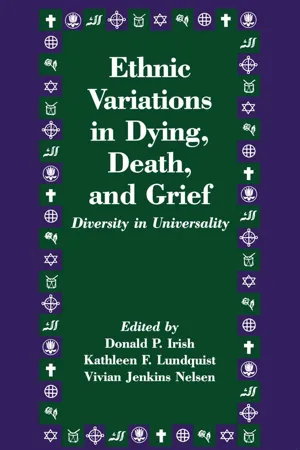
eBook - ePub
Ethnic Variations in Dying, Death and Grief
Diversity in Universality
- 248 pages
- English
- ePUB (mobile friendly)
- Available on iOS & Android
eBook - ePub
Ethnic Variations in Dying, Death and Grief
Diversity in Universality
About this book
This volume is directed towards professionals who work in the fields concerning death and dying. These professionals must perceive the needs of people with cultural patterns which are different from the "standard and dominant" patterns in the United States and Canada. Accordingly, the book includes illustrative episodes and in-depth presentations of selected "ethnic patterns".; Each of the "ethnic chapters" is written by an author who shares the cultural traditions the chapter describes. Other chapters examine multicultural issues and provide the means for personal reflection on death and dying. There are also two bibliographic sections, one general and one geared towards children. The text is divided into three sections - Cross-Cultural and Personal perspectives, Dying, Death, and Grief Among Selected Ethnic Communities, and Reflections and Conclusions.; The book is aimed at those in the fields of clinical psychology, grief therapy, sociology, nursing, social and health care work.
Information
Publisher
Taylor & FrancisYear
2014Print ISBN
9781560322788
9781138168756
Edition
1eBook ISBN
9781317756859
Part One
Cross-Cultural and Personal Perspectives

Chapter One
Cross-Cultural Variation in the Experience, Expression, and Understanding of Grief
New anthropological studies of dying, death, and grief suggest that there is no one grief theory or one psychology of ego defenses that applies to everyone. Majority-culture American social scientists and human service practitioners may have been unintentionally ethnocentric in ways that have made it difficult to understand and deal with the realities of people from other cultures. American theory, research, and practice have reified Western culture and elevated it to the status of universal truth (cf. Good, Good, & Moradi, 1985; Lutz, 1985). Western cultural concepts such as “dying” and “grief” originated in the context of its culture. It now seems that realities differ so greatly from culture to culture that it is misleading and ethnocentric to assume that Western concepts apply generally.
In talking about the troubles of people from other cultures, we should put quotation marks around the terms we use from our own culture. “American” terms that describe emotion, such as grief, depression, and anxiety, are highly suspect. Even physical health terms like ulcers and hypertension should be questioned (Good, Good, & Moradi, 1985). These are categories from American culture, based on American beliefs and the way Americans think, categorize, and understand. People from other cultures understand and classify their experiences and perceptions differently and place them in the context of their own beliefs about the origins of events, the nature of the person, the proper way to behave, the meaning of losses, and much more.
It is easy, in looking at the emotions and experiences of people from other cultures, to adopt a superficially helpful but nonetheless ethnocentric stance that implies, “Of course, our understandings are the right ones, but we will communicate with you in your own terms while still remaining assured that our way of thinking is correct.” We will never understand people whose language or culture is different from ours if we translate what they say into our own terms and assume the transcendent reality of those terms.
DEATH AND LIFE
Perhaps our fundamental assumption in terminal care is that we know what dying, death, and life are. That assumption is not supported by recent cross-cultural research. In many cultures people are counted as dead whom most Americans would consider alive, and people are counted as alive whom most Americans would consider dead. On the island of Vanatinai, southeast of Papua New Guinea, for instance, people are thought of as dead whom we would consider merely unconscious, so it is possible for a person to die a number of times (Lepowsky, 1985). Among extremely poor women in northeastern Brazil, children are counted as dead whom we would consider merely ill (Scheper-Hughes, 1985). Counting somebody as dead whom we would consider alive generally leads to what we would consider neglect. But in Vanatinai or northeastern Brazilian culture, what people do makes perfect sense to them.
On Vanatinai, as in many cultures, the dead, in some sort of ghostly or spiritual manifestation, are considered to be capable of actively affecting the lives of the living and to be open to interaction with the living (cf. Rosenblatt, Walsh, & Jackson, 1976; Rosenblatt, 1983). Many Americans, too, believe that they have an ongoing relationship with the spirits of deceased people who were important to them in life (Rosenblatt & Eide, 1990). We should not presume, however, that spiritual contacts have the same character or meaning from one culture to another. Even if one's beliefs bear a resemblance to those of people one is trying to help, there may be crucial differences.
“GRIEF” ACROSS CULTURES
What people who have experienced a loss believe, feel, and do varies enormously from culture to culture (Rosenblatt, 1988). For the impoverished northeastern Brazilian mothers studied by Scheper-Hughes, for example, most infant and child deaths were understood as inevitable and as a function of the individual child's will to live. In consequence, infants and children were typically not mourned more than a few days. The dead children are still counted as part of the nuclear family, however, and mothers expect to join these children in heaven.
“Muted Grief”
In Bali, the gods will not heed one's prayers if one is not calm. Emotional control in bereavement is highly prized there (Wikan, 1988). Emotional agitation is perceived as a threat to health, making one more vulnerable to the sorcery of malevolen...
Table of contents
- Cover
- Half Title
- Series In Death Education, Aging, and Health Care
- Title Page
- Copyright Page
- Dedication
- Table of Contents
- Contributor
- Foreword
- Preface
- Acknowledgments
- Introduction–Multiculturalism and the Majority Population
- Part 1: Cross-Cultural and Personal Perspectives
- Part 2: Dying, Death, and Grief Among Selected Ethnic Communities
- Part 3: Reflections and Conclusions
- General Bibliography
- Bibliography for Children
- Index
Trusted by 375,005 students
Access to over 1.5 million titles for a fair monthly price.
Study more efficiently using our study tools.
Frequently asked questions
Yes, you can cancel anytime from the Subscription tab in your account settings on the Perlego website. Your subscription will stay active until the end of your current billing period. Learn how to cancel your subscription
No, books cannot be downloaded as external files, such as PDFs, for use outside of Perlego. However, you can download books within the Perlego app for offline reading on mobile or tablet. Learn how to download books offline
Perlego offers two plans: Essential and Complete
- Essential is ideal for learners and professionals who enjoy exploring a wide range of subjects. Access the Essential Library with 800,000+ trusted titles and best-sellers across business, personal growth, and the humanities. Includes unlimited reading time and Standard Read Aloud voice.
- Complete: Perfect for advanced learners and researchers needing full, unrestricted access. Unlock 1.5M+ books across hundreds of subjects, including academic and specialized titles. The Complete Plan also includes advanced features like Premium Read Aloud and Research Assistant.
We are an online textbook subscription service, where you can get access to an entire online library for less than the price of a single book per month. With over 1.5 million books across 990+ topics, we’ve got you covered! Learn about our mission
Look out for the read-aloud symbol on your next book to see if you can listen to it. The read-aloud tool reads text aloud for you, highlighting the text as it is being read. You can pause it, speed it up and slow it down. Learn more about Read Aloud
Yes! You can use the Perlego app on both iOS and Android devices to read anytime, anywhere — even offline. Perfect for commutes or when you’re on the go.
Please note we cannot support devices running on iOS 13 and Android 7 or earlier. Learn more about using the app
Please note we cannot support devices running on iOS 13 and Android 7 or earlier. Learn more about using the app
Yes, you can access Ethnic Variations in Dying, Death and Grief by Donald P. Irish, Kathleen F. Lundquist, Vivian J. Nelsen, Donald P. Irish,Kathleen F. Lundquist,Vivian J. Nelsen in PDF and/or ePUB format, as well as other popular books in Psychology & Mental Health in Psychology. We have over 1.5 million books available in our catalogue for you to explore.