![]()
1 Context
East Asian economy, space and society
1.0 Introduction: migration, time, and place
This book explores the intersection of two bodies of knowledge, each of which is of increasing academic and political importance. The first is migration and mobility. Studies of migration are breaking new ground conceptually and theoretically, and are helping to transform the social sciences through their very strong inter-disciplinarity and their methodological inclusiveness. Migration is also close to the top of the policy agendas of many international organizations, national governments and political parties, and the treatment of immigrant minorities, especially when they are poor and powerless, is one of the best indicators of the social progressiveness and political success of a country in this increasingly multicultural, globally interactive world.
The second is East Asia. Who can now deny the importance of a knowledge and understanding of East Asian societies for the students and decision makers of the 21st century? We have recently witnessed the appalling errors of judgement that follow from a dangerous mixture of arrogance towards, and ignorance of, non-Western cultures and societies on the part of Western leaders who, let’s be blunt, ‘should have known better’. Can the world afford a repeat of such errors in the forging of new relationships with the increasingly wealthy and powerful countries of East Asia? No, it cannot. So up-to-date descriptions, analyses and interpretations of events and situations in East Asia are essential. That this region remains poorly represented in our school and university courses, in our governmental planning, and in company boardroom discussions represents a significant failure. It is time to change this.
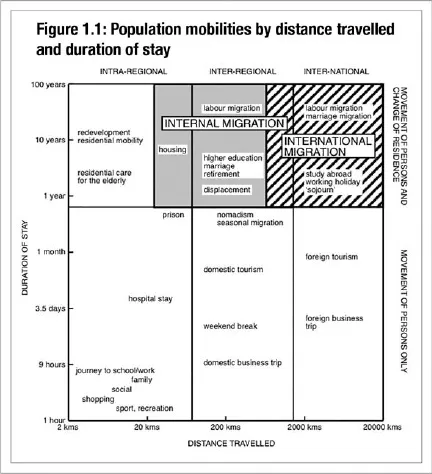
We should establish at the outset, and in the broadest possible terms, where the boundaries of this study are located. As far as migration is concerned, this can be done with the help of Figure 1.1. Our focus in this book is on movements that involve a change of residence and a significant length of stay in a new place (for example, long enough to get a job and earn some money). Those movements that do not imply the crossing of an international boundary are described as ‘internal migration’; those that do are described as ‘international migration’. It is of the utmost importance, however, to stress that there are internal migrations that, because of the distance moved and of the cultural, social and legal barriers to be overcome, are more typical of international migration (for example, many long-distance migrations within China), while at the same time there are some international migrations that differ little from internal migration (for example, some short-distance migrations between Singapore, Malaysia and Indonesia). Figure 1.1 also helps us to recognize the potential overlaps between migration and other forms of mobility. Visits and ‘working holidays’, for example, can easily turn into de facto, but sometimes undocumented (that is ‘illegal’), migration.
The focus of the study is on contemporary migration, and historical material will only be introduced if, and to the degree that, it helps us to understand what is happening now, or has happened in the recent past.
The place we are studying is East Asia, which is defined here as being composed of three groups of countries:
1 Southeast Asia: that is, Indonesia (and Timor Leste), Singapore, Malaysia (and Brunei), Thailand, Myanmar (Burma), Laos, Cambodia, Vietnam, and the Philippines
2 China ‘plus’: that is, the People’s Republic of China (PRC, including Hong Kong and Macao), Taiwan, and Mongolia
3 Northeast Asia: that is, Japan, Republic of Korea (South Korea), Democratic People’s Republic of Korea (North Korea), and Russia (Russian Far East province)
In practice, little information is available on migrations within some of these countries (for example, Myanmar and North Korea), and the undocumented nature of much of the international migration affecting some of these countries reduces the reliability of that information as well.
1.1 East Asian economy
The purpose of this first section is to provide an overview, necessarily a highly generalized one, of the East Asian economy, selecting those features that are most significant for an understanding of the region’s migrations. Let us begin with a few facts.
East Asia is, economically speaking, very large, and is rapidly growing larger. Its share of the global economy in 2011 was 25.3% on a gross national income (GNI) basis (using World Bank data). Since the region’s share of the world’s population was 31.3%, one can see that despite the extraordinarily high incomes enjoyed by ordinary people in some countries (notably Japan), people were, on average, slightly poorer in East Asia than in the world as a whole. However, this gap between East Asia’s share of global wealth and its share of population is shrinking fast.
East Asia is dominated by the national economies of just two states, China and Japan. In GNI terms, the PRC is the world’s second largest economy (after the USA, of course), and accounts for 40% of the East Asian economy (Japan is 35%). So these two countries, when put together, represent about three-quarters of the wealth of East Asia.
Per capita incomes in East Asia vary enormously between countries. In GNI per capita per annum, the Japanese and Singaporeans are on average amazingly rich (US
45,000 and
43,000, respectively); Hong Kong/Macao and Brunei residents are rich (
35,000/
45,000 and
32,000); Taiwanese and South Koreans are well off (
22,000 and
21,000); Russians, Malaysians, Thais, and Chi-nese are poor-ish (though in the last three cases far less poor than they used to be); Filipinos and Indonesians/Timor Leste are poorer still; and those who live in the remaining countries (Mongolia, North Korea, Myanmar, Vietnam, Laos and Cambodia) are extremely poor, with average incomes of the last three countries only around
1,000 per annum. Incomes also vary greatly within countries, and most of the poorest countries have small wealthy elites, which means that the larger parts of their populations are desperately poor. Wealth and poverty are fairly directly reflected in the security of life. The average life expectation at birth for East Asia is 72 years: Japan, Hong Kong and Singapore are exceptionally favoured at 83/82 years; South Korea is the only other
country over 80 (81); Taiwan, Brunei, Vietnam, Thailand and Malaysia have figures in the mid-to-high 70s; China is now just above the average at 73; most of the remaining countries cluster at just below the average, but in four cases life expectation is much lower – they are Laos (67), Myanmar (65), Cambodia (63), and Timor Leste (62).
In the years after 1945, communism was adopted by about half of the countries of East Asia, covering (with, of course, different degrees of popular support) about three-quarters of the region’s population. At its peak, centrally planned, socialist economies were to be found in the PRC, Vietnam, Burma, North Korea, Cambodia, Laos, and the Soviet Union. However, in the period 1978–90, almost all of these countries experienced a transition, sometimes slowly, sometimes suddenly, away from socialist forms of economic management towards a competitive market economy dominated by capitalist property and employment relations. In one country, North Korea, this transition has, at the time of writing, barely begun, but the changes are well advanced in Vietnam and, above all, in the PRC, where a Communist Party-dominated political system presides over an increasingly capitalist economy, and the transition is virtually complete in the Russian Far East. So, within about 50 years, much of East Asia has experienced two very different forms of economic mobilization, each one being, in terms of its impact on ordinary people’s lives, partly very successful, partly disastrous.
Related to these forms of economic management (but not in any simple way, such that all capitalist economies, for example, have increasingly wealthy populations), are the annual rates of growth in gross national product (GNP). In the early post-1945 years, it was Japan that had a booming economy with growth rates from the early 1950s to the early 1970s averaging around 9% per annum. This was followed a few years later by the sudden economic success of the four East Asian ‘tiger’ economies – South Korea, Taiwan, Hong Kong and Singapore. Soon they were joined by Thailand and Malaysia (and now Vietnam), but, above all, by the PRC, which has had annual GNP growth rates averaging about 10% over the last 25 years. As China has boomed, Japan has stopped still, so that the 1990s came to be seen as Japan’s ‘lost decade’ – a period (now more than two decades) of low or no growth after 40 years of sustained economic expansion.
It is clear that there is a distinctive geography to this pattern of economic growth, so much so that many observers came to adopt a ‘flying geese’ model of the spatial diffusion of growth. This model sees Japan as pivotal to East Asian development. Led by the early post-1945 boom in Japan, high growth moved to those places that were functionally ‘closest’ to Japan, that is, South Korea and Taiwan, and the entrepôt city-states of Hong Kong and Singapore. It did so because costs of production in Japan and a rising value of the Japanese currency (yen), were reducing that country’s competitiveness in international markets, which, in turn, was leading to a major export of capital from Japan to lower-cost locations in the nearby East Asian region. These ‘tiger’ economies, as newly industrialized countries (NICs), then became themselves the bases of capital export to nearby regions as they also experienced rising incomes (and stronger currencies). Thus Taiwan and Hong Kong firms were instrumental in the radical capitalist modernization of the Fujian and Guangdong provinces of the PRC. The NICs joined Japan as sources of investment capital in Thailand, Malaysia, Indonesia and the Philippines and as markets for their products, thus boosting these economies as well. The problem, however, with this simple descriptive model is that: (i) it overstates the importance of Japan in the process of East Asian economic growth (at the expense of US and European markets, capital and technology); and (ii) it plays down other sources of endogenous growth in East and Southeast Asia – for example, the important role played by ‘developmental state’ policies, and by the overseas Chinese.
Together, this rapid growth of the East Asian economies was labelled the ‘East Asian miracle’. Why was the word ‘miracle’ used? It is because it was thought that only in East Asia were ‘third world’ countries’ populations successfully rising out of poverty, and only here were technologically advanced manufacturing companies systematically out-competing firms based in high-income countries. Inevitably, academic, business and political/government observers began to ask why East Asia was experiencing such miraculous rates of economic growth. A sort of answer was provided by the World Bank’s report entitled The East Asian Miracle (1993). I say a ‘sort of answer’ because the report conveys more than one message. It claims in its summary statements that the success of the East Asian economies rests on the fact that they were embracing a Western-style liberal market form of economic management with its emphasis on free trade, unregulated capital markets, and competition. In much of the text, however, a different story is being told, one which places the emphasis on the way that ‘developmental states’ (that is, countries with governments totally committed to the achievement of maximum economic growth) have massively intervened to bolster economic performance. They have done this through ‘administrative guidance’, the control and/or direction of private investment, the selective protection of domestic production, and the use of public funds for investment in social capital (for example, education) and physical infrastructure (for example, roads, airports, etc.). The debate continues, but whatever the disagreements, all seem to agree that East Asian economic growth has, to a significant degree, been based upon: (i) a remarkable success in exporting to the world’s major economies (especially the USA); (ii) a high propensity to save (that is, to sacrifice current consumption for the sake of future production); and (iii) a remarkable success in mobilizing the skills of a well-educated workforce.
While the big story of the East Asian economy is its success (which, despite the economic downturn that began in 2007/08, continues to this day), there was a smaller story which at the time seemed to pose a serious question mark against the inevitability and reliability of economic growth. This was the East Asian economic crisis of 1997. Starting with the forced devaluation of the Thai currency (the baht), domestic and international confidence suddenly evaporated, and several countries (notably Thailand, Indonesia, Malaysia, the Philippines and South Korea) saw capital flight, and a very sharp downturn in both production and asset values (such as land and property prices, and the value of stock market shares). Many explanations of this frightening event have been offered, but it seems that there is agreement about three things: (i) that land and property speculation had got out of hand; (ii) that institutional capacity and financial regulation had fallen behind the pace of economic growth; and (iii) that such an event could not have happened without the fluidities inherent in the move towards a more globalized world economy.
There is a second qualification to the dominantly positive view of economic success in East Asia. This emphasizes, in a highly critical way, the manner in which these economies are run. It points out that governments (most of them tending to be fairly authoritarian) and business elites (in Southeast Asia these tend to be ethnically Chinese) are often unhealthily...