eBook - ePub
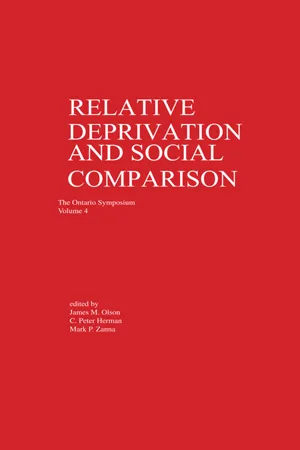
Relative Deprivation and Social Comparison
The Ontario Symposium, Volume 4
- 272 pages
- English
- ePUB (mobile friendly)
- Available on iOS & Android
eBook - ePub
Relative Deprivation and Social Comparison
The Ontario Symposium, Volume 4
About this book
First published in 1986. This volume presents papers from the fourth Ontario Symposium on Personality and Social Psychology, held at the University o f Western Ontario, October 15- 16, 1983. The contributors are active researchers in the areas of relative deprivation and social com parison, whose chapters document the continuing vitality of these topics. One of the purposes of this volume is to provide an accurate picture of our current knowledge about relative deprivation and social comparison processes.
Information
1 Relative Deprivation and Social Comparison: An Integrative Perspective
University of Western Ontario
This book is about relative deprivation. It is also about social comparison. Although these topics have distinct histories in social psychology, they are conceptually similar in many important ways. The chapters in this volume address a wide variety of issues concerning relative deprivation and social comparison, ranging from the usefulness of current models of relative deprivation (Chapter 2 by Crosby, Muehrer, & Loewenstein) to possible developmental changes across the life span in social comparison processes (Chapter 6 by Suls). Readers will note that, in virtually every chapter, both relative deprivation and social comparison processes are discussed, underscoring the close links between these topics. In the past, explicit analyses of the similarities (and differences) between the concepts of relative deprivation and social comparison have been rare in social psychology, although many authors have noted that the concepts are related. We are hopeful that the present volume will stimulate more integrative work by identifying potentially productive areas of overlap between the theories.
The purpose of this chapter is to set the stage for the ensuing contributions by reviewing briefly some of the highlights in theory and research on relative deprivation and social comparison. Our review is by no means exhaustive. The subsequent chapters provide detailed descriptions of current directions in the two literatures and identify some important issues for future research. Thus, our goal in this chapter is to present a selective examination of past work. We review the two literatures separately and then discuss some of the parallels between the concepts.
RELATIVE DEPRIVATION
The term relative deprivation was coined by Stouffer, Suchman, DeVinney, Star, and Williams (1949) in their famous study of American soldiers. Stouffer et al. documented 11 cases where soldiers’ subjective satisfaction with some aspect of army life did not parallel their objective conditions (see Davis, 1959, for a description of these instances). For example, Military Police reported greater satisfaction with their opportunities for promotion than did members of the Air Corps, despite the fact that actual promotions were approximately twice as frequent in the latter than in the former group. Stouffer et al. suggested that the availability of promoted comparison peers in the Air Corps both reduced the positive affective impact of being promoted and engendered strong dissatisfaction among those men who failed to advance. In contrast, the Military Police had relatively few comparison persons within their branch who had been promoted, so personal promotions produced strong feelings of satisfaction and failures to advance did not engender much anger, since many others shared this deprived state.
Thus, Stouffer et al. made the important observation that feelings of satisfaction or dissatisfaction with one’s outcomes depend more on subjective standards, such as the level of outcomes obtained by salient comparison persons, than on objective prosperity. As Crosby (1976) has put it, “Deprivation is relative, not absolute” (p. 85).
Theoretical Formulations
Although Stouffer et al. (1949) used the concept of relative deprivation to explain some of their unexpected findings, they did not develop a formal theory of the causes or consequences of this state. The first formal theory of relative deprivation was proposed by Davis (1959), who suggested that comparisons with ingroup versus outgroup members lead to different kinds of emotional reactions. Essentially, Davis proposed that comparisons with ingroup members can produce feelings of relative deprivation or relative gratification (depending on whether one’s outcomes are worse or better than the referent person’s), whereas comparisons with outgroup members can produce feelings of relative subordination or relative superiority. Thus, Davis explicitly limited the concept of relative deprivation to comparisons with “similar others” (ingroup members) who possess some desired object to which the deprived perceiver feels entitled.
Runciman (1966) introduced a distinction between egoistical versus fraternal deprivation, both of which are presumably “relative” in the sense described above. Egoistical deprivation refers to the perception that one’s own outcomes fall below a subjective standard (usually based on other individuals’ outcomes), whereas fraternal deprivation refers to the perception that one’s reference group as a whole is deprived (usually relative to other groups). Runciman also proposed that feelings of relative deprivation will not occur unless individuals think it is “feasible” that they (or their group) should have the desired object. The precise meaning of “feasibility” in this context is somewhat unclear (e.g., it can be interpreted as referring only to future hopefulness or as additionally implicating perceptions of entitlement and “what might have been”), a confusion that has led to some theoretical controversy. Finally, Runciman pointed out that comparisons with one’s own outcomes in the past can produce feelings of relative deprivation—a possibility that removes the necessity for social comparisons.
Gurr (1970) proposed a theory of rebellion, wherein three types of deprivation were distinguished (aspirational, decremental, and progressive), based on different ways that people’s expectations (perceived entitlements) can exceed their capabilities (actual outcomes). In each type, though, the essential process was postulated to be the same: People feel deprived when they perceive that they are unlikely to obtain the outcomes to which they feel entitled. Thus, in contrast to Runciman (1966), Gurr proposed that deprivation is more likely to occur when people believe that it is not feasible for them to obtain their desired outcomes.
The most elegant model of relative deprivation was proposed by Crosby (1976); her model has profoundly influenced subsequent research. On the basis of a review and integration of prior theories, Crosby proposed five necessary and sufficient “preconditions” for feelings of egoistical relative deprivation. In order for individuals to feel resentful about not possessing some desired object (X), they must (a) see that someone else possesses X, (b) want X, (c) feel entitled to X, (d) think it feasible to obtain X, and (e) lack a sense of personal responsibility for not having X. Crosby also speculated about some of the determinants of these preconditions, as well as the possible consequences of relative deprivation, although her proposed set of preconditions has engendered the most subsequent interest. As evidenced by several chapters in the present volume, Crosby’s 1976 model stimulated a variety of research programs exploring the psychological underpinnings of relative deprivation.
Research Directions
The cursory review of theoretical formulations in the previous section described four well-known theories of relative deprivation. Since 1976, research has progressed in numerous directions, uncovering problems with each of the models and exploring additional implications of the concept of relative deprivation. In this section, we identify five developments that illustrate the growth of relative deprivation research.
Testing the Models. Some authors, most notably Crosby and her colleagues (e.g., Bernstein & Crosby, 1980; Cook, Crosby, & Hennigan, 1977; Crosby, 1982), have been concerned with testing the validity of the different models of relative deprivation. Based on a survey of the correlates of grievance at work and at home, Crosby (1982) suggested that only two preconditions may be necessary and sufficient for egoistical relative deprivation—wanting and entitlement. That is, individuals may feel resentful about not possessing some object when they merely want that object and feel entitled to it. Other perceptions (e.g., social comparisons) may affect relative deprivation indirectly, via these two preconditions, but wanting and entitlement are the immediate causes of resentment. In Chapter 2 of the present volume, Crosby, Muehrer, and Loewenstein consider further the validity of this two-factor model.
Referent Cognitions Theory. A second theoretical development since 1976 has been the articulation of “referent cognitions theory” by Folger and his colleagues (e.g., Folger, Rosenfield, Rheaume, & Martin, 1983; Folger, Rosenfield, & Robinson, 1983). This approach integrates relative deprivation research with recent work in social cognition and provides a novel perspective on several previously confusing theoretical issues (e.g., the role of “feasibility” in relative deprivation). As described in Chapter 3 of the present volume, Folger’s model suggests that resentment will occur when (a) individuals can easily imagine that better outcomes could have occurred, (b) the processes or events that could have produced better outcomes seem more justifiable (fairer) than the processes or events that actually occurred, and (c) it seems unlikely that better outcomes will be obtained in the future.
Effects of Improving Outcomes. Several researchers have tested the paradoxical notion that improving outcomes can sometimes produce greater discontent than previously existed in a deprived group. For example, deCarufel (1979) found that improvements which failed to match salient normative standards engendered strong dissatisfaction, despite the fact that subjects’ objective prosperity had increased (see also deCarufel & Schopler, 1979; Folger, 1977). Presumably, improvements can serve to legitimize deprived individuals’ rights to better outcomes, thereby producing higher expectations, increased feelings of entitlement, and greater awareness of previous injustices (see Chapter 10 by deCarufel in the present volume). Thus, events such as protest or revolt during times of increasing prosperity may be interpretable within a relative deprivation framework.
Egoistical Versus Fraternal Deprivation. A fourth trend in recent research has been a return to Runciman’s (1966) distinction between egoistical (personal) and fraternal (group) deprivation. Several authors (e.g., Abeles, 1976; Guimond & Dubé-Simard, 1983; Martin, 1981; Vanneman & Pettigrew, 1972) have argued that these two types of deprivation have different consequences and that ignoring this distinction has muddied the theoretical waters in the relative deprivation literature. For example, in Chapter 11 of the present volume, Dubé and Guimond show that perceptions of group deprivation predict protest behaviors more strongly than do perceptions of personal deprivation (see also Chapter 9 by Dion and Chapter 12 by Martin). Although most models of relative deprivation continue to focus on dissatisfaction with personal outcomes (i.e., egoistical deprivation), some theorists are expanding their models to address group deprivation (see, for example, Folger’s discussion of fraternal deprivation in Chapter 3 of the present volume). It seems likely that group deprivation as a target state and collective action as an outcome measure will each become more important in future relative deprivation research.
Sociological Factors. Finally, the role of sociological forces in stimulating protest and assertive action has been receiving increased attention in recent work (e.g., McCarthy & Zald, 1977). In particular, Martin (e.g., Martin, Brickman, & Murray, 1984; Martin & Murray, 1984; see also Chapter 12 in the present volume) has suggested that psychological variables (such as perceived injustice or felt deprivation) will not necessarily be strongly related to assertive action. Sociological factors such as opportunities for engaging in various activities and possible repercussions (costs) of those actions must also be taken into account. To the extent that social psychologists want to address the behavioral consequences of relative deprivation (a seemingly obvious concern), future models need to incorporate these sociological variables.
SOCIAL COMPARISON
In 1950, Festinger articulated a theory of opinion influence processes in social groups. The theory held that, because people are motivated to assess the correctness of their opinions and to achieve uniformity within their group, social communication in groups can exert a powerful influence on the formation of opinions.
Four years later, Festinger expanded this theory into a more general statement about individuals’ reliance on others for information necessary to evaluate opinions and abilities—in short, for information necessary to construct social reality. This concern with self-other comparisons provided a link with a sociological tradition dating back, at least, to Mead’s (1934) conceptualization of the self, as well as Merton and Kitt’s (1950) reference group theory and Stouffer et al.’s (1949) analysis of relative deprivation. For psychologists, Festinger’s 1954 paper presented an elaborate and heuristically useful formulation of the self-evaluation process. The theory outlined in this paper was, of course, social comparison theory.
Festinger’s Theoretical Formulation
The fundamental postulate of social comparison theory is that humans have a drive to evaluate their opinions and abilities. Presumably, this motive has developed because erroneous appraisals of important opinions and abilities can have serious consequences for the individual. The theory specifies how perceivers will make these evaluations: In the absence of objective, physical reality, people will evaluate their opinions and abilities by comparison with others. A central feature of the theory concerns who these comparison others are likely to be. According to Festinger, we maximize information and achieve stable and precise judgments when we compare to similar others (i.e., others who are close to us on the particular opinion or ability in question). Sometimes, though, we must compare with dissimilar others, and according to the theory, this produces pressures toward uniformity. The theory specifies how these pressures differ for abilities and opinions and how these differences affect affiliation and group behavior.
Research Directions
In the three decades since Festinger’s original formulation, interest in social comparison theory has waxed and waned (see Goethals, 1984, for an insightful analysis of this period). Nevertheless, a number of research directions have emerged, which have served to clarify, modify, and extend various aspects of the theory. Some of these developments are reviewed below.
Social Comparison of Emotions. One of the first extensions of social comparison theory was proposed by Schachter (1959; Schachter & Singer, 1962). Whereas Festinger was concerned with the evaluation of abilities and opinions, Schachter recognized that social comparison occurs in the evaluation of emotions as well: People use similar others as a source of information to determine the appropriateness of their fear reactions (and therefore will seek out others when afraid) and to explain unexpected arousal. For critical reviews of the fear-affiliation and emotional arousal literatures, respectively, see Cottrell and Epley (1977) and Cotton (19...
Table of contents
- Cover
- Half Title
- Title Page
- Copyright Page
- Table of Contents
- Preface
- 1. Relative Deprivation and Social Comparison: An Integrative Perspective
- 2. Relative Deprivation and Explanation: Models and Concepts
- 3. A Referent Cognitions Theory of Relative Deprivation
- 4. Resentment About Deprivation: Entitlement and Hopefulness As Mediators of the Effects of Qualifications
- 5. Determinants of Subjective Well-Being
- 6. Comparison Processes in Relative Deprivation: A Life-Span Analysis
- 7. The Perception of Social Categories: Implications for the Social Comparison Process
- 8. Fabricating and Ignoring Social Reality: Self-Serving Estimates of Consensus
- 9. Responses to Perceived Discrimination and Relative Deprivation
- 10. Pay Secrecy, Social Comparison, and Relative Deprivation in Organizations
- 11. Relative Deprivation and Social Protest: The Personal-Group Issue
- 12. The Tolerance of Injustice
- Author Index
- Subject Index
Trusted by 375,005 students
Access to over 1.5 million titles for a fair monthly price.
Study more efficiently using our study tools.
Frequently asked questions
Yes, you can cancel anytime from the Subscription tab in your account settings on the Perlego website. Your subscription will stay active until the end of your current billing period. Learn how to cancel your subscription
No, books cannot be downloaded as external files, such as PDFs, for use outside of Perlego. However, you can download books within the Perlego app for offline reading on mobile or tablet. Learn how to download books offline
Perlego offers two plans: Essential and Complete
- Essential is ideal for learners and professionals who enjoy exploring a wide range of subjects. Access the Essential Library with 800,000+ trusted titles and best-sellers across business, personal growth, and the humanities. Includes unlimited reading time and Standard Read Aloud voice.
- Complete: Perfect for advanced learners and researchers needing full, unrestricted access. Unlock 1.5M+ books across hundreds of subjects, including academic and specialized titles. The Complete Plan also includes advanced features like Premium Read Aloud and Research Assistant.
We are an online textbook subscription service, where you can get access to an entire online library for less than the price of a single book per month. With over 1.5 million books across 990+ topics, we’ve got you covered! Learn about our mission
Look out for the read-aloud symbol on your next book to see if you can listen to it. The read-aloud tool reads text aloud for you, highlighting the text as it is being read. You can pause it, speed it up and slow it down. Learn more about Read Aloud
Yes! You can use the Perlego app on both iOS and Android devices to read anytime, anywhere — even offline. Perfect for commutes or when you’re on the go.
Please note we cannot support devices running on iOS 13 and Android 7 or earlier. Learn more about using the app
Please note we cannot support devices running on iOS 13 and Android 7 or earlier. Learn more about using the app
Yes, you can access Relative Deprivation and Social Comparison by James M. Olson,C. P. Herman,Mark P. Zanna in PDF and/or ePUB format, as well as other popular books in Psychology & History & Theory in Psychology. We have over 1.5 million books available in our catalogue for you to explore.