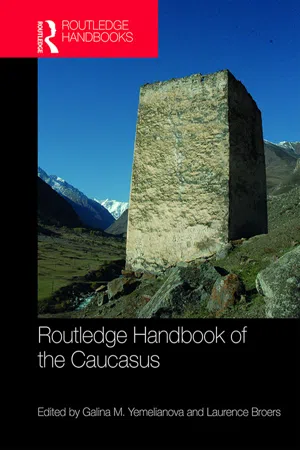
The Routledge Handbook of the Caucasus offers an integrated, multidisciplinary overview of the historical, ethno-linguistic, cultural, socio-economic and political complexities of the Caucasus. Covering both the North and South Caucasus, the book gathers together leading Western, Caucasian and Russian scholars of the region from different disciplines in the humanities and social sciences. Following a thorough introduction by the editors, the handbook is divided into six parts which combine thematic and chronological principles:
Place, peoples and culture
Political history
The contemporary Caucasus: politics, economics and societies
Conflict and political violence
The Caucasus in the wider world
Societal and cultural dynamics.
This handbook will be an essential reference work for scholars interested in Russian and Eastern-European studies, Eurasian history and politics, and religious and Islamic studies.
The Caucasus is defined by its magnificent mountains, its location between the Caspian and Black Seas and its belonging, both geographically and culturally, to both the Near/Middle East1 and Eurasia. The main Caucasus range runs over a thousand kilometres from the Taman Peninsula on the Black Sea to the Apsheron Peninsula on the Caspian. Traditionally taken to delimit a boundary between Europe and Asia, the northern slopes of the Caucasus give an expansively imagined Europe its highest peak, Mount Elbrus (5,642 metres) (Figure 1.1). To the south the Likhi mountain range (highest point: 1,926 metres) divides the southern Caucasus into eastern and western lowland sectors. Extending on from the Likhi range is the Lesser Caucasus, a composite system of mountain ranges reaching beyond the region’s modern political boundaries, with its highest peak at Aragats (4,090 metres). Geologically, topographically and climatically speaking, however, ‘the Caucasus has never been one place but many’ (King 2008: 8): alpine environments intersect with river valleys, fertile floodplains, prairies, arid plains and subtropical coastline.
Figure 1.1 Highway in Kabardino-Balkaria, featuring Mount Elbrus in the background. Courtesy of Buzzhigit Akkiev
The name ‘Caucasus’ or ‘Caucasia’2 (from Καύκασος, in ancient Greek) was used from at least the sixth century BCE in ancient Greek sources with reference to both the region and the region’s stunning mountains. The term may derive from an old Indo-European word for ‘high’ or ‘lofty’ (*kówko- in Proto-Indo-European, related to the Gothic hauhs and English high) (see Chapter 3 in this volume). In many early Armenian, Georgian, Syriac and Arabic sources the term ‘Caucasus’ was used alongside other, alternative names. For example, Georgian and Armenian sources more frequently referred to the present-day southern Caucasus as ‘the North’ – č‛rdiloy (‘north’, in Georgian) and hiwsis (‘north’, in Armenian), while Arab caliphal sources applied the term Qabq to describe the region encompassing present-day southern Dagestan (Bab al-Abwab), northern Azerbaijan and eastern Georgia (Vacca 2017: xv). Another caliphal tradition revived the Sasanian provincial designation Jarbi, related to the Syriac garbya, meaning ‘north’ to refer to the Caliphate’s frontier provinces in Armenia, Caucasian Albania and Azerbaijan. Caliphal geographers depicted these provinces as a single space, also known as Rihab (Vacca 2017: 70). The subsequent association of the adjective Caucasian with phenotypical human features originated in early studies of race, and specifically in febrile imaginaries that saw in some of the peoples of the Caucasus idealised progenitors of a purported ‘white race’.
This diversity of designations reflects the fact that throughout history, the Caucasus has been a frontier – and meeting point – where states, cultures and religions intersected. In antiquity,3 the Caucasus was located at the peripheral nexus of three vital spaces: Mesopotamia’s ‘Fertile Crescent’, which tapers away into the Caucasian isthmus circumscribed by the Black and Caspian Seas; the expansive Eurasian steppe unfolding to the north; and the maritime pathways and littoral cultures of the Black Sea, and beyond it, the Mediterranean. The Caucasus was first known to classical Greek geographers in the form of local kingdoms with disarmingly familiar names, Colchis, Iberia and Caucasian Albania. These political entities proved fleeting, however, as the Caucasus ‘marks its earliest histories through conquest’ (Grant and Yalçın-Heckmann 2007: 1). This in fact remained the case through to the twentieth century, and indeed the Caucasus remains to this day a site of competitive influence-seeking by outside powers.
From late antiquity to medieval times, the Caucasus was a multi-facing periphery continually contested by great powers: Rome, Parthia, Byzantium, the Umayyad and Abbasid Caliphates, Persia, the Ottoman Empire, and by the early modern era Russia, to name but a few. In every case, however, the Caucasus was at the limit of metropolitan power, interrogating it through strategies of detachment, resistance, accommodation, adaptation and syncretism. Few world regions provide more vivid illustration of David Braund’s observation that ‘it is at their peripheries that societies receive their most unsettling interrogations and most searching tests’ (Braund 1994: 3); in the Caucasus, who is socialising whom is a timeless question. This is in part due to terrain. The Caucasian highlands and some other parts, inhabited by neighbourhood- and kinship-based communities, were largely able to retain a considerable degree of autonomy from both external and local centres of political domination. By comparison, in those parts of the Caucasus which harboured well-established polities, local dynasties tended to alternate between asserting royal claims to sovereignty at times of weakened external influence, and vassalage or dissolution in the face of strengthening outside hegemons.
Between the eleventh and fifteenth centuries the Caucasus was part of a succession of Seljuk, Genghizid and other Oghuz Turkic, Kipchak (Qipchaq) Turkic, Kurdish and Turko-Mongol nomadic Muslim empires, while from the sixteenth till the eighteenth centuries it was contested by Sunni Ottoman Turks and Shi‛a Safavid Iranians. Throughout the nineteenth century the great power rivalry over the Caucasus took another turn with the arrival in the region of the Christian Orthodox Russian Empire. During this period, the Caucasus’ geopolitics was affected by the ‘Great Game’ between the British and Russian Empires for domination over Asia.4 It would be Russia that, after decades of the cruel and protracted Caucasian War (1817–64), absorbed the Caucasus. Under its imperial rule, the Caucasus underwent a series of politico-administrative re-arrangements leading to its division into the modern northern Caucasus and Zakavkaz’e, a Russian term literally meaning ‘on the other side of the Caucasus’, usually translated as Transcaucasia, or the Transcaucasus, corresponding to the southern Caucasus. Unlike Kazan, Astrakhan and some other ethnically non-Russian provinces, which were fully integrated into the imperial governance system, the Caucasus, like Russian Turkestan, was put under a mixed system of governance centred on military control, thus allowing local elites and communities a degree of autonomy in the socio-economic and cultural spheres. From the mid-nineteenth century the Caucasus was partially exposed to a new and radical form of transformation, industrialisation, especially related to the Baku oil boom. At the same time the region’s educated elites were introduced to the Western ideologies of liberalism, nationalism and socialism. Cultural revival movements among the Georgians, Armenians, Azerbaijani Turks and others contributed to the spawning of modern nations.
In 1917 the Russian Empire disintegrated. In compressed and exceptionally violent form, the following few years recalled the historical patterns of local efflorescence in the Caucasus followed by metropolitan reabsorption. In 1918 several projects in sovereign nation-state building emerged in the Caucasus by default. Cast adrift by turmoil in Russia and buffeted by both geopolitical and revolutionary winds, an experiment in Transcaucasian federation collapsed within a few weeks to give birth to the sovereign republics of Armenia, Azerbaijan and Georgia. Riven by competing territorial claims, myriad local revolts and offers of foreign patronage, their existence would be short-lived. All were reabsorbed by their northern neighbour, transformed into the Soviet Union in 1922. Consequently, the Caucasus, along with other parts of the Soviet Union, was subjected to comprehensive structural, societal and ideational Sovietisation. The implementation of the Stalinist nationalities policy divided the region into Soviet Transcaucasia, consisting of the union republics of Armenia, Azerbaijan and Georgia, and the northern Caucasus, which was divided into several autonomous republics and regions within the Russian union republic.
As the Soviet Union began to falter from the mid-1980s, the Caucasus was far from unique in seeing mass mobilisation around ethno-nationalism, but it was unusual in the extent to which interethnic disputes became violent. In the South Caucasus, among the outcomes of clashing ethnic nationalisms were the Georgian-Abkhaz, the Georgian-South Ossetian and the Armenian–Azerbaijani conflicts, which have remained unresolved. The north-eastern Caucasus (except Dagestan)5 witnessed the Ingush-North Ossetian conflict and two devastating Russo-Chechen wars. Research on conflict appears to be the Caucasus’ primary export to the mainstream of social science; articles and books on the region’s conflicts far outnumber those on any other research theme (Cheterian 2008; Coppieters 2001; Cornell 2001, 2002, 2017; de Waal 2013; Dunlop 1998; Evangelista 2002; Hughes 2008; Lieven 1999; Matveeva 1999; Russell 2007; Sakwa 2001; Seely 2001; Souleimanov 2013; Tishkov 2004; Toal 2017; Welt 2004; Zürcher 2006).
Following the dissolution of the Soviet Union in 1991 the Caucasus witnessed the diminished role of Russia and some reassertion of the influence of the historic regional powers, Turkey and Iran, mainly in the economic, educational and cultural spheres. The South Caucasus, made up of the newly independent states of Armenia, Azerbaijan and Georgia, also experienced to varying degrees the influence of non-historic global actors, the USA and the European Union (EU). The three South Caucasus states, alongside the former Soviet Ukraine, Moldova and Belarus, were included in the EU’s European Neighbourhood Policy, and then Eastern Partnership, geared to the promotion of an associated set of political, societal and cultural values and norms. Oil- and gas-rich Azerbaijan became actively involved with Western-dominated major energy companies through the ‘Deal of the Century’ in the development of new oil fields. The Caucasus yet again assumed its historical position as a strategic periphery contested by Russia, the West, Turkey and, to a lesser extent, Iran. The international politics of the South Caucasus consequently plays out across a complex web of contested and insurgent sovereignties, great power penetration and overreach, and manoeuvres among conflicting regimes of international norms and multiple sources of foreign patronage.
Despite this rich and fascinating history, the Caucasus remains an outlier in the study of regions of the former Soviet Union. The relative smallness of the region, its high concentration of often extremely challenging local languages, the prevalence of both physical and epistemological frontlines due to the region’s conflicts, and enduring ambiguity regarding which area studies rubrics it ‘belongs’ to, have all contributed to a quite small research community. Underlying these tensions is ambivalence over what is included in the term ‘Caucasus’. Expansively understood, the term embraces the areas both to the north and south of the Caucasus mountains. In Western parlance, however, the term is often used as a shorthand for only its southern part. In this volume, we understand the term ‘Caucasus’ broadly, to comprise both northern and southern areas, encompassing the Russian Federation’s seven North Caucasus autonomous republics, and the sovereign states of the South Caucasus, Armenia, Azerbaijan and Georgia. To the north, the Caucasus fades into the adjacent Stavropol’ and Krasnodar regions of the Russian Federation, and to the south into neighbouring provinces of Turkey and Iran that have historically been closely connected to peoples and nations of the contemporary Caucasus.
Although there is a rich anthropological and geographical literature treating the Caucasus as a unified cultural space or ‘world area’ (e.g., Charachidzé 1987; Grant and Yalçın-Heckmann 2007; Voell and Khutsishvili 2013; O’Loughlin, Kolossov and Radvanyi 2007), very few modern studies by Western scholars encompass this broad definition of the Caucasus: Gammer (2008), King (2008) and Forsyth (2013) are rare exceptions, although several scholars have covered conflicts in both the North and South Caucasus. Of particular significance for the study of ethnic conflicts in the North Caucasus are the publications of Etnologicheskii Monitoring (Ethnological Monitoring) by the network of regional ethnologists headed by Valery A. Tishkov.6 De Waal (2010) and Oskanian (2013) have contributed notable surveys of the South Caucasus. However, a rich and diverse scholarship on the Caucasus which flourishes in Dagestan and other parts of the region, as well as in Iran and Turkey, remains largely inaccessible to Western readers due to language barriers.
As editors, we are acutely aware of the unevenness in Caucasian studies and the existence of multiple and sometimes conflicting theoretical, cultural and political approaches to the region. In our quest to generate as balanced and multi-faceted a perspective on the region as possible we have gathered together leading scholars in multiple disciplines – historians, linguists, social anthropologists, geographers and political scientists – from the UK, Europe, the USA, Canada, Turkey, Russia and the Caucasus itself. We nevertheless realise the inevitable limitations of such an ambitious and challenging endeavour, including the volume’s relatively short account of the early history compared to contemporary topics, as well as the lack of coverage of the region’s sophisticated architectural and artistic traditions. The outcome of our joint efforts is the present book consisting of 27 chapters divided into six parts along chronological and thematic principles.
Part I: Place, peoples and culture
The volume’s first part introduces readers to the Caucasus as a concept, and to its peoples and cultures. The Caucasus’ frontier location and natural diversity have accounted for its fascinating ethno-linguistic, cultural and socio-political pluralism, and its particular attractiveness to invaders, raiders, merchants and proselytisers. From earliest times foreigners exoticised the Caucasus as a realm beyond the known and familiar. The tropes of danger and the seductive powers of wealth and knowledge combine in the myth of the Golden Fleece, stolen from King Aietes of Colchis on the Black Sea coast by Jason and the Argonauts. Aietes’ daughter, Medea, would wreak a terrible revenge for Jason’s subsequent infidelity, murdering her two sons by Jason in the Greek playwright Euripides’ bleakest work. Knowledge, theft and vengeance also mark the myth of Prometheus, chained to a Caucasian mountainside to have his liver eaten out daily by an eagle in punishment for bestowing the gift of fire upon humanity. Other traditions, such as that of the Iranian ‘North’, also depicted the Caucasus as a forbidding land populated by demons and spirits.
In his contribution to this volume, Florian Mühlfried argues that the contemporary Western gaze upon the Caucasus continues this tradition of ‘othering’ or exoticising the region, by characterising it as being deficient compared to more modern, more ‘advanced’ nations and spaces in Europe and the ‘Global North’. Mühlfried argues that the Caucasus, like Central Asia, is always depicted as lacking something – knowledge, civil society, democracy, peacebuilding or good governance – that others must provide. This projection of deficiency codes the Caucasus as a kind of ‘Orient’, an essential, unchanging and unknowable space demanding enlightenment – and conquest, whether physical or ideological. He argues that the study of the Caucasus has its roots in a Russian imperialist epistemology, fixated with naming and numbering nations, ethnicities and tribes. This underpins ‘Caucasology’, the study of the Caucasus. To overcome implicit orientalism, Mühlfried suggests alternative paradigms of the Caucasus as a border area, contact area and cultural area. In Mühlfried’s conception, the Caucasus emerges as a distinctive entity marked by a radical heterogeneity, discarding traditional conceptions of bordered space and bounded identities.
In the following chapter, John Colarusso presents his unique findings on the Caucasus’ extreme ethno-linguistic diversity and its rich folklore. Colarusso argues that the Caucasus’ numerous indigenous languages, which belong to North-Western, North-Eastern and Southern (Kartvelian) language families, although revealing some area commonalities, also diverge radically in terms of their linguistics and show a degree of grammatical complexity that surpasses anything on the continent. He substantiates his argument by comparative analysis of the grammatical structures of the Circassian, Besleney, Ubykh and Abkhaz languages of the North-Western family; the Vai Nakh, Avar-Andic, Lak, Dargwa and Samurian languages of the North-Eastern family; and Georgian of the Kartvelian family. The chapter then proceeds to explore ‘external language families’ – Armenian, Kurdish, Ossetian, Tati, Altaic (Turkic), Russian and Ukrainian ‘that have ...
Table of contents
Cover
Half Title
Title Page
Copyright Page
Dedication
Table of Contents
List of figures
List of maps
List of tables
List of contributors
Glossary
Note on transliteration, place-names and ethnonyms
Acknowledgements
1. Introducing the Caucasus
PART I: Place, peoples and culture
PART II: Political history
PART III: The contemporary Caucasus: politics, economics and societies
PART IV: Conflict and political violence
PART V: The Caucasus in the wider world
PART VI: Societal and cultural dynamics
Index
Trusted by 375,005 students
Access to over 1.5 million titles for a fair monthly price.
Study more efficiently using our study tools.
Frequently asked questions
Yes, you can cancel anytime from the Subscription tab in your account settings on the Perlego website. Your subscription will stay active until the end of your current billing period. Learn how to cancel your subscription
No, books cannot be downloaded as external files, such as PDFs, for use outside of Perlego. However, you can download books within the Perlego app for offline reading on mobile or tablet. Learn how to download books offline
Perlego offers two plans: Essential and Complete
Essential is ideal for learners and professionals who enjoy exploring a wide range of subjects. Access the Essential Library with 800,000+ trusted titles and best-sellers across business, personal growth, and the humanities. Includes unlimited reading time and Standard Read Aloud voice.
Complete: Perfect for advanced learners and researchers needing full, unrestricted access. Unlock 1.5M+ books across hundreds of subjects, including academic and specialized titles. The Complete Plan also includes advanced features like Premium Read Aloud and Research Assistant.
Both plans are available with monthly, semester, or annual billing cycles.
We are an online textbook subscription service, where you can get access to an entire online library for less than the price of a single book per month. With over 1.5 million books across 990+ topics, we’ve got you covered! Learn about our mission
Look out for the read-aloud symbol on your next book to see if you can listen to it. The read-aloud tool reads text aloud for you, highlighting the text as it is being read. You can pause it, speed it up and slow it down. Learn more about Read Aloud
Yes! You can use the Perlego app on both iOS and Android devices to read anytime, anywhere — even offline. Perfect for commutes or when you’re on the go. Please note we cannot support devices running on iOS 13 and Android 7 or earlier. Learn more about using the app
Yes, you can access Routledge Handbook of the Caucasus by Galina M. Yemelianova, Laurence Broers, Galina M. Yemelianova,Laurence Broers in PDF and/or ePUB format, as well as other popular books in Social Sciences & Russian History. We have over 1.5 million books available in our catalogue for you to explore.